








Quadric CEO and Co-Founder Veerbhan Kheterpal on the Catalyzing AI Innovation panel!
Learn how on-device AI powers high-performance, energy-efficient solutions.
quadric.ai/events
#QuadricAI #EdgeAI #OnDeviceAI #AIEdgeComputing #EnergyEfficientAI #HighPerformanceAI #MicroelectronicsUS #NextGenAI

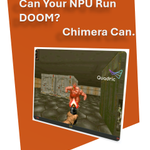
Is your NPU DOOMed? Quadric's Chimera GPNPU runs every AI model — and a complete DOOM engine. Find out why Quadric is different.
quadric.ai/blog/can-your-npu…

Discover how LLMs run fast, efficiently, and powerfully on-device.
Connect with Quadric experts and discover the future of AI processors—all at IP SoC 2026. Don’t miss it!
quadric.ai/events
#OnDeviceAI, #EdgeAI, #AIProcessors, #LLM, #AIatTheEdge, #NextGenAI, #NPU IP

If you're working in AI, semiconductors, or edge computing, this will be a great evening of ideas and discussion.
Discover Quadric Solutions quadric.ai
#AI #Semiconductors #EdgeAI #ComputerArchitecture #MachineLearning #HardwareDesign

Will you be visiting Embedded Vision Summit?
Have an Edge AI project in development? Schedule a meeting with a Quadric SME to discuss your architecture, performance goals, and deployment strategy. quadric.ai/contact
#Events #Solutions #EVS26 (edited)

Dramatic Improvements in Edge AI | SemiWiki Podcast
Quadric CEO Veer Kheterpal explains in this week’s SemiWiki podcast.
quadric.ai/video-content

New Podcast: Quadric CEO interviewed by SemiWiki @DanielNenni quadric.ai/video-content
"Cloud AI is a restaurant kitchen. Edge AI is a personal chef."
On a day when some competitors announced they were giving up on the AI Processor business, Quadric is growing!
quadric.ai/press-release/qua…

Quadric Appoints Ravi Chakaravarthy as VP Software Engineering
AMD and Broadcom Veteran Joins Expanded Executive Team
quadric.io/press-release/qua…
Quadric retweeted

Tesla's FSD chips: Integer vs. Floating-point
At Tesla's shareholder meeting Elon said that, "integer operations are fundamentally more efficient than floating-point operations...integer is much more power efficient, much more silicon efficient, but you actually have to train for integer inference - everyone else is training for floating-point - that's a niche technical detail, but it's actually very important."
So what does he mean?
Well, imagine you’re driving a Tesla, and the car’s “brain” has to think really fast to decide what to do every second:
- Is that a shadow or a pothole?
- How far away is that car?
- Can I make this turn safely?
All of that happens millions of times per second - like a giant video game running in real life.
Two Ways the Car’s Brain Can Do Math
Computers think using numbers, and there are two main kinds of math they can use:
Floating Point (“fancy math”) – handles decimals like 3.14159 → Super accurate, but slower and more energy-hungry.
Integer (“simple math”) – handles whole numbers like 3 or 4 → Slightly less precise, but way faster and more efficient.
Why Tesla Likes Integer Math
Tesla’s Full Self-Driving (FSD) chip in the car runs AI models that turn camera video into driving decisions. To make this happen in real time, Tesla needs speed and efficiency more than perfect decimals.
Here’s the trick:
The AI doesn’t need to know if something is 3.14159 meters away. It just needs to know it’s about 3 meters away - that’s good enough to brake safely.
So instead of wasting power on floating-point math, it uses integer math, which is like rounding to the nearest whole number.
That’s enough precision for driving, and it makes everything run faster.
What Happens Inside the Chip
Think of the chip like a big army of tiny workers (transistors).
Integer math: the workers do simple, quick jobs - they don’t get tired and don’t need much energy.
Floating point math: the workers do harder, more detailed jobs - they need more space, more time, and more power.
Tesla’s chip uses millions of small, efficient workers (integer units) that can handle tons of simple math at once - kind of like having a million fast-thinking ants instead of a few slow geniuses.
The Result
Because Tesla uses integer math:
- The car reacts faster (less delay between seeing and acting).
- The computer uses less energy, so there’s more battery power for driving.
- The chip costs less to make and runs cooler.
- Tesla can process huge amounts of video data cheaply in its training supercomputer.


See what SemiWiki has to say about the impact Quadric is making on the Edge AI market.
semiwiki.com/ip/quadric/3627…

Quadric CEO and co-Founder Veerbhan Kheterpal will be speaking on a panel at the next Silicon Catalyst event. September 4th at TSMC's offices in San Jose. Come join in the conversation! @SiliconCatalyst
Catalysts of Innovation: Building Enduring Semiconductor Companies Tickets, Thu, Sep 4, 2025 at 12:30 PM | Eventbrite
Our growing success is getting noticed!
Quadric is pleased to have been included for a second straight year in the EETimes Silicon 100 list.
Silicon 100: Startups to Watch in 2025 eetimes.com/silicon-100-2025…

The Edge NPU architecture shakeout is accelerating. A handful of winners/survivors will emerge, while dozens will disappear. It's a movie we've all seen before.
semiengineering.com/the-comi…

Another new customer joins the family of Quadric Chimera processor users!
Thank you, Kyocera for relying upon Quadric to power your future SoC design!
quadric.io/press-release/kyo…

quadric.io/press-release/qua…
Winner winner!!
Many thanks to the Edge AI & Vision Alliance for selecting Quadric's Chimera processor family as Product of the Year!

Quadric retweeted

70 TOPS is nearly not enough. Need to pack 400 TOPS for robotics at that price point. Check out @quadric_io is cheaper, and more flexible @thegrahamcooke

Nvidia just released a $249 computer that will change AI forever.
It's called the Jetson Nano - a tiny device that can run AI models locally.
This means AI can run without connecting to the cloud.
And it's about to spark the biggest tech battle of our time:

Readers added context they thought people might want to know
This is referencing the Jetson Orin Nano, released earlier this week, not the Jetson Nano, which was released in 2019. The Jetson Orin Nano has 140x the performance of the Jetson Nano.
developer.nvidia.com/embedded/jetso….
Who knew that Hamlet could teach us much ado about AI/ML?
semiengineering.com/to-batch…

SemiWiki says the predictable thinning of the herd of NPU architectures is upon us. Will 2025 be the year that the 100+ choices of NPUs/GPNPUs coalesces into a handful of viable long-term solutions?
semiwiki.com/artificial-inte…

SDVs and increased software content shake up the automotive electronics value chain. (SemiWiki)
semiwiki.com/artificial-inte…
