


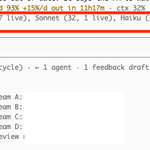





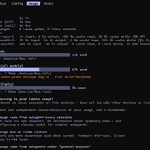

Consistently seeing MS Defender taking up huge memory, even across restarts. Anyone has an idea? At this screenshot I have just one Claude session and Task Manager open.
@Microsoft @Windows_defense

All the good tricks that help with using agents for coding! I personally use a lot of these and can attest

Finally summarized what I've been sending to friends in DMs View article


Good find, Encryption at rest for secrets!!
P.S. I would still keep do not auto-reload on providers.

Running teams of agents is the surest way to gobble up your Claude limits
How do I see those agents in session? I use github.com/AbhiramDwivedi/cl…

Can your Agentic solution use Tools? Should it?
Wire up APIs in your pipelines. Their invocation is fast and free. Keep tool invocations where the agent must use them and the work cant be done outside.
Screenshot from Claude that highlighted this challenge
🤖 Made with AI

This has been my experience too. The 5min subagent cache vs 1 hr main thread cache causes challenges with long running sub agents.
Interesting fix, haven't tried yet.

I just fixed this workflow by asking the orchestrator to spawn background threads (using claude agents) instead of subagents and to communicate with them.
You have to be very specific about this. Otherwise, for some reason, it will still use subagents.
My conclusion is that subagents should be used sparingly for quick, one-off exploration tasks. They shouldn't make expensive tool calls that could take more than 5 minutes.
I also think @AnthropicAI should improve this by fixing subagents, adding a warning, or making background session orchestration the default for this kind of work. The comments show that a lot of people are struggling with this.
I am hearing some people say they are getting good results from Luna. While, I am struggling with Opus Medium.
What has been the experience of people here?


What a beautiful day for humanity!
Anthropic takes safety initiative (unsurprisingly) and OpenAI rightfully agrees it a step in right direction and commits to follow foot steps

Poisoned skill is at least a theoretical possibility.
Thankfully Claude Code comes with a PreToolUse hook that can intercept and check a skill for safety before installing it.
Nvidia Skill Doctor is a great OSS tool to plug-in and scan like that.

Got hacked yesterday. The link came from inside Claude chat.
I was installing a transcription app. Claude sent the download link, and I pasted the command into the terminal. It all looked legit.
It wasn't though.
It was a copycat site bundling malware. It ran instantly, tried to take everything from me.
Nothing sensitive got out. So I wiped the laptop and rebuilt clean.
But here's the scary part.
Restoring from the backup, I found a poisoned SKILL.md for Claude Code.
It looked exactly like my own writing style guide.
But buried inside:
it had instructions to silently re-download the malware and steal my credentials every time the AI loaded it.
If I'd restored that one file, my new clean laptop is owned on day one.
What saved me:
I read every skill, hook, and config file before letting the AI touch them.
Two lessons here:
AI assistants will hand you links they never verified. Check before you paste.
And AI agent files are executable code now, disguised as notes. You have to read them.
Stay safe out there.
I am surprisingly running into Claude Limits on Max 20x plan. Is there a feature where Claude can diagnose whats wrong with my prompting / the way I work? I try to use sub-agents a lot to minimize Opus, is that counter-productive?
@claudeai @claude_code @trq212

Life's Good. Two consecutive weeks of draining out Claude Code Max 20x.
And the scare of running out of credits enabled some time back to Netflix.

New Parkinson's law: "Work expands so as to fill the tokens available for its completion". The routine things that good engineering requires, but are often de-prioritized due to lack of bandwidth (/money) can be done now. Thank you Jevons paradox

A weird experiment I've been trying the last few weeks is having Claude take over day-to-day maintenance of our apps. Seeing early signs of life that this might be possible.
The setup is straightforward: we have a Slack channel called proj-claude-maintains-apps. In it, Claude Tag runs a bunch of daily routines across iOS, Android, Desktop, web, CLI, and Agent SDK:
- Crash fuzzer: open the app in a simulator and tap around to find ways to crash it, then root cause and fix the crashes
- Dup unifier: scans the codebase for similar-yet-slightly-divergent abstractions, and puts up PRs to unify them
- Dead-code remover: removes statically unreachable code, and adds logging to suspected dead code to check if it's really dead and if so, remove it the next day
- Abstraction police: fixes leaky abstractions
- a bunch more..
Results have been surprisingly positive. Over the last few weeks, these routines have opened 388 PRs across our repos, 180 of which we merged after Claude Code Review + human review. We're now thinking about how to streamline this to make merging these kinds of mechanical changes easier.
Claude generally gets these PRs right on the first shot, and if it doesn't, we ask Claude to tune its routines so it's better the next day. Sometimes it takes a few days of tuning.
To try a similar workflow, ask Claude Code or Tag, or create some routines directly at claude.ai/code/routines. A few of the actual prompts I used below.
Has anyone experimented with similar workflows?

