

Connecting our newsroom and our readers. We want to hear from you: https://xitter.cf/t.co/8jnlute5qK
New York, NY
Joined March 2016
- Tweets3.3K
- Following1K
- Followers9.5K
- Likes803



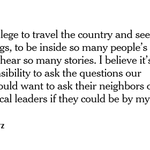



"Now the peace process is unfolding. I don’t have a college degree. An uncertain future waits for me and for girls who get the highest scores at the Rustam School." — @NYTimes reporter in Afghanistan @fatmafaizi nyti.ms/33V11js

How @fatmafaizi, "with a broken heart and broken English," began her career as an @NYTimes reporter in Afghanistan. nyti.ms/2ym0ont
As a U.S. peace deal with the Taliban unfolds, a Times journalist recalls how a visit to one of Afghanistan’s most progressive rural schools triggered a bittersweet flashback to her own childhood dreams. nyti.ms/2w3gh1i
“Don’t worry. I’m not going to kill you,” one source told NYT investigative reporter @Kim_Barker as he drove her through a wooded area in the Bahamas. She and Toronto bureau chief Catherine Porter felt at times like characters in a thriller. nyti.ms/2VS3YPF
"Impartiality, for me, is not about hiding something I really think, or trying to keep my real views from being exposed. It is about trust." @elizabethjdias, a national correspondent, and other Times journalists discuss how they think about independence: nyti.ms/38fY0Ld

Can you guess @NYTNational's go-to source for a morning energy boost? Hint: It's not coffee. nyti.ms/2IjJNCo

What does it mean to be impartial? Times journalists, including @peterbakernyt, @stefsaul and @kimseverson, discuss what they do in their personal lives to remain objective in their work: nyti.ms/2Ie3Lyg
"For me, it’s easier to stay out of the fray if I never make up my mind, even in the privacy of the kitchen or the voting booth, that one candidate is better than another, that one side is right and the other wrong." — @peterbakernyt nyti.ms/39gSCc3
Independence is the bedrock of Times journalism. But what does it mean in practice? Our reporters and editors, including @peterbakernyt, @elizabethjdias and @MaggieAstor, discuss what they do in their personal lives to remain impartial in their work. nyti.ms/2PF04Wq
How do journalists try to remain impartial? Times reporters and editors talk about the measures they take in their personal lives to stay objective in their work. nyti.ms/3amCE0c
NYT Reader Center retweeted

Independence is the foundation of @nytimes journalism. But what does it mean in practice? I asked some of our top journalists to discuss what they do in their personal lives to remain impartial in their work: nytimes.com/2020/03/02/reade…
In the words of @samsifton, a founding editor of NYT Cooking, “It’s Tuesday night: Like, what are you doing dude?” nyti.ms/2OXxgZ4
The promise is simple: a delicious dish, often a full meal, without much cleanup. nyti.ms/2uQmZXF
How to wholly capture and respectfully represent nudists, avoid making them feel objectified and adhere to The Times’s guidelines? That was the objective for Jason Henry, the photographer on assignment. nyti.ms/39NIOpW
In the words of Sam Sifton, a founding editor of NYT Cooking, “It’s Tuesday night: Like, what are you doing dude?” nyti.ms/2OXxgZ4
Science reporter Donald G. McNeil Jr. discusses unanswered questions and false leads surrounding the coronavirus. nyti.ms/2ULOFaU

“Now, your political beliefs are a referendum on your entire life, with all your values aligned neatly under a single label.” Readers tell us how online dating has changed in the Trump era: nyti.ms/2u01Fig
How do politics affect the way you swipe on dating apps? More than 200 readers told us about their political deal breakers, the subtle profile clues they look for and their connections across the aisle. nyti.ms/2u01Fig
Fact: Kissing, according to one study, transfers up to one billion bacteria from one mouth to another, along with 0.2 micrograms of food bits. nyti.ms/39pMheJ

How do politics affect the way you swipe on dating apps? More than 200 readers told us about their political deal breakers, the subtle profile clues they look for and their connections across the aisle. nyti.ms/2u01Fig