




AngryV retweeted

Oracle has secured all the funding we need to fulfill our contract with OpenAI. With our final capital raise earlier this month, we became the first hyperscaler fully funded for this investment cycle. The financing we outlined at Oracle Investor Day, including vendor financing, is in place. Any further private discussions with vendors are just additional options. Our ability to deliver on our OpenAI contract does not depend on those discussions. Any media reports that will come out and say the contrary are incorrect and wrong.
Oracle and OpenAI are making rapid progress on our infrastructure partnership. Our Abilene campus, where Astra-6 was trained, is nearly complete. Shackelford, our next gigawatt-scale campus, is fully permitted. The handover of NVIDIA Vera Rubin racks in its data halls is on track for the coming weeks.
We continue to expect positive free cash flow in the second half of FY2028. We are targeting more than $30 billion in free cash flow in FY2029 and expect to self-fund future growth beginning that year.

AngryV retweeted

$IREN $NBIS $CRWV
Anyone who thought $NVDA was going to abandon a customer base that they literally cultivated is an actual retard.
Hint: Their current largest customers are trying to stop using their chips. At least 2 of them are vehemently against open source models. Nvidia needs to expand their customer base, not concentrate it. Thats why Jensen was trying like hell to scale neoclouds. It should also tell you that there are some very powerful market forces that really don’t want to see neoclouds succeed. One of them is IPOing this week. It doesn’t strike me as a coincidence that all of the news stories piling on Nvidia are leading into the $ANT IPO.
There’s probably a combined $10T worth of companies that would gladly kneecap Nvidia, take their fab allocations, and run their closed source models on their own chips at their own facilities. If Nvidia wants to put guardrails on their credit backstops, more power to them. But if you thought they were going to stop, you’re a fucking moron.

Nvidia CFO Colette Kress on neoclouds:
“Neoclouds and frontier labs are seeing extraordinary demand for AI infrastructure, yet many are growing faster than their balance sheets and long-term credit profiles can support.”
Nvidia says securing land, power, and data center capacity has become the next critical phase of the AI buildout.
To address this, Nvidia is helping select neoclouds secure that infrastructure. Its commitments are conditional on customers obtaining financing and getting the compute capacity deployed and operational. Commitments can be reduced or eliminated if those conditions aren't met.
Under these arrangements, Nvidia earns revenue from upfront infrastructure sales and could also receive a share of the revenue neoclouds generate from third-party customers.

Reposted today without comment
$IREN

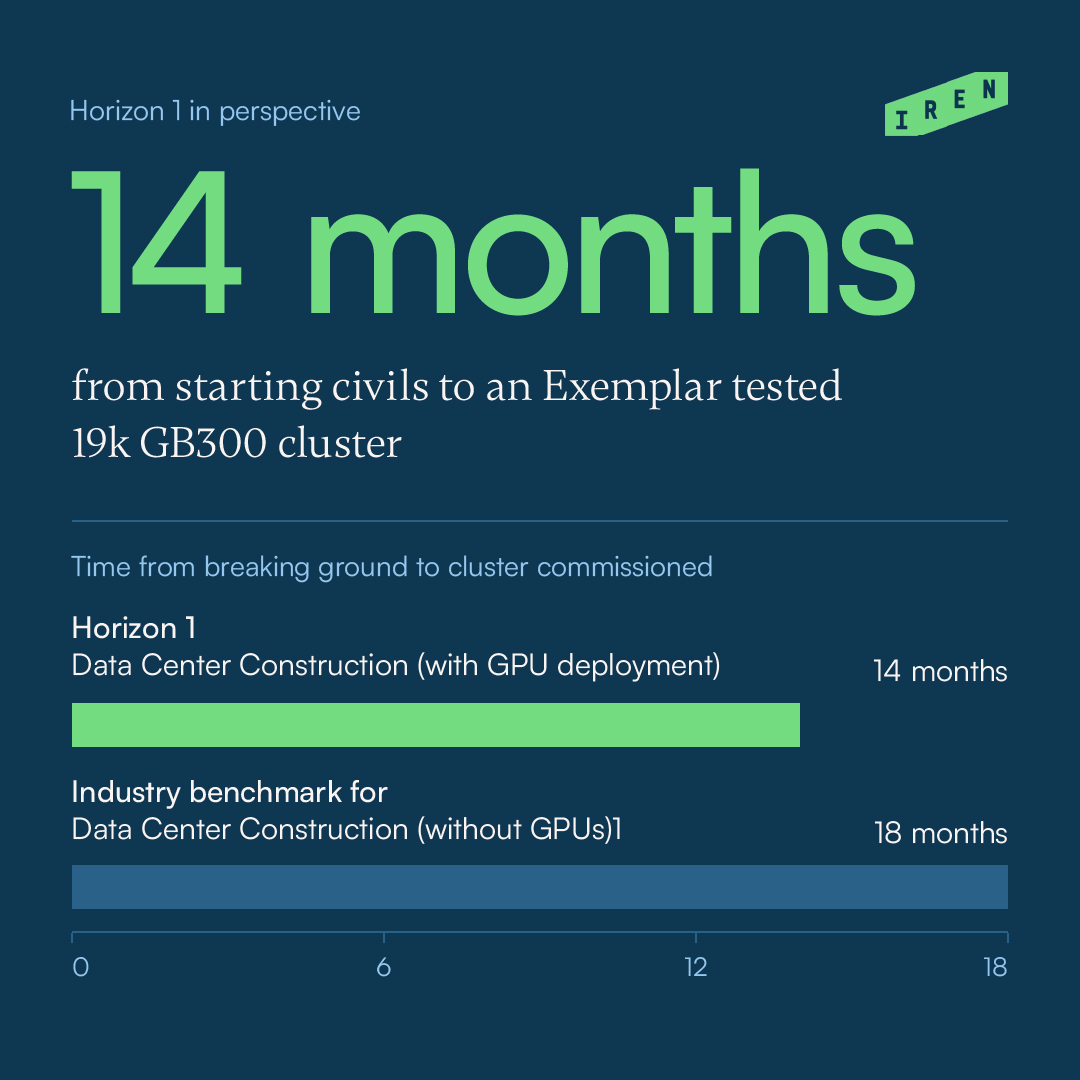
22% faster delivery than the industry benchmark.
Horizon 1, the first of four 50MW (IT) AI Cloud deployments for Microsoft, went from starting civils to an NVIDIA Exemplar Cloud-tested GB300 cluster in 14 months.
IREN's vertical integration delivers end-to-end control across design, engineering and construction, so contracted capacity reaches customers sooner.

1
17
828
AngryV retweeted

22% faster delivery than the industry benchmark.
Horizon 1, the first of four 50MW (IT) AI Cloud deployments for Microsoft, went from starting civils to an NVIDIA Exemplar Cloud-tested GB300 cluster in 14 months.
IREN's vertical integration delivers end-to-end control across design, engineering and construction, so contracted capacity reaches customers sooner.
AngryV retweeted

It’s rough, but patience will prevail. Jumping to NBIS now IMO is like changing lanes in traffic each time the lane you’re not in advances further a little bit only to stop once you have made the lane change.
-Ace ♥️
AngryV retweeted

Texans deserve a seat at the table when data centers come to their communities. Governor-elect Hinojosa has said it, and we agree. It’s how we’ve operated from day one.
Hear from our neighbors in Mitchell County and Colorado City, Texas in their own words:
So much dunking on Jensen, awful comments about his family etc. Sad for everyone involved. A devoted wife is betrayed, a well respected leader destroyed his trust and reputation.
And all the innocent AI equity holders that will be bludgeoned tomorrow (me)
1
213
AngryV retweeted

That's an exceptionally high ebidta margin for a company this early in it's revenue ramp imo. Yes high capex but microsoft project margin was guided at 85% at $12 a watt. With over $20 dollars a watt now for long contracts those projects have over 92.5% ebitda margins. At $40 96.25%. This company is asymptomatically approaching 100% ebitda margins. It's pipeline is so large now that 1 gigawatt is basically a rounding error. $IREN
Q1 FY27 at a glance: Explore IREN's quarter-on-quarter growth in operating capacity, revenue, and customer commitments from our latest investor presentation.
View the presentation: iren.com/api/media/file/Q1-F…
Read more: iren.gcs-web.com/static-file…

AngryV retweeted

Well well well!
- No delay credits.
- $MSFT recabling request.
- Q1 delivery of remaining Horizons.
Did Iren miss their target?
Yes
Did Microsoft’s call them out as delayed?
Absolutely not.
Whatever happened in FY27 Q1 is behind us, $IREN x $MSFT is a fantastic relationship.

Let's break down this latest hit piece by @theinformation, talking about delays at $IREN.
Before I dive into this, it's important to understand that there are 2 "delays" floating on this platform.
First of all, there is the FY27 Q1 CapEx shortfall, for the quarter ending September 30. @Microsoft reported $45.2B in CapEx, compared to its previous guidance of more than $50B, while disclosing that some third-party capacity deliveries originally expected in Q1 had been delayed.
Secondly, there is the CapEx guidance for FY27 Q2, which ends on December 31. Microsoft noted that it expects CapEx to exceed $50B for the quarter, while separately disclosing that some third-party GPU-as-a-Service contracts originally expected in Q2 have been delayed into FY27 H2 (January–June 2027).
The piece by The Information, labeled:
"Exclusive: Microsoft Lowered Data Center Spending Following Delays By Cloud Firm Iren", is strictly speaking about the first topic, the shortfall of ~$5B of CapEx by Microsoft, noting that:
"Microsoft didn’t name the 'third party' behind those delays, but one of them is Iren".
It's important to understand what this means, and how IREN investors should perceive this.
In my opinion, this is not "news", because we are talking about the quarter that has already ended over a month ago.
If we dissect the words from $MSFT's earnings call on October 28, and we believe that IREN was one of the 3rd parties responsible for the delays, as The Information claims, then all this comes down to is a discrepancy between what Microsoft expected on July 29, and what was delivered by IREN after Horizon 1 was accepted on August 13.
Clearly Horizon 1 was delivered and accepted during FY27 Q1, so this lease amount is undoubtedly included in the realized CapEx during that quarter.
So we have to consider what Microsoft expected to record from IREN beyond Horizon 1 in that same quarter.
Logically, this can only be Horizon 2.
And if we go by IREN's own words, the company said on May 7 that H1 was targeted for CY26 Q3, and H2–H4 were targeted by year-end.
So the discussion here is: What is "year-end" for IREN, how should IREN investors have read this, and when did Microsoft expect this to be delivered?
Microsoft held its earnings call more than 2.5 months after IREN announced H2–H4 would be delivered by year-end.
Can we make that deduction here, and claim that Horizon 2 could never have been planned for Q3, because IREN specifically only mentioned H1 to be delivered in CY26 Q3? I think that's debatable, but you may still assume that September is part of the "year-end".
Clearly by August 27, IREN had moved Horizon 2–4 to CY26 Q4, so from IREN to investors, and from IREN to Microsoft, there should have been no surprises anymore that Horizon 2 was not going to be delivered in September.
So we are really only focused on the period between July 29 and August 27.
Could Microsoft have expected Horizon 2 by September when they held their earnings call on July 29, and if so, what happened during the month of August, when IREN specifically put Horizon 2–4 in CY26 Q4?
Well, I think it's incredibly difficult to assume that IREN had told Microsoft by July 29 that they expected Horizon 2 to be ready before the end of September.
First of all, the picture I added is from 7/30, the day after Microsoft said it expected more than $50B in CapEx during FY27 Q1. Clearly, the cooling plant was not ready yet, and lots of construction was still going on.
Secondly, on the day IREN announced that Horizon 1 had been handed over to Microsoft, August 13, IREN received a batch of GPUs for data hall 2.3, which is the last data hall of Horizon 2 (see second picture).
Subsequently, IREN continued to receive GPUs during the next week, with final deliveries in the week of August 20.
Realistically speaking, IREN's GPU procurement team would have been aware of the GPU schedule for that month, and that makes for a strong case that they would not have expected to get everything up and billing, and merged with Horizon 1, before the end of September.
When Microsoft held its earnings call on July 29, and the ENTIRE reason we are now having this discussion about delays from IREN, did they really believe IREN would deliver Horizon 2 before the end of September?
How plausible is that, given that neither the construction progress during July and August nor the GPU delivery schedule indicated that such an event was going to happen?
And clearly IREN made sure that the market knew this, when they clarified on August 27 that they expected to deliver Horizons 2–4 in the December quarter.
So while everyone is zooming in on the past quarter, and pointing out the delays of IREN from the past, how realistic is it that this was actually the case?
And even if it's true that Microsoft did expect Horizon 2 to be delivered by the end of September, then how large is IREN's part in the CapEx miss?
We don't know exactly how Microsoft accounts for IREN's lease and whether it considers the prepayment. But doing a sensitivity analysis, I have the following numbers:
Under the base-case assumptions, Horizon 2 could represent approximately $1.7–2.2 billion, or 34–44%, of a $5 billion shortfall.
That's significant, and in the worst case, that's almost half of the CapEx miss.
But it's important to remember that this hinges entirely on the notion that Microsoft believed IREN would deliver more than Horizon 1 during FY27 Q1.
So we need to consider The Information's source, and then compare that to my research, and you can draw your own conclusions as to who may be right here.
That being said, even if the Horizon 2 delivery was initially expected in FY27 Q1 by Microsoft, the market obviously knew that it didn't happen.
First of all, IREN specifically placed Horizon 2 in the December quarter during their earnings call on August 27. Secondly, there was no subsequent announcement of a Horizon 2 handover and acceptance during the remainder of the quarter ending September 30.
So then we have to take a look at the real implications of this alleged delay, for the contractual relationship between IREN and Microsoft.
In the August 27 10-K, IREN states:
"Horizon 2-4 is targeted for delivery in phases in calendar Q4 2026, with grace periods under the Microsoft Agreement for delivery extending from mid-Q4 of calendar 2026 to the beginning of Q2 of calendar 2027."
We can infer from this that Horizon 2 is within its grace period if it's delivered before "mid-Q4", which we can consider to be November 15.
If Microsoft expected Horizon 2 to be delivered by September 30, then making the grace period for that delivery "mid-Q4" gives it approximately 45 days between the assumed original date and the grace period ending.
Now Horizon 4 has an inferred grace period ending by April 1st, so that would be more than 3 months after IREN's own "EOY 2026" deadline for it.
If Microsoft expected Horizon 2 by September 30, it would have approximately 45 days of grace to meet the "mid-Q4" qualification.
By that same token, would Microsoft then expect Horizon 4 to be delivered 45 days before April 2027?
Why would Horizon 2 receive a shorter grace period than Horizon 4?
This is a very interesting topic, because clearly there is a discrepancy here between what Microsoft knew on July 29 and what has been contractually agreed upon, which matches the grace periods.
Still, I believe that Microsoft would not report something they knew was not going to happen on July 29, despite having contractual agreements saying it should be delivered then.
If Horizon 4 has a similar grace period as Horizon 2, it makes perfect sense that Horizon 2 was agreed upon to be delivered well before September 30.
But that does not overrule the fact that Microsoft was well aware of the status of the project by July 29, when they disclosed their FY27 Q1 CapEx guidance.
Considerations:
-> Did IREN not properly inform Microsoft of the status of Horizon 2 by July 29?
-> Did IREN lean on grace periods, counting on having more time to deliver it within their agreed-upon delivery time with Microsoft, while still being in line with their communication towards the market?
-> Or did Microsoft know about Horizon 2 not making the September quarter, but still guided for it because it was within the original contracted target date?
Taking all things into account, the whole situation doesn't add up.
Either IREN or Microsoft must have known by July 29 that it would be incredibly hard, or near impossible, to get Horizon 2 up and running and merged with Horizon 1 before the end of September.
IREN already indicated to the market that it did not expect to meet a September deadline for Horizon 2 (if there even was any), by explicitly placing Horizon 2 in the December quarter.
Is this a case of miscommunication between IREN and Microsoft in the weeks leading up to their earnings call?
Did Microsoft gloss over all these 3rd party contracts, rounding up their expected CapEx plans for the September quarter, keeping in line with market expectations, and not giving attention to upcoming delays they were already aware of?
IREN is being sacrificed by the market, and targeted by The Information without any kind of nuance considering all I have said above.
As far as we know today, the "delay" is inconsequential, and both parties were well aware of this in August, and more importantly: the market already knew Horizon 2 was placed in the December quarter.
How can anyone confidently make this a real "news" item, if the nuance around this delivery is likely more relevant than the "delay" itself?
Honestly, this whole thing is completely overblown, and given the fact that it just seems to be about finger-pointing at 1 company, while not being able to quantify the delayed amount, I think it's important to scrutinize this calling out of only IREN.
Clearly, this is a great headline for the Blockspaces and SemiAnalysis of this world to run. But if you zoom in, and look at what is really reported, expected, and disclosed, you will find that this is just rehashing old news, in favor of getting clicks and engagement.
Unfortunately, IREN is the AI Cloud scapegoat of 2026, and clearly there are various reasons for that, both founded and unfounded.
But when IREN and Microsoft have internal arrangements that move capacity from one fiscal quarter to another, I think we should not go out here and blame them for delays, when they are well within their contractual (grace) periods.
Now I will go briefly into the other "delay" that is going around, because yes, Microsoft has noted another delay as I said at the beginning of this post.
The FY27 Q2 CapEx guidance also referenced third-party GPU leases that had been pushed into FY27 H2.
I'm well aware of information circulating that Aterio has said that Horizon 4 looks to be delayed, and @Jefferies has cut their price target on IREN for it, but from my latest aerial imagery and satellite footage, I have no reason to believe that H3–H4 as a cluster will miss the year-end deadline.
Unfortunately, my next flyover is probably just after the earnings call, but I will do my best to come back to this when the content comes in.
For now, don't follow the herd and don't just take what The Information tells you as a reason to blame IREN for anything that Microsoft has said.
We don't know a lot of things, and just quoting an unnamed source without any numbers or proof is not how we like to do things around here.


AngryV retweeted

Caught up with $IREN Co-CEO Dan Roberts today after earnings. The ER largely spoke for itself, but it was good to get his read in on the continued momentum and positive progress on the business. Seeing short term agreements (3-6 month) reach $40 million/MW is a great reminder of the demand environment. Long term contracts coming in at $22 million/mw shows that the patience in signing deals is working. No doubt the market (read share price) is challenging for IREN because it feels very disconnected from the fundamentals. The company is no doubt focused on execution. Conversation reiterated my confidence in the business.
AngryV retweeted

🔥 @danroberts0101 IS COOKING ON $IREN 🔥
Former Macquarie VP + Palisade infrastructure heavyweight is turning decades of real-asset financing into his advantage. On today’s earnings call he dropped this:
A customer just agreed to fund 90% of the GPU capex on a fresh 5-year deal at ~$22M per MW. Not 45%. Not 55%. 90%.
While most companies beg for capital, IREN is getting customers to bankroll the GPUs themselves — then stacking A-rated 6% financing and single-digit paper on top. Data centers stay owned, cash-funded, zero debt against the assets. This is infrastructure-grade execution applied to AI compute. The market is still pricing it like a miner. The customers are treating it like the future. $IREN is not asking for capital anymore. Capital is chasing them.
Stay locked. This is just getting started. 🚀

$IREN revenue jumped 66% QoQ to $228M as AI Cloud revenue nearly tripled to $200M, delivering $66M in adjusted EBITDA and an 86% AI Cloud gross margin. Operating ARR doubled to $1B, backed by a $20.3B backlog and a fully contracted, fully funded $4B+ ARR target expected in January 2027.
TLDR; DETAILS :
Revenue and profitability accelerating: Total revenue jumped 66% QoQ to $228 million, beating estimates, as AI Cloud revenue nearly tripled to $200 million. Adjusted EBITDA surged to $66 million, supported by Horizon 1 going live for Microsoft and achieving NVIDIA Exemplar status.
ARR ramp fully contracted and funded: Operating ARR doubled to $1 billion. The $4 billion-plus ARR target is now expected in January 2027, potentially extending into February following a Microsoft-requested network upgrade for frontier models, with no penalties.
AI Cloud gross margin holding at 86%: Margins remained steady QoQ, highlighting strong unit economics as the business scales.
Revenue backlog reached $20.3 billion: Up 22% QoQ, with roughly two-thirds tied to investment-grade counterparties, providing substantial multiyear revenue visibility.
Pricing power strengthening: Contracted rates increased 11% on three-year deals and 12% on five-year deals. Post-quarter wins included H100 GPUs at twice previous pricing and a short-term contract priced at $40 million per IT MW.
Customer momentum continuing: Post-quarter wins included an expanded contract with a leading frontier AI lab and a five-year deal with customer prepayments covering approximately 90% of associated GPU capex.
Mackenzie expansion advancing: Air-cooled GPU retrofits are progressing at the 80 MW site, alongside new liquid-cooled data center construction at the expanded approximately 100 MW campus, supported by roughly $2.4 billion in dedicated GPU financing.
Net loss narrowed sharply: Net loss declined to $263 million from $684 million in the prior quarter as the Bitcoin-to-AI transition continued.
Funding supports the buildout: Cash, restricted cash, and committed financing cover the majority of remaining FY27 capex needs.
Shares rose after hours: The revenue beat, EBITDA growth, Microsoft milestone, and expanding backlog strengthened the AI Cloud growth story.

Contrast what @theallinpod guys are discussing about @CoreWeave financing structure with what CEO @danroberts0101 is saying here about $IREN. These two companies are both neoclouds, but they are NOT the same.


A lot of questions this week on funding, so here's how a GPU typically gets funded at $IREN.
First, the customer signs a multi-year take-or-pay contract and agrees to a prepayment. On our recent 3-year contracts, prepayments have been 45% to 55% of the associated GPU capex.
Second, financing is committed, secured by the contracted GPUs. On the Microsoft contract we secured an A-rated facility at around 6%, which together with prepayments covers 96% of GPU capex. More recently, for a non-investment grade counterparty at Mackenzie, we secured financing at 9% fixed, which together with prepayments covers more than the full cost of the GPUs.
That's the GPU side. The data centers are a separate, long-term asset base, and we own the ones our GPUs run in. Construction has been funded from cash to date, with no debt against these multi-billion dollar assets. As they come online with contracted customers, they can support financing in their own right.
The processes behind the next facilities are continuing, and new paper will cost what the market charges. With GPU paybacks of around two years on our recent 3-year contracts, a wider spread barely moves the economics.
There's more customer demand than we can build for. As we noted at our recent earnings, 2026 is largely sold out, recent 3-year contracts are at more than double the prior year's pricing, and demand for anything we can bring online in 2027 covers it several times over, with prepayments a focus in every negotiation. Conversations on 2028 capacity are already underway.
Meanwhile announced capacity keeps slipping across the industry, which is the point: signing deals isn't the bottleneck in this market, bringing GPUs online is, and that's our focus.
3
184
AngryV retweeted

A lot of questions this week on funding, so here's how a GPU typically gets funded at $IREN.
First, the customer signs a multi-year take-or-pay contract and agrees to a prepayment. On our recent 3-year contracts, prepayments have been 45% to 55% of the associated GPU capex.
Second, financing is committed, secured by the contracted GPUs. On the Microsoft contract we secured an A-rated facility at around 6%, which together with prepayments covers 96% of GPU capex. More recently, for a non-investment grade counterparty at Mackenzie, we secured financing at 9% fixed, which together with prepayments covers more than the full cost of the GPUs.
That's the GPU side. The data centers are a separate, long-term asset base, and we own the ones our GPUs run in. Construction has been funded from cash to date, with no debt against these multi-billion dollar assets. As they come online with contracted customers, they can support financing in their own right.
The processes behind the next facilities are continuing, and new paper will cost what the market charges. With GPU paybacks of around two years on our recent 3-year contracts, a wider spread barely moves the economics.
There's more customer demand than we can build for. As we noted at our recent earnings, 2026 is largely sold out, recent 3-year contracts are at more than double the prior year's pricing, and demand for anything we can bring online in 2027 covers it several times over, with prepayments a focus in every negotiation. Conversations on 2028 capacity are already underway.
Meanwhile announced capacity keeps slipping across the industry, which is the point: signing deals isn't the bottleneck in this market, bringing GPUs online is, and that's our focus.


