

build products and businesses for economic leverage. ex @Paxos, @Coinbase, @Square. exploring AI + finance. invest via @a16z. dad x3. @ChelseaFC supporter.
Brooklyn, NY
Joined March 2009
- Tweets6.4K
- Following6.5K
- Followers3.3K
- Likes8.7K








Ronak Daya retweeted

My current feeling is that frontier OAI/Ant/Gemini models with harness on desktop are phenomenally useful for real work...
But despite how useful they are, I also still feel like my mind is being psychologically raided when I'm switching between all the different chat threads
And on top of this, all of these agents I'm supposed to text all day that seemed awesome at first are in fact not very useful (dot/muse/instinct/whatever)
Makes me increasingly convinced that "chat" alone is decidedly not the final interface of using a computer, or at least doing work on a computer. So much power and so little interface innovation
Curious for those who disagree. Perhaps I'm just bad at this

good summary

Inside ChatGPT Wallet: End-to-End Mechanics
1. Card Enrollment
- Secure entry: The user inputs card details through an isolated, PCI-compliant form rather than inside the chat interface.
- Issuer verification: The issuing bank verifies the card via native app flows or biometrics (e.g., deep-linking into Chase Mobile or scanning a QR code).
- Token link: The payment network binds the card and returns an abstracted, tokenized reference to OpenAI without exposing the real account number (PAN).
2. Order Discovery & Setup
- User instruction: The user prompts their agent ("dot") to find, configure, or purchase an item.
- Cart building: The agent navigates to the merchant’s site, selects product options (size, color, quantity), and adds items to the cart.
3. User Intent & Biometric Approval
- No autonomous spending: The agent cannot complete purchases on its own. It displays a confirmation card showing the merchant, exact items, total cost (including shipping and tax), and selected payment method.
- Biometric sign-off: The user confirms using on-device biometrics (Face ID, Touch ID, or fingerprint), generating an auditable, cryptographic proof of purchase intent.
4. Token Generation & Dispatch
- Authorization trigger: OpenAI forwards the approval signal to the payment network (Visa, Mastercard, or American Express).
- Dynamic network token: The network issues a single-use or domain-restricted virtual token with a dynamic cryptogram/CVV and limited lifespan for that specific transaction.
5. Checkout Injection
- Filling checkout: The agent injects the tokenized credentials into the merchant's standard checkout fields (or passes them via structured WebMCP APIs).
- Standard gateway handling: The store’s payment gateway (Stripe, Adyen, Checkout, etc.) processes the transaction as if it were a conventional card payment.
6. Authorization & Clearing
- Network routing: The acquiring gateway routes the token to the card network.
- Token detokenization: The network maps the token back to the actual account, validates the single-use cryptogram against the prior user authorization, and routes the charge to the issuing bank.
- Bank approval: The issuing bank verifies available funds/credit line and approves the transaction.
7. Confirmation, Settlement & Payout
- Order completion: The merchant receives payment approval, issues an order confirmation, and the agent displays the receipt in the chat thread.
- Fund settlement: Money moves along standard banking rails (Acquiring processor → Clearing network → Merchant bank account), following standard payout schedules (T+1/T+2).
- Merchant of Record (MoR): The merchant remains the sole seller of record, responsible for fulfillment, shipping, receipts, sales tax, customer support, and returns.

4
17
1,470
It's here, and it's the first half of what I guessed: card credentials with a control layer on top. No balances or stablecoins yet.
Quick reactions, longer post coming:
- Network tokens keep rewards and disputes intact. A strong signal that agents will run on the card rails we have.
- Every purchase still needs Face ID. OpenAI says limits by spending, category and time come later. That's when agents really get delegated authority, and it's the hard part.
- Each approval creates a record of what the agent was allowed to buy. That record is what issuers and merchants need.
- It's built for one person. Once budgets arrive, who holds a household's budget across agents and cards?

Wallet coming to @ChatGPT soon? 👀
Suspect it’s a way to store card credentials with a control layer, but would be fun to see if they build their own wallet to hold balances and support stablecoins!

7
28
1,505

Now your dot can securely complete purchases on your behalf—with your approval.
With ChatGPT Wallet, agents pay without access to your actual card details. Every purchase requires a security check.
ChatGPT Wallet is rolling out starting today to dots, for Pro subscribers in the US.
openai.com/index/introducing…
75
Fun nerding out on a call with @vigstar1 this morning. Always great to chat with someone who knows payments history deeply and is actively figuring out how to extend it to new paradigms. He’s right that incentives are what’s holding agentic commerce back.
A few places I’d push further:
- Agents act on delegated authority. There’s always a person or a company behind them, so the economics should flow back to that principal, or at least align with what the principal wants.
- Agentic tokens can extend what already works: issuers stay in the loop, and rewards and chargebacks carry over. The missing piece is a clear rule for who absorbs a purchase that was authorized but wrong, and the networks are best placed to set it.
- Inference costs will get subsidized while labs chase users, like Uber and Facebook did. Ads, referrals, merchant incentives and subscriptions will cover the rest, and payments should contribute to that mix.
- Whoever owns the surface where people decide what to buy will shape how payments work.
More to figure out, especially on B2B, where most of the volume will be.

this is a deeply personal piece! the title might seem provocative, but i hope it resonates with everyone across the commerce and payments ecosystem.
as always, please share your thoughts and disagree with me!
RIP @deewhock, we will not let you down!

4
20
1,272
Fun read from @DanteReminick on the role of a bank and how the core jobs wont change but how and by whom they get solved for the customer will change dramatically in the coming decade.

I wrote this article purely for my own benefit. I wanted to be able to organize my thoughts around a subject that I've spent lots of time researching/thinking about. I shared this with some friends who said I need to publish it.
Hope you enjoy.

3
7
495
Ronak Daya retweeted

Rain continues to lead in payment products, first with cards, then with ramps and orchestration, and now with agentic vaults that actually provide value back to the customer's program, and do so globally, because money doesn't see borders and the payments companies shouldn't be the only ones accruing value from your users.

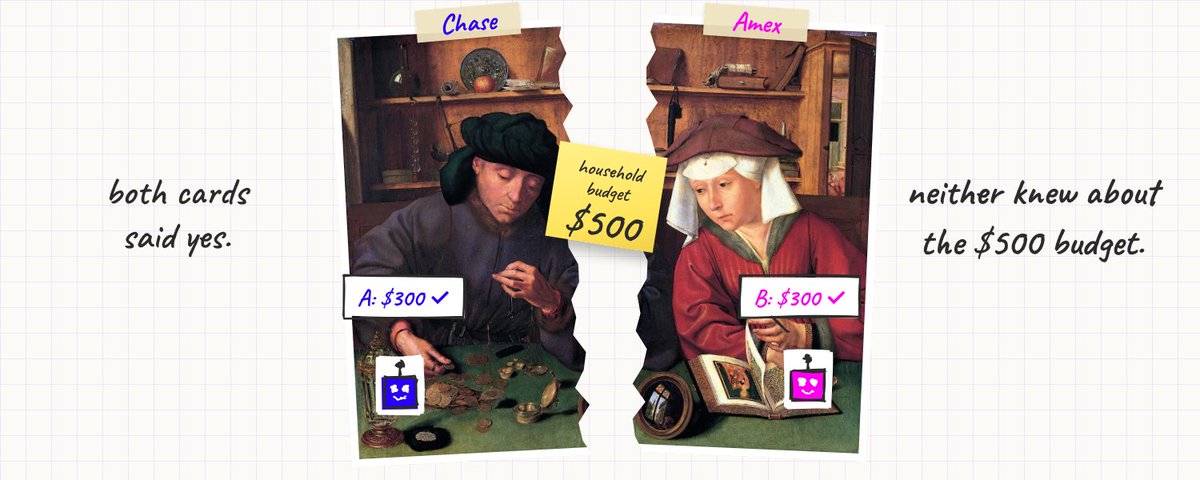
Thanks for the h/t, @sytaylor. Tokens vs balance is a fight over how the payment settles. The bigger one is who keeps track of what each agent is still allowed to spend.
Would I leave a balance with my agent? Yes. I suspect these start acting a lot like a Venmo balance, and eventually earn rewards. For one shopping agent it's also the simplest way to make a limit hold, because the money left and the authority left are the same number.
Once I'm running several agents with their own budgets, those numbers split. Someone has to track what each agent has spent and reserved, whether the payment settles as a token, a balance or my own card. Nobody owns that yet.

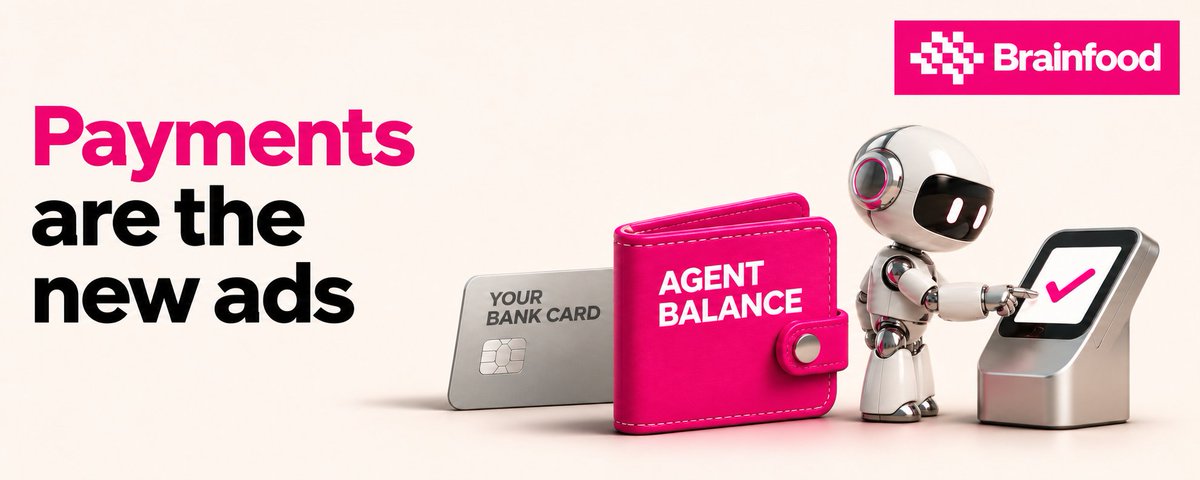
AI agents are starting to shop for us. But agentic commerce is a mess.
If your agent buys the wrong thing, who pays?
While banks figure that out, some apps are giving agents their own money to spend. We might not need banks at all.
Fascinating times.
8
673
Learnt this morning on walk to soccer ⚽️ practice with almost 6y old that he thought we looked alike because our bdays are close (4 days apart on calendar month) and that obviously made sense because my younger brother and I are 3 days apart and look similar. Ha
Such a fun alternate reality to imagine and then we got into chatting about genes 🧬, which are equally fascinating.
Now he’s very into it and I’m vibe building a game/site with @ChatGPT to teach him to pull on his version and teach him about genes while he plays soccer.

1
11
618

Agents are getting wallets and balances! @stripe launched @link balance: fund, set a limit, and the agent buys without asking.
A balance is the start of a much wider stack. Some early thoughts on how this might evolve here writing.ronakdaya.com/p/givi…
How do you see it? DMs open.

This is wild.
Side quests are Block >> voice AI companies that raised billions of dollars??

Meet Dessa, our AI model trained from scratch on nothing but speech.
We believe speech is the natural interface for technology. So we built Dessa.
And we’re inviting AI safety researchers to explore Dessa.
Learn more: block.xyz/dessa
2
16
872
Ronak Daya retweeted

Brutally honest and reflective look at the end of a company I loved for its product and culture.

Foursquare was acquired last month. The outcome was disappointing. It's taken me a while to write this, but I think I'm finally done grieving it. Here are some thoughts on our final years, an effort to honor the team who helped build & maintain FSQ's legacy, and my attempt to finally get some closure. teendrama.substack.com/p/som…

Yep. Been true for a bit now. Tradfi will catch up too.

hot take: crypto and fintech are basically the same industry now.
stablecoins and blockchain rails ARE a financial technology.
crypto native companies are now launching cards, bank accounts, other financial products, while traditional fintechs are integrating wallets, stablecoins and blockchain rails at an unprecedented rate.
we’re watching both industries attack the same problems from opposite directions until they eventually meet in the middle.
crypto companies are becoming fintechs and fintechs are becoming crypto companies.
2
6
397
Wallet coming to @ChatGPT soon? 👀
Suspect it’s a way to store card credentials with a control layer, but would be fun to see if they build their own wallet to hold balances and support stablecoins!