Sarthak Mittal (@sarthmit) profile picture
Montréal, Québec
Joined February 2019
Photo by Sarthak Mittal (@sarthmit)Photo by Sarthak Mittal (@sarthmit)Photo by Sarthak Mittal (@sarthmit)Photo by Sarthak Mittal (@sarthmit)Photo by Sarthak Mittal (@sarthmit)Photo by Sarthak Mittal (@sarthmit)Photo by Sarthak Mittal (@sarthmit)Photo by Sarthak Mittal (@sarthmit)Photo by Sarthak Mittal (@sarthmit)Photo by Sarthak Mittal (@sarthmit)
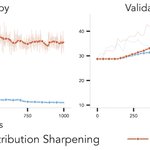
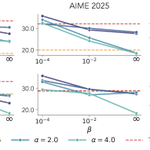
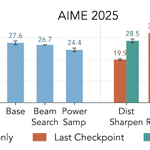
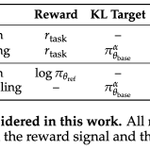
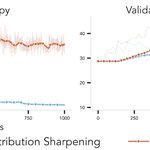
Is distribution sharpening actually the future of scaling, or just a massive hype train? 📉 We put it to the test using an RL framework – simulating everything from sharpening to task reward optimization. Result: It’s not the silver bullet everyone thinks it is!
2
7
12
2,290
Cool work, happy to see it out finally! Always fun to follow and debate around Eric's quest for understanding compositionality!
Couldn't be happier to announce my new paper on defining compositional structure — and generating it! I see this project as the culmination of my PhD, as it unifies all my interests: compositionality, compression, structure, and open-endedness. More below! arxiv.org/abs/2610.20922
9
450
Haven't posted on X in a while so figured I'd do a small update. I moved to London a bit more than 4 months ago and joined @MistralAI as an AI Scientist. I will also be at COLM this week, presenting arxiv.org/abs/2604.16259 (oral) on Wed, and looking forward to meeting people!
3
2
85
3,276
Spot on.
Thoughts About Scaling Law Scaling, but not only of parameters. Every model release now ends with the same question: how many parameters? It isn't a question that can be answered on its own. Parameter count is only meaningful alongside three others — how much data you have, where you intend to spend your compute, and who will run the model, under what conditions. The field learned this the hard way. Kaplan et al. (2020) fit an exponent that told everyone to grow parameters faster than data — roughly 2.7:1 — and the industry complied: GPT-3, Gopher, MT-NLG. Hoffmann et al. (2022) redid the experiment across four hundred models and found the compute-optimal split is closer to 20 tokens per parameter, and that with sufficient compute the two should grow at the same rate rather than drifting apart. The error in the earlier fit compounded with every order of magnitude of compute, which is why the largest models of that generation were the most misallocated. The trillion-parameter round was, in retrospect, a detour the whole field took together and then reversed. Chinchilla wasn't the end either. It optimized training compute for models that would be trained once and evaluated. Today a model is called billions of times a day and inference dominates lifetime cost. Put inference into the objective and the optimum moves toward smaller models trained far longer — deliberate over-training, which is what Llama-2-7B and Gemma-2-9B were doing at roughly 290 and 889 tokens per parameter. Sparsity moved the target again. In a MoE model two quantities have to be kept apart: total parameters govern roughly how much the model can hold — knowledge, facts, the long tail — while activated parameters and effective depth govern roughly how far it can think, how many steps of a causal chain it can carry before it comes apart. A dense 20:1 ratio does not transfer. And the ratio isn't a single number at all: Roberts et al. (2025) find the optimal tokens-per-parameter is task-dependent, with memorization favoring more parameters and reasoning favoring more data. Follow-up work on MoE observes that at fixed TPP, pushing total parameters higher actually degrades reasoning, while activating more experts reliably helps it. This matters for what we are building toward. Finding a vulnerability is not a retrieval problem. It doesn't come from having memorized more CVEs; it comes from carrying a twenty-step chain of inference to the end without losing the thread. That capability does not live in total parameter count. Which brings us to this release. Total parameters appear to matter up to a threshold — enough to hold the world — after which additional capability comes from scaling elsewhere: effective depth per forward pass, and above all post-training. GLM-5.3 is our controlled experiment on that claim. Same base, same architecture, same total and activated parameters as GLM-5.2. One month of scaling long-horizon environments and RL. The gains are not marginal. Well, scaling has more than one dial. We turned the post-training one this time because it had the most slack left in it — not because the others are finished. Base model size, pretraining data, compute spent per forward pass: all of them are still on the table, and we will come back to each. What this experiment taught us is that the dials do not have to be turned together, and that the one worth turning next is rarely the one that was worth turning last. We are not done scaling. Next time, maybe mid-training, pre-training, and even more.
3
740
Sarthak Mittal retweeted
It’s fairly well known frontier labs use value functions now, but we still don't have good open value function infra. Here's something cool from my ongoing internship @MistralAI with @laurence_ai getting value functions to work Introducing - Prime Values > Clean hackable, independent abstractions built on top of prime-rl by @PrimeIntellect > First-class asynchronous value trainer and evaluator nodes, with no trainer bottleneck > Native value warmup support > Streaming replay buffer feeds value model exploiting its greater staleness/reuse tolerance Defaults validated to match or outperform mean-baseline GRPO on both single-turn and multi-turn tasks
13
41
3
315
40,761
Sarthak Mittal retweeted
I'm excited to share my latest work, which focuses on how to give causal transformers the ability to model arbitrary conditionals. This work was done with a bunch of excellent folks @EricElmoznino @g_lajoie_ @le0gagn0n @sarthmit @tejaskasetty . arxiv.org/abs/2606.14943
1
18
1
105
10,867
Sarthak Mittal retweeted
We recently investigated how humans and AI reason through causal rules: arxiv.org/abs/2606.06464 We gave adults and LLMs agency to actively experiment using a Blicket causal game, breaking down their process into the iterative loop shown in the following figure:
3
11
3
74
12,997
Wow
The US government, citing national security authorities, has issued an export control directive to suspend all access to Fable 5 and Mythos 5 by any foreign national, whether inside or outside the United States, including foreign national Anthropic employees. The net effect of this order is that we must abruptly disable Fable 5 and Mythos 5 for all our customers to ensure compliance. Access to all other Claude models is not affected. We apologize for this disruption to our customers. We believe this is a misunderstanding and are working to restore access as soon as possible. Read our full statement: anthropic.com/news/fable-myt…
1
242
I always feel more people should know this
Replying to @yoavgo
As it turns out, the KL regularized return maximization objective is exactly the ELBO from variational inference. One is forced to REINFORCE because you can’t use the reparameterization trick, but other than that it’s a VAE where action / reasoning tokens are the latents.
1
15
8,589
Sarthak Mittal retweeted
Our post-training pipeline is a substantial redesign from Super. The core idea: don't rely on stacked RL stages alone. We do SFT, multi-environment RLVR across a huge mix of agentic/reasoning/code/safety environments, then Multi-teacher On-Policy Distillation (MOPD). 10+ domain-specialized teachers, merged into the student via dense token-level guidance on its own rollouts. See Figures below for overview and tech report for all the details. 2/4
9
38
9
284
109,544
Sarthak Mittal retweeted
🚨Excited to announce our workshop Context Beyond the Window hosted at COLM in SF! 🚨 LLMs have finite context windows, yet real-world tasks demand absorbing, retaining, and acting on information that far exceeds any single prompt. 1/3 We're looking for submissions across: context-beyond-window.github… • Context compression 🧃 — token compaction, recursive subagent calls, and external memory for storing and retrieving information • Efficient architectures 🚀 — sub-quadratic attention variants that make extremely long context computationally feasible • Continual training 🌱 — test-time training on streaming data, context distillation, and knowledge accumulation through continued pre-training • Agentic memory systems 🐘 — scaffolds and test-time scaling techniques that improve knowledge retention and acquisition in LLMs • Evaluation 🎯 — benchmarking models on increasingly long-horizon tasks
6
29
8
104
37,036
RT @AnjaSurina: AlphaProof Nexus advancing research math, solving 9 Erdős problems & more! Amazing experience to be part of this team & pro…
This quoted post is unavailable.
2
32
Sarthak Mittal retweeted
The scientific process involves collecting informative measurements while effectively allocating limited resources. We developed MaD-Physics, a new benchmark to measure this capability of agents.
1
17
3
39
6,720
Sarthak Mittal retweeted
Sharing our work on full-duplex multimodal models -- real-time interaction that's natural and intuitive without compromising on intelligence. We started Thinky in part to differentially advance capabilities for human-AI collaboration, which are underemphasized relative to intelligence/autonomy because they're harder to eval. In the future, we think every AI system will have something like an interaction model as the outer user-facing layer, continually keeping the user informed and learning what they actually want.
People talk, listen, watch, think, and collaborate at the same time, in real time. We've designed an AI that works with people the same way. We share our approach, early results, and a quick look at our model in action. thinkingmachines.ai/blog/int…
36
82
15
927
126,960
Many congratulations to @FrankRHutter @noahholl, sauraj and the entire prior team!!
Today we announced a major milestone: @prior_labs has entered into a definitive agreement to be acquired by @SAP, scaling Prior Labs to become the next frontier AI lab for structured data. 🧵
1
333
Kind of weird that Gemma 4 2B model is actually 5B (including embeddings, guess that is why they say E2B) And here I was thinking I found something comparative to Qwen3 1.7B
1
4
440
The real moat feels like data and compute; what do others think?
This quoted post is unavailable.
3
337
Could this all have to do with RL-training instabilities and not distribution sharpening? Our training health checks highlight consistently improving reward, showing that the training methodology works fine, but the optimum is to blame.
1
159
We used the Nemo RL codebase to implement the RL training. Paper: arxiv.org/pdf/2604.16259 Joint work with Leo and Guillaume. The setup is heavily inspired from arxiv.org/abs/2310.04363
2
157