Saujas Vaduguru (@saujasv) profile picture

PhD candidate @LTIatCMU | collaborative AI agents | Previous: Intern @MSFTResearch @autodesk, student @iiit_hyderabad, intern @ChandarLab @Mila_Quebec | he/him

Joined September 2013
Photo by Saujas Vaduguru (@saujasv)Photo by Saujas Vaduguru (@saujasv)Photo by Saujas Vaduguru (@saujasv)Photo by Saujas Vaduguru (@saujasv)Photo by Saujas Vaduguru (@saujasv)Photo by Saujas Vaduguru (@saujasv)Photo by Saujas Vaduguru (@saujasv)Photo by Saujas Vaduguru (@saujasv)Photo by Saujas Vaduguru (@saujasv)Photo by Saujas Vaduguru (@saujasv)
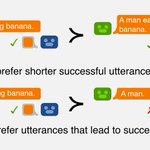
People adapt their language to communicate more efficiently over time. How can we make models do this? In our recent work, we trained models in self-play, and found that using the right incentives can make models adapt to communicate efficiently even without human demonstrations.
2
5
3
26
6,804
I'll be at #ACL2026 presenting our work on convention formation! I'm thinking about collaborating and communicating with agents these days, and am excited to chat with others working on these problems! Find us at Poster Session E on Monday, July 6 to check out the work!
People adapt their language to communicate more efficiently over time. How can we make models do this? In our recent work, we trained models in self-play, and found that using the right incentives can make models adapt to communicate efficiently even without human demonstrations.
1
3
21
1,433
I'm also presenting this work at SCiL on the 4th, and excited to chat with the community!
102
When we instruct an agent to design something, its first output may not be precisely what we want. Humans collaborating refine their creations iteratively. Can we instruct an agent to refine its output? Is language the best medium for these instructions? We explore this in mrCAD.
1
7
2
19
4,922
We asked pairs of people to recreate designs. A Designer could freely use language and drawing to instruct a Maker to create a 2D CAD object over multiple rounds of a game until the recreation was close enough to the target.
1
184
Check out our work on pragmatic reasoning for program synthesis using a learned ranking function! I’m very excited about the idea of rankings in this work and how it might relate to preference feedback. Reach out if you want to chat about it!
rational speech acts too slow? I will present #ICML2024 "Amortizing Pragmatic Program Synthesis with Rankings". we distill RSA to a simple ranking of programs, leading or order of magnitudes of speed-ups, while retaining performance [3min vid] youtu.be/hLeadcTFz4k?si=Uu0E…
4
18
1,408
Super excited to be presenting this at #ICLR2024 next week! Swing by during Poster Session 2 on 7 May, at 4:30pm CEST 😃 I'm also excited to see folks in Vienna, so if you want to chat about grounded communication in context (especially about programs), reach out on DM or email!
Neural program synthesizers usually interpret examples literally – finding a program that’s just consistent with the given examples. However, users informatively select examples to illustrate a desired program. How can synthesizers make use of this informativity?
1
5
1
41
4,135
Awesome to see @ShashwatGoel7 and @nikhilchandak29 getting recognized for this work 🏆🎉 Congratulations!
Work with @nikhilchandak29, @DominikPeters just won the Outstanding Paper Award🏆at AAAI 2024 (top-3/12000+). We study a framework for making multiple decisions that fairly satisfy diverse preferences. Potential applications range from faculty hiring to how AI combines values🧵👇
1
11
817
Neural program synthesizers usually interpret examples literally – finding a program that’s just consistent with the given examples. However, users informatively select examples to illustrate a desired program. How can synthesizers make use of this informativity?
1
10
3
41
12,835
In our new work, we present a framework to enable neural synthesizers to leverage informative examples without having humans provide these examples. We use computational pragmatic reasoning to generate synthetic examples for training to make our models work well with users.
1
2
220
This is excellent!
I've read ~50 SOPs (via STEM for development, my personal network, random email requests, and my recent Twitter form) over the past 2 months, and these are COMMON MISTAKES I've noticed graduate school applicants making quite often: [A thread]
1
3
930
It's that time of the year again
There's a lot of great advice on how to write a good SOP for (CS/NLP/ML) PhD applications out there, but how do you translate this to writing an actual statement? I try to show how I did this in a new blog post: saujasv.github.io/annotated-… Hope applicants find this useful!
2
10
1,557
There's a lot of great advice on how to write a good SOP for (CS/NLP/ML) PhD applications out there, but how do you translate this to writing an actual statement? I try to show how I did this in a new blog post: saujasv.github.io/annotated-… Hope applicants find this useful!
2
38
5
169
These posts highlight a really interesting perspective on how to think about problems in terms of programs and synthesis, and helps people get a foot in the door. @evanthebouncy's perspective has influenced my own thoughts on this space a lot, and I highly recommend reading this!
want to get into program synthesis but don't know how to started? I wrote a minimalist intro to modern program synthesis that can help you -- from problem formulation to generating code by fine-tuning llm on huggingface. evanthebouncy.github.io/prog…
4
I'm thrilled to share that I've accepted an offer to join @SCSatCMU as a PhD student! Really excited to work with @dan_fried and other amazing faculty and students @LTIatCMU!
21
4
195
I've had the privilege of having incredible mentors like @monojitchou, @evanthebouncy, @prasannapartha, and @apsarathchandar who have provided a lot of opportunities, help, and guidance, and deeply influenced how I think about research.
2
15
This is a really interesting paper, and an exciting takeaway!
More broadly, it’s an exciting time to be working on language + action/RL! A lot of work has been focused on e.g. language for generalization, but our work hints at how language humans use to *communicate* present distinct challenges for grounded agents (pragmatics, etc.!). [8/8]
1
Looking forward to the #NeurIPS2021 Meaning in Context Workshop (mic-workshop.github.io) where we'll present "Efficient Pragmatic Program Synthesis with Informative Specifications" exploring synthesis from pragmatic specs, making it scale better, and using neural methods. (1/2)
1
4
11
Talk live at 16:00 ET on the 13th. Drop by and say hi! w/ @evanthebouncy and Kevin Ellis. Paper: saujasv.github.io/assets/pap… (2/2)
If you're @aclmeeting, do check out the presentation of our work @sigmorphon, and drop by the Q/A session tomorrow!
2
6
We adapt a program synthesis algorithm that learns rules for string transformations, and apply it to a set of challenging phonology problems from Linguistics Olympiads.
1
2