

Dad. Husband. Born/raised Kyiv. Developer of HyPh/y,Aeon. Former mathematician, current professor of biology at Temple U. Google scholar: https://xitter.cf/t.co/qyzpbkVCPz
Gladwyne, PA
Joined January 2017
- Tweets1.3K
- Following728
- Followers2.1K
- Likes780



Pinned Tweet
🧬 Continuing our push to rethink foundational methods in molecular evolution from first principles with 𝗔𝗜-𝗮𝗰𝗰𝗲𝗹𝗲𝗿𝗮𝘁𝗲𝗱 𝗮𝗹𝗴𝗼𝗿𝗶𝘁𝗵𝗺 𝗱𝗲𝘀𝗶𝗴𝗻: why do we build a phylogenetic tree just to calibrate a molecular clock?
🚀 Our updated preprint & replication suite describes 𝗖𝗵𝗿𝗼𝗻𝗔𝗲𝗼𝗻—a tree-free paradigm for molecular clock calibration that replaces discrete tree search and MCMC chains with 𝗰𝗼𝗻𝘁𝗶𝗻𝘂𝗼𝘂𝘀 𝗱𝗶𝘀𝘁𝗮𝗻𝗰𝗲 𝗴𝗲𝗼𝗺𝗲𝘁𝗿𝘆, 𝗳𝗼𝘂𝗻𝗱𝗮𝘁𝗶𝗼𝗻-𝗺𝗼𝗱𝗲𝗹 𝗮𝘁𝘁𝗲𝗻𝘁𝗶𝗼𝗻, and 𝘀𝗽𝗲𝗰𝘁𝗿𝗮𝗹 𝗽𝗮𝗿𝘁𝗶𝘁𝗶𝗼𝗻𝗶𝗻𝗴 across millions of pathogen genomes.
📄 Preprint & Replication Suite (v2.0): doi.org/10.5281/zenodo.23560…
📖 Blog & 60-sec slides: spond.github.io/CV.js/blog/2…
🌐 Browser app (WASM): primaeon.org/time/
📊 Interactive benchmarks: veg.github.io/chronaeon/
⚙️ 𝗛𝗼𝘄 𝘁𝗵𝗲 𝘀𝘁𝗮𝗰𝗸 𝘄𝗼𝗿𝗸𝘀:
🧭 𝗖𝗼𝗻𝘁𝗶𝗻𝘂𝗼𝘂𝘀 𝗣𝗿𝗼𝗳𝗶𝗹𝗲 𝗥𝗼𝗼𝘁𝗶𝗻𝗴: Instead of anchoring to a brittle single reference or majority-vote consensus sequence, ChronAeon projects sequences onto a time-weighted nucleotide probability profile Q—contracting deeply saturated alignments (like Central African HIV-1 Group M, where >80% of pairs exceed d > 0.20) back into the linear substitution regime.
🎯 𝗛𝘆𝗽𝗵𝗔𝗲𝗼𝗻 𝗔𝘁𝘁𝗲𝗻𝘁𝗶𝗼𝗻 𝗖𝗼𝘃𝗮𝗿𝗶𝗮𝗻𝗰𝗲 & 𝗙𝗶𝗲𝗹𝗹𝗲𝗿 𝗜𝗻𝘁𝗲𝗿𝘃𝗮𝗹𝘀: To discount shared evolutionary history without building a tree, ChronAeon extracts a cross-sequence attention covariance kernel from a single forward pass of our pre-trained axial transformer HyphAeon, solving Pagel's PGLS in O(N) scalar steps per evaluation and computing exact asymmetric confidence sets via Fieller's theorem (automatically flagging uninformative data when g ≥ 1).
⚡ 𝗔𝘂𝘁𝗼𝗖𝗹𝗼𝗰𝗸 𝗦𝗽𝗲𝗰𝘁𝗿𝗮𝗹 𝗣𝗮𝗿𝘁𝗶𝘁𝗶𝗼𝗻𝗶𝗻𝗴 & 𝗦𝗵𝗲𝗿𝗺𝗮𝗻-𝗠𝗼𝗿𝗿𝗶𝘀𝗼𝗻 𝗟𝗢𝗢𝗖𝗩: Recursive Fiedler-vector bisection of the normalized graph Laplacian separates co-circulating sublineages evolving at different rates without manual curation, while rank-1 Sherman-Morrison downdating flags high-leverage temporal outliers in milliseconds.
🌊 𝗢𝗻𝗹𝗶𝗻𝗲 𝗔𝗟𝗗 𝗡𝘆𝘀𝘁𝗿𝗼̈𝗺 𝗖𝗼𝗿𝗲𝘀𝗲𝘁𝘀 (𝗡 ≫ 𝗟): For million-genome streams ordered strictly by database release date, ChronAeon locks 256 ancestral anchors + 1,792 online Approximate Linear Dependence (ALD) landmarks to track pandemic evolution in flat memory and O(N·M) time.
🦀 Across empirical, experimental, and synthetic benchmarks, ChronAeon delivers:
🏛️ 𝟰𝟮 𝗘𝗺𝗽𝗶𝗿𝗶𝗰𝗮𝗹 𝗕𝗘𝗔𝗦𝗧 𝗕𝗲𝗻𝗰𝗵𝗺𝗮𝗿𝗸𝘀 & 𝗗𝗲𝗹𝗽𝗵𝘆: Matches published Bayesian emergence dates across five millennia (log10 R = 0.94, modern R = 0.86) in seconds while running 426×–725× faster than mutation-tree MCMC (Delphy) and >10,000× faster than BEAST X.
🧪 𝟱𝟬,𝟬𝟬𝟬-𝗚𝗲𝗻𝗲𝗿𝗮𝘁𝗶𝗼𝗻 𝗘. 𝗰𝗼𝗹𝗶 𝗟𝗧𝗘𝗘 & 𝟭𝟰𝟴,𝟱𝟭𝟲 𝗦𝗶𝗺𝘂𝗹𝗮𝘁𝗶𝗼𝗻𝘀: Recovers the ground-truth 1988 Lenski LTEE substitution rate to within -0.8% (root date 1987.51 vs 1988.15) and maintains 93%–98% CI coverage under relaxed clocks.
🦆 𝟰𝟵,𝟴𝟳𝟱 𝗜𝗻𝗳𝗹𝘂𝗲𝗻𝘇𝗮 𝗔 𝗚𝗲𝗻𝗼𝗺𝗲𝘀 (𝟭𝟲 𝗦𝘂𝗯𝘁𝘆𝗽𝗲𝘀): Automatically quarantines 453 temporal/lab outliers and partitions 72 host- and subtype-specific sublineage clocks in minutes.
🦠 𝟲,𝟯𝟭𝟳,𝟬𝟰𝟮 𝗦𝗔𝗥𝗦-𝗖𝗼𝗩-𝟮 𝗚𝗲𝗻𝗼𝗺𝗲𝘀 (𝟮𝟬𝟮𝟬–𝟮𝟬𝟮𝟲 𝗥𝗲𝘄𝗶𝗻𝗱): Saturates at M = 1,887 active landmarks (d_eff = 1,242.2), resolves multi-wave Simpson's paradox into a conserved 1.43×10⁻³ subs/site/yr within-lineage rate, and locks onto Alpha, Delta, BA.1, XBB.1.5, and JN.1 clocks 18 to 119 days before 50% global dominance (avoiding the 25–93d delays of N = 3,000 subsampling).
🌳 𝗕𝗼𝗻𝘂𝘀 — 𝗧𝗶𝗺𝗲𝗧𝗿𝗲𝗲𝘀 & 𝗖𝗼𝗮𝗹𝗲𝘀𝗰𝗲𝗻𝘁 𝗦𝗸𝘆𝗹𝗶𝗻𝗲𝘀 𝗶𝗻 𝗠𝗶𝗹𝗹𝗶𝘀𝗲𝗰𝗼𝗻𝗱𝘀: What if you *do* want an explicit time-tree after calibrating the clock? @sdwfrost has already extended ChronAeon with chronaeon.timetree—a hybrid distance-geometry + tree-isotonic solver that reconstructs complete binary time-trees and calibrated coalescent skyline trajectories (Ne(t) with 94.8% CI coverage) directly from sequences in 5–900 ms without ML tree search or MCMC: github.com/sdwfrost/chronaeo…
🤝 With @DarrenM98230782, @sdwfrost, Brittany Rife Magalis, Sudhir Kumar, @JD_zehr, Danielle Callan, @jwertheim, @stvnwvr, and @nekrut.
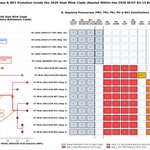
Why did a single Idaho H5N1 lineage survive the 2025 bottleneck to drive the 2026 dairy cattle outbreak while California’s 3,216-genome clade went extinct?
We ran a temporal dN/dS scan across all 4,467 codons (10 proteins) of the Nextstrain H5N1 cattle tree using HyphAeon Temporal
Instead of adapting gradually, H5N1 evolved in 4 synchronized selection waves (79 sweeps). Three waves built the surviving Idaho trunk step-by-step:
🟦 Pulse 1 (Mid-2024 — Idaho Trunk Base)
6 mutations across 5 segments swept in lockstep:
• HA: D104G, S336N (receptor base & cleavage loop)
• PB2: K670R (627-domain)
• NS1: R67G • M1: S82N • NP: I119V
🟧 Pulse 2 (Early 2025 — Surviving Idaho Founder)
• NA: K111R (#2 strongest site in proteome; tetramer assembly) & I19V
• NS2: D27G (#7 in proteome; nuclear export)
• NS1: A60T (#3 in proteome; dsRNA-binding helix)
⬜ Mid-2025 Dead-End Burst (Extinct Clades)
Isolated HA antigenic bursts (E201K, K250R, R343K) without whole-genome coordination → died out by late 2025.
🟥 Pulse 3 (Late 2025 / 2026 — Bottleneck Sweep)
Simultaneous 8-protein overhaul before the 2026 expansion:
• NS1: M124T (#1 site in proteome; PKR/CPSF30 motif), Q25R, I54L
• HA: S233P (RBS rim) + M2: V51I (amphipathic helix)
• NA: N434S & K432E (430-loop 2nd sialic acid site)
• Polymerase/NP: PA I219T, V44I, L425F • PB1 T543S • NP A27T
💡 What temporal dN/dS teaches us:
When an adaptive mutation fixes once on a surviving trunk branch, static dN/dS misses it because there are no repeated parallel hits—catching only 8 of the 79 sweeps. Meanwhile, recurrent dead-end mutations (like HA:V147M, LRT=12.1) inflate static scores. Regressing branch selection over time with date-shuffling permutations rescues 71 single-branch trunk sweeps and filters out recurrent noise (HA:V147M p_perm=0.35).
🤖 100% Agentic Workflow:
This entire analysis was executed end-to-end by an AI coding agent from a single prompt: extracting the 10-protein codon alignments from Nextstrain JSONs, running GPU-accelerated HyphAeon neural inference + 500-permutation temporal wave decomposition across 4,467 codons, decoding the 79 sweeps, and rendering the figure.

My feed is currently full of takes treating a Utah mink farm like a Bond villain's volcano lair ("Dr. Evil tries to spark a pandemic", "classical dangerous Gain of Function experiment").
The limited sequence data actually show this:
We have 10 mink genomes in NCBI/NextStrain (QB062305–QB062376 + SRR40350173), all sampled on a single day (Aug 7). Because they form a three-step internal ladder on the tree, they don't just capture a point spillover—their standing diversity traces back ~6–7 weeks to a mid-June farm ancestor (~2026.46).
What did the virus actually do during ~7 weeks in mink?
- HA (568 codons) accumulated zero amino acid changes. Every mink HA protein is 100% identical to neighboring May/June ID & UT dairy cattle.
- Canonical PB2 mammalian sweeps (627K, 701N, 271A): zero.
- Instead, the basal mink stem fixed changes in the polymerase and M2 (PB2 Q13R, PB1 K388R, PA I129T, M2 G58D/S64F). An internal branch (8/10 tips) added PB2 I399T and reverted NS1 T60A back to the pre-2025 residue, and a nested split (5/10 tips) added PB1 N642T.
- Downstream spread into cattle, poultry, wild birds, or humans since August: zero.
Our genomic window on that farm closes on Aug 7 because the October follow-up samples still haven't been released. Less movie-pitch hyperbole and faster open deposits in GenBank would be a nice start.

I spent some time tonight looking at the Nextstrain H5N1 dairy cattle tree that @SolidEvidence shared. What jumps out at me is not an uncontained national wave, but a dramatic evolutionary bottleneck.
Every major 2024 and 2025 lineage went extinct. The massive California wave vanished last fall. So did the Colorado and Midwest lineages, along with the original Texas and Michigan clades. Every single 2026 sequence on that tree traces back to one late-2025 ancestor in Idaho.
Bulk milk testing worked. Mandatory bulk-tank screening and farm quarantines in Colorado and California, followed by the USDA National Milk Testing Strategy, cleared the virus from most dairy states. That state-by-state clearance is why the January 2026 USDA guidance added an exemption for certified unaffected states. Rather than circulating across the country, roughly 96% of the 2026 sequences come from two neighboring states, Idaho and Utah, plus one small secondary jump to Texas.
Why does the 2026 cluster sit on such a long branch? Sampling cadence explains a lot of the visual gap. Sequencing in Idaho went quiet for five months in late 2025 and then ramped back up this spring with much faster GenBank turnaround. Even with uneven sampling, the fact that every 2026 sequence across cattle, birds, and mink coalesces to a single late-2025 Idaho ancestor points to a real contraction.
We ran our selection, clock, and reassortment tools across all eight segments to see what carried that lone Idaho lineage through the bottleneck. Reassortment played no role. All eight segments tracked together clonally, and PB2 did not pick up a single nucleotide change along the entire bottleneck stem. The other seven segments went through a sharp clock acceleration and fixed a tight cluster of co-evolving changes in NS1, HA, and NA. When that lineage spilled into a Utah mink farm, it picked up a set of polymerase changes and immediately reverted an NS1 mutation (A60T) that the virus had acquired in Idaho cattle back in 2024.
Inside the surviving Idaho and Utah pocket, peridomestic birds and small mammals sit interleaved with dairy cattle on the tree. Curious what @SolidEvidence and others think: is this last lineage holding on in the Intermountain basin through local farm-to-wildlife cycling, or did those NS1 and surface changes alter within-herd persistence?
xitter.cf/SolidEvidence/status/2…

There is something really concerning (and disappointing) going on in the US right now.
A dangerous and preventable situation.
Let me explain.
nextstrain.org/avian-flu/h5n…
1/

I have been ASSUMING all writing (papers, grants etc) goes to an AI reviewer for some time now. The policies of "do not use AI" are basically uneforceable and the incentives (and now with this justification) are absurdly high.

Harvard Study: AI Peer Reviews of Journal Papers Outperform Top Human Experts?!
(When I was an editor for technical journals, I focused on understandably: often asking authors what their sentences meant. Sometimes, they did not know what their sentences meant. I wonder if AI also focuses on this aspect.)
Free article PDF: gking.harvard.edu/peerless/

🧬 We have been using 𝗔𝗜-𝗮𝗰𝗰𝗲𝗹𝗲𝗿𝗮𝘁𝗲𝗱 𝗮𝗹𝗴𝗼𝗿𝗶𝘁𝗵𝗺 𝗱𝗲𝘀𝗶𝗴𝗻 to rethink foundational methods in molecular evolution from first principles.
🚀 Our new preprint introduces 𝗥𝗵𝗶𝘇𝗔𝗲𝗼𝗻—a new paradigm for recombination analysis that replaces discrete tree searches and combinatorial triplet tests with 𝗰𝗼𝗻𝘁𝗶𝗻𝘂𝗼𝘂𝘀 𝘁𝗿𝗮𝗷𝗲𝗰𝘁𝗼𝗿𝘆 𝗺𝗲𝗰𝗵𝗮𝗻𝗶𝗰𝘀 in linear O(NKL) time.
📄 Preprint: biorxiv.org/content/10.64898…
📖 Blog & 60-sec slides: spond.github.io/CV.js/blog/2…
🌐 Browser app: veg.github.io/rhizaeon-code/
💻 Code: github.com/veg/rhizaeon-code
⚙️ 𝗛𝗼𝘄 𝘁𝗵𝗲 𝘀𝘁𝗮𝗰𝗸 𝘄𝗼𝗿𝗸𝘀:
🧭 𝗠𝗲𝘁𝗿𝗶𝗰 𝗠𝗮𝗽 & 𝗥𝗼𝗼𝘁 𝗦𝗶𝗻𝗸: K reference genomes form a fixed metric map with an unpolarized root sink at the origin. Branch-specific rate bursts flow into the sink, holding false positives at 0.58%–1.01% across 333,334 clonal genomes in a 1,000,000-alignment sweep.
🎯 𝗔𝘁𝘁𝗲𝗻𝘁𝗶𝗼𝗻 𝗠𝗮𝗽𝘀 & 𝗚𝗵𝗼𝘀𝘁 𝗔𝘅𝗶𝘀: Each sequence is tracked along the chromosome via soft attention weights over the landmarks, plus an orthogonal projection that captures unsampled ("ghost") donor lineages.
⚡ 𝗙𝗼𝗿𝗰𝗲 𝗗𝗶𝗽𝗼𝗹𝗲𝘀: Crossovers shift attention from one donor to another, creating an equal-and-opposite force dipole across the breakpoint that we test against a Brownian-bridge null.
🌊 𝗗𝘆𝗮𝗱𝗶𝗰 𝗪𝗮𝘃𝗲𝗹𝗲𝘁 𝗣𝗼𝗹𝗶𝘀𝗵𝗶𝗻𝗴: Multi-scale wavelet filters, 5-state Viterbi decoding, likelihood polishing, and iterative tract scrubbing resolve nested transfers from 80 bp gene conversions to 30 kb cassettes while merging shared clade transfers into a single ancestral event (98.8% exact).
🦀 Written in Rust and Python and compiled to WebAssembly for zero-install browser runs, RhizAeon maps:
🦠 83 whole sarbecovirus genomes (31 kb) in 2.6 seconds
🧫 240 S. pneumoniae chromosomes (2.22 Mb) in 36.1 seconds
🛡️ 379 primate HLA Class I alleles in 1.1 seconds
🤝 With Danielle Callan, @stvnwvr Hannah Verdonk, @JD_zehr @SpyrosLytras, @nekrut, @tpaisie, and @DarrenM98230782 .

I was curious what I can learn from currenly available publicly available sequences using our AI-based new tools.
60-seconds: spond.github.io/CV.js/blog/2…
4 minutes: spond.github.io/CV.js/blog/2…


On 20 October 2026, France reported the first documented case of human disease caused by the Shamonda virus. This virus primarily affects animals such as cattle, sheep, goats and horses.
WHO is in touch with the French authorities and is closely monitoring the situation.
Here is what you need to know ➡️


A really impressive and creative PNAS study by Ekaterina Riumina, @GBazykin , and colleagues tackles one of the hardest questions in viral evolution: does escaping human CD8+ T cells actually help SARS-
CoV-2 spread at the population level? 1/


And so does SARS-CoV-2: pnas.org/doi/10.1073/pnas.26…

In surface Spike regions (RBD/NTD), antibody escape evolves ~3.5× faster and can overlap with T-cell epitopes (Y145H, R346K). Yet in Spike’s intracellular tail where antibodies can never reach— selection and epistasis (V1264L) peak right on top of a 12-allele HLA hotspot 5/

@bloomlab study is very cool for many reasons [techical, framing, rigor. Is this patter unique to SARS-CoV-2? No—we see the same "germline de-immunization" across HIV, flu, HCV, and herpesviruses 1/

SARS-CoV-2 evolved since 2019 to evade human biological defenses. Obviously.
But not just how it’s been known previously. Also to evade our *Hardwired* human biolog.
That is - Not to just evade our prior immune responses - but actually to better evade eliciting a robust response by our naive B cells.
Looking at prepandemic cryopreserved samples, @jbloom_lab showed a 3x difference in the fraction of naive B cells responsive to the original Wuhan spike RBD protein compared to more contemporary Omicron lineages.
This isn’t a simple “evade prior elicited antibody response” as we all understand
This is actually - the virus mutates to help avoid detection altogether by humans - uniquely by evading aspects of the human germline encoded naive B cells responsive repertoire.
They look at mice, for example, and saw no difference in ability of naive B cells to respond to the different variants
Altogether it points to a world where we not only have immune imprinting to impair protection, plus the “regular” virus mutation to avoid existing immunity, but now mutation specifically to avoid hardwired human biology.
Even T-cell epitopes follow this rule: long-adapted human herpesviruses and evolved HIV clades systematically purge peptides recognized by common human HLA genes ("evolutionary de-immunization"). doi.org/10.1128/JVI.02636-06 6/