


Shreky🐉 retweeted

Guys this is not what you think it is. The PM is making it sound like the world is slowly embracing Ayurvedic mumbo-jumbo. It is not.
Please note, PM Modi did not state that Ayurveda training courses are recognized abroad as medical degrees or clinical licenses.
He highlighted that over 150 Ayurveda training courses have received recognition (as in "Hello there, nice to meet you" - kind of recognition) - across various countries that India has signed Memoranda of Understanding (MoUs - with 28 nations) - most of these nations are also the ones giving him dubious, highly publicized one-time awards - to promote business of traditional medicine.
Seeing this, if a BAMS (Ayurveda) or BHMS (Homeopathy) or BYNS (Naturopathy) or BUMS (Unani) or BSMS (Siddha) graduate from India takes a flight and goes to any of these countries and starts to practice, they will be deported or put in jail because AYUSH is considered illegitimate clinical medicine and an unregulated harmful alternative medicine practice outside India.
Ayurveda is the mother of all pseudosciences. It has been for 2000 years. Zero output other than vague MoUs and wastage of public funds and many documents deaths. It survives because majority of Indians are hostage to politicization, indoctrination and tradition-emotiveness of healthcare. Stop falling for cliched BS like this.

150+ AYURVEDA COURSES RECOGNISED ABROAD, SAYS PM MODI
Speaking in Bengaluru, PM Modi said India has signed agreements with 28 countries to promote Ayurveda. He said the AYUSH sector is now worth tens of thousands of crores, with AYUSH and herbal exports rising and global demand for turmeric growing.
He also said Ayurveda and naturopathy are playing a significant role as holistic healthcare gains ground worldwide.
#PMModiInBengaluru #Ayurveda #Karnataka #AyushSector #Bengaluru


Shreky🐉 retweeted

In 2023, the University of Madras hiked the PhD thesis submission fee from ₹100 to ₹25,000 for full-time scholars. I asked under RTI who approved it.
It took three years, two appeals and REPEATED DIRECTIONS from the State Information Commission to get an answer. Here is what that answer exposes. #MadrasUniversity 1/9


Shreky🐉 retweeted

Accord builds the GPS that guides India's defence systems.
It can't locate its own cash. 🛰️
→ ₹139 Cr profit, 3x in one year
→ −₹78 Cr operating cash flow
→ ₹456 Cr owed by customers, almost a full year of sales
→ An audit disclaimer on the FY26 accounts
The business is genuinely strong. Own technology, 72% gross margins, made-in-India NavIC chips and DRDO as a customer.
But the money is stuck. One DRDO order shipped in March 2023 still hasn't been fully paid. The growth is being funded by ₹360 Cr of bank loans, personally guaranteed by the founders.
So is FY26 a breakout, or just a very large IOU?
The full Datafin deep dive covers the business model, the receivables, the red flags and the valuation 👇
datafin.in/blog/accord-the-g…

Shreky🐉 retweeted

What awaits Fungo Genesis holders?
1- A share of every sale:
4.5% of every sale on the launchpad goes to Genesis NFT holders, the Genesis sale included. 20% of the platform's other revenue (creation, bid, royalty, token and pool fees) flows into the same pool. It's all split equally across the 3,232 NFTs and claimable in ETH, ZAMA and drop tokens from the Genesis tab in your Vault.
2- A share of every token launched:
Every token launched on FungoLabs gives at least 5%, and up to 20%, of its supply to Genesis holders.
3- The FUNGO airdrop:
36% of the $FUNGO supply goes to Genesis holders: 1,113,861 FUNGO per NFT. The snapshot is taken at the TGE block, there are 7 days to claim, and unclaimed tokens are burned.
4- Buyback and burn:
The revenue share of the team's NFTs is used to buy back and burn FUNGO.
🟨 And some good news: more than 3,000 projects have already applied to launch on FungoLabs.
Shreky🐉 retweeted

On 10 Oct Delhi Police detained @dhruv_rathee and took his phone. On @kunalkamra88’s podcast with @ShyamMeeraSingh he said he believes they tried to clone it with Cellebrite. We can’t verify that. But we can show what the government buys. (1/10)
Writes @Vikram0Raj : internetfreedom.in/the-home-…

Shreky🐉 retweeted

Who is the IMPOSTOR of RSS?
Delhi HC disposes off the petition by IFF & SFLC. No action warranted against @internetfreedom
🙏Thank You Sr Adv @SibalAkhil , Adv Abhik Chimni, Pranjal Abrol and Pragya Jain!
@apar1984 & IFF is playing a crucial role defending creators & individuals both inside and outside the court

#BREAKING X informs Delhi High Court that takedown notices sent to Internet Freedom Foundation and SFLC were by some impostor and not by Delhi Police.
X says complaint has been filed to find the impostor and no action is taken against IFF and SFLC.
@Slfc05 @internetfreedom

Shreky🐉 retweeted
Due to the lack of any official denial or rescision by the Delhi Police for the takedown notices for IFF's X Account that were communicated by X to us, IFF has been constrained to file a writ petition in the Hon'ble High Court of Delhi. The matter is registered and will come up for hearing tomorrow. We rely on your good wishes and support.🤞


Statement: Legal notice to the Delhi Police and X Corp. over takedown demands against IFF’s account
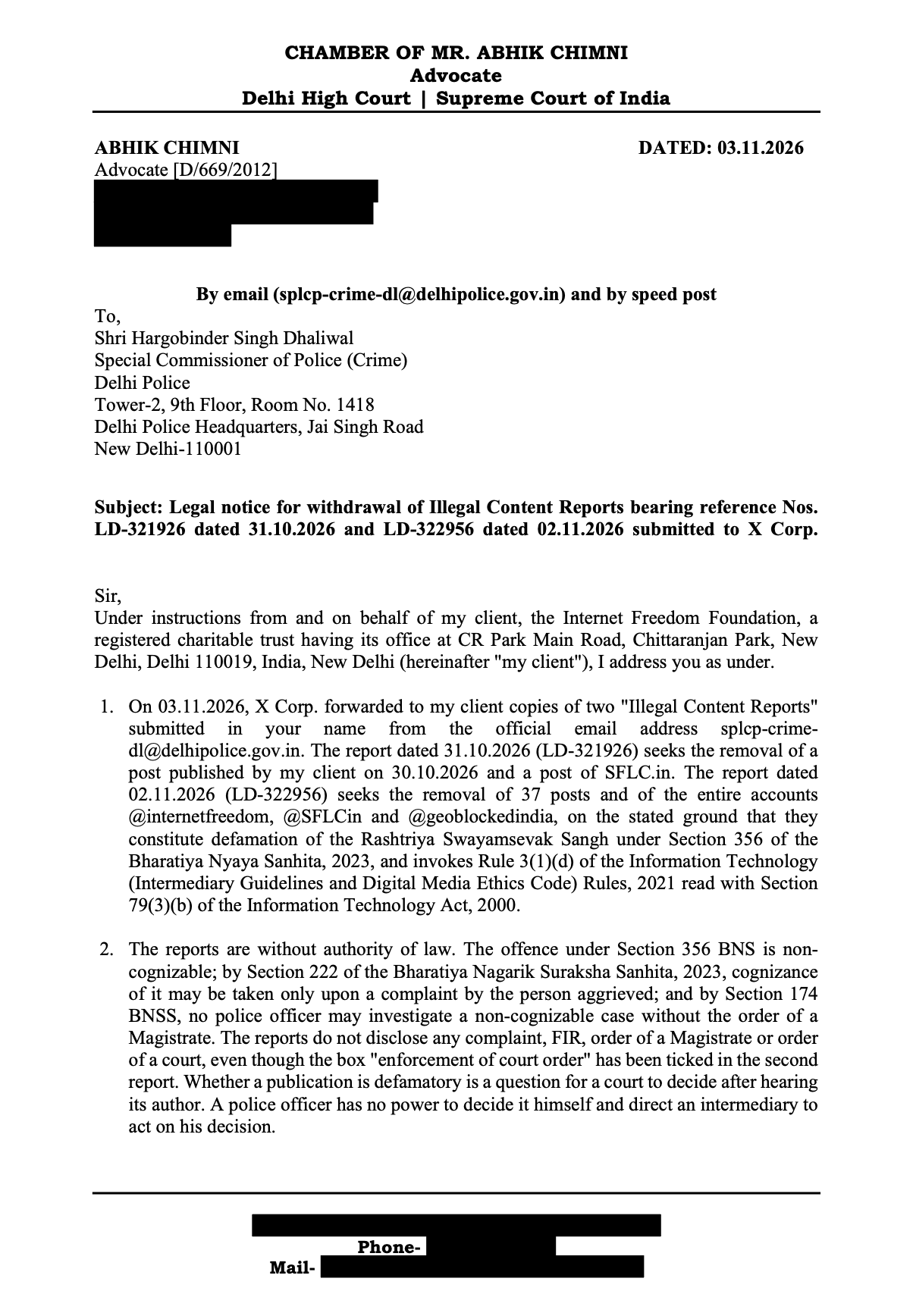
On 3 November 2026, X Corp. forwarded to us two “Illegal Content Reports” submitted in the name of the Special Commissioner of Police (Crime), @delhipolice. The first, dated 31 October, sought removal of a post we published on 30 October and a post by @SFLCin. The second, dated 2 November, sought removal of 37 posts and the withholding of three accounts in their entirety, @internetfreedom, @SFLCin and @geoblockedindia, on the ground that they defame the Rashtriya Swayamsevak Sangh under Section 356 of the Bharatiya Nyaya Sanhita. The posts in question reproduce and comment on a legal notice that was sent to us. They are protected speech under Article 19(1)(a) of the Constitution. We were given no notice before these reports were filed. We learnt of them only because X forwarded copies.
Today, through our counsel Advocate Abhik Chimni and his colleagues, we served a legal notice on the Delhi Police, with a copy to X Corp.
Our position is simple:
1. Defamation is a non-cognizable offence. The police cannot investigate it without a Magistrate’s order, and cognizance can be taken only on a complaint by the person aggrieved.
2. The reports cite no complaint, no FIR, no Magistrate’s order and no court order, even though the box for “enforcement of court order” was ticked. Under Shreya Singhal v. Union of India, an intermediary can be required to take down content only on a court order or a reasoned government notification. A web form with “hate speech”, “defamation”, “safety/security” and “court order” ticked against 40 URLs, with one sentence of reasons, is not that.
3. Whether something is defamatory is for a court to decide after hearing the author. A police officer cannot decide it himself and direct a platform to act on his decision. Demanding that three accounts be withheld in full is grossly disproportionate to any grievance stated.
We have called upon the Delhi Police to withdraw both reports or disclaim within seven days, to furnish us the complaint and authority on which they were made, and to confirm that no further takedown requests will be made on this matter. If they do not, we will approach the Delhi High Court under Article 226. We have also requested X Corp. to take no action on the reports pending their withdrawal or adjudication.
We are grateful to Advocate Abhik Chimni and his team for representing us in this matter. Redacted copies of the notice are attached.


Shreky🐉 retweeted
Statement: Proposed withdrawal of safe harbour under Section 79
5 November 2026
The Internet Freedom Foundation is alarmed by the Indian Express that the Ministry of Electronics and IT has begun discussions on stripping social media platforms of safe harbour under Section 79 of the IT Act, 2000. Nobody should mistake this for a move against Big Tech for it is a move against the people who use these platforms.
Safe harbour is not a gift to Meta, Google or X. It is the legal foundation that lets ordinary Indians speak online without a platform's lawyers deciding in advance whether their post is worth the risk and taking it down. If it is taken away, and every platform becomes liable for every post, comment and video. The rational response for any company is to remove anything that might draw a complaint, a notice or a summons. Criticism of the government, reporting on protests, satire, and the speech of people without lawyers will be the first casualties which are already being censored by automated filters implemented pursuant to the IT Rules, 2021. The Supreme Court recognised exactly this in Shreya Singhal (2015), which is why it read down Section 79(3)(b) to require a court order or a lawful government direction before platforms must act.
The timing tells its own story as the report says that MEITY’s rethink was shaped by a view within government that platform algorithms have favoured Opposition and anti-establishment narratives over official messaging, and by the role of Instagram during the student protests in July. In other words, the complaint is not that platforms host too much illegal content but it is that they host too much content the government dislikes.
This is also the latest step in an escalation that has been building for years. The 2023 Fact Check Unit amendment tried to make the government the arbiter of truth about itself, until the Bombay High Court struck it down. The Sahyog portal has turned Section 79(3)(b) into a parallel, opaque takedown channel that sidesteps the safeguards of Section 69A, a practice X is now challenging in court. In August, a Parliamentary Standing Committee gave Mark Zuckerberg three days to apologise personally for the brief removal of the Prime Minister's video or face the loss of safe harbour.
Subsequently advisories were issued on October 8, 2026 and October 10, 2026 pressuring digital platforms to implement pro-active censorship through, “enhanced due diligence”. Safe harbour was never meant to be a bargaining chip that MEITY waves at a company to extract compliance.
There are real problems on these platforms such as child sexual abuse material, non-consensual intimate imagery and deepfakes. The Supreme Court's observations in Just Rights for Children Alliance on October 15 deserve a serious answer. But the answer is targeted, rights-respecting obligations with independent oversight, transparency about takedowns, and a grievance process that works for users. It is not a liability regime that pushes platforms to delete first and never ask. Nor is it a rule that platforms must clear product changes with the government before shipping them, which would hand the state a license raj over the design of the services Indians use every day.
Any change of this scale must go through Parliament, with a published draft, a genuine consultation and a full debate. It cannot be settled in closed-door meetings between the Ministry and a handful of companies.
What IFF will do
IFF will send a detailed representation to the Ministry of Electronics and IT setting out why the proposed changes to Section 79 are unconstitutional and unworkable, and what a rights-respecting approach to platform accountability should look like. We will also write to the Parliamentary Standing Committee on Communications and Information Technology.
We are filing RTI applications with MeitY seeking the minutes, agendas, attendance lists and file notings of every meeting held on the review of safe harbour, including the meetings with Meta and other platforms in July and August, and the basis for the Ministry's assessment of how platform algorithms treat government and Opposition content. The public has a right to know who is in the room when the rules of their speech are being rewritten.
We will publish what we receive, and we invite other civil society groups, journalists and platform users to join us in asking the Ministry to put any proposal to open consultation before it goes anywhere near Parliament.


Shreky🐉 retweeted

Whole country is “SCAM”
PVR cinemas using “used GLASS” They charge 300 and above!
Cancer medicines are FAKE
GHEE is made FAKE
PANEER is FAKE
Cooking OIL is FAKE
Is this a country or huge 150 cr ppl dungeon? No citizen has conscience in this largest democracy in the world? 🤮🤮
Shreky🐉 retweeted

🚨 Uttarakhand is one of the most beautiful states in India, and it is sad to see this happening. 💔
Shreky🐉 retweeted

To verify the authenticity of the takedown orders we received yesterday, issued against SFLC.in's X handle and posts, we emailed @DelhiPolice at the email ID mentioned in the orders. However, our email bounced back with a message stating that the user does not exist.
Interestingly, the same email address is also listed on the Delhi Police website. We had verified the same.
This raises questions about the authenticity of the takedown orders. @DelhiPolice, @hgsdhaliwalips could you please confirm if these orders were issued by you?
@nit_set @neha_aisa @SauravDassss @SaketGokhale @JohnBrittas @svaradarajan @tajmahalfoxtrot @AbhinandanSekhr @ravish_journo @VTankha @derekobrienmp @cpimlliberation @MahuaMoitra @supriya_sule @MaktoobMedia @AroonDeep


Two takedown orders have allegedly been issued by the Delhi Police against SFLC.in's X account and four of our posts.
We are trying to verify the authenticity of these orders. @DelhiPolice @hgsdhaliwalips, could you please confirm whether these notices were issued by you?


Shreky🐉 retweeted
SFLC.in has concerns about the authenticity of the takedown orders purportedly sent by the Delhi Police to X, seeking the removal of SFLC.in's X account and posts.
To verify this, we have written to @XCorpIndia requesting clarity on:
(i) The channels or mechanisms through which the Delhi Police submitted the takedown requests to X.
(ii) X's verification process for requests submitted through its Legal Request Portal.
(iii) Whether these requests were actually submitted by @DelhiPolice and @hgsdhaliwalips.
(iv) Whether X received any accompanying court orders, directions, or other supporting documents in relation to these requests.
Read our full letter below. 👇
@GlobalAffairs @elonmusk @X
@nit_set @neha_aisa @SauravDassss @SaketGokhale @JohnBrittas @svaradarajan @tajmahalfoxtrot @AbhinandanSekhr @ravish_journo @VTankha @derekobrienmp @cpimlliberation @MahuaMoitra @supriya_sule @MaktoobMedia @AroonDeep @dhanyarajendran @PankajPachauri @clifroz @ManishSharmaIYC @zoo_bear @free_thinker


SFLC.in strongly objects to the takedown requests targeting its X handle and posts documenting instances of online censorship in India.
On 3 November 2026 at 3:18 AM and 4:33 AM, SFLC.in received an email from X’s Legal Department informing us that it had received takedown requests from the Delhi Police concerning 42 URLs. These include the handles of SFLC.in, @internetfreedom, @geoblockedindia, and posts from the said organisations and other users. A separate notification identified five (5) URLs concerning SFLC.in’s X account and our posts.
The requests relate to posts discussing legal notices received by SFLC.in, IFF and @geoblockedindia from an advocate purportedly acting on behalf of the Rashtriya Swayamsevak Sangh (RSS). They also include posts by users who commented on or reshared these posts, as well as other posts by @geoblockedindia documenting instances of digital censorship.
Chain of Events
1. On 29 October 2026, when SFLC.in, IFF and @geoblockedindia (collectively “Organisations”) received a legal notice from an advocate purportedly acting on behalf of the RSS. The notice took objection to SFLC.in's Free Speech Tracker, which documents instances of censorship and online content restrictions and account takedowns in India. SFLC.in and IFF raised concerns about the authenticity of the notice, which did not carry an official letterhead or identify an authorised signatory.
2. On 1 November 2026, the Organisations received another notice from the same advocate. This notice stated that the matter had been transferred to the RSS's legal and advocacy wing, the Akhil Bharatiya Adhivakta Parishad, and referred to complaints allegedly filed in different states.
3. On the same day, X informed SFLC.in that it had received a request from the “Indian Police” alleging that a post discussing the legal notice violated Indian law. However, this notification did not identify the requesting law enforcement agency, statutory provisions invoked, or provide a copy of the underlying order or request. The post remains accessible on X at the time of writing.
4. On 3 November 2026, X communicated further directions from Delhi Police covering 42 URLs, including the URL for SFLC.in’s account itself. In the attached notices, the first notice refers to Section 356 of the Bharatiya Nyaya Sanhita (BNS), 2023 which deals with the offence of criminal defamation as the legal basis. The second notice refers to Section 356 of BNS and Section 79(3)(b) of the Information Technology Act, read with Rule 3(1)(b) of the Information Technology Rules 2021, which deal with intermediary liability and due diligence of intermediaries as the legal basis. The grounds cited for the takedown requests concerning SFLC.in’s X handle and posts include hate speech, defamation of RSS, and safety/security.
Takedown requests targeting SFLC.in's handle threaten its public service work
SFLC.in's X handle is an important public-facing channel through which it disseminates the organisation's ongoing work to the general public. It is through SFLC.in social media handles that users who face digital rights violation and online harms reach out to us for pro bono legal services. Through the handle we publish legal and policy analysis, document instances of censorship, raise awareness about digital rights violations, and communicate such information with the public including journalists, researchers, civil society organisations among others. It also serves as a channel for sharing developments concerning internet shutdowns, content restrictions, account takedowns and other violations of digital rights and for providing important assistance, through RightsLine, to citizens facing online harms ranging from gender based violence and harassment to cyberfraud.
A direction seeking the takedown of an organisation’s entire account, rather than addressing specific content through a transparent and legally established process, would have consequences far beyond the posts that have been identified. It would also deprive the public of an established and credible source of information on digital rights and the exercise of fundamental freedoms online.
The request to restrict SFLC.in’s entire X handle, rather than identifying and seeking the removal of specific allegedly unlawful content does not meet the necessity and proportionality standards. The right to freedom of expression under Article 19(1)(a) of the Constitution extends to disseminate information, circulate ideas and reach an audience. Restrictions on fundamental freedoms must not be arbitrary or excessive and must not go beyond what is necessary to achieve their legitimate objective (Chintaman Rao v. State of Madhya Pradesh, AIR 1951 SC 118). Any restriction on an organisation's established channel of communication must therefore be assessed in light of its wider impact on the organisation's ability to exercise its rights and the public's corresponding right to receive information.
Further, the reliance on Section 79(3)(b) of the Information Technology Act, 2000, read with Rule 3(1)(d) of the IT Rules, 2021, raises questions to whether intermediary liability provisions are being used as an independent mechanism for restricting online speech, potentially bypassing the procedural safeguards prescribed under Section 69A of the IT Act and the Blocking Rules, 2009. In Shreya Singhal v. Union of India, (2015) 5 SCC 1, the Supreme Court read down Section 79(3)(b), clarifying that an intermediary's obligation to remove or disable access to content must arise from a court order or notification by the appropriate government or its agency, and that such orders or notifications must strictly conform to the grounds enumerated under Article 19(2) of the Constitution. Section 79(3)(b), which forms part of the intermediary safe-harbour framework, cannot be treated as an unrestricted or independent source of blocking power or used to circumvent the safeguards governing restrictions on online information.
It is also pertinent to note that SFLC.in in Software Freedom Law Center, India v. State of NCT of Delhi & Ors, W.P.(C) 7650/2025 has also challenged the constitutional legality of the notification issued by Lieutenant Governor (LG) which empowers the Delhi Police to issue takedown orders for removal of online content from social media. The matter is currently pending in the Delhi High Court.
Documenting censorship is not facilitating circumvention
The Free Speech Tracker is an initiative to document instances of censorship in India. Its purpose is to make censorship visible, identify patterns in content moderation and provide the public with information about restrictions affecting online expression.
Documenting a restriction does not amount to endorsing the restricted content, facilitating access to it or encouraging circumvention of the law. Over the last few months, we have seen an unprecedented number of online content restrictions happening in India, and in the absence of adequate transparency from the government and platforms about the nature, extent and legal basis of these restrictions, we wanted to document these instances in a manner that is informative to the general public. Freedom of expression encompasses not only the right to publish and disseminate information but also the right to question restrictions on speech, seek accountability and scrutinise decisions affecting public discourse.
Independent civil society organisations like ours play an important role in documenting these developments and ensuring that restrictions on online expression do not go unnoticed. Such takedown requests risk creating a chilling effect on public-interest advocacy and may discourage individuals from discussing or questioning instances of censorship.
Irregularities in notice received
The first notice received by SFLC.in from X, pertains to this post. The notice states that the content in question is being reported on the grounds of ‘safety/security; defamation; and other’. Furthermore, the notice states that the post is “defamatory towards the Rashtriya Swayamsevak Sangh under the Section 356 of the Bharatiya Nyaya Sanhita, 2023 (BNS).” Criminal defamation under Section 356 of the BNS, 2023, is a non-cognizable offence and therefore, requires a court order for the police to initiate action.
The second notice received, pertains to a list of 42 posts and accounts. The notice states that the content in question is being reported on the grounds of “Hate speech; safety/security; defamation; enforcement of court order; and other’. The posts published by SFLC.in did not contain any defamatory statements or allegations against RSS, as it was purely factual reporting based on information relating to the notice received by the Organisations on 29 October 2026.
Furthermore, criminal defamation is a non-cognizable offence which requires a court order for the police to initiate action. The Delhi Police is not empowered to issue a content takedown order for such offence via the Sahyog Portal in the absence of such an order. While the notice mentions enforcement of a court order as one of the grounds, no such court order is cited or made available in the notice. Additionally, the notice does not identify a legal basis or statutory provision for the offences of hate speech or safety/security. The notice also relies on Rule 3(1)(d) of the Information Technology (Intermediary Guidelines and Digital Media Ethics Code) Rules, 2021 read with Section 79(3)(b) of the Information Technology Act, 2000 and states that action must be taken by X within 3 hours.
Therefore, in light of the above, SFLC.in condemns the takedown request issued by the Delhi Police and maintains that they are unlawful, disproportionate and violative of the fundamental rights to freedom of speech and expression under Article 19(1)(a). SFLC.in calls upon the Delhi Police and the concerned authorities to immediately withdraw these requests. If there exists any relevant court order directing the removal of the content, SFLC.in calls upon the Delhi Police to provide copies of said order to the Organisations (SFLC.in, IFF, and @geoblockedindia) posthaste.
We stand in solidarity with all individuals and organisations affected by these takedown requests and reaffirm our commitment to defending their right to speak, document and question restrictions on online expression. Transparency, accountability and access to remedies must remain central to any process that seeks to restrict online expression.


Shreky🐉 retweeted

Asked @HPCL under RTI: where is “implicit subsidy” on LPG defined?
Reply: “No such information is available with this CPIO.”
No definition. No records.
But a ministry letter ordering biometric KYC of 30 crore LPG users exists. Exempt from RTI.
Under which law @PetroleumMin?

Shreky🐉 retweeted

Delhi Police has approached X seeking the takedown of the accounts of @internetfreedom, @SFLCin and @geoblockedindia, along with posts by 16 other users, for allegedly defaming the RSS.
During the recent protests in Delhi, we saw exactly whose interests Delhi Police is serving. Instead of acting as an impartial law-enforcement agency, it behaved like the RSS's enforcement arm. Right-wing goons, operating in plain clothes, were seen beating protesters, molesting young women and assaulting journalists alongside the police.
Now, the same police force is going after civil society organisations and citizens for criticising the RSS.
The message is unmistakable:
Under Amit Shah, the Union Home and Cooperation Minister, Delhi Police has become an arm of the RSS.
Delhi Police asks X to take down IFF's account and posts. IFF will challenge the notices in court unless they are withdrawn.
The Delhi Police has asked X to remove the Internet Freedom Foundation's account, six of its posts, the accounts of SFLC and @geoblockedindia, and posts by 16 other users, on the ground that they defame the Rashtriya Swayamsevak Sangh. The posts document and comment on a legal notice sent in the RSS's name to IFF, SFLC and @geoblockedindia, which demanded that the three stop criticising and documenting government blocking orders. IFF received copies of the two police notices from X on the morning of 3 November 2026.
IFF calls on the Delhi Police to withdraw both notices. If they are not withdrawn, IFF will challenge them in court.
What has happened
On 29 October 2026 at 9:54 PM, IFF, SFLC and the operator of @geoblockedindia received a two-page "legal notice" said to be issued on behalf of the RSS. It asked the three to stop opposing the government's blocking directions, stop documenting restricted content, stop posting details of geo-blocked posts, and confirm in writing within seven days that they would comply. It was signed by an unnamed "Authorised Signatory". Several RSS office-bearers have since said on X that the notice is not authentic. IFF replied to the notice, wrote to the RSS at its official address asking whether it had authorised it, and published both the notice and its reply on 30 October.
On 31 October 2026 at 8:06 PM, the Special Commissioner of Police (Crime), Delhi Police, filed an "Illegal Content Report" with X (reference LD-321926). It listed two posts: IFF's post of 30 October on the notice, and SFLC post of the same day. The stated reason was that the posts are "defamatory towards the Rashtriya Swayamsevak Sangh under Section 356 of the Bharatiya Nyaya Sanhita, 2023". The boxes for "safety/security", "defamation" and "other" were ticked. The fields for the nature of the court order and court order details were left empty. The desired action was "Remove/withhold content".
On 1 November 2026, a second notice arrived in the RSS's name. It said the matter had been handed to the Akhil Bharatiya Adhivakta Parishad, that complaints had been filed in several states, and that requests had been made to block IFF's X account and suspend the organisations. The Delhi Police had made its first request to X the previous evening. IFF did not know this until X told it on 3 November.
On 2 November 2026 at 8:51 AM, the Special Commissioner of Police (Crime) filed a second notice with X (reference LD-322956). It lists 40 URLs. Thirty-seven are posts. Three are the entire accounts of @internetfreedom, @SFLCin and @geoblockedindia. This time the boxes for "Hate speech", "defamation", "safety/security", "enforcement of court order" and "other" were all ticked. The court order fields were again left empty. The stated reason reads: "The posts constitute defamation and illegal content under Section 356 BNS. Under Rule 3(1)(d) of the IT Rules, 2021, read with Section 79(3)(b) IT Act, lawful notices require action within 3 hours."
The 16 other users are @ProdctiveUseful, @PanjwaniManoj, @jidge_, @RatanSharda55, @baxiabhishek, @SchrdingersDbag, @ashleshbiradar, @seemay, @NasirHussainINC, @Being_creat_ive, @AjoyDharmavaram, @othlaw, @_ananyaaa, @AimPoojaind, @incorigibleBhai and @rraoind. Their posts, as far as IFF can tell, comment on the notice or on the notice about it.
X forwarded both notice to IFF on 3 November 2026, at 8:47 AM and 10:03 AM, saying it was doing so "in the interest of transparency" and that IFF may wish to seek legal counsel and challenge the request in court. X's emails do not say that it has acted on the requests. The Delhi Police has not written to IFF, and no court has been approached, as far as the reports disclose. SFLC and @geoblockedindia have separately reported notifications from X about requests from the Uttar Pradesh Police, the Telangana Police and the Delhi Police's Cyber Crime unit, one of them against the whole of the @geoblockedindia account.
IFF's position
IFF condemns this legal action. A police force has made itself the enforcement arm of a private legal notice whose authenticity the organisation it names has not confirmed, and whose demand was that three organisations stop documenting censorship. The notices would deliver exactly what the notice asked for as they would also remove the accounts of the three groups in India that keep public records of what is blocked, and of who ordered it.
The posts in question are about a legal notice sent to us. They quote it, criticise how it was drafted, and say that we will carry on with our work. A person who receives a threat is entitled to publish it and answer it and that is not defamation of the sender.
In the three weeks before the first notice, IFF assisted 86 people whose accounts were suspended or whose posts were withheld in India. SFLC's Free Speech Tracker recorded about 268 content restrictions and 83 account restrictions in the first 29 days of October. @geoblockedindia publishes the orders behind such blocks when platforms disclose them. None of this is unlawful. Documenting censorship and challenging it in court is what the Constitution expects of citizens.
IFF will not delete the posts. If the Delhi Police does not withdraw the notices, we will challenge them in court.
Why the reports are unlawful
Defamation is not a police matter. Section 356 of the Bharatiya Nyaya Sanhita, 2023 is a non-cognizable and bailable offence. Under Section 222 of the Bharatiya Nagarik Suraksha Sanhita, 2023, no court can take cognizance of it except on a complaint by the person aggrieved.
Under Section 174 of the BNSS, the police cannot investigate a non-cognizable offence without an order of a Magistrate. The Special Commissioner of Police (Crime) is not the person aggrieved. The notices disclose no complaint by the RSS and no order of any Magistrate. Whether a statement is defamatory is for a court to decide after hearing its author, with the defences of truth, fair comment and good faith available to that author.
In Subramanian Swamy v. Union of India, (2016) 7 SCC 221, the Supreme Court upheld criminal defamation on the strength of these safeguards. A police officer who asks a platform to remove speech as defamatory has decided the question himself, without a complainant, a court or a hearing.
The posts are protected comment. Exceptions 1 to 3 to Section 356(1) protect the truth published for the public good, opinion on the public conduct of public servants, and opinion on the conduct of any person touching a public question. The posts publish a notice that was sent to us and give our opinion of it. The RSS, if it sent the notice, chose to enter a public question. If it did not, the posts defame no one.
Further, Section 79(3)(b) and Rule 3(1)(d) do not permit this. In Shreya Singhal v. Union of India, (2015) 5 SCC 1, the Supreme Court read down Section 79(3)(b) so that an intermediary acquires "actual knowledge" only through a court order, or a notification from the appropriate government or its agency that unlawful acts relatable to Article 19(2) are being committed. The court said that it would be difficult for intermediaries to judge the legitimacy of the millions of requests they receive, and that the burden must not be placed on them. Rule 3(1)(d), as amended in November 2025 and February 2026, now requires the intimation to come from an officer not below the rank of Joint Secretary or Deputy Inspector General, to be reasoned, and to specify the legal basis and the nature of the unlawful act, subject to a monthly review by a Secretary-level officer. The three-hour window the notice invokes applies to a lawful order that meets these conditions. A web form that ticks "hate speech" and "enforcement of court order" while leaving the court order fields blank, and that gives one sentence of reasons for 40 URLs, is not such an order.
The notices by the Delhi Police are disproportionate. They seek to remove three accounts in their entirety, with years of posts, over six, four and eleven posts respectively. They sweep in 16 third parties whose only connection is that they commented on a public controversy. In Anuradha Bhasin v. Union of India, (2020) 3 SCC 637, the Supreme Court held that any restriction on speech must be necessary, proportionate and the least restrictive measure available, and that orders restricting speech must be published and reasoned. Removing an organisation's entire account for criticising a legal notice fails each of these tests.
The effect is to silence documentation of censorship and providing legal aid to Indian internet users. The accounts named are those that record blocking orders in India. The notice asked them to stop. A takedown request that accomplishes the demand of an anonymous private notice is not law enforcement. It is the use of state power for a private end, which Article 14 forbids.
Our demands
1. To the Delhi Police: Withdraw reports LD-321926 and LD-322956 and confirm the withdrawal in writing to X and to IFF.
2. To the Delhi Police: Disclose the complaint on which the Special Commissioner of Police (Crime) acted, the authority under which the reports were filed, and whether any order of a Magistrate under Section 174 BNSS exists. Disclose every request made to any platform in this matter, including those made by the Cyber Crime unit against @geoblockedindia.
3. To X: Do not act on the reports. If any content is withheld in India, tell the affected user before acting, give them the full request, and name the legal basis. Publish both reports to the Lumen database, as the reporting form itself contemplates.
4. To the Ministry of Electronics and Information Technology and the Ministry of Home Affairs: Have the Secretary-level review required by Rule 3(1)(d) examine these intimations, and tell police forces that Rule 3(1)(d) is not a remedy for defamation, which the law reserves to the person aggrieved and to the courts.
5. To the RSS: State publicly whether it authorised either notice or any complaint to the police. If it did not, say so to the Delhi Police.
If the notices are not withdrawn, IFF will challenge them in court. We will continue to document blocking orders, to publish them, and to provide legal assistance to anyone whose account or post is withheld in India. Nothing in these notices changes that.


Shreky🐉 retweeted

on 29th october - IFF received a notice on behalf of the RSS.
"Stop Opposing Govt Orders, and Stop Documenting them"
then, 2nd notice - from ABAP - another RSS affiliated org, "requests made to block X accounts"
why? because IFF is documenting draconian orders by the government.
and now - Delhi police has asked X to remove IFF's account.
makes you wonder. whose behalf is delhi police acting upon
this is not incompetence. this is malignance.
Delhi Police asks X to take down IFF's account and posts. IFF will challenge the notices in court unless they are withdrawn.
The Delhi Police has asked X to remove the Internet Freedom Foundation's account, six of its posts, the accounts of SFLC and @geoblockedindia, and posts by 16 other users, on the ground that they defame the Rashtriya Swayamsevak Sangh. The posts document and comment on a legal notice sent in the RSS's name to IFF, SFLC and @geoblockedindia, which demanded that the three stop criticising and documenting government blocking orders. IFF received copies of the two police notices from X on the morning of 3 November 2026.
IFF calls on the Delhi Police to withdraw both notices. If they are not withdrawn, IFF will challenge them in court.
What has happened
On 29 October 2026 at 9:54 PM, IFF, SFLC and the operator of @geoblockedindia received a two-page "legal notice" said to be issued on behalf of the RSS. It asked the three to stop opposing the government's blocking directions, stop documenting restricted content, stop posting details of geo-blocked posts, and confirm in writing within seven days that they would comply. It was signed by an unnamed "Authorised Signatory". Several RSS office-bearers have since said on X that the notice is not authentic. IFF replied to the notice, wrote to the RSS at its official address asking whether it had authorised it, and published both the notice and its reply on 30 October.
On 31 October 2026 at 8:06 PM, the Special Commissioner of Police (Crime), Delhi Police, filed an "Illegal Content Report" with X (reference LD-321926). It listed two posts: IFF's post of 30 October on the notice, and SFLC post of the same day. The stated reason was that the posts are "defamatory towards the Rashtriya Swayamsevak Sangh under Section 356 of the Bharatiya Nyaya Sanhita, 2023". The boxes for "safety/security", "defamation" and "other" were ticked. The fields for the nature of the court order and court order details were left empty. The desired action was "Remove/withhold content".
On 1 November 2026, a second notice arrived in the RSS's name. It said the matter had been handed to the Akhil Bharatiya Adhivakta Parishad, that complaints had been filed in several states, and that requests had been made to block IFF's X account and suspend the organisations. The Delhi Police had made its first request to X the previous evening. IFF did not know this until X told it on 3 November.
On 2 November 2026 at 8:51 AM, the Special Commissioner of Police (Crime) filed a second notice with X (reference LD-322956). It lists 40 URLs. Thirty-seven are posts. Three are the entire accounts of @internetfreedom, @SFLCin and @geoblockedindia. This time the boxes for "Hate speech", "defamation", "safety/security", "enforcement of court order" and "other" were all ticked. The court order fields were again left empty. The stated reason reads: "The posts constitute defamation and illegal content under Section 356 BNS. Under Rule 3(1)(d) of the IT Rules, 2021, read with Section 79(3)(b) IT Act, lawful notices require action within 3 hours."
The 16 other users are @ProdctiveUseful, @PanjwaniManoj, @jidge_, @RatanSharda55, @baxiabhishek, @SchrdingersDbag, @ashleshbiradar, @seemay, @NasirHussainINC, @Being_creat_ive, @AjoyDharmavaram, @othlaw, @_ananyaaa, @AimPoojaind, @incorigibleBhai and @rraoind. Their posts, as far as IFF can tell, comment on the notice or on the notice about it.
X forwarded both notice to IFF on 3 November 2026, at 8:47 AM and 10:03 AM, saying it was doing so "in the interest of transparency" and that IFF may wish to seek legal counsel and challenge the request in court. X's emails do not say that it has acted on the requests. The Delhi Police has not written to IFF, and no court has been approached, as far as the reports disclose. SFLC and @geoblockedindia have separately reported notifications from X about requests from the Uttar Pradesh Police, the Telangana Police and the Delhi Police's Cyber Crime unit, one of them against the whole of the @geoblockedindia account.
IFF's position
IFF condemns this legal action. A police force has made itself the enforcement arm of a private legal notice whose authenticity the organisation it names has not confirmed, and whose demand was that three organisations stop documenting censorship. The notices would deliver exactly what the notice asked for as they would also remove the accounts of the three groups in India that keep public records of what is blocked, and of who ordered it.
The posts in question are about a legal notice sent to us. They quote it, criticise how it was drafted, and say that we will carry on with our work. A person who receives a threat is entitled to publish it and answer it and that is not defamation of the sender.
In the three weeks before the first notice, IFF assisted 86 people whose accounts were suspended or whose posts were withheld in India. SFLC's Free Speech Tracker recorded about 268 content restrictions and 83 account restrictions in the first 29 days of October. @geoblockedindia publishes the orders behind such blocks when platforms disclose them. None of this is unlawful. Documenting censorship and challenging it in court is what the Constitution expects of citizens.
IFF will not delete the posts. If the Delhi Police does not withdraw the notices, we will challenge them in court.
Why the reports are unlawful
Defamation is not a police matter. Section 356 of the Bharatiya Nyaya Sanhita, 2023 is a non-cognizable and bailable offence. Under Section 222 of the Bharatiya Nagarik Suraksha Sanhita, 2023, no court can take cognizance of it except on a complaint by the person aggrieved.
Under Section 174 of the BNSS, the police cannot investigate a non-cognizable offence without an order of a Magistrate. The Special Commissioner of Police (Crime) is not the person aggrieved. The notices disclose no complaint by the RSS and no order of any Magistrate. Whether a statement is defamatory is for a court to decide after hearing its author, with the defences of truth, fair comment and good faith available to that author.
In Subramanian Swamy v. Union of India, (2016) 7 SCC 221, the Supreme Court upheld criminal defamation on the strength of these safeguards. A police officer who asks a platform to remove speech as defamatory has decided the question himself, without a complainant, a court or a hearing.
The posts are protected comment. Exceptions 1 to 3 to Section 356(1) protect the truth published for the public good, opinion on the public conduct of public servants, and opinion on the conduct of any person touching a public question. The posts publish a notice that was sent to us and give our opinion of it. The RSS, if it sent the notice, chose to enter a public question. If it did not, the posts defame no one.
Further, Section 79(3)(b) and Rule 3(1)(d) do not permit this. In Shreya Singhal v. Union of India, (2015) 5 SCC 1, the Supreme Court read down Section 79(3)(b) so that an intermediary acquires "actual knowledge" only through a court order, or a notification from the appropriate government or its agency that unlawful acts relatable to Article 19(2) are being committed. The court said that it would be difficult for intermediaries to judge the legitimacy of the millions of requests they receive, and that the burden must not be placed on them. Rule 3(1)(d), as amended in November 2025 and February 2026, now requires the intimation to come from an officer not below the rank of Joint Secretary or Deputy Inspector General, to be reasoned, and to specify the legal basis and the nature of the unlawful act, subject to a monthly review by a Secretary-level officer. The three-hour window the notice invokes applies to a lawful order that meets these conditions. A web form that ticks "hate speech" and "enforcement of court order" while leaving the court order fields blank, and that gives one sentence of reasons for 40 URLs, is not such an order.
The notices by the Delhi Police are disproportionate. They seek to remove three accounts in their entirety, with years of posts, over six, four and eleven posts respectively. They sweep in 16 third parties whose only connection is that they commented on a public controversy. In Anuradha Bhasin v. Union of India, (2020) 3 SCC 637, the Supreme Court held that any restriction on speech must be necessary, proportionate and the least restrictive measure available, and that orders restricting speech must be published and reasoned. Removing an organisation's entire account for criticising a legal notice fails each of these tests.
The effect is to silence documentation of censorship and providing legal aid to Indian internet users. The accounts named are those that record blocking orders in India. The notice asked them to stop. A takedown request that accomplishes the demand of an anonymous private notice is not law enforcement. It is the use of state power for a private end, which Article 14 forbids.
Our demands
1. To the Delhi Police: Withdraw reports LD-321926 and LD-322956 and confirm the withdrawal in writing to X and to IFF.
2. To the Delhi Police: Disclose the complaint on which the Special Commissioner of Police (Crime) acted, the authority under which the reports were filed, and whether any order of a Magistrate under Section 174 BNSS exists. Disclose every request made to any platform in this matter, including those made by the Cyber Crime unit against @geoblockedindia.
3. To X: Do not act on the reports. If any content is withheld in India, tell the affected user before acting, give them the full request, and name the legal basis. Publish both reports to the Lumen database, as the reporting form itself contemplates.
4. To the Ministry of Electronics and Information Technology and the Ministry of Home Affairs: Have the Secretary-level review required by Rule 3(1)(d) examine these intimations, and tell police forces that Rule 3(1)(d) is not a remedy for defamation, which the law reserves to the person aggrieved and to the courts.
5. To the RSS: State publicly whether it authorised either notice or any complaint to the police. If it did not, say so to the Delhi Police.
If the notices are not withdrawn, IFF will challenge them in court. We will continue to document blocking orders, to publish them, and to provide legal assistance to anyone whose account or post is withheld in India. Nothing in these notices changes that.
Shreky🐉 retweeted

Please to speak up and share in solidarity. If IFF's account disappears from X we may not be able to reach in future.
Delhi Police asks X to take down IFF's account and posts. IFF will challenge the notices in court unless they are withdrawn.
The Delhi Police has asked X to remove the Internet Freedom Foundation's account, six of its posts, the accounts of SFLC and @geoblockedindia, and posts by 16 other users, on the ground that they defame the Rashtriya Swayamsevak Sangh. The posts document and comment on a legal notice sent in the RSS's name to IFF, SFLC and @geoblockedindia, which demanded that the three stop criticising and documenting government blocking orders. IFF received copies of the two police notices from X on the morning of 3 November 2026.
IFF calls on the Delhi Police to withdraw both notices. If they are not withdrawn, IFF will challenge them in court.
What has happened
On 29 October 2026 at 9:54 PM, IFF, SFLC and the operator of @geoblockedindia received a two-page "legal notice" said to be issued on behalf of the RSS. It asked the three to stop opposing the government's blocking directions, stop documenting restricted content, stop posting details of geo-blocked posts, and confirm in writing within seven days that they would comply. It was signed by an unnamed "Authorised Signatory". Several RSS office-bearers have since said on X that the notice is not authentic. IFF replied to the notice, wrote to the RSS at its official address asking whether it had authorised it, and published both the notice and its reply on 30 October.
On 31 October 2026 at 8:06 PM, the Special Commissioner of Police (Crime), Delhi Police, filed an "Illegal Content Report" with X (reference LD-321926). It listed two posts: IFF's post of 30 October on the notice, and SFLC post of the same day. The stated reason was that the posts are "defamatory towards the Rashtriya Swayamsevak Sangh under Section 356 of the Bharatiya Nyaya Sanhita, 2023". The boxes for "safety/security", "defamation" and "other" were ticked. The fields for the nature of the court order and court order details were left empty. The desired action was "Remove/withhold content".
On 1 November 2026, a second notice arrived in the RSS's name. It said the matter had been handed to the Akhil Bharatiya Adhivakta Parishad, that complaints had been filed in several states, and that requests had been made to block IFF's X account and suspend the organisations. The Delhi Police had made its first request to X the previous evening. IFF did not know this until X told it on 3 November.
On 2 November 2026 at 8:51 AM, the Special Commissioner of Police (Crime) filed a second notice with X (reference LD-322956). It lists 40 URLs. Thirty-seven are posts. Three are the entire accounts of @internetfreedom, @SFLCin and @geoblockedindia. This time the boxes for "Hate speech", "defamation", "safety/security", "enforcement of court order" and "other" were all ticked. The court order fields were again left empty. The stated reason reads: "The posts constitute defamation and illegal content under Section 356 BNS. Under Rule 3(1)(d) of the IT Rules, 2021, read with Section 79(3)(b) IT Act, lawful notices require action within 3 hours."
The 16 other users are @ProdctiveUseful, @PanjwaniManoj, @jidge_, @RatanSharda55, @baxiabhishek, @SchrdingersDbag, @ashleshbiradar, @seemay, @NasirHussainINC, @Being_creat_ive, @AjoyDharmavaram, @othlaw, @_ananyaaa, @AimPoojaind, @incorigibleBhai and @rraoind. Their posts, as far as IFF can tell, comment on the notice or on the notice about it.
X forwarded both notice to IFF on 3 November 2026, at 8:47 AM and 10:03 AM, saying it was doing so "in the interest of transparency" and that IFF may wish to seek legal counsel and challenge the request in court. X's emails do not say that it has acted on the requests. The Delhi Police has not written to IFF, and no court has been approached, as far as the reports disclose. SFLC and @geoblockedindia have separately reported notifications from X about requests from the Uttar Pradesh Police, the Telangana Police and the Delhi Police's Cyber Crime unit, one of them against the whole of the @geoblockedindia account.
IFF's position
IFF condemns this legal action. A police force has made itself the enforcement arm of a private legal notice whose authenticity the organisation it names has not confirmed, and whose demand was that three organisations stop documenting censorship. The notices would deliver exactly what the notice asked for as they would also remove the accounts of the three groups in India that keep public records of what is blocked, and of who ordered it.
The posts in question are about a legal notice sent to us. They quote it, criticise how it was drafted, and say that we will carry on with our work. A person who receives a threat is entitled to publish it and answer it and that is not defamation of the sender.
In the three weeks before the first notice, IFF assisted 86 people whose accounts were suspended or whose posts were withheld in India. SFLC's Free Speech Tracker recorded about 268 content restrictions and 83 account restrictions in the first 29 days of October. @geoblockedindia publishes the orders behind such blocks when platforms disclose them. None of this is unlawful. Documenting censorship and challenging it in court is what the Constitution expects of citizens.
IFF will not delete the posts. If the Delhi Police does not withdraw the notices, we will challenge them in court.
Why the reports are unlawful
Defamation is not a police matter. Section 356 of the Bharatiya Nyaya Sanhita, 2023 is a non-cognizable and bailable offence. Under Section 222 of the Bharatiya Nagarik Suraksha Sanhita, 2023, no court can take cognizance of it except on a complaint by the person aggrieved.
Under Section 174 of the BNSS, the police cannot investigate a non-cognizable offence without an order of a Magistrate. The Special Commissioner of Police (Crime) is not the person aggrieved. The notices disclose no complaint by the RSS and no order of any Magistrate. Whether a statement is defamatory is for a court to decide after hearing its author, with the defences of truth, fair comment and good faith available to that author.
In Subramanian Swamy v. Union of India, (2016) 7 SCC 221, the Supreme Court upheld criminal defamation on the strength of these safeguards. A police officer who asks a platform to remove speech as defamatory has decided the question himself, without a complainant, a court or a hearing.
The posts are protected comment. Exceptions 1 to 3 to Section 356(1) protect the truth published for the public good, opinion on the public conduct of public servants, and opinion on the conduct of any person touching a public question. The posts publish a notice that was sent to us and give our opinion of it. The RSS, if it sent the notice, chose to enter a public question. If it did not, the posts defame no one.
Further, Section 79(3)(b) and Rule 3(1)(d) do not permit this. In Shreya Singhal v. Union of India, (2015) 5 SCC 1, the Supreme Court read down Section 79(3)(b) so that an intermediary acquires "actual knowledge" only through a court order, or a notification from the appropriate government or its agency that unlawful acts relatable to Article 19(2) are being committed. The court said that it would be difficult for intermediaries to judge the legitimacy of the millions of requests they receive, and that the burden must not be placed on them. Rule 3(1)(d), as amended in November 2025 and February 2026, now requires the intimation to come from an officer not below the rank of Joint Secretary or Deputy Inspector General, to be reasoned, and to specify the legal basis and the nature of the unlawful act, subject to a monthly review by a Secretary-level officer. The three-hour window the notice invokes applies to a lawful order that meets these conditions. A web form that ticks "hate speech" and "enforcement of court order" while leaving the court order fields blank, and that gives one sentence of reasons for 40 URLs, is not such an order.
The notices by the Delhi Police are disproportionate. They seek to remove three accounts in their entirety, with years of posts, over six, four and eleven posts respectively. They sweep in 16 third parties whose only connection is that they commented on a public controversy. In Anuradha Bhasin v. Union of India, (2020) 3 SCC 637, the Supreme Court held that any restriction on speech must be necessary, proportionate and the least restrictive measure available, and that orders restricting speech must be published and reasoned. Removing an organisation's entire account for criticising a legal notice fails each of these tests.
The effect is to silence documentation of censorship and providing legal aid to Indian internet users. The accounts named are those that record blocking orders in India. The notice asked them to stop. A takedown request that accomplishes the demand of an anonymous private notice is not law enforcement. It is the use of state power for a private end, which Article 14 forbids.
Our demands
1. To the Delhi Police: Withdraw reports LD-321926 and LD-322956 and confirm the withdrawal in writing to X and to IFF.
2. To the Delhi Police: Disclose the complaint on which the Special Commissioner of Police (Crime) acted, the authority under which the reports were filed, and whether any order of a Magistrate under Section 174 BNSS exists. Disclose every request made to any platform in this matter, including those made by the Cyber Crime unit against @geoblockedindia.
3. To X: Do not act on the reports. If any content is withheld in India, tell the affected user before acting, give them the full request, and name the legal basis. Publish both reports to the Lumen database, as the reporting form itself contemplates.
4. To the Ministry of Electronics and Information Technology and the Ministry of Home Affairs: Have the Secretary-level review required by Rule 3(1)(d) examine these intimations, and tell police forces that Rule 3(1)(d) is not a remedy for defamation, which the law reserves to the person aggrieved and to the courts.
5. To the RSS: State publicly whether it authorised either notice or any complaint to the police. If it did not, say so to the Delhi Police.
If the notices are not withdrawn, IFF will challenge them in court. We will continue to document blocking orders, to publish them, and to provide legal assistance to anyone whose account or post is withheld in India. Nothing in these notices changes that.
Shreky🐉 retweeted
Delhi Police asks X to take down IFF's account and posts. IFF will challenge the notices in court unless they are withdrawn.
The Delhi Police has asked X to remove the Internet Freedom Foundation's account, six of its posts, the accounts of SFLC and @geoblockedindia, and posts by 16 other users, on the ground that they defame the Rashtriya Swayamsevak Sangh. The posts document and comment on a legal notice sent in the RSS's name to IFF, SFLC and @geoblockedindia, which demanded that the three stop criticising and documenting government blocking orders. IFF received copies of the two police notices from X on the morning of 3 November 2026.
IFF calls on the Delhi Police to withdraw both notices. If they are not withdrawn, IFF will challenge them in court.
What has happened
On 29 October 2026 at 9:54 PM, IFF, SFLC and the operator of @geoblockedindia received a two-page "legal notice" said to be issued on behalf of the RSS. It asked the three to stop opposing the government's blocking directions, stop documenting restricted content, stop posting details of geo-blocked posts, and confirm in writing within seven days that they would comply. It was signed by an unnamed "Authorised Signatory". Several RSS office-bearers have since said on X that the notice is not authentic. IFF replied to the notice, wrote to the RSS at its official address asking whether it had authorised it, and published both the notice and its reply on 30 October.
On 31 October 2026 at 8:06 PM, the Special Commissioner of Police (Crime), Delhi Police, filed an "Illegal Content Report" with X (reference LD-321926). It listed two posts: IFF's post of 30 October on the notice, and SFLC post of the same day. The stated reason was that the posts are "defamatory towards the Rashtriya Swayamsevak Sangh under Section 356 of the Bharatiya Nyaya Sanhita, 2023". The boxes for "safety/security", "defamation" and "other" were ticked. The fields for the nature of the court order and court order details were left empty. The desired action was "Remove/withhold content".
On 1 November 2026, a second notice arrived in the RSS's name. It said the matter had been handed to the Akhil Bharatiya Adhivakta Parishad, that complaints had been filed in several states, and that requests had been made to block IFF's X account and suspend the organisations. The Delhi Police had made its first request to X the previous evening. IFF did not know this until X told it on 3 November.
On 2 November 2026 at 8:51 AM, the Special Commissioner of Police (Crime) filed a second notice with X (reference LD-322956). It lists 40 URLs. Thirty-seven are posts. Three are the entire accounts of @internetfreedom, @SFLCin and @geoblockedindia. This time the boxes for "Hate speech", "defamation", "safety/security", "enforcement of court order" and "other" were all ticked. The court order fields were again left empty. The stated reason reads: "The posts constitute defamation and illegal content under Section 356 BNS. Under Rule 3(1)(d) of the IT Rules, 2021, read with Section 79(3)(b) IT Act, lawful notices require action within 3 hours."
The 16 other users are @ProdctiveUseful, @PanjwaniManoj, @jidge_, @RatanSharda55, @baxiabhishek, @SchrdingersDbag, @ashleshbiradar, @seemay, @NasirHussainINC, @Being_creat_ive, @AjoyDharmavaram, @othlaw, @_ananyaaa, @AimPoojaind, @incorigibleBhai and @rraoind. Their posts, as far as IFF can tell, comment on the notice or on the notice about it.
X forwarded both notice to IFF on 3 November 2026, at 8:47 AM and 10:03 AM, saying it was doing so "in the interest of transparency" and that IFF may wish to seek legal counsel and challenge the request in court. X's emails do not say that it has acted on the requests. The Delhi Police has not written to IFF, and no court has been approached, as far as the reports disclose. SFLC and @geoblockedindia have separately reported notifications from X about requests from the Uttar Pradesh Police, the Telangana Police and the Delhi Police's Cyber Crime unit, one of them against the whole of the @geoblockedindia account.
IFF's position
IFF condemns this legal action. A police force has made itself the enforcement arm of a private legal notice whose authenticity the organisation it names has not confirmed, and whose demand was that three organisations stop documenting censorship. The notices would deliver exactly what the notice asked for as they would also remove the accounts of the three groups in India that keep public records of what is blocked, and of who ordered it.
The posts in question are about a legal notice sent to us. They quote it, criticise how it was drafted, and say that we will carry on with our work. A person who receives a threat is entitled to publish it and answer it and that is not defamation of the sender.
In the three weeks before the first notice, IFF assisted 86 people whose accounts were suspended or whose posts were withheld in India. SFLC's Free Speech Tracker recorded about 268 content restrictions and 83 account restrictions in the first 29 days of October. @geoblockedindia publishes the orders behind such blocks when platforms disclose them. None of this is unlawful. Documenting censorship and challenging it in court is what the Constitution expects of citizens.
IFF will not delete the posts. If the Delhi Police does not withdraw the notices, we will challenge them in court.
Why the reports are unlawful
Defamation is not a police matter. Section 356 of the Bharatiya Nyaya Sanhita, 2023 is a non-cognizable and bailable offence. Under Section 222 of the Bharatiya Nagarik Suraksha Sanhita, 2023, no court can take cognizance of it except on a complaint by the person aggrieved.
Under Section 174 of the BNSS, the police cannot investigate a non-cognizable offence without an order of a Magistrate. The Special Commissioner of Police (Crime) is not the person aggrieved. The notices disclose no complaint by the RSS and no order of any Magistrate. Whether a statement is defamatory is for a court to decide after hearing its author, with the defences of truth, fair comment and good faith available to that author.
In Subramanian Swamy v. Union of India, (2016) 7 SCC 221, the Supreme Court upheld criminal defamation on the strength of these safeguards. A police officer who asks a platform to remove speech as defamatory has decided the question himself, without a complainant, a court or a hearing.
The posts are protected comment. Exceptions 1 to 3 to Section 356(1) protect the truth published for the public good, opinion on the public conduct of public servants, and opinion on the conduct of any person touching a public question. The posts publish a notice that was sent to us and give our opinion of it. The RSS, if it sent the notice, chose to enter a public question. If it did not, the posts defame no one.
Further, Section 79(3)(b) and Rule 3(1)(d) do not permit this. In Shreya Singhal v. Union of India, (2015) 5 SCC 1, the Supreme Court read down Section 79(3)(b) so that an intermediary acquires "actual knowledge" only through a court order, or a notification from the appropriate government or its agency that unlawful acts relatable to Article 19(2) are being committed. The court said that it would be difficult for intermediaries to judge the legitimacy of the millions of requests they receive, and that the burden must not be placed on them. Rule 3(1)(d), as amended in November 2025 and February 2026, now requires the intimation to come from an officer not below the rank of Joint Secretary or Deputy Inspector General, to be reasoned, and to specify the legal basis and the nature of the unlawful act, subject to a monthly review by a Secretary-level officer. The three-hour window the notice invokes applies to a lawful order that meets these conditions. A web form that ticks "hate speech" and "enforcement of court order" while leaving the court order fields blank, and that gives one sentence of reasons for 40 URLs, is not such an order.
The notices by the Delhi Police are disproportionate. They seek to remove three accounts in their entirety, with years of posts, over six, four and eleven posts respectively. They sweep in 16 third parties whose only connection is that they commented on a public controversy. In Anuradha Bhasin v. Union of India, (2020) 3 SCC 637, the Supreme Court held that any restriction on speech must be necessary, proportionate and the least restrictive measure available, and that orders restricting speech must be published and reasoned. Removing an organisation's entire account for criticising a legal notice fails each of these tests.
The effect is to silence documentation of censorship and providing legal aid to Indian internet users. The accounts named are those that record blocking orders in India. The notice asked them to stop. A takedown request that accomplishes the demand of an anonymous private notice is not law enforcement. It is the use of state power for a private end, which Article 14 forbids.
Our demands
1. To the Delhi Police: Withdraw reports LD-321926 and LD-322956 and confirm the withdrawal in writing to X and to IFF.
2. To the Delhi Police: Disclose the complaint on which the Special Commissioner of Police (Crime) acted, the authority under which the reports were filed, and whether any order of a Magistrate under Section 174 BNSS exists. Disclose every request made to any platform in this matter, including those made by the Cyber Crime unit against @geoblockedindia.
3. To X: Do not act on the reports. If any content is withheld in India, tell the affected user before acting, give them the full request, and name the legal basis. Publish both reports to the Lumen database, as the reporting form itself contemplates.
4. To the Ministry of Electronics and Information Technology and the Ministry of Home Affairs: Have the Secretary-level review required by Rule 3(1)(d) examine these intimations, and tell police forces that Rule 3(1)(d) is not a remedy for defamation, which the law reserves to the person aggrieved and to the courts.
5. To the RSS: State publicly whether it authorised either notice or any complaint to the police. If it did not, say so to the Delhi Police.
If the notices are not withdrawn, IFF will challenge them in court. We will continue to document blocking orders, to publish them, and to provide legal assistance to anyone whose account or post is withheld in India. Nothing in these notices changes that.