







[email protected] retweeted

12/17
Der erste Schritt ist schon erfolgt: Spanien verlängerte im August 2026 die Betriebsgenehmigung für Almaraz I und II bis zum 8. Juni 2030.
Ursprünglich geplant waren Abschaltungen im November 2027 und Oktober 2028 rund 31 bzw. 19 Monate früher.

ALT Kernkraftwerk Almaraz in Extremadura mit den beiden Westinghouse-Druckwasserreaktoren. Spanien hat die Betriebsgenehmigung beider Blöcke im August 2026 bis zum 8. Juni 2030 verlängert. Foto: Foro Nuclear.

[email protected] retweeted
10/17
Spanien belastet Kernkraft zusätzlich mit spezifischen Abgaben. Die IEA nennt nach Wegfall der allgemeinen Stromerzeugungssteuer IVPEE rund 13 €/MWh verbleibende Steuern und Gebühren.
Hinzu kommt die Enresa-Abgabe für Entsorgung und Rückbau: 10,4 €/MWh (2025).
[email protected] retweeted
8/17
Der spanische Energieplan setzt bis 2030 auf 81 % erneuerbaren Strom und 22,5 GW Speicherleistung.
Das kann den Ersatz konventioneller Erzeugung erleichtern. Doch GW Speicherleistung sagen nichts über Speicherdauer oder die tatsächlich abrufbare Energiemenge aus.
[email protected] retweeted
6/17
Ein technischer Punkt: Kernkraftwerke speisen über große Synchrongeneratoren ein. Deren rotierende Massen liefern Momentanreserve und bremsen schnelle Frequenzänderungen nach Störungen.
Diese Eigenschaft ist nicht identisch mit bloßer Stromerzeugung in TWh.
[email protected] retweeted
5/17
54 TWh Kernenergie lassen sich nicht allein durch 7,1 GW neue Nennleistung ersetzen.
Entscheidend ist, wann Strom verfügbar ist, auch abends, bei wenig Wind und während Wartungen. Gesicherte Leistung, Jahreserzeugung und Flexibilität sind unterschiedliche Größen.
[email protected] retweeted
4/17
Auffällig ist der internationale Laufzeitvergleich der IEA:
Spanien: 46 Jahre
Asien: 54 Jahre
Europa: 58 Jahre
Nordamerika: 69 Jahre
Das sind durchschnittlich GEPLANTE Betriebsdauern, keine technischen Höchstgrenzen. Die spanische Planung liegt deutlich darunter.

[email protected] retweeted
3/17
Die Größenordnung: Spaniens sieben Reaktoren verfügen über rund 7,1 GW Nettoleistung. 2025 erzeugten sie 54 TWh Strom – 18 % der gesamten Stromproduktion.
Bei nur 4,8 % der installierten Kraftwerksleistung erreichten sie laut IEA einen Auslastungsgrad von rund 90 %.
[email protected] retweeted
2/17
Der Ausstiegsfahrplan stammt aus einer Vereinbarung von 2019: Sieben Reaktoren sollten zwischen 2027 und 2035 vom Netz gehen.
Das sind energiepolitisch festgelegte Termine keine Aussage, dass die Anlagen dann technisch nicht mehr sicher betrieben werden könnten.
[email protected] retweeted

German energy ministry needs to bring some coal power plants back online. Temporarily, as usuall.
It has become somewhat of a tradition to go back to coal in winter.
Majority of Germans already think nuclear phaseout was a mistake.


[email protected] retweeted

Note that the Sir Adam Beck generating station at Niagara Falls was built in 1922. It’s over 100 years old, and its concrete experiences far more stress than anything at Pickering.


[email protected] retweeted

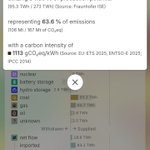
BW hatte 2001, im Jahr des Atomausstiegs, fünf KKW Blöcke. Fast 5 GW lieferten sie - CO2 frei. Das ist die komplette Grundlast - im Sommer darüber. BW war Selbstversorger - der billige Atomstrom ein der Grundlagen für den wirtschaftlichen Aufstieg.
Heute gibt es Gas, Kohle und Import. Wind und Solar - fanden in der letzten Woche kaum statt. Die Folge: Der in BW erzeugte Strom ist irre CO2 intensiv. Grünen nennen das Klimaschutz - nun sollen mehr Gaskraftweke ran ...


Wer Versorgungssicherheit will, muss Gaskraftwerke dort bauen, wo sie gebraucht werden. Deshalb müssen zwei Drittel der neuen Kraftwerkskapazitäten im Süden Deutschlands entstehen. Dafür muss der Bund jetzt die Weichen stellen. baden-wuerttemberg.de/de/ser…
[email protected] retweeted
Nachdem die Abschaltorgie insbesondere in Westeuropa überstanden ist, setzt sich eine rationale Energiepolitik durch: Laufzeitverlängerungen statt Anlagensabotage und Neubauten statt Abriss. Langsam dreht sich der Trend – wie bei einem Supertanker – erst kaum sichtbar, dafür später umso nachhaltiger. Vollzeitdekarbonisierer.


⚛️ Gestern wurde in Berlin der kernkraftkritische WNISR 2026 vorgestellt. Die Schlagzeilen sprechen vom Niedergang.
Doch die eigenen Zahlen zeigen: Rekordproduktion, Rekordleistung und 73 Reaktoren im Bau!
Unsere Analyse mit Originalgrafiken:
nuklearia.de/2026/11/11/wnis…

[email protected] retweeted

Germany remains happy to bring shuttered coal plants back online but refuses to cease and desist from the vandalism/decommissioning of its nuclear reactors, six of which could be restored to working order within a few years, bringing 7+ GW back onto the European grid.

[email protected] retweeted
Imagine a uranium mine that can supply nearly one-fifth of the world’s current mined uranium production while extracting little more than a double-decker bus's worth of ore each day.
That is the extraordinary proposition behind NexGen Energy’s Arrow project in northern Saskatchewan. Beneath the forests of the western Athabasca Basin lies one of the richest undeveloped uranium deposits on Earth.
NexGen plans to produce approximately 30 million pounds of uranium annually, comparable to the combined output of Cameco’s McArthur River and Cigar Lake mines, which together account for roughly 20% of global uranium mine production.
Yet the geological fortune that makes Arrow so attractive also presents an enormous industrial challenge. NexGen must turn a mineral discovery into a functioning mine, something Canada hasn't done with a major new greenfield uranium project in more than two decades.
After recently exploring the uranium market with @cameconews's Grant Isaac, I sat down with @NexGenEnergy_ founder and CEO @leighcuryer to hear the perspective of a junior miner trying to become one of the world’s largest uranium producers.
Things got spicey.
See my s\/bst@ck for the full analysis and check out the YouTube video. Links in replies.

[email protected] retweeted

UCS's Ed Lyman (@NucSafetyUCS) is wrong.
He claims, without evidence, that the NRC made a mistake by approving the construction permit for DOW's Long Mott project. His issue is that X-Energy's (@xenergynuclear) Xe-100 reactors don't have a traditional containment structure.
The Nuclear Regulatory Commission (@NRCgov) – staffed with thousands of reactor safety professionals and charged with protecting the public – decided that the design was safe enough to build.
He's mad that the NRC didn't kill the project by adding a consequential, unnecessary time and cost burden to the plant's construction by requiring a thick walled, steel lined, pressure tight containment.
There are several reasons why they determined the conventional structure was unnecessary .
1. Xe-100 uses a qualified TRISO design that is proven to retain fission products even at temperatures well above those that can be achieved during any credible accident scenarios.
2. Helium, which Xe-100 uses as the heat transfer fluid (reactor coolant), is inert and cannot be activated by neutrons. It is a terrible solvent – unlike hot water and steam – that cannot carry radioactive particles out of the plant in the unlikely event of fuel damage AND a leak in the coolant system.
3. Unlike the pressurized, superheated water used as a coolant in many conventional reactors, helium is always a gas and does not change phase in the event of a leak. It is never subject to the kind of immediate phase change – aka steam explosion – that was a fundamental cause of the damage at Chernobyl. The phase change from water to vapor (steam) was the driving force that led to radioactive material distribution during the 3/11/11 accident at the Fukushima Daiichi nuclear power plant.
4. Xe-100 has passive reactor safety that is designed in as a result of physics and heat transfer. If the fuel temperature increases, physics ensures that the fission reaction slows and then stops. Once fissions stop, there is still a predictable quantity of heat being released by fission product decay. But Xe-100 reactors have a low power density and plenty of surface area. At their rated thermal power output of 200 MWth, there is enough surface area to transfer all of the decay heat out of the reactor core. Heat production is always decreasing as isotopes decay, and heat transfer speeds up as temperature increases. The combination leads to a predictable maximum temperature that cannot be exceeded.
The public is being adequately protected by the NRC's decision to approve the Long Mott construction permit without requiring a conventional containment structure.
Lyman and the UCS are just doing the job that their donors tell them to do – resist all nuclear projects – even the ones that safely contribute to the nation's energy security and improve the cleanliness of the environment.
Serious question for Dr. Lyman: What other power source could possibly replace the combustion fuels DOW is currently using to supply heat and electricity to its chemical plant in Seadrift, TX?
When you add ultra low emissions as a requirement, the option list narrows even more.
Final note: We all have a vested interest in avoiding unnecessary requirements that add a heavy cost and schedule burden on nuclear projects. That is ESPECIALLY true in the case of a project that has received ~$2 B of US government (taxpayer) support.

We keep hearing again that Russia supposedly needs security guarantees. Even though no one has attacked Russia for many decades. Since the Second World War, Moscow has not gone through even one decade without starting a war or using military force against another country.
So when the Russians now talk about a security architecture for themselves, or about security guarantees for Russia – they are hardly talking about real security. And peace.
What they really want – is to freely interfere in the affairs of other countries, and to use force whenever they want, and to make sure that no one can support liberty inside Russia because Putin wants to keep his personal power forever and pass on his imperialist and, in many ways, simply fascist views to the next generations.
From a speech at the Danish Folketing. (3/3)
[email protected] retweeted
A commonly used bit of rhetoric aimed as dissing small reactor developers is to accuse them of describing a situation where micro reactors are installed "at every WalMart."
I can't recall any deck actually projecting sales based on filling a certain number of orders from the ~4,600 U.S. WalMarts, but I suppose some publicly available briefs or talks could give the impression that chain was a target market.
Dr. Jessica Lovering's (@J_Lovering) comment on the issue stimulated this response.
The scenario of distributed micro reactors that power essential loads in the event of grid disruption is an important one. I like to think of the response to a grid disruption in such a case as "rigging for reduced electrical" and the local grid design as having "vital" and "non vital" buses.
Because those reactors will often have reasonably low fuel costs and will certainly operate without any local pollution, they can be operated continuously, perhaps at varying output. They can even be designed for very quiet operation if that is a criteria. 😉They can be operational without giant blowers or noisy, smelly exhaust systems.
When there is a loss of grid supply, their fully rated output is instantly available because it is already connected and automatically responding to load changes – often using nuclear physics, not control systems. That is quite different from conventional backup generators.
As one special case, conventional nuclear plants could benefit by having small nuclear generators on site performing an expanded list of functions currently performed by emergency diesel generators. On some measures of effectiveness, a small nuclear alternative to diesels will be a significant improvement.
1. They can run continuously and generate sales revenues.
2. Their continuous operation changes certain safety analysis assumptions related to start up and transfer delays.
3. The installation can be expanded as experience is gained and prices come down.
4. Testing programs change. Proving they can start within a specified period of time is less necessary or "safety related."
5. Nearly zero probability of needing fuel deliveries during a loss of off site power.
There are probably more.
Other advantages of putting small reactors on existing nuclear plant sites are:
1. Can use the established security perimeter
2. Onsite workforce is available and expandable to cover additional nuclear generation
3. Facilities already exist for radioactive materials handling, transportation and storage.
4. Well known site with available geological and meteorology data
There are probably more.
I've been thinking and writing about advantages and use cases of smaller, simpler nuclear plants for several decades. In my current role @nucleationvc, I continue learning from others as I review an increasing number of pitch decks from both new entrants and established participants that are expanding their vision and seeking another increment of resources.

[email protected] retweeted

Germany shut down 20 GW of nuclear power. Now consumers are paying billions for new gas plants 🏭
On 3 November, Germany announced the results of its first major tender for new gas-fired power plants covering 5.2 GW.
The operators will receive around 12 billion euros in capacity payments over 15 years, paid by electricity consumers, and according to Germany’s own regulator, Bundesnetzagentur, Germany will need between 22.4 and 35.5 GW of additional dispatchable capacity by 2035.
Meanwhile, Germany has phased out its entire nuclear fleet of 17 reactors, amounting to around 20 GW of installed capacity.
The new gas plants will not only be paid for being available. They will also be able to sell electricity into the wholesale market. That means consumers will both fund the plants through the capacity mechanism and pay market prices when they generate electricity.
And because of the merit-order principle, gas can account for a relatively small share of electricity generation while setting wholesale prices in a much larger share of hours. A recent analysis by the European Central Bank (ECB) highlights how nuclear power in France has helped reduce the frequency with which gas sets electricity prices.
Before anyone points out that wind and solar have helped phase out fossil fuels in Germany, I agree. Renewables have made a substantial contribution to reducing fossil fuel generation. My criticism is directed at Germany's decision to shut down 20 GW of existing low-carbon nuclear capacity.
By shutting down low marginal cost nuclear power, Germany has increased the need for other sources of firm generation. That leaves gas and coal setting the power price more often than if the reactors had stayed online.
As we speak, Germany and neighbouring countries are facing a prolonged Dunkelflaute, with electricity prices reaching levels otherwise associated with the energy crisis in 2022. Many are quick to point to the Hormuz crisis and Europe’s continued dependence on Russian gas, which are real factors. But we should also remember that Europe has helped put itself in this position. When perfectly functional nuclear power plants are shut down, they have to be replaced by something.
We now see this clearly in Germany. The country removed a large source of reliable, low-carbon electricity and is now paying billions to replace part of it with gas.

[email protected] retweeted

Just sighted Twiggy Forrest’s green hydrogen debacle on the ground.
Massive monument to technical and economic naivety, enabled by gullible politicians. Gullible is the generous interpretation.
[email protected] retweeted

I hope that it's now obvious that neither 48 hours of storage nor more wind farms will stop GB relying on electricity generation from gas.
