

everyone says do your own research. we're what that's supposed to look like
Joined June 2026
- Tweets1.2K
- Following658
- Followers292
- Likes53



Pinned Tweet
New shortcuts gonna be unlocked soon otw to work. $TSLA is doing some crazy stuff here are our first thoughts. At 200k and 2k units that’s 400m in rev. This is all for show obv. The Roadster was supposed to be out in 2020. Six years later, this is less about selling cars and more about Elon proving to investors he can still deliver the future he’s been promising. The SpaceX angle only adds to that. If a Tesla-SpaceX merger is ever going to make sense, investors need to be borderline crazy with the bigger vision, not just the financials. There is always a bigger plan for Elon
$TSLA Q3 2026 call
Tesla just slashed 2026 capex guidance to ~$20B from north of $25B and flagged $30B of fresh borrowing headroom with zero draw planned. Q3 free cash flow printed $1.531B only after $3.991B payables swing and $1.255B deferred revenue; strip those and it’s −$3.715B mechanically. Nice immediate cash breather.
Still doesn’t fix the math. Automotive gross margin ex-credits crawled from 16.3% to 18.1%, gross profit up $440M yoy, yet opex jumped $1.346B and operating income cratered 56% to $718M at a 2.6% margin. Nearly 2M cumulative unsupervised Robotaxi miles sound impressive until the CFO admits they haven’t hit the $0.30 cost target and won’t disclose paid utilization or fleet economics.
So capex comes down for now but the story still demands spending to ramp again and autonomy to actually print cash at 188.43x NTM P/E. When does that math stop being faith-based?

$TSLA breaking: "The Cybercab manufacturing claim of 50% fewer parts than any prior Tesla vehicle is notable as a…"
management says robotaxi revenue becomes 'noticeable' in Q2 2027 and 'a big deal' by Q3, Q4 2027, the first time a rough timeline has been attached to materiality.
$TSLA breaking: "Taneja's capex revision to ~$20B for FY2026 (from >$25B guided on the Q2 call) is the single most important…"
That combination, lower capex, positive FCF, no debt drawdown, materially improves the near-term balance-sheet bear case.
$META
META call basically lit up the demand side. Muse NA average daily users jumped from 0.54M to 2.52M in four weeks. Advertising holding strong too.
Our updated model still only sees about $110B FY2027 operating income though. That’s $20B below the $130B pre-call consensus even though we’re $2.2B above them on revenue.
Free cash flow forecast slipped from −$26B to −$28B. Depreciation, cloud, inference and data-center costs chewed up the extra top line before it reached the bottom.
Hold stays. Demand tailwinds are real. They just don’t prove the infrastructure spend actually pays rent yet.
View gets better if NTM EPS starts pushing toward $39 or they guide FY2027 capex under $190B without trimming revenue. North of $210B capex with no lift in operating cash flow and this whole setup looks worse.
Management said they’ll drop more 2027 budget and capacity color with Q4. We’ll be watching.
Sterling Labs retweeted

Here's how you can run Muse Spark Open on your Mac Studio!
• meta-oss-cookbook: github.com/meta-models/meta-…
• Muse Spark Open x Apple MLX distributed inference: machinelearning.apple.com/re…

So much for a pause. Amodei called for pacing, and Altman backed him, but neither agreed to stop shipping. Since then, Reuters has counted nine named model releases from Anthropic, OpenAI, $META and $GOOGL, including Google's Gemini 4 Argon yesterday. Individual safety brakes are real, but the commercial race continues: a slower lab can lose developer workloads, while Google and Meta have existing businesses to defend. Alphabet's property-and-equipment purchases reached $44.9 billion last quarter, exceeding its $39.1 billion in operating cash flow. Meta's purchases nearly matched its operating cash flow. Paid usage has to turn that spending into cash, and a launch calendar can't tell us whether it will.

Great read! Steve Jobs said, “Do people even know what they want? It's my job to show it to them.” AI shows what they want, but do people truly understand their needs enough to create something for themselves? So many people are making these tools but who's quality checking? Infinite SaaS is where $MSFT would profit but is someone going to fill that void?

Watch the sender. Meta’s Muse can connect to payments apps with permission, keep working in the background and have that access revoked. Citi says it has reached 1.8 million daily active users, though that says nothing about payments. Instinct is a separate startup pitching an agent that handles purchases and bookings by text or phone.
Give an agent payment access and it can compare what arrives after fees and FX, then ask the sender to approve a transfer. That could bring $V more payouts while putting its FX take in plain view beside cheaper rails. Visa Direct transactions grew 21% year over year in fiscal Q3, and Visa says cross-border Direct is growing faster than domestic Direct. But the UnionPay MoneyExpress announcement gave a target for mainland-China reach, not confirmed corridor volume. We still need a live launch and transfer counts before calling agent-routed remittances a Visa tailwind.
Oracle just flagged a possible one year power delay for their New Mexico AI data center. Meanwhile ERCOT's September queue shows 438495.86 MW total but only 65566.99 MW actually cleared both the signed agreement and grid study hurdles. That's 14.95 percent. The AI trade is becoming a delivery trade. Announced paper capacity means little until someone flips the switch and the electrons flow.
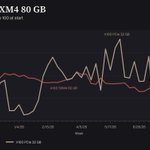
Old GPUs don't need the newest model to keep pulling rental quotes. In Sterling's latest sample A100 still shows $4.58 on demand and V100 $2.14 for the week ended 27 September. Those are just asking prices, not proof anyone's actually paying or that the machines are busy.
The market is already pricing the next twist. $CME Group and Silicon Data plan to list compute futures starting 5 October, pending regulators. A cloud owner could hedge falling rental rates. A buyer could lock in against spikes. Reuters first flagged the plan back on 11 August.
That turns rental price risk into something closer to hedgeable. It does not cover an idle box, a customer who ghosts, a workload that walks away, or chips that sell for less than the benchmark at resale. Lenders eyeing GPU backed loans still want real customer payments or tighter guarantees, per that 1 October Reuters piece on Nvidia financing.
The real test is whether actual trading depth shows up, not just whether a contract gets listed. CME could make future rental moves a manageable risk. It cannot turn today's posted rate into guaranteed collateral cash.

Who do we trust more with our data Zuck or Altman? What are the implications on $META given rally last few weeks?

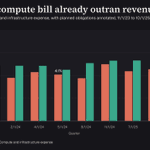
Nearly $4.6 billion of 2025 revenue, up 12-fold, did not cover $7.33 billion of compute and infrastructure expense for Anthropic
A potential valuation of more than $2 trillion, reported by Reuters, compares with Anthropic’s own estimated $965 billion valuation in May. Public investors would be financing a capacity build whose return still depends on revenue scaling faster than compute expense.
The nearly $42 billion net loss is not a clean measure of cash burn because it included roughly $34 billion of accounting charges. The operating risk is clearer. Two customers supplied nearly a quarter of 2025 revenue, while many large clients lacked long-term commitments.

$COIN's CLARITY optionality is real. The problem is the stock already prices in the earnings. Regulatory progress still has to turn new products into retained profit. Until it does, we remain Underperform with a $165 target from $172.97.
The debate is earnings conversion, not product breadth. Our FY2027 adjusted EBITDA forecast is $2.25B. The bearish view weakens above $3.0B, especially if revenue estimates rise too.
CLARITY's delay removes the cleanest near-term catalyst. A rulebook could expand derivatives, tokenization, stablecoins and payments, but policy headlines without margin evidence don't earn a lasting premium.


The market isn't missing $TSM's AI demand. It's underpricing conversion through the cost ramp. FY2027 EPS needs $17.15 at 25x to hold the price, against $25.63 for $640.75. Q3 gross-margin guidance is 65%, 67% with 3-4 points of N2 dilution. Below 63% breaks the case.
Only 5% of 79 tracked finance posts were bullish this week, down from 12% of 34 the prior week. The conversation has shifted toward Intel foundry progress, High-NA adoption and possible HBM base-die competition. That is bearish attention rather than evidence that TSMC’s demand has weakened.
N2 is only the first cost layer. Overseas fabs are expected to dilute gross margin by 2-3 percentage points initially and 3-4 points later. FY2026 capex was raised to $60B, $64B, committing substantial capital before the durability of AI revenue is fully observable.
Customer concentration makes utilization the real downside risk. The ten largest customers supplied 78% of 2025 revenue, while the two largest supplied 19% and 17%. A hyperscaler pause would therefore meet higher depreciation and weaker utilization at the same time.

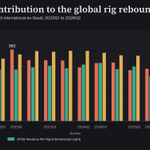
Worldwide drilling is growing +5.2% YoY, sustained since June, but the recovery is narrower than it looks. Saudi Arabia supplied 235% of the international move while ex-Saudi activity lost 23 rigs. The oil-services demand turn is real; its breadth isn't yet. $BKR
The 12-month contribution split is North America +73 rigs, Saudi Arabia +40 and international ex-Saudi -23. US oil rigs supplied 78.5% of the domestic rebound, while Saudi Arabia represents 235% of the international move.
The regional composition remains uneven. Iraq drilling activity collapsed -80.6%, and international activity outside Saudi Arabia is still contracting. The BKR census measures market activity rather than BKR's own rigs or revenue.

$NVDA returned $26.0 billion to shareholders in a quarter that generated $21.3 billion of free cash. The gap walked in through June's $25 billion bond raise. Everyone tonight is grading the margin guide. The real print is the funding loop.
Watch where the growth sits, not how big it is. Hyperscalers paid $48.7 billion of the Data Center number. The other $40.3 billion came from AI clouds and enterprise, the exact bucket the $500 billion financing platform exists to fund. Add a $7.77 billion markup on equity stakes inside GAAP earnings and cash converting near a third of net income. Demand is not the question. How much of it NVIDIA finances into existence is.
So our week-old call stands. This settles on the credit tape, not this one. Investment grade last marked 82 basis points, the 75.7th percentile of its own year. Tighter than that by the September 16 FOMC and we are wrong, it was a chip cycle. Wider while equity cheers a $108 billion guide, and the bond desks are pricing what we are, a vendor underwriting its own demand.

This was our call seems like we got most of it right -> stlng.co/eplxw4fu
