Learning Economics and #Bitcoin. Tweeting about electronics, Linux and how Bitcoin is not what most people think it is.
Joined February 2018
- Tweets13.2K
- Following1.6K
- Followers1.2K
- Likes21.1K


Yope retweeted

REFUSE MASS SURVEILLANCE AS A CHRISTMAS GIFT!
Update on Chat Control 2.0 give us every reason to be disappointed in the EPP leadership and question its role in pushing mass surveillance in the EU.
Remember how @EPPGroup pushed Chat Control 1.0 through Parliament just before the summer recess, using the urgent procedure under Rule 170, despite a majority of voting MEPs opposing untargeted scanning?
Now look at the timeline for Chat Control 2.0:
2 December: national ambassadors are expected to endorse the Council's new negotiating mandate.
8 December: political trilogue, which could be the final one if the negotiations go according to plan.
Just before Christmas we can expect the vote in the European Parliament.
According to the latest reports from the negotiations in the leaked Council document WK 17300/2026 of 12 November, the @EUCouncil wants to:
(1) Make Chat Control 1.0 permanent, despite its own previous recognition that a high volume of reports generated under this regime do not lead to any operational outcome.
(2) Remove the existing protection for end-to-end encryption, opening the door to scanning your private messages directly on your devices;
(3) Mandatory scanning of private communications of everyone, refusing to limit it to suspected in crime.
All this while hackers are already targeting everything from supermarket refrigerators across Europe and blood banks in France to the @EU_Commission 's own systems containing staff salary, medical and personal information.
What can you do now?
Before 2 December, call or write to your Ministers of Justice and Interior. Ask them:
— Do you reflect at all on what these recent cyberattacks, including those against EU institutions themselves, tell us about the importance of encryption and cybersecurity?
— How will introducing new vulnerabilities into our digital infrastructure make Europe more resilient to attacks by hackers, organised crime and hostile states?
— Why risk making every one of us more vulnerable instead of strengthening Europe's cybersecurity and supporting the development of privacy-preserving technologies in the EU?
— What is your government's position on permanent mass scanning, mandatory detection orders and the removal of existing encryption protections?
Before 8 December, call or write to your MEP. Remind them of the procedural tricks the EPP used before the summer recess and ask:
— What guarantees do we have that the EPP leadership will not try to repeat the same procedural manoeuvre before Christmas?
— Will you defend @Europarl_EN 's original mandate, including individual targeting, judicial authorisation and the protection of end-to-end encryption?
— Will you oppose another attempt to rush Chat Control through Parliament using the urgent procedure?
Ask these questions publicly. Write emails, publish posts on social media, tag your ministers and MEPs, and share their answers.
Remember how much difference your voice made in previous negotiations. They need to see that you are watching their every move, including before Christmas.
Let's stop it before it is too late.
Please repost.
🤖 Made with AI


Yope retweeted

Last year I got to meet a refugee whose life had benefitted directly because he lived in a world where Bitcoin existed.
His story is both moving, and a rare insight into the hundreds of thousands of refugees who have been able to relocate with Bitcoin
Yope retweeted
JUST IN: Nigeria mainstream news outlet, The Cable, just ran a piece on Bitcoin mining, saying Bitcoin mining
* pays power producers for electricity nobody else is using. Miners * are flexible, bringing generators revenue when demand is low
* can be built where the power is, unlike most industry
* switches off when others need the power.
* can support mini-grids for rural communities.
* supports renewable building

Yope retweeted

“You can revoke a user's access. You can change what the model is willing to do. When a model is released in an uncontrolled manner, there's no ability to do that. It's entirely out of your hands.”
And the mask slips. It's all about control, all about being able to grant or refuse permission.
Amodei, you may think you're doing this for "safety", but what the fuck do you think Is going to happen when the psychopaths who infect governments get such power?
An AI-enabled boot grinding a human face, forever.

Dario Amodei on open source models:
“If the path continues, I think we could get to a very dangerous place.”
“When you control a model and you're deploying it, you have the ability to monitor its usage.”
“You can revoke a user's access. You can change what the model is willing to do.”
“When a model is released in an uncontrolled manner, there's no ability to do that. It's entirely out of your hands.”
“We should confront the advocates of this with that problem and challenge them to solve it.”
He clearly doesn't believe Intelligence should be in the hand of the masses and Sam Altman also saying "RAM" shouldn't be accessible to everyone indefinitely agreed with him.
Yope retweeted

Tom van Lamoen, a representative of the Libertarian Party in the Netherlands, criticized the scale of the requirements and their impact on ordinary people.
“Fighting financial crime should mean targeting criminals, not treating everyone as a suspect,” he told Forbes.
> Het gezamenlijke rapport van financiële rekenkamers van Nederland, Duitsland,
Cyprus, Polen en Spanje laat zien dat er na al die jaren en miljarden aan verkwisting geen meetbare effectiviteit te zien is in het bestrijden van witwaspraktijken.
De Nederlandse centrale bank weigert artikelen over te dragen voor justitiële controle.
Ondertussen worden alle inwoners met een bankrekening behandeld als verdachte. En erger nog: wordt er enorm veel privacy gevoelige data verzameld op centrale plekken die een target worden voor hacks.

Europe is expanding financial surveillance while auditors reveal that no one has properly checked if the existing system works.
People are treated as suspects, their financial data collected and their privacy put at risk, while Dutch banks spent €1.6 BILLION on compliance in one year.
The Dutch central bank even refused to hand over 362 documents for confidential judicial inspection.
With financial exclusion, barriers to banking and exposed financial data linked to physical attacks, what exactly are we achieving?
My latest @Forbes investigation.
forbes.com/sites/digital-ass…
@HRiFEU @DNB_NL @StemLP

Yope retweeted

Een miljonairsbelasting. Maar wie krijgt straks écht de rekening?
De Raad van State ziet grote problemen met de nieuwe box 3-plannen. Toch ging de Tweede Kamer akkoord met aanpassingen. Wat is er precies aangenomen, wat moet nog langs de Eerste Kamer en wat kan dit betekenen als je jarenlang hebt gespaard of belegd?
In deze aflevering van Madelon Praat duik ik in de plannen voor box 3, de miljonairsbelasting en een mogelijke exitheffing. Ik kijk ook naar de vraag waarom sommige beleggers overwegen Nederland te verlaten en waarom de rekening volgens mij vooral bij de middenklasse kan belanden.
Verder bespreek ik wat stijgende energieprijzen doen met je koopkracht, wat de Algemene Rekenkamer ontdekte over het toezicht op onze goudvoorraad en welk koersniveau ik deze week bij bitcoin in de gaten houd.
Dit en meer in mijn nieuwste video: youtu.be/cEi0mbh4byM

Yope retweeted

Using Qwen 3.8 Flash Next? You probably want to be aware of this. This plugin makes webfetch-heavy sessions a lot faster and smarter.
We need help from experts in abliteration who might be able to patch out this one misbehavior. Who is capable?


Yope retweeted
De goud petitie over de ongelijke behandeling in de Box 3 plannen zit op ruim 5500 ondertekeningen.
Ben jij ook vóór een gelijk speelveld? Teken de petitie en retweet deze tweet 👇🏼
goudinbox3.petities.nl/

Yope retweeted
Who worked on Qwen-3.8-Flash-Next abliteration or uncensoring? I believe similar surgery on weights might be able to fix this model bug. Reproducer tool can help you see the bug easily. Find the weight and zero it out?
Yope retweeted

Top Models For your Hardware 2026
-- 8GB --
- lfm-2.6B: very solid, trained on tons of data, obviously limited by good place to start
Use this for snippet tool calls, or to play around and build infra huggingface.co/LiquidAI/LFM2…
-- 16GB --
I am a big fan of Ornith models, they do well at tool calling and they certainly push models farther
Gemma is a more well rounded model for chat, and vision IMO
huggingface.co/google/gemma-…
huggingface.co/ornith-ai/Orn…
-- 24GB up to 96GB --
Qwen3.8-27B is IMO the first model here you can code with, it's really strong. Use the exl3 versions.
huggingface.co/turboderp/Qwe…
-- 96GB up to 196GB --
Qwen3.8-Flash-Next is where it's at. Phenomenal model, very fast even on slower hardware, kv cache is smaller and part of the model is basic enough to be offloaded to ram huggingface.co/Qwen/Qwen3.8-…
-- 196GB up to 384GB --
GLM-5.3-Flash is frontier at home, built to run on 10,000$ of hardware. It's really a gift. It is natively multimodal, image/video/ audio?
It hold up over 1 million tokens in context, and is hybrid attention, it holds on higher concurrency. Very good for 3D, coding, hacking, art.
huggingface.co/zai-org/GLM-5…
-- 384GB up to 512GB --
Sacrifice speed for intelligence, GLM-5.3 is tied for #1 Open Weight model, and is the best for pure coding and systems work.
huggingface.co/zai-org/GLM-5…
I told you August was going to be awesome, now we go to slower months.
-------------
It's not Local AI we have to worry about anymore.

Yope retweeted

Wolfenstein 3d for the stock Commodore 64 released! Full shareware episode included. Armed with only a combat knife, a stolen pistol, and raw grit, you must fight through 8 levels of hell and defeat Hans Grosse to escape. kweepa.itch.io/wolf64

Yope retweeted

Bitcoin Core has shipped one consensus change in the last nine years, and it broke. Taproot activated in 2021, and within 13 months people were using it to stuff arbitrary data into the chain in a way nobody designed for and nobody agreed to. Every attempt to fix that has been rejected or closed, and the one policy constraint that was slowing it down got removed over broad opposition, spurring a significant portion of node runners to abandon Core entirely and rally behind a competing implementation.
Meanwhile CTV and BIP-54 have both been sitting for seven years, one trying to add functionality and the other trying to fix bugs that have existed since the beginning. Neither has really moved. And now the same people who shipped a consensus change they did not understand, and refused to clean up after, want to change consensus again.
Taproot's consequences came as a surprise because the Bitcoin consensus protocol has never been formally specified. A BIP describes what it intends to do, but it gets layered on top of a protocol that nobody has ever fully written down. When you change something you have not fully characterized, you cannot know what you are actually changing. That is how unintended behavior makes it to mainnet, and it is why the same thing can happen again.
I am not against changing Bitcoin. I am against changing Bitcoin blind. Before anyone earns the right to change consensus again, they need to demonstrate two things: that they know how to make consensus changes safely, and that they are willing to fix their mistakes when those changes go wrong. That means a formal specification of the entire existing consensus protocol, formal verification of any proposed change against that specification, and differential testing against independent implementations before anything ships. Alternative implementations exist. What does not exist is any process that treats them as a mandatory check on Core before a consensus change goes live.
The bar for changing the monetary base layer of human civilization is not vibes and rough consensus. Build the infrastructure to do this right, or stop asking.

Yope retweeted

Tldr for scared people:
1) If you have significant money on keys generated by a ColdCard Mk3 without proper dice rolling and without a strong passphrase, MOVE THEM NOW, even just to a hot wallet, while you fix your cold setup (if your hot device is compromised you may lose funds anyway, but if you leave them there you most likely will pretty soon, so don't wait for the perfect setup to move, move now and perfect later).
2) If you have significant money on keys generated on a more recent ColdCard, or on a Mk3 with a very strong passphrase, or in a MK3 multisig you didn't spend from yet, you have more time. Take a few calm, focused hours in the next few days, create a good setup, understand it, test it, and then move. Mind privacy, even if it may seem the least of your concerns now. I personally use a 4-layer segregation between phone LN wallets, a LN node, a JAM wallet, a cold setup with decreasing threshold 3/3 multisig with Liana: a old laptop with Tails with persistent storage on Electrum, an old Ledger NanoS, a ColdCard Q, in all 3 I generated entropy externally with cards, the other seeds generated from the ColdCard with BIP85. There's no one size fits all.
3) If you don't use ColdCard, it's still a good occasion to review and improve your setup. Use multisig with different vendors to spread out the risk. If you have money on exchanges, the very same LLMs that found this will also find vulnerability in those massive honeypot. Take your money away from there asap.


Yope retweeted
I don't have infinite tweet power, so bear with me.
1. "Protocol/Ledger neutrality": The protocol has never been "neutral". It only accepts data fitting a very narrow set of rules that represent monetary transactions. BIP110 only adds comparatively tiny further narrowing to that.
Yope retweeted

Most criticisms of BIP110 come from people who don’t understand the history that made BIP110 necessary.
If your understanding of BIP110 is “people are trying to change Bitcoin” you’ve missed the entire argument.
Here’s the timeline as I understand it. Please comment if I missed anything or made any mistakes.
1/ Bitcoin originally had anti-spam protections.
Satoshi implemented the first spam filters, and suggested there were “other things we could do if necessary” when trying to prevent use of the blockchain for arbitrary data.
Developers unanimously agreed that data storage was discernable, undesirable and to be discouraged
2/ SegWit introduced discounted witness space.
This was so that UTXOs were more cheap to consume than create. It was deliberately not made too large as there were concerns about it being used for spam.
Meant for scaling.
People that would use it to store non-monetary data would still be limited by the existing spam filters.
3/ Taproot increased script flexibility and bypassed existing filters.
Meant for privacy and smart contracting.
Created new ways to embed arbitrary data that would be relayed by the entire network before being mined
4/ Developers discovered the loophole.
Large amounts of non-payment data could now be stored more efficiently than before.
5/ Ordinals, inscriptions, tokens, and data schemes appeared.
6/@LukeDashjr proposed fixes.
He argued the bug was understood and fixable - simply subject taproot spends that reveal large amounts of frivolous data to the existing limits that applied to data storage elsewhere.
Core declined to update the filters and fix the bug with taproot.
7/ A new philosophy emerged inside Core.
“If it’s valid at the protocol level, it cannot be spam.” A standard that does not exist on any other protocol.
This replaced Bitcoin’s traditional anti-spam posture.
8/ Financial interests formed around the loophole.
Companies, exchanges, token issuers, NFT projects, and infrastructure providers began profiting from non-payment usage.
9/ The longer it would remaine open, the weaker Bitcoin would become, on a cultural level and on a technical level due to massively decreasing its efficiency as a payment network
Businesses were created with the expectation of a passive network that would not defend itself.
Non Bitcoin users became invested in the schemes.
Economic interests formed around preserving them.
10/ Core then went from failing to fix the filters to intentionally removing them in Core 30.
This was presented as “neutrality”.
Instead it was active solitication of parasitic use cases. They had moved from ignoring/tolerating spam to accommodating it.
11/ Trust in Core governance began to erode.
The issue was no longer inscriptions.
The issue was now the need to redefine Bitcoin as a solely monetary network, not a permissionless file storage network as that would create problems for users very quickly.
This is when @BitcoinKnots became popular.
12/ BIP110 was proposed - written by @dathon_ohm
To restore Bitcoin’s original anti-spam posture.
Not a new direction, but a revival of a network hostile to non-monetary usage.
To summarize:
First the loophole was created..
Then people exploited it..
Then businesses formed around it..
Then the businesses corrupted the trusted developers in the space who are now being fired as the network drops their client.
Because of all this, saying “large OP_RETURNs have always been consensus-valid” is completely disingenuous - a red herring at best.
Yope retweeted

If you don't want Bitcoin to change to allow data storage (ie, Core30), then you want BIP110.
BIP110 is just itself a counter-fork to reject Core30's controversial changes.
Without it, a tiny fringe minority would have succeeded in materially changing Bitcoin without consensus.
Yope retweeted
This chart says "Bitcoin is most owned where it solves very real problems"
The data tells us it is solving a lot of problems, at scale, and often at an existential level
For example for 10 of the top 14 countries adopting Bitcoin, here's the problems it solves
UAE: Remittances
The world's highest-migrant-share workforce sends money home through banks that skim 6%+ a transfer. Bitcoin moves it for a fraction
Vietnam: Bank-account control
The state deactivated 86M+ bank accounts in a single "AML sweep". I personally spoke to people this happened to who lost their savings. They had left Vietnam years before, and found the account that held their money simply closed. A bank that can freeze you for going quiet is the whole argument for holding your own keys.
Philippines: Remittances
Overseas workers wire billions home each year. Bitcoin rails undercut the high-fee operators they are otherwise forced to use.
Iran: Sanctions
Locked out of the dollar system, Iran mines its subsidised energy into Bitcoin and spends it on imports the banks can't touch.
Brazil: Inflation hedge
Brazilians hold Bitcoin as hard money against a currency that keeps losing ground, and as a serious investment asset
Venezuela: Hyperinflation
As the bolivar collapses, Venezuelans move savings into Bitcoin to hold value the state can't erase
El Salvador: Day-to-day transactions
The IMF stripped the legal-tender mandate in 2025, so nobody has to touch Bitcoin. But ~ 1 in 10 Salvadorians still do anyway, by choice. One story that moved me was of a rural Salvadorian who used Bitcoin to pay his utility bill so he didn't have to have a half-day round trip to the nearest bank each month.
Ukraine: War
When ATMs capped withdrawals and savings froze, Bitcoin crossed borders money couldn't, and funded the defence.
Argentina: Inflation.
After decades of a falling peso, Argentines save in Bitcoin to protect what their melting-icecube currency keeps eroding.
South Africa: Hedging the rand.
The rand has devalued 8x against the USD since 2000. A weak, volatile currency and a deep investor base push South Africans into Bitcoin as an alternative asset
Notice the common theme? With the exception of US/Thailand/Saudi (Investment) and Singapore (Zero Capital Gains Tax) all the other countries are using Bitcoin to solve problems that affect basic livelihood in ways most of us struggle to imagine even being necessary in the West.
There is a name for this: "Solipsistic". It means treating one's own experience as the only reality.
(source references for each country and chart reference in comments)

Yope retweeted

Privacy, and our basic freedoms, are under attack from all sides.
Incredibly, the so-called 'liberal democracies' are now leading these attacks; arresting their own citizens for posting online, rolling out facial recognition cameras, and moving to ban VPNs.
"What can men do against such reckless hate?" And are we losing this battle?
Absolutely not. There's still time to fight back, and we have much in our arsenal. We at @bitcoinpolicyuk have put together a 'Privacy Toolkit', that should let anyone, whatever their skill level, take a few small steps towards improving their privacy and their freedom, and making themselves just a little bit harder for governments to track and to oppress.
This isn't comprehensive, and we'll continue to update it as time goes by. We hope it's useful to everyone and serves as a handy guide to help us all push back against government overreach, wherever we find it.
Link in the thread and comments welcome! 👇


🚨NEW: Britain has developed a reputation as perhaps the most censorious 'liberal' democracy.
How did we get here — and what can we do about it?
✍️: @charliecolecc investigates.
📖: pimlicojournal.co.uk/p/resto…

Yope retweeted
This is the sort of article that can lose a media publication's credibility. Fast.
In a truly embarassing effort from Switzerland's public broadcaster @swissinfo_en just claimed a long-debunked claim that "Bitcoin emits a lot of energy per transaction"
For the record, no it doesn't. Bitcoin resource use comes through mining, not transactions (getting this wrong is a rookie error). It was debunked 4 times in peer reviewed papers (Masanet et al, 2019, Dittmar et al. 2019, Sedlmeir et al, 2020, and Sai and Vraken, 2023.)
That's why no reputable mainstream media companies make this claim any more.
Oops.
Imagine having done so little research on your article that you
a. didn't know that
b. didn't know that all your peers in the media except you already know that
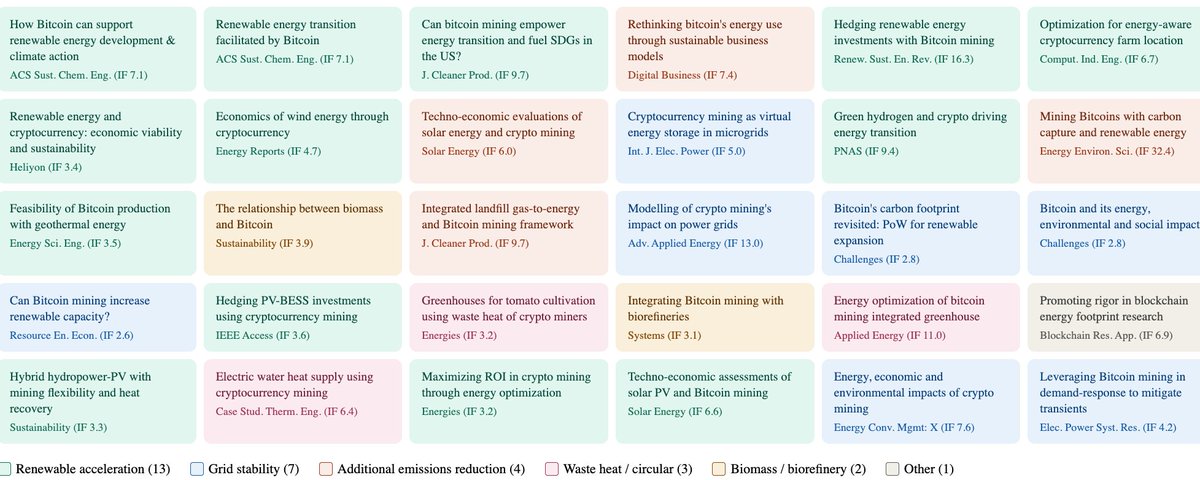
But the Swiss article gets worse. The author mentioned none of the actual contemporary research on Bitcoin, appearing to have no awareness that since 2021 there have been 30 peer reviewed articles (source: teapawt.org/DSBatten/status/206179…) showing that Bitcoin is not only not a big emitter, but it is a genuine solution to ending the era of big emissions by:
- Accelerating renewable energy transition (16 papers)
- Monetizing wasted renewable energy (14 paper)
- Obviating flaring, landfill gas emissions, or gas peaker plants (3 papers)
Finally, the article references its own previous copy, an article from 31 May 2025 quoting the non-peer reviewed hobby blog Digiconomist (which Wikipedia expressly states is not a reputable source), authored by Dutch Central Banker Alex de Vries, whose work on Bitcoin Mining was debunked in 2023 (Sai and Vranken)
Source: sciencedirect.com/science/ar…
So in summary, what can we objectively say is true about this article on Bitcoin's environmental impact from @swissinfo_es. They have
1. Not acknowledged 30 peer reviewed papers which contradict their thesis
2. Referenced the hobby blog from an author whose work's academic merits are disputed (to say the least)
3. stated the flawed "per transaction" metric which has been debunked 4 times in academic work
Irrespective of your opinion on Bitcoin or Bitcoin mining, this is not a great look for Swissinfo.
Rather, it is misinformation against a technology that has been established in multiple academic journals, by energy experts, grid operators and renewable energy generators as being an important part of the UNSDGs and environmental action.
in short: the sort of article that establishes a news outlet as not a reliable source
Do better @swissinfo_jp @swissinfo_fr @swissinfo_de