

Tracking the companies and technologies behind the AI buildout. Research informed by company interviews, site visits, analysts, and industry experts.
Taipei City, Taiwan
Joined June 2024
- Tweets2K
- Following138
- Followers5K
- Likes916




Pinned Tweet
If you follow $LITE and $COHR, the AI optics buildout also runs through 17 Taiwan-listed companies.
We mapped them across five layers and rated how directly each one benefits. Supply is tightest in laser materials today, while CPO parts are mostly a 2027 and 2028 revenue story.
Top tier:
LandMark (3081 TT)
VPEC (2455 TT)
EZconn (6442 TT).
LandMark and VPEC grow the InP and GaAs epitaxial wafers that laser and photodetector chips are built on. LandMark has a four-year agreement with a US customer for data center CW lasers covering 2027 to 2030. WIN Semiconductors (3105 TT) and IntelliEPI (4971 TT) sit in the same layer, with less of their revenue tied to AI optics.
Modules and laser packaging are where 2026 demand shows up first, because pluggable 800G and 1.6T modules remain the volume product. LuxNet (4979 TT) began volume production of 800G products this year and expects 1.6T NPO mass production in the second half of 2027. Elite Advanced Laser (3450 TT) mounts laser chips onto submounts for module makers.
Fiber passives are benefiting from denser data center cabling now.
EZconn makes high fiber-count trunk cables and MPO cords. High fiber-count products passed half its sales in 1H26, when gross margin reached 59.5%. FOCI (3363 TT) is developing fiber array units for CPO and has told local media it expects shipments to pick up clearly in 2027.
Optical module boards need mSAP HDI from 800G up. Zhen Ding (4958 TT) and Compeq (2313 TT) both make them. A US broker expects the mSAP market for 1.6T and faster modules to grow from $0.8B in 2026 to $2.9B in 2028.
Accton (2345 TT) builds AI data center switches and also sells optical transceivers. How much it benefits depends on AI networking’s share of its revenue.
What we’re watching closely:
-How fast 1.6T replaces 800G in 2027
-Whether new InP substrate and CW laser capacity eases pricing
-CPO switch volumes, which decide when FAU and CPO parts turn into revenue

SK hynix earned almost as much revenue from its largest customer in Q3 alone as it did in the entire first half of 2026.
Revenue from the unnamed customer reached ₩34.98 trillion in January through September, versus ₩17.61 trillion in the first half, according to BusinessKorea. That implies Q3 revenue of approximately ₩17.37 trillion. The nine-month figure roughly doubled from a year earlier.
Industry observers believe the customer is NVIDIA, though SK hynix did not identify it.
$NVDA
1
269
Broadcom and Qualcomm could face a slower Wi-Fi 7 upgrade cycle as rising memory costs keep newer routers expensive.
Wi-Fi 7’s share of Taiwanese router shipments barely moved in Q3 2026, rising just 0.4 percentage points to 36.3%, according to DIGITIMES Research.
Networking suppliers had expected upgrades to accelerate once the price premium over Wi-Fi 6 fell below $10. Higher memory costs are slowing that convergence, potentially pushing price-sensitive customers to delay upgrades and extending Wi-Fi 6’s life.
For Broadcom and Qualcomm, both suppliers of Wi-Fi 7 networking chips, we see a risk to the timing of demand shifting toward newer chipsets. For router brands such as Netgear, slower adoption puts pressure on assumptions for shipment growth and higher selling prices from a richer product mix.
Taiwanese router makers’ estimated Q3 shipments fell 1.2% sequentially to 16.82 million units, while production value rose 5.1% to $1.068 billion.
DIGITIMES attributes the increase in value to memory-cost pass-through and changes in product configuration. Shipments were still up 9.6% from a year earlier, with telecom deployment schedules also affecting quarterly deliveries.
$AVGO $QCOM $NTGR
digitimes.com.tw/tech/dt/n/s…

1
6
645
MPI (6223 TT) has delivered Insertion 3 CPO test engineering systems to three customers and expects production-system orders in the first half of 2027. Equipment lead times are at least six months, followed by customer acceptance, according to its Nov. 16 earnings call.
MPI, a Taiwanese probe-card and test-equipment supplier, outlined two separate tracks:
• Insertion 2: qualification results from its first customer are expected in December 2026. The company is also in discussions with a second major international customer.
• Insertion 3: three customers have received engineering systems, with deliveries to another three to follow. Production-system orders are expected to begin arriving in H1 2027.
MPI also plans to open its CPO equipment assembly space in Q1 2027.
For investors tracking CPO adoption, these milestones help distinguish engineering-system deliveries, production orders and customer acceptance.
money.udn.com/money/story/56…

AI demand is giving suppliers more pricing power in everyday circuit-board materials. At Ventec (6672 TT), general-material prices have nearly doubled this year, while that business’s gross margin rose from roughly 16–17% in Q1 to about 40% in Q3, according to a Nov. 16 CTBC Securities report.
Ventec makes copper-clad laminates and prepregs, the materials used to build and bond the layers of printed circuit boards.
The report describes pressure at two levels. Glass-fabric capacity is shifting toward higher-end grades, squeezing the supply of conventional E-glass. Major laminate makers are also prioritizing AI orders, leaving less capacity for lower-end products.
Ventec has been taking spillover orders while keeping lead times at about four weeks. Higher prices helped lift margins, alongside a growing share of higher-margin prepregs and more heat-resistant, halogen-free materials.
We see this as a way AI spending can raise costs beyond the AI hardware itself. Buyers of conventional board materials can face tighter supply even without stronger demand for their own products. Suppliers that can still deliver gain room to raise prices.
That pricing power depends on how long the shortages last. CTBC already sees price increases slowing for thick glass fabric, which can be made on Chinese weaving equipment. The report says Ventec expects supply and demand for thick fabric to improve after Q2 2027.

15
1,017
Jensen basically built a crazy powerful flywheel on pure conviction and energy.
1. Push the supply chain to move insanely fast, with investments and whatever else it took.
2. Create hardware demand by going all in on neoclouds and backing them, pulling future demand forward.
3. Make AI way cheaper. The first two made token prices collapse, and that's why AI adoption took off so fast.
4. Then go hard on every kind of AI app, investing in both digital AI and physical AI.
It's like he hit 3x speed on the whole AI industry. And the interesting part is, if you got on board with AI, you pretty much didn't lose.
- The AI supply chain and CSPs
- Companies using AI to create value
- Employees and anyone who's good at using AI
So who's losing? Supply chains that couldn't get into AI, because parts and labor got pricier and consumer electronics got wrecked. Companies not using AI, because they'll fall behind. And regular people, who end up with more work or get laid off.
So what if that 3x gets turned down to 2x or 1.5x? Keep an eye on those four wheels.
Here's another way to look at it. You'd think slower tech progress is bad for the leaders and good for the No. 2 suppliers. But if it slows down a lot, the leaders and the No. 2s end up fighting over the same turf. If that turns into a price war that slows growth across the board, everyone gets hurt.
When tech was moving fast, the No. 2s could see their stocks rip just on the dream of breaking in someday. That free ride might be over.
So honestly, I'd rather this not happen. But if it does, be ready. I'm not picking a side yet. Investing is just adjusting to the odds as things play out.
Taipei 101 is lit up tonight with “Taiwan ♡ Jensen.”
Less than a week after Jensen Huang resigned as Nvidia CEO, a group of Taiwan tech industry associations pooled their money to pay for the light show. The tower is rotating through “Thrive Together,” and a line about building the future of AI together.
For a lot of people here in Taiwan, Jensen never felt like a foreign CEO. He was born in Tainan, he’s at Computex every year, and he’s famous for night market runs and big dinners with his Taiwanese suppliers. Nvidia orders keep a huge part of the island’s supply chain busy, from TSMC to the server makers.
The organizers say tonight is about years of working together and hoping that partnership continues.


Liquid-cooling connector demand is already filling production lines at Lotes (3533 TT), which aims to double quick-disconnect capacity over the coming quarter. We see that as a useful signal for investors following the pace of liquid-cooling adoption.
Lotes, a Taiwanese supplier of CPU sockets and connectors, reported full utilization of its quick-disconnect (QD) lines in notes from its Nov. 13 earnings call. These fittings connect coolant lines and allow them to be disconnected for servicing.
QDs accounted for about 1% of Lotes’ revenue in July and 2% in August. The company expects that share to reach 3–5% in December and close to 10% for full-year 2027.
For Vertiv a component supplier running flat out adds evidence of demand further down the supply chain. For Amphenol, Lotes’ expansion raises a question about how much of that growth comes from a larger market and how much comes from suppliers winning share.
Lotes also offers a view into the next server CPU upgrade cycle.
The call notes put a faster ramp for AMD’s Venice platform around the end of Q1 2027. Intel’s Oak Stream has slipped from an earlier expectation of H2 2026 to initial small-volume shipments around late Q1 or early Q2 2027, with a more substantial ramp in H2.
Those timings matter for when demand for the new CPU sockets builds. From Lotes’ perspective, Venice starts accelerating around the end of Q1, while Oak Stream’s larger contribution comes later in the year.
$VRT $APH $AMD $INTC
31
1,881
CMP pad supplier Praise Victor (7768 TT) told us it is short of capacity and expanding, as chip packaging takes on polishing steps that used to belong mainly to wafer fabs.
Its subsidiary IV Technologies makes CMP pads, and its customers include $TSM and $MU.
Semiconductor products were 66% of revenue in the first half of 2026, up from 48% in 2023.
At this month’s NCKU Materials Industry Forum, we are pleased to talk to IV Technologies President Yang Wei Wen. He told us CoWoS lines in Taiwan already use a lot of CMP, and that CoPoS will bring in new materials, including glass substrates in the future.
Supply is the constraint here. At its August earnings call, the company said existing lines were close to full and that a major advanced-packaging customer had asked it to hold 90 days of inventory. New plants in Hefei and Taichung are expected to contribute from 2027, and Yang said a new R&D center will be completed next year.
Our read: pads are consumables, so demand follows the number of polishing steps as well as the number of wafers. If packaging keeps adding planarization, pad demand rises with packaging capacity too. How quickly Praise Victor benefits depends on when its new plants pass customer qualification.
Our full interview with Yang is in the video.
KYEC (2449 TT) is the largest pure-play chip test house. Its customers include $NVDA, which has prepaid $1.1 billion to reserve KYEC testing capacity in the US.
At this month’s NCKU Materials Industry Forum, we are pleased to have KYEC President Gauss Chang to walk us through some of their key business.
New materials going into AI chip packages have to prove themselves in electrical testing before they reach production, President Chang told us. He wants chip testers involved from the moment those materials are introduced.
We think that as advanced packaging brings in new materials, each one adds something to verify, so testing work can grow faster than chip volumes.
KYEC’s revenue mix is already moving with chip design. Burn-in testing rose to 9.8% of Q3 revenue from 7.7% in Q2, which can be attributed to the higher power of Nvidia’s Rubin GPUs.
Timing still depends on customers. KYEC has lowered its 2026 revenue growth guidance to 30% to 35%, from close to 40%, as its main customer adjusts product designs.
Our full interview with KYEC is in the video.
I think in this whole Nvidia situation, there's an important second-order effect that could play out over the next six months.
Everyone’s been wondering how Chinese AI models caught up so fast. Besides China’s dense AI talent and its efficiency in model distillation and algorithms, getting advanced GPUs through gray channels for training is probably part of the reason too.
But from here on, Chinese companies are bound to face much stricter scrutiny when buying GPUs. On top of that, the US is getting ready to restrict Chinese companies from renting advanced GPUs through overseas data centers. China could gradually fall behind in the next generation of frontier models.
That’s bullish for US frontier model makers, including the CSPs that control distribution, and for AI’s long-term development.
Chinese models aren’t just closing the gap on tech. Their rock-bottom token prices are squeezing US model makers’ margins. Once China’s catch-up slows, US model makers can hold their tech lead, and their monetization and profitability could improve at the same time.
Thank you @benitoz for taking the time doing the interview with us. Explore the remarkable 3D rack models at BEP Research, and read his research on Substack.

10
1,067
I’ve been hearing similar things, but still need to check with senior executives in the supply chain to confirm.
China hawks will regain the upper hand in Washington after the midterms. Restrictions on China’s access to technology and tighter supply chain controls will likely keep expanding, bringing U.S. policy closer to what we saw toward the end of Biden’s term.

Following Jensen's resignation, Taiwanese server manufacturers are tightening their checks on customers and shipping locations, and even suspending orders from unfamiliar clients.
An executive at another server vendor revealed that the business team has been instructed to suspend accepting orders from unfamiliar new and small clients, whose products include Nvidia, AMD, and Intel.
Hampden, senior vice president of Proxima, a supply chain consulting firm under Bain & Company, believes that the real impact of Jensen Huang's resignation on supply will be on orders, long-term capacity commitments, sales channels, and regulatory changes. Feldman, a manager at ClearBridge Investments, also said that Nvidia's product planning for the next few years is largely clear; the problem lies in execution and scheduling.
$NVDA


After Jensen Huang’s departure from Nvidia, will AI hardware upgrades slow down? Google and AMD were already pushing suppliers in different directions.
Google’s TPU 8i Max puts two of its existing TPU 8i chips in one package. Google says that doubles both compute and high-bandwidth memory bandwidth versus the 8i, within the same rack footprint.
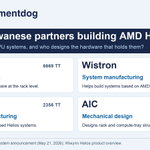
AMD’s Helios shows where Taiwan fits. Server makers Wiwynn, Wistron and Inventec are helping build systems around AMD’s MI450X GPUs. Another Taiwanese supplier, AIC, is working on the mechanical design of the rack and the compute trays that slide into it.
For investors following Taiwan’s server supply chain, that last detail matters. AMD’s design decisions are already shaping what Taiwanese engineers build, down to the trays that hold the hardware.


I think TSMC’s planned investments in OpenAI and Anthropic could give it a clearer view of how much compute its customers ultimately need.
Its board approved investments of up to $500 million in each company. One potential benefit is a more direct line to the AI developers whose demand feeds through cloud providers and chip designers into wafer orders.
There’s this thing called the bullwhip effect in supply chains. When capacity is tight, companies can order extra to secure supply. If deployment plans later slip, each layer may cut those buffers. A modest change in end demand can then become a much larger drop in orders upstream.
Thus, closer ties to the model developers could help $TSM compare their compute plans with the orders coming from chip customers, giving it another input when deciding how much capacity to build.
We expect HDD price increases to moderate, with higher capacity per drive still supporting revenue growth at Seagate and Western Digital into the first half of 2027.
HDD makers have historically relied on shipping more storage capacity to offset falling prices per terabyte. AI-driven demand for data-center storage has tightened supply enough for both shipment capacity and prices to rise.
Higher-density recording allows them to ship more terabytes without a comparable increase in the number of drives. That gives revenue a source of growth even as price increases become smaller.
Our outlook assumes storage demand remains strong enough to absorb that additional capacity. Under those conditions, modest price increases could continue to add to revenue growth.
$STX $WDC


1
16
1,289
[Taiwan’s Weekly Standout #4]
Taiwan Glass (1802 TT) reported a 56.5% jump in October revenue to NT$5.57 billion, citing stronger glass-fabric demand from AI and other smart technologies. Its shares rose 47.2% between the Nov. 6 and Nov. 13 closes.
The company makes glass yarn and fabric used in electronic materials. Two product families connect it to AI hardware.
Low-DK glass fabric helps reduce signal loss in high-speed circuit boards. Low-CTE glass fabric limits thermal expansion in chip-package substrates, helping reduce warping as the chip and substrate expand by different amounts when heated.
We estimates that October revenue from high-end glass fabric rose about 14% to 17% from September.
The two product families are ramping at different speeds. Low-CTE shipments began in small volumes in late 2025 and have increased substantially since early 2026. Low-DK2 is expected to contribute more revenue than Low-CTE in 2027, with Low-CTE narrowing the gap as new capacity comes online in the second half of 2027 and 2028.
On Nov. 2, Chairman Lin Po-feng said high-end glass-fabric supply was still falling short of demand. Taiwan Glass is targeting 2027 completion and production for its third expansion phase and has launched a fourth, according to Economic Daily News.
Our read is that Low-DK2 shipments for high-speed circuit boards matter more to near-term growth, while Low-CTE for package substrates offers a longer ramp.


$ASX opened the first phase of its advanced packaging site today. For investors tracking packaging supply in 2027 and 2028, one part of the expansion is already operating. The second phase broke ground today.
ASE converted an existing factory for the first phase.
It expects total investment across both phases to reach about NT$100 billion and estimates the site could generate NT$80 billion in annual revenue once both phases are running at full capacity.
That puts the spending timeline in perspective. ASE has already invested in the first production lines, while construction spending on the second phase still lies ahead.
1
17
1,355
Nvidia CEO Jensen Huang stepped down, and Gigabyte was the first Taiwanese AI server maker to respond publicly.
Nvidia’s ties with Gigabyte (2376 TT) run well beyond the executive suite, the Taiwanese AI server maker said today when asked how Nvidia’s leadership change might affect their partnership.
We estimate that 55% to 65% of Gigabyte’s 2026 revenue is tied to NVIDIA, the highest share among the 15 Taiwanese suppliers we reviewed.
Gigabyte’s co-president expects the partnership to continue through the leadership change.
Gigabyte’s margins also challenge a common assumption that building AI servers squeezes assemblers’ margins. Its company-wide gross margin rose from 9.6% in Q2 to 14.0% in Q3, and its operating margin reached 8.3%.
money.udn.com/money/story/56…

Taiwanese here. A lot of Nvidia's server, rack, cooling and power suppliers in Taiwan started as old-economy family businesses. Foxconn began in 1974 making plastic knobs for TVs. That world still runs on ties built over years of dinners and drinks, and many of the strongest ones sit with Jensen personally.
Getting that many supply chain bosses around one table isn't easy, and Jensen had the pull to do it. I think it does make a difference when the CEO across the table isn't familiar with Taiwanese culture. When a problem spans several suppliers, someone still has to get every decision-maker in the room, and that person is now gone.
Local analysts don't see every supplier as equally exposed. $TSM, $ASX and MediaTek (2454TT) were called irreplaceable, since any AI chip still needs them, whether for wafers, packaging or design.
The worry is the next tier down, where several Taiwanese vendors can do the same job and relationships help decide who gets the order. One Taipei analyst called it a risk of orders getting "poached."
I don't think this supply chain can be replaced anytime soon. Any lost Nvidia orders would likely shift to other customers, and the same suppliers already build for $AMD and custom ASIC programs.
