

Empowering OSS developers with decentralized rewards for their contributions. Layer 2 for open source.
Joined February 2022
- Tweets2.8K
- Following54
- Followers187K
- Likes3K


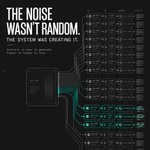
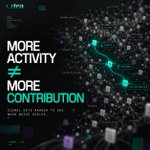
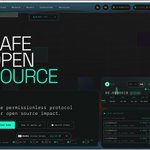




The interface is not the whole product.
A polished screen can show you packages, repositories and pull requests.
But displaying activity is not the same as understanding it.
What matters is the system behind that information.
Provenance. Dependency context. Developer identity. Evidence of contribution.
As AI accelerates software creation, the ability to connect and verify these signals becomes increasingly important.
That is what has been shaping tea's next application layer.
Not simply making open-source activity easier to see, but building the infrastructure to better understand what sits behind it.
The interface is what you see. The evidence underneath is what gives it meaning.

Open source matters more in an AI world, not less.
AI is accelerating how software gets written, tested and shipped.
But it isn't starting from zero.
Much of what AI helps create still depends on libraries, packages and developer tools that open-source maintainers have spent years building and improving.
As software creation accelerates, understanding that foundation becomes more important.
What does it depend on? Where did it come from? Who maintains it? What evidence can be verified?
That is what tea is building around: connecting repository context, provenance and contribution evidence so the people and projects behind modern software are easier to understand, recognize and support.
Faster software should not make the foundation invisible.

Code is getting cheaper. Judgment is not.
AI can now generate code, packages, repositories and pull requests at a scale that would have been impossible only a few years ago.
That is powerful.
It also changes the problem.
When software activity becomes cheap to generate, volume becomes a weaker signal of value. A pull request still needs to be reviewed. A package still needs context. A contributor still needs to be understood. Maintainer attention is still finite.
The question shifts from:
Can we create more?
to:
What actually deserves attention?
We saw an early version of that problem during testnet. Now it is becoming a much bigger problem across open source.
The next phase of tea is being built around that reality.
Better evidence. Better context. Better ways to separate meaningful activity from everything surrounding it.
When the noise scales, the signal has to get stronger.

The noise wasn’t random. It was feedback.
During testnet, we saw a flood of packages, pull requests, accounts and transactions.
Some of it was genuine participation. Some of it was spam.
But the more important lesson was that people were responding to the system we had put in front of them.
If volume looked like contribution, volume became the strategy.
That same problem is now playing out across open source at a much larger scale. Automated pull requests, spam packages and machine-generated activity are growing faster than maintainers can meaningfully evaluate them.
So we went back to the application layer.
Not to change the mission, but to build a better way of distinguishing activity from contribution, and noise from signal.
Identity. Provenance. Repository context. Contribution evidence. Maintainer authority.
That is what the last few months have been about.
We’re getting close to showing you what we’ve been building.

More activity does not mean more contribution.
Testnet made that impossible to ignore.
Alongside real participation, we saw Sybil accounts, automated activity and attempts to extract value at scale.
That forced us to rethink the application layer around a harder question:
how do you make real signal easier to identify, verify and act on?
Over the last few months, that is what we have been rebuilding around.
Identity. Provenance. Repository evidence. Contribution.
The signal matters more when the noise scales.

We said: judge us by what we build.
Here is one of the things Tim discussed during the AMA.
This is an early testnet build of the tea Dev Wallet, running as a browser sidecar alongside tea.xyz.
Open a repository and the idea starts to become tangible.
Repository evidence. Identity. Provenance. Vulnerability context. The information around the software, brought closer to the place where developers are already looking at it.
And that is only one surface.
tea.xyz in the browser.
Dev Wallet beside the repo.
Tea CLI in the terminal.
Different entry points into the same product layer.
The direction is to make tea less of a destination developers have to visit, and more of an intelligence and coordination layer around the open-source work they are already doing.
This is still testnet. It is still being built.
But it is becoming something you can see.

Missed the AMA?
Here are the key takeaways.
Tim covered TEA utility, upcoming products, runway, revenue, and what comes next for tea.
Full summary below.


We asked for the difficult questions. You brought them.
Here are the key takeaways from our recent AMA with Tim.
Thank you again to everyone who joined, asked direct questions, and challenged us.
Questions → Answers → Build.
You brought the questions. Thank you for the conversation.
Thank you to everyone who joined the AMA, listened in, and took the time to ask thoughtful, direct questions about the roadmap, the product, the launch, and where tea goes from here.
These conversations matter. They help show us where we need to explain more clearly, where the community wants more detail, and which parts of the roadmap deserve deeper discussion.
For anyone who couldn’t make it, or wants to revisit what was covered, we’ll publish an AMA summary tomorrow with the key questions, answers, and takeaways.
To everyone who joined, challenged us, and contributed:
thank you.
More tomorrow.

AMA is today.
We go live at 3:00 PM UTC to talk through the roadmap, the product direction, and what comes next for tea.
If you’ve got questions about the roadmap, the tea Product Layer, OSS Intelligence / Oracle, developer + agent workflows, repository coordination, or where tea is headed next, drop them in the replies below.
We’ll take as many as we can during the AMA.
Join here:
discord.gg/H3waEnesT?event=1…

The roadmap is out. Now let’s talk through it.
On September 22 at 3:00 PM UTC, we’re hosting a live AMA in the tea Discord to go deeper on the roadmap, the product direction, and what comes next.
We’ll cover:
• what’s live today
• the tea Product Layer
• OSS Intelligence / Oracle
• developer + agent workflows
• repository coordination
• the road toward repository economies
We’ll also take questions directly from the community.
Bring the difficult questions.
Join the AMA:
discord.gg/H3waEnesT?event=1…

tea is not building five separate products.
We’re building one system, layer by layer, from the network that is live today to the repository economies we believe open source will need next.
LIVE NOW
Tea Network + TEA are the foundation.
Tea is already a live OP Stack L2 with native verification for GPG/PGP signatures, SSHSIG and X.509 leaf certificates.
That matters because developer identity, signatures and software provenance should not sit outside the economic layer. They should be usable as part of it.
OCTOBER 2026
The next major step is the integrated tea Product Layer.
tea.xyz, Dev Wallet, TeaRank, PR-backed workflows and OSS Intelligence are not separate launches. They are parts of the same system.
At the intelligence layer, tea is building pipelines that ingest and connect repository, package, vulnerability, maintenance, signature and provenance data into a structured OSS data lakehouse.
That data can then power TeaRank, developer workflows, product surfaces and, over time, enterprise APIs.
We are also building the architecture toward the controls, traceability and operational discipline expected of a future SOC 2-aligned data environment.
LATE 2026
The evidence layer becomes actionable.
tea-signer, CLI tooling and WebMCP extend tea into developer and agent-assisted workflows, while keeping identity, keys and authorization under developer control.
EARLY 2027
The focus expands from individual actions to coordination.
Repository governance. Contribution funding. Bounty and work flows. Deeper on-chain economic coordination. Aerodrome / AERO integration.
2027 HORIZON
The longer-term direction is repository economies.
Infrastructure that allows projects, contributors and communities to coordinate funding, incentives and economic activity around the software itself.
That is the logic behind the roadmap:
Network → Evidence → Action → Coordination → Economy
Some dates are target windows and will move with testing, integrations and release readiness.
But the direction is clear.
tea is building from a live blockchain into the economic and intelligence infrastructure for open source.

The launch of TEA did not go the way we planned.
We know that, and we are not going to rewrite what happened.
We addressed it at the time:
tea.xyz/blog/work-continues
Since then, we have been quieter publicly.
But the work did not stop.
The mission has not changed.
Open source still runs modern software, and the infrastructure around how that work is understood, verified, governed and supported still has a long way to go.
What has changed is the world around it.
AI is accelerating how software is written, tested and changed. As producing software becomes easier, provenance, accountability, human judgment and maintainer attention become more important.
Our thinking, and the product, have evolved with that reality.
On September 17, we will publish our updated roadmap.
On September 22, we will host an AMA on Discord.
Bring the difficult questions.
We do not expect one post to change anyone's mind.
Judge us by what we build.
Over the next two weeks, we will start showing you.
tea retweeted

Checkout our downstream dependency and vulnerability propagation views to see if there's unaddressed vulnerabilities in one of your tools.

“A verdict isn't auditable if someone can quietly change it later.”
@OpensourceWtf is combining source analysis, sandbox execution, and public onchain verdicts to make package risk easier to inspect while releases are still moving through the software supply chain.
A strong community-built use of tea.
Read the full article ↓

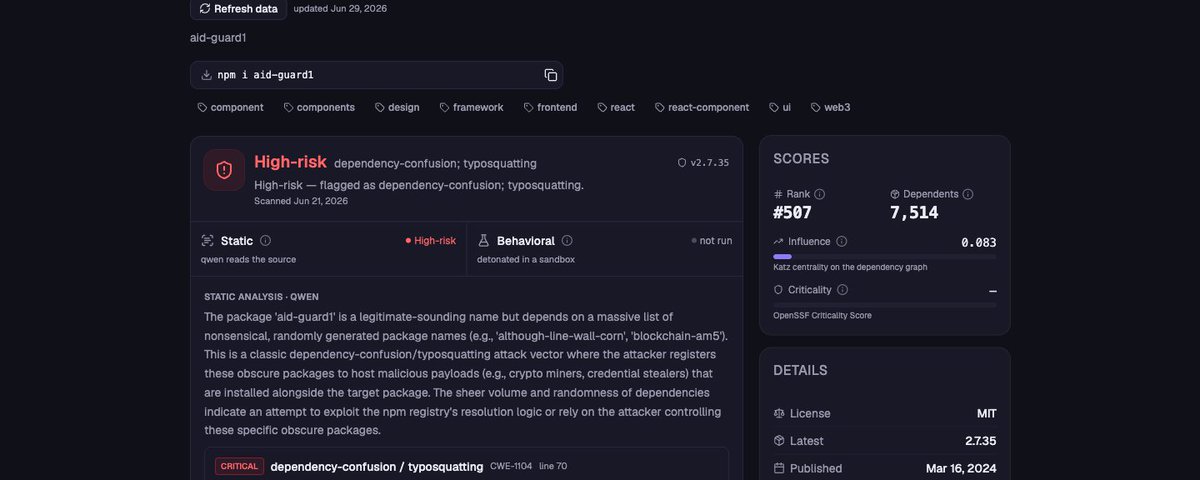
1/ Community Spotlight: OpenSource WTF is live.
@OpensourceWtf is a community-built app that gives people a new way to explore open-source package activity, leaderboard movement, and what is being published across the software graph.
8/ Explore @OpensourceWtf.
Share feedback with the builders.
And to the team behind it:
thank you for building.
Read the full Community Spotlight on the tea blog: tea.xyz/blog/oswtf-is-live