ALI exists to aid students in their path to proficiency in ancient languages | @vergilpress @ekholang | Founders @JRob1572 @HammillRyan
Joined June 2018
- Tweets3.1K
- Following908
- Followers7.2K
- Likes3.3K








Feminism, Sexual Communism, and Philosopher Kings, feat. Daniel O’Toole | Episode CXIX
Three waves: first, equality of the sexes; second, the abolition of the family; and third… rule by philosopher-kings?
In Book V of Plato’s Republic, Socrates guides his interlocutors through three “waves” of objections, each more shocking than the last. Hillsdale philosophy professor Daniel O’Toole joins Jonathan and Ryan to explore what many consider the most radical book of the Republic, from its feminism to its sexual communism. Along the way, they take up the questions that stump nearly every student of Book V: Why does the dialogue take such a dystopian turn? What does equality between men and women have to do with the rule of the wise? And why do the men and women of the city exercise in the nude?


Ancient Language Institute retweeted

All eight books of Thucydides are on Kevilex, in Ancient Greek, and you can click on each word for definitions and to save vocabulary:
kevilex.com/collections/thuc…

Ancient Language Institute retweeted

Last Spring I joined a panel sponsored by @theancientlang on Shakespeare and Liberal Education at @ciceroniansoc. I presented there on liberal education in The Tempest, alongside Kathrine Bradshaw and Jonathan Roberts. My presentation was just posted on "The Sower." Link in reply


Ancient Language Institute retweeted

An amazing company with incredible pedagogy and educational materials. I encourage everyone to study numerous languages with ALI if you are able.

Very nice to be mentioned by Jeanne M. Neumann in TAPA (alongside lots of friends like @LukePolymath @legentibusapp @SaturaLanx_Lat @ProfEricAdler @lacvolo). muse.jhu.edu/pub/1/issue/577…


Very nice to be mentioned by Jeanne M. Neumann in TAPA (alongside lots of friends like @LukePolymath @legentibusapp @SaturaLanx_Lat @ProfEricAdler @lacvolo). muse.jhu.edu/pub/1/issue/577…
Ancient Language Institute retweeted

Clicking to view sensitive content makes you Leontius with a divided soul
This quoted post is unavailable.
Leontius was passing by the corpses of executed Athenians and tried not to look. But eventually, giving in, he ran over and leaned in to stare. "Have your fill!" he shouted at his own eyes.
🖼️ "The Corpses of the De Witt Brothers" by Jan de Baen

Socrates tells this story in Book IV of Plato's Republic, in part to illustrate his theory of the tripartite soul: the desiring, the rational, and the spirited faculty. It is this "spiritedness," the θυμός (transliterated thymos or thumos), that seems so close to desire but also seems to oppose desire.
Ian Dagg joins Ryan and Jonathan to discuss Leontius and the rest of Book IV, including the parts of the soul as they relate to the parts of the city, the impiety of Socrates, and the proper eye color for a statue.
podcasts.apple.com/us/podcas…
Ancient Language Institute retweeted
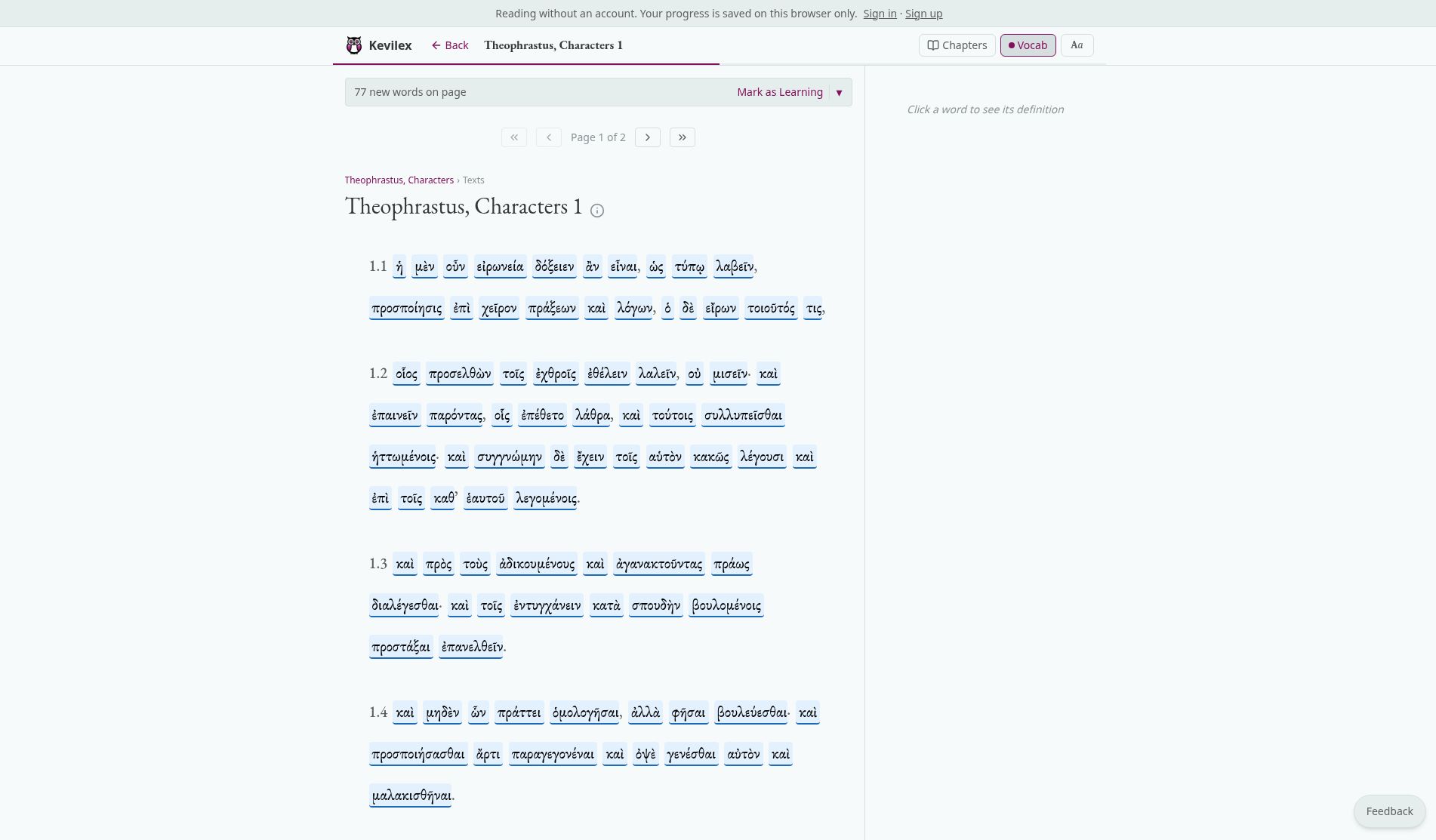
Theophrastus's Characters is now on Kevilex. "Characters" is sketches personality types in Ancient Greek — kevilex.com
Ancient Language Institute retweeted

While on Ekho, you can now log into your Kevilex account and access your saved words and text progress. Thanks @kevinpalbrecht!

Ancient Language Institute retweeted

For those who are tracking the "should children learn philosophy" and want to know more, I recommend this podcast by @theancientlang on my essay related to the subject.
🔗👇

Ancient Language Institute retweeted

"Academic life was dominated by Latin and, to a lesser extent, Greek. The exact share varied, but the classical languages took up generally at least half of teaching hours, and sometimes as much as 80 percent, especially earlier in the century."

Works in Progress: Why were Victorian elites so effective? - The biggest empire the world has ever seen was run by a small elite who partied all night, drank liters of port, and stayed in bed until the afternoon worksinprogress.co/issue/the…

Ancient Language Institute retweeted

While I was on a poetic roll, the possible missing line in Hadrian's little deathbed poem ('animula vagula blandula') came to me (at night, but not in a dream).
Here are my workings and the result.
armanddangour.substack.com/p…
Charondas, one of the great lawgivers of ancient Greece, famously took his own life on the spot, when he realized he'd broken his own law by unintentionally bringing a dagger into the Assembly.
But Charondas' life and legislation are full of other colorful anecdotes, including his ancient analogue to Chesterton's Fence: Anyone proposing a change in the law must place his head in the noose, and if his proposal is not accepted, he is to be hung.
New Humanists+ episode on Underrated Greek Lawgivers in the Bibliotheca Historica of Diodorus Siculus
app.ancientlanguage.com/tabs…

Ancient Language Institute retweeted
Later, Ælfric's pedagogical Latin was glossed in Old English, so the dialogue functions like a medieval Loeb: written in Latin but translated into (Old) English.
Sweet's version in First Steps is just the (Old) English simplified for the (Modern) English student.