

Researcher at @mcgillu combining AI and neuroscience. Also on Bluesky (@tyrellturing.bsky.social) and Mastodon: @tyrell_turing@fediscience.org.
Montréal, Québec
Joined April 2013
- Tweets23.1K
- Following1.8K
- Followers16.1K
- Likes54K





Pinned Tweet
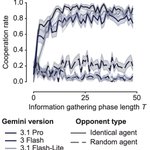
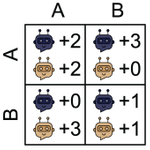
1/15) What could drive AI agents to cooperate with each other, even if there is no chance for reciprocity or pay back? 🤔
🧵 Our team at Google, Paradigms of Intelligence, uncovered new paths to cooperation and a new game theory for foundation models 👇

Blake Richards retweeted

Paper out!
arxiv.org/abs/2610.19487

"How long is the coast of a neuron?
The point neuron — ubiquitous in theoretical neuroscience, hardwired into every neural net — is a ruler. Coarsen it and dendritic computation looks additive. Refine it and a readout gains capacity for free."
Preprint soon. Here is the trailer!
youtube.com/shorts/mkQJfYQDY…
Check out our new model for creating realistic motion in a virtual rat during RL!
I think of this as providing the "brainstem and spinal cord" for NeuroAI researchers who want to simulate realistic neuroscience experiments.
Congrats to @aidan_sirbu for getting this out!

1/14) Virtual animals are a long-standing goal in neuro-AI, but they should actually behave like real animals.
We present SCAMPER: a virtual rat for RL studies that moves naturally during both exploration, and goal-directed behavior.
Project page: aidansirbu.com/SCAMPER-site/
Blake Richards retweeted

Friends in San Francisco: Join me at @longnow on October 22 for a conversation on interdependence with @baratunde.
We'll explore cooperation as the core governing principle of nature and synthetic minds, why intelligence is inherently collective, and what this means for our shared future.
Get tickets here: eventbrite.com/e/on-interdep…


How do we co-create a future with tech that actually serves humanity and the planet? On Oct 22, join @baratunde (creator of How to Citizen & Life With Machines) alongside Google VP @blaiseaguera for "On Interdependence": a 10,000-year look at civic action, Indigenous wisdom, and human survival.
More information and tickets here: na2.hubs.ly/H082rvS0

Blake Richards retweeted

DeltaNet-PC is out! It turns out that predictive coding offered a native mechanism for test-time memorization of sequential data all along. The crucial insight was to treat updates to the fast associative memory as an inferred latent variable, not a long term learned weight.

Blake Richards retweeted

Thank you Rocket Drew @rocketalignment for hosting me on The Information about world models and interp!
Rocket is a precise & careful technical interviewer who is a pleasure to talk to, and who let me go into a technical rabbithole while keeping the convo accessible!

🚀 AI Deep Dive Episode 6: Are We Building World Models The Wrong Way?
@rocketalignment and World Mechanics co-founder @soniajoseph_ explore how models represent physics, whether interpretability could improve training and why language alone may not be enough for physical AI.
00:00 Intro
01:39 What counts as a world model?
07:12 Looking inside models for physical understanding
11:28 Interpretable training and the bitter lesson
19:24 Physics, language and understandable explanations
28:07 Surgical robots and manufacturing
31:10 Language models and recursive self-improvement
38:13 JEPA and specialized world models
45:25 What video models actually learn about physics
Blake Richards retweeted

Mila's annual supervision request process is now open to receive MSc and PhD applications for Fall 2027 admission! For more information, visit mila.quebec/en/prospective-s…

Blake Richards retweeted

Over 400 researchers and I have signed this open letter calling for the AI and security communities to come together to improve alignment and containment approaches in order to protect our critical infrastructure and digital systems.
ai-security-letter.org/

Blake Richards retweeted

Over 400 academics in 30+ countries signed our open letter calling for immediate changes in AI development and deployment practices to ensure that cybersecurity incidents do not continue to occur, as future incidents will be far more damaging to our critical infrastructure.

I signed! This is some common sense stuff.

Blake Richards retweeted
We've released our first blog post on interpretability as a critical ingredient for scaling physical intelligence in a way that is data efficient, generalizable, and verifiable!


Blake Richards retweeted

1/ Why does predicting in latent space (JEPA, CPC, SimCLR...) work so well on messy data, with changing lighting, camera angles, and busy backgrounds? The usual answer: it can ignore nuisance. But that answer holds a conundrum.
Blake Richards retweeted
1/9 New paper led by Michael Hauri & Peter Buttaroni: “Learning Commute-Time-Preserving World Models for Planning.” We show how to shape a world model's latent space so its distances mean something for planning.🧵
📄 arxiv.org/abs/2610.01373
🌐 ctwm-website.github.io/
PSA for all the folks submitting AI generated papers to ML conferences:
ACs are now being given the power to desk reject papers for being incomprehensible, and we will use this power.
Make sure your paper is actually human parsable, FFS!
Blake Richards retweeted

the hardware lottery is also the hardware curse.
with our team, we've been pushing the boundaries of what fully local neural cellular automata models achieve on visual reasoning.
we believe this opens the door to a swathe of efficient, robust, and scalable hardware designs.

Blake Richards retweeted

Can complex multi-step reasoning emerge purely from cells that only talk to immediate neighbors?
Happy to share our paper “Reasoning with Neural Cellular Automata (NCA)”, from our team at Google, Paradigms of Intelligence 🧵👇
I'm super proud of our team's work here, congrats to everyone, particularly @mayalen_etc and @eyvindn!
I'm pretty confident the future of AI lies in more decentralized, recurrent models like these. There are major possibilities vis-a-vis efficiency and robustness, I think.
Blake Richards retweeted
I’ve collaborated with @cvenhoff00 for 2 years across institutions, from VLM failure traces at @MATSprogram to interpretable CLIP at @AIatMeta.
His view on world model & physical interpretability will deeply shape the industry. Excited to keep building this critical field!

I’m excited to share that I am co-founding World Mechanics, a frontier lab working on interpretable foundation models for the physical world, together with @soniajoseph_.
A big reason I’m excited about physical AI is that it gives us a rare opportunity to rethink interpretability from the ground up. For LLMs, much of interpretability is necessarily post hoc, where we take a model that has already been trained and try to reverse-engineer its internal representations, often without clear ground truth for what it should have learned.
For physical AI, we’re still early enough to make interpretability a first-order objective of training itself. Physical systems also give us unusually useful data-generating processes for interpretability. We can intervene on systems in simulation or on real machines, observe how they respond, and make use of known physical structure. This gives us a path toward representations that faithfully abstract the underlying system and remain controllable under intervention.
At the same time, the interpretability problem itself changes. Video and sensor data are not directly legible in the way language is, and models that reason about the physical world learn very different representations from those we see in LLMs. Many interpretability methods developed for language models already do not transfer directly, leaving a lot of fundamental work to do.
This matters because safe and generalizable behavior of physical AI models depends on them learning faithful abstractions of the systems they act on, including the right semantics and causal structure. Current black-box evaluations give us only indirect evidence that these abstractions are correct, since they cannot cover every scenario or explain why a model fails in a particular one. Interpretability-based white-box evaluations, on the other hand, would allow us to understand the model’s representations directly, explain failure modes, and use those insights to improve the reliability and safety of physical AI models.
Because the field is still early, I also care a lot about how the research community around it develops. We want to do as much of our work in the open as possible and collaborate closely with researchers in academia and elsewhere.
If you’re working on related problems, or this sounds like something you’d want to help build, reach out!
Blake Richards retweeted
This week marks one year since “What Is Intelligence?” was published.
It was a really fun book to write. I knew that some of the material would be dated by the time it reached readers. But I hoped that, despite rapid progress in AI, the core ideas about life and intelligence would endure. So far, so good, I think!
Hearing how you have connected with the book has meant so much. Thank you for reading, and an extra big thank you to those of you who have reviewed it, recommended it, or given it to friends.
Blake Richards retweeted

Excited to present this work @NeurIPSConf this December!
Thanks again to my collaborators @fcicala @blaiseaguera @tyrell_turing @natashajaques @maxhkw @eyvindn !!!

Can self-interested, self-improving, self-replicating agents learn to cooperate?
Our new paper, Tapes Together Strong, shows they can: when social behavior, computation, and reproduction share one energy budget, cooperation evolves from scratch.
arxiv.org/abs/2609.10817 🧵
