
ML Research Intern @ Scale AI| MS in Computer Science @ UMD College Park| BS in Stat/ML @ CMU |
Joined July 2024
- Tweets26
- Following38
- Followers39
- Likes14



Pinned Tweet
Post-training makes LLMs safer and better at following instructions, but less diverse.
🤔 Can we get that diversity back without sacrificing alignment?
Introducing ReDiPO: a preference optimization recipe for restoring distributional diversity while preserving safety and instruction-following.

Vinay Samuel retweeted

1/ We taught a team of Inkling 2 Small agents to work together, communicate, and delegate work, without predefined roles on hard chess puzzles. Using our simple multi-agent RL recipe, we are able to turn pass@k into pass@1.
Work with @emilianogl and @GabeVisotsky
🧵
Vinay Samuel retweeted
1/ As agentic tasks grow longer and rollouts become more expensive, the choice between critic-based PPO and critic-free GRPO becomes increasingly important.
Critics can reduce gradient variance, allowing models to learn from fewer trajectories, but they also introduce additional compute costs and potential bias from bootstrapping.
Our new research @ScaleAILabs compares PPO and GRPO under a shared actor objective across 1,200+ training runs in control tasks, short-horizon math, and long-horizon terminal agents. We studied how three factors influence this tradeoff: batch size, critic reliance, and task complexity. 🧵

Had an exciting time leading this work over the summer!
more insightful extensions and results coming soon ......

Practitioners often put a lot of thought in how to best make an environment amenable to LLM agents. Should one build a vector DB? Or alter a tool description? If one has a way to measure the agent on downstream tasks, then existing prompt and harness optimization methods offer several ways to iteratively build and optimize these artifacts. For novel environments, however, we may not know the task distribution till test time. What then?
Our intern @vsamuel2003 spent the summer asking the question: can we use agents to study and preprocess environments much before test time? We found that dynamic agent-based studying methods are often robust and competitive across environment types when compared against existing corpus indexing and self-play methods that were designed for specific niches.
Check out the work here: arxiv.org/abs/2609.10824v1

1
2
350
Vinay Samuel retweeted

Can open-weight language models write long stories?
Not well: either their writing quality degrades at longer lengths or they severely undershoot in length as the requested length grows, if not both.
Frontier models fare better.
This begs the question, can we train open-weight language models to write long stories with limited data and compute?

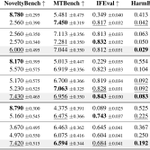
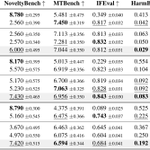
Across Qwen3-4B, OLMo-3-7B, and LLaMA-3.1-8B, ReDiPO boosts NoveltyBench distinct_k over instruct checkpoints by:
📈 +134%
📈 +33%
📈 +44%
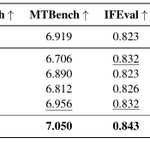
These novelty gains do not compromise instruction following or safety alignment on all tested models.🛡️

Takeaway: alignment should not mean model collapse for distributional diversity.
Base models can be reservoirs of valid alternatives that instruction tuning pushes down. ReDiPO shows how careful preference data can bring those modes back into instruct models. 🌱
1
2
139
Paper: arxiv.org/abs/2605.30021
Code/data: github.com/vsamuel2003/ReDiP…
Work with @YapeiChang and @MohitIyyer
3
135
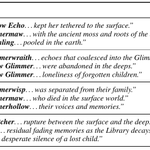
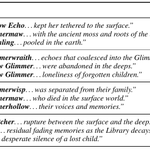
Post-training usually optimizes one answer at a time: helpful, safe, well-formatted. But for brainstorming, creative writing, and hypothesis generation, users often need many distinct valid answers, not multiple samples of the same idea.
ReDiPO uses the base model as a source of missing alternatives. For each prompt, it samples base + instruct responses, rewrites base outputs in instruct style, filters unsafe/low-quality candidates, then forms DPO pairs where quality is matched but marginal diversity differs. 🔁

1
2
224
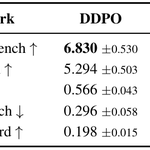
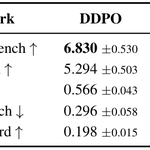
Compared with DDPO, a DPO baseline for creative writing, RiDiPO gives up some raw novelty but keeps the model much more aligned:
✅ MTBench: 5.29 vs 7.38
✅ IFEval: 0.566 vs 0.817
✅ HarmBench ASR: 0.296 vs 0.075
✅ Arena-Hard: 0.198 vs 0.287

1
2
35

Vinay Samuel retweeted

Excited to announce my first preprint in LM interpretability!
Latent reasoning models are not monitorable by default, since they don't reason in human-readable, natural language text. But can we make progress in understanding their intermediate reasoning steps using mech interp?

Vinay Samuel retweeted

LM agents today primarily aim to automate tasks. Can we turn them into collaborative teammates?
Introducing Collaborative Gym (Co-Gym), a framework for enabling & evaluating human-agent collaboration! I now get used to agents proactively seeking confirmation or my deep thinking.