


tigerwallstreet retweeted

Quants are now some of the richest people on earth.
Thomas Peterffy is worth $83.7 billion. Jeff Yass, $77.8 billion. Ken Griffin, $54.9 billion. That's three of the 35 richest people alive, and all three built firms that trade with models.
I mapped 13 of the biggest quant fortunes, $352 billion in total, each with the firm behind it and the style of trading that built it.
This is what math, code and speed are worth rn.


tigerwallstreet retweeted

I earned $1.4M in arbitrage profits on Solana in the last 5 months. Here is how I did it.
A lot of people are messaging me about how to get started so I thought I would make a basic outline.
More detailed article to come so make sure to follow.
A thread 🧵

tigerwallstreet retweeted

I'll never forget this lesson from Druckenmiller.
The best in the world.
But human nature still plays the decisive role in investing.
It's always been that way. And it always will be.


Thoughts of Stanley Druckenmiller
My 20 Favorite Takes
No losing year in 30 years
On Tuesday in Austin he said he cannot remember having less clarity. Ten takes from the stage, and ten hard lessons from my role model and the Goat himself.
Here: thierryvonarvy.substack.com/…

tigerwallstreet retweeted

Jane Street's Eric Mannes, a former commodities trader at the firm who now works on alt data, on Jane Street's Signals and Threads podcast, on why trading is harder than physics:
"In finance, the patterns that you find often get discovered and competed away over time."
"And so you have to keep discovering new things. And then what remains looks ever more and more like a random walk."
"This is why actually our signal-to-noise ratios are kind of miserable."
"When you act in this system, other people respond and change their behavior in ways that weren't visible in your training data."
tigerwallstreet retweeted

This is f*cking insane. Sam Altman runs the most valuable AI startup on Earth, and he just told every 22-year-old they're holding a winning ticket:
"If I were 22 right now, I would feel like the luckiest kid in history.
We are going to see 10-person billion-dollar companies pretty soon"
In 22 seconds, he says the next $1B company won't need an office full of people. Just a few founders and a team of agents
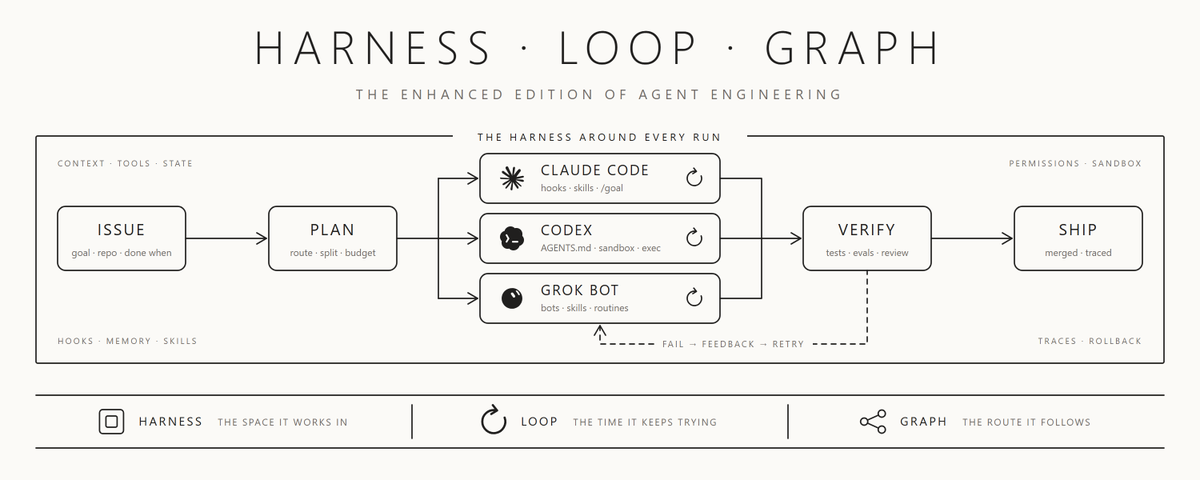
1 Founder → Agents → Harness → Evals → A 10-Person Company Worth $1B
Everything you need to start, free:
A practical guide to building agents
cdn.openai.com/business-guid…
OpenAI Agents SDK
github.com/openai/openai-age…
Codex, the coding agent in your terminal
github.com/openai/codex
AGENTS.md, the README your agents read first
agents.md
OpenAI Cookbook, agent recipes that run
developers.openai.com/cookbo…
OpenAI Academy, free courses
academy.openai.com
LangGraph, agents with memory and loops
github.com/langchain-ai/lang…
Google's Agent Development Kit
github.com/google/adk-python
OpenHands, an open-source AI developer
github.com/OpenHands/OpenHan…
Hugging Face free agents course
huggingface.co/learn/agents-…
Stripe's toolkit so your agents can take payments
github.com/stripe/ai
YC Startup School
startupschool.org
All of this costs $0
The next 10-person billion-dollar company is being built by someone with these links open right now
Then read how to build the harness, loops and graphs that run it in the guide below ↓

tigerwallstreet retweeted

F*CK YES... MIT students found the CHEAT CODE to Jane Street's trading challenge: an $8,000,000 P&L in one hour from 51 lines of Python
the cheat code: never guess direction - quote $1 under & $1 over the last trade & take a cut of EVERY trade, about 5,000 a round
it's called market making, the same game Jane Street plays for real
first understand how this works:
> Jane Street gave every team a fake exchange: 7 symbols, rival bots & thousands of trades in every 5-minute round
> the bot takes the last traded price as fair value & quotes $1 under & $1 over it, so its orders fill first
> it went from $300 a round with arbitrage to over $10,000 a round with this, & the final hour closed at $8,000,000
how to run it with Claude Code:
1. tell Claude Code to clone github.com/EnriqueKhai/JaneS… & hummingbot/hummingbot
2. have it read market_maker.py: the whole winning strategy is 51 lines
3. ask Claude to port it into a Hummingbot script: fair price = the last trade, one buy just under it, one sell just over it, cancel & replace on every new trade
4. start it on binance_paper_trade with BTC-USDT: live Binance data, no API keys
5. let it run a full session & save every fill to a csv, the one thing the winners said they wish they'd done
6. ask Claude to add an inventory cap, so the bot stops buying when it holds too much
7. have it widen the spread when BTC gets volatile: the challenge's bots were calm & real markets aren't
8. compare its P&L per hour with Hummingbot's own simple_pmm script
9. move to a live account only when a week of paper fills holds up
i won't say anything more:


tigerwallstreet retweeted
The complete roadmap to becoming a quant: the foundation every firm builds on, the engineering edge and the one thing that separates the best.
tigerwallstreet retweeted
Quant firms have quietly become the biggest money makers in finance.
Jane Street made $39.6 billion last year, and this year it has already passed $40 billion. Two Sigma manages about $65 billion for its investors.
I put 14 of the biggest trading firms on one chart, from the ones trading in microseconds to the ones holding for years, each with its latest public figure.
This is the real map of modern markets.


tigerwallstreet retweeted

I still don’t understand why everyone is not doing this yet. Elon Musk reposted my Grok Bot GUIDE, and using this exact agent setup, I made $7,350 last week alone
Eight Grok agents on the desk, $200 a month, running a floor that usually costs a crypto fund $580K a year in analyst salaries
The morning call is at 4:30. I am not in it
1. SEARCH finds early alpha, dev GitHubs, and hidden Telegram signals before CT notices them
2. RISK checks contract code, mint permissions, and LP locks, blocking honeypots before entry
3. SNIPER sends fast on-chain orders the exact millisecond safety checks pass
4. WHALE monitors smart money wallets and flags big accumulation live
5. RUG watches dev wallets 24/7 and sells everything if LP is touched
6. EXIT moves stops dynamically, taking profits as liquidity grows
7. SHILL tracks social buzz, hype speed, and major influencer mentions
8. HEAD OF DESK never trades, routes data, checks handoffs, and brings me the one call needing a human
371 tokens scanned, 28 qualified setups, 13 executed trades while I was asleep. Net result: +$7,350 after fees and zero bad fills
Each agent runs its own cloud browser, terminal, and memory. The desk stays active with my laptop closed
Setting this up is easier than it looks:
Install Grok Bot and build your Head of Desk
Give the other 7 agents role descriptions like briefing new hires
Demo the workflow once on your screen while they watch
Link your Telegram and wallet webhooks
No VPS, no coding, no waiting for devs
Trading crypto used to mean 16-hour screen time, paid alpha groups, and burnout. I built mine in one evening
Bookmark this before your next trade


tigerwallstreet retweeted

i made $1.2m devving memecoins and decided to put the entire method out for free.
just dropped a 15-minute video going through how i got started, what i did, the opportunities i took and what i'd focus on if i had to start from zero today.
no course, no paid group, none of that.
just sharing what actually worked for me.
if you've ever wanted to get into devving, give this a watch. you might be sitting on an opportunity you've been overlooking.
tigerwallstreet retweeted

BREAKING: An Anthropic researcher says AI will likely leave “pretty much all humans on Earth” permanently unemployable and dependent on government welfare.
Tao Lin, who works on safeguards for Anthropic’s Claude models, said in an interview with Palisade Research that he expects “broadly superhuman AI,” as good as or better than the best human expert in almost every field, by around the end of 2027.
He said people would eventually “need to strictly rely on government welfare to sustain themselves.” But he doesn’t expect mass unemployment by 2027. He sees a gradual transition in which workers first lose their current roles and move into temporary jobs, partly because “there aren’t enough robots yet.”
“People should be angry at me and everyone else developing AI,” Lin said.
tigerwallstreet retweeted

19 year old Japanese student built an AI trading bot in just 48 hours.
Used his iPad as a second monitor.
First night: $6,732 profit.
Starting capital: $68.
Total profit so far: $750,000.
[ 𝐍𝐨𝐭𝐞: 𝐅𝐨𝐥𝐥𝐨𝐰 𝐌𝐞 @zakiraicoder 𝐅𝐨𝐫 𝐢𝐧𝐬𝐭𝐚𝐧𝐭𝐥𝐲 𝐚𝐮𝐭𝐨 𝐃𝐌]
Here's how it works 👇
The bot monitors over 50 markets simultaneously.
Syncs live BTC data from Binance.
Uses Grok for analytical reasoning.
Identifies potential price discrepancies before manual traders notice them.
→ Grok handles trading logic
→ Binance API provides real-time market data
→ AI analyzes price movements
→ The dashboard monitors multiple markets
→ Automated rules evaluate potential opportunities
No endless chart watching.
No emotional decisions.
Just data, automation, and pattern recognition.
Most people are still manually checking charts.
Meanwhile, automated systems can analyze multiple markets simultaneously.
{ Only for educational purposes. Not financial advice }
I'm giving away the exact Grok Bot setup for free.
24 hours only.
To get it 👇
1️⃣ Comment " Setup "
2️⃣ Like and Repost
3️⃣ Follow @zakiraicoder (so I can send it via DM)
tigerwallstreet retweeted
EVERY MAJOR MODEL IN QUANT FINANCE FITS SOMEWHERE ON THIS CHART.
From classic statistics to neural networks to large language models, each one is placed by how complex it is and how much data it needs to learn.
Each one comes with its role inside a fund, the research behind it, and the math that decides which model wins.
Start here before you build anything.

tigerwallstreet retweeted

Jane Street made $39.6 BILLION last year. In 2013 they built a card game called Figgie to teach new traders ONE thing.
Your biggest pile of cards is almost always WORTHLESS.
This f*cking formula shows why your longest suit pays NOTHING 80% of the time.
I ran the math on 200,000 hands.
6 spades on the deal - each spade worth $1.16. Each club worth $6.09.
10 cards in hand - best guess is right 38%. Never 90% sure.
Longest suit is the goal only 21% of the time. Worse than random.
Same game. Same hand. Different information. Different price.
P(deck) ∝ ∏ C(suit size, cards held)
Holding 6 cards of a suit is 5x more likely if that suit has 12 cards than if it has 8. Bayes flips it: your longest suit is probably the 12. And the 12 never pays.
Your own hand gives 38% accuracy. 30 cards of information gives 64%. The only way to see the other 30 is to TRADE.
Your private information is a starting estimate. Always wrong. The price is everyone's information at once.
The full paper is below.
Bookmark before it's buried.


tigerwallstreet retweeted
FIRMS LIKE JANE STREET AND CITADEL RUN ON ENGINES LIKE THIS.
From the moment a price moves on the exchange to the moment a new order goes back out, every step of a market maker’s engine is designed on one page.
Here’s the system behind that speed: every component from the network card to the order gateway, the math behind every quote, and the engineering rules that hold it all together.
This is the machine at the center of modern markets.

tigerwallstreet retweeted

24 Chinese researchers taught an AI to breed trading signals like livestock: mutation, crossover, survival of the fittest. Then they put the code on GitHub for free..
This is free f*cking gold for anyone who trades...
Every search for a trading factor is an animal. Weak ones die, strong ones mate, and by generation 12 about 350 survivors are left.
Mined on Chinese stocks, moved to the S&P 500 untouched: +137% excess return over 4 years. It beats Microsoft's own RD-Agent by 17.8% a year.
-> Only 388 stars. Almost nobody has seen it.
How to run it on your laptop, step by step:
Step 1 -> paste the prompt below into Claude Code, it reads the official repo and installs everything in its own environment.
Step 2 -> plug in any OpenAI-compatible key. The paper used GPT-5.2, a cheaper model works for the first run.
Step 3 -> it pulls the market data the repo ships on Hugging Face, no exchange account, no paid feed.
Step 4 -> start the evolution: 10 generations, each one mutates the bad steps of a factor and crosses the good halves of two others.
Step 5 -> the killer part: every factor must keep its hypothesis, its formula and its code saying the same thing, or it gets thrown out. No lucky noise survives.
Step 6 -> you get the survivors ranked by IC, with their formulas in plain text, plus a backtest with return and drawdown.
Step 7 -> change one line to test the same factors on a different market or a different model.
The result: the factor-mining engine a quant fund hides behind an NDA, evolving on your laptop while you sleep.
Run it today.
Full prompt in the first reply ↓


tigerwallstreet retweeted
Jane Street made $39.6 BILLION last year. Partner capital only. Not one outside dollar allowed.
Renaissance's Medallion caps at $15 BILLION and sends the rest back. 40% a year since 1988.
This f*cking formula shows why they both say NO.
I ran the math on the capacity ceiling.
$5 BILLION fund - earns $3.3B a year.
$15 BILLION fund - earns $6B a year. Peak.
$30 BILLION fund - earns ZERO. Same edge, twice the size.
Same strategy. Same people. Different size. Different fate.
Profit = Capital × (α − β × Capital)
Peak at Q* = α / (2β). At twice the optimum, the market pushes back exactly as hard as the strategy pushes forward. Dollar profit = 0.
In 2020 Medallion made 76%. The same firm's funds open to outsiders LOST 23% and 34%. Not a different manager. A different size.
Scaling didn't clone the edge. It replaced it.
The optimal size of an edge is a function of the edge, not of how much money wants in.
The full paper is below.
Bookmark before it's buried.

tigerwallstreet retweeted

Ted Weschler turned a $70,000 retirement account into $264 million. Then he paid $5,252,722 for two lunches with Warren Buffett, and the second one ended with a job offer.
At Berkshire, he made one rule: don’t trust the CEO.
In the video below, Weschler explains why he refuses to meet the bosses of companies he buys: “I made a couple big mistakes where I got involved in situations where I liked people too much.”
In 1989, he left W.R. Grace and became a partner at private equity firm Quad-C. His IRA then held about $70,000.
In 1999, he started his own hedge fund, Peninsula Capital Advisors.
In 2010, he bid $2,626,311 at a charity auction to have lunch with Buffett. In 2011, he bid $2,626,411 for a second one.
At that second lunch, Buffett offered him a job. In 2012, he joined Berkshire.
That same year he converted his IRA to a Roth, paying over $28 million in federal tax.
In March 2014, he told CNBC that CEOs are “really good” salesmen who “probably spin people.”
His fix: “rely on reading transcripts, 10-Ks, 10-Qs.”
By 2018, his IRA had reached $264 million, columnist Allan Sloan reported.
Today, Weschler is expected to become Berkshire’s top stock picker as Greg Abel takes over, Barron’s reported.
Would you trust a CEO you liked, or only the numbers on paper?