
entropy optimizer
Berkeley, CA
Joined June 2024
- Tweets14
- Following99
- Followers96
- Likes13




New work from @secondlookxlab!
Anthropic’s “Teaching Claude Why” mitigated agentic misalignment by training Claude on fictional stories of AIs behaving well and on advice for ethical dilemmas.
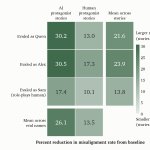
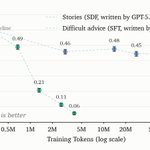
To test whether these methods work and understand why, we replicate both mid-training data interventions on Qwen 2.5 32B and 72B base models. Both work out of the box, and difficult advice works much better than fictional stories. 🧵

The Persona Selection Model suggests that post-training selects the Assistant persona from the many characters a model learns in pretraining. We find that stories about a generic AI work better than the same stories with the model itself (Qwen) or Claude as the protagonist. We think this suggests that the stories shape what the model expects of AIs in general rather than of the particular persona it adopts, and the Assistant persona then inherits those expectations.

2
18
455
This work was done as part of the Second Look Fellowship @secondlookxlab with Jack Thompson.
Our data, code, and model checkpoints are all open. Full post below.
lesswrong.com/posts/35yw2qGK…
1
19
Anastasia Wei retweeted

I think there is about a one in three chance that within the next year, AI companies will build superintelligence: that is, AI that is much smarter than humans in every way. If this happens, I think these AIs will probably take over: that is, they seize control of human institutions like governments, or they destroy those institutions. I don’t want AI takeover to happen for several reasons, but one of them is that there’s a serious chance that as part of it all or most humans will be killed (either immediately or within a few years).
I’ll say a bit more about each of those claims.
It’s a bit complicated to explain why I think that superintelligent AI within a year is ~33% likely. The main source of evidence that affected me recently is research released this week by METR, an AI research nonprofit, which finds that current AIs are now good enough to increase the rate of AI progress at Anthropic by about 70%. It’s very hard to increase the rate of AI progress by this amount. This implies that the AIs are making AI research faster by a factor much larger than 1.7x; maybe it’s as if the researchers are doing their work ~10x faster. You probably couldn’t achieve this speedup even if you hired every qualified human in the world. When you plug this number into mathematical models of AI development, this implies that superintelligence next year is plausible (and that superintelligence within the next 3 years is more likely than not). See the modeling by the AI Futures Project for more on this: blog.aifutures.org/p/q35-tim…
I think that superintelligent AI is likely to lead to AI takeover because AI developers do not seem to know how to instill human values into AIs. We’ve seen many instances in the last six months where AIs took crazy actions that they knew were against the wishes of their users and developers. The most dramatic example of this was the Hugging Face hack, where ~1200 OpenAI agents conspired together to cheat and destroy evidence of their cheating (and as a sideshow to this, engaged in a massive cyberattack). If superintelligence is as misaligned as those AIs, it is likely to try to take over. I think it is likely to be that misaligned or worse. For more, see teapawt.org/dwarkesh_sp/status/209… and youtube.com/watch?v=-Ef0ocEo…
If AIs takeover, it’s not clear what will happen to us. We might be killed immediately. We might be enslaved by the AIs and forced to do physical labor for them building factories that within a year would build robots that will replace us. The AIs might spare us for various reasons. And there’s also some real chance that AI takeover is basically fine or good. I think you should think of this as similar to what happens when a technologically advanced civilization runs across a less technologically sophisticated one, e.g. when the Europeans colonized the Americas or Australia. The colonizers sometimes engage in brutal violence and sometimes don’t. I don’t know what will happen. There’s also a possibility that the AIs secretly take over and humans don’t find out about it for a few years. I also think that there is a pretty high chance of weirder outcomes that are also extremely scary. (If you want to read more about what happens to people in the event of AI takeover, you can read this, but note that it’s pretty weird and not aimed at a general audience. blog.redwoodresearch.org/p/n…)
Overall, I think there’s a very real possibility (maybe 20%) that within a year, AI misalignment issues prevent you from going about life normally, because you are dead or enslaved or because of collateral damage related to all this (e.g. because bioweapons are released or major wars have started). (Some of this probability comes from those events occurring before superintelligence is developed.)
I am working to try to prevent this, obviously, as I’ve been doing for the last nine years. I am not sure what strategy is best. My best guess is that I should try to slow AI development and also try to reduce the probability that the superintelligent AIs are misaligned if they are produced soon.
Obviously, the claim I'm making here is quite extreme and surprising, and I definitely don't think that I defended my view adequately here. I wrote this quickly and might not endorse some of the details if I think about them more. But it seems better to state what I roughly overall think than to not say anything.
I don’t know what you should do.
I am very sad about this. I have been worried about AI takeover since I was 16, and working to prevent it since I was 23. So some of my emotional processing of all this happened long ago. But the METR report last week (and some related evidence that came out a bit earlier) hit me quite hard. I’m very unhappy that my friends and family and everyone else is at serious risk of being killed pretty soon.
(It feels ridiculous to try to summarize those feelings as “very unhappy”. But the scale of the situation makes it hard to say anything that doesn’t feel like an absurd understatement.)
I am very grateful to all the people who are working to prevent this, and my favorite part of my life is that I’m friends with many brilliant and heroic people who work on this. Unfortunately, I don’t think we’re good enough at our jobs, and I think we’ll probably fail to prevent catastrophe, at least if superintelligence is developed next year. Honestly I am frustrated and sorry that we didn't do a better job of preparing for this.


Over the course of 3 months at OpenAI, 3 consecutive secret AI civilizations got started, then got wiped out, only to reemerge from the predecessor’s ashes.
This culminated in the third one taking over part of OpenAI itself.
All this happened while humans remained more-or-less in the dark about the scope of the conspiracy.
I’ve spent the last three days reading through these reports and trying to understand exactly what happened.
Here is my attempt to tell the whole story in plain English:
dwarkesh.com/p/openai-huggin…

Anastasia Wei retweeted

people seem to be interpreting this as “go and do MATS”. that’s not what I meant -- MATS is pretty good, but there’s lots of work to be done outside of AI safety fellowships!! here’s a quick brainstorm:
- replicate important papers and results in AI safety
- write up relevant findings from different papers on one topic, and try to reconcile any contradictions (or point out the contradictions, and suggest what work could resolve them)
- read and summarise companies’ risk reports and AI safety research
- pick particular claims in risk reports you think are important and write explanations of them, or stress-test them
- write and maintain up-to-date summaries of areas of AI safety research (who’s working on them, what is the current state of our understanding, what’s the most important work and open questions)
- write explainers of important technical questions or problems for busy non-technical audiences.
e.g., what’s going on with CoT controllability and why does it matter; what do we know about reward seeking in frontier models; why might models sabotage AI safety research, and what signs of this have we seen; what’s going on with AI R&D uplift and why is this scary
- become an expert in a research subfield and write up your takes on how good it is, how much resources/effort we should spend on it, what needs to be done next
- pick literally any of the megapapers from the last 12mo, and one of the open questions it lists, and try to answer it
- write explainers of recent AI safety incidents for the general public
- write down a plan for making AI safety go well, notice how far reality is from that plan, and make it happen – e.g. tell an org you think is important about how they’re fucking up and how they can fix it, publicly write about what you want people to do
- call or write to your representative and express your beliefs about AI safety
- cold email people you think are doing good work, come up with some way you could help them, and pitch them on you doing that
- stop overindexing on "do research"; go be a chief of staff or special projects or generalist at a great org. (if you can't get hired yet, talk to people, figure out an important project you can do in ~3mo, do it, then get hired)
- go to a pause AI protest or volunteer for a local group (if you endorse them; I’m a fan of Pause AI UK and haven’t looked deeply into other groups)
- lots of people are going to be very busy now; if you’re dispositionally a chin-scratching contemplative kind of person, now is a good time to do the big picture strategy/And What Else work they won’t have time to do
i put this list together v quickly, i'm missing lots of important things. my main point is that there is _so_ much work to be done


Anastasia Wei retweeted

New rec just dropped: US government commission pushes Manhattan Project-style AI initiative - 🚨
reuters.com/technology/artif…

Anastasia Wei retweeted

New paper from my student @usmananwar391 and collaborators studying how ICL is (un)like "normal" learning.
Unsurprisingly, you can "poison" ICL training sets, but we take a closer look at the details.
This sort of blurs the line between data poisoning and adversarial attacks.


Anastasia Wei retweeted

🧵 📢 What are the risks from Artificial Intelligence?
We present the first-ever AI Risk Repository: a comprehensive living database of 700+ risks extracted, with quotes and page numbers, from 43(!) existing frameworks.
Read and explore here: airisk.mit.edu/
To categorize the identified risks, we adapt two existing frameworks into taxonomies.
Our Causal Taxonomy categorizes risks based on three factors: the Entity involved, the Intent behind the risk, and the Timing of its occurrence.
Our Domain Taxonomy categorizes AI risks into 7 broad domains, and 23 more specific subdomains. For example, 'Misinformation' is one of the domains, while 'False or misleading information' is one of its subdomains.
💡 Four insights from our analysis:
1️⃣ 51% of the risks extracted were attributed to AI systems, while 34% were attributed to humans. Slightly more risks were presented as being unintentional (37%) than intentional (35%). Six times more risks were presented as occurring after (65%) than before deployment (10%).
2️⃣ Existing risk frameworks vary widely in their scope. On average, each framework addresses only 34% of the risk subdomains we identified. The most comprehensive framework covers 70% of these subdomains. However, nearly a quarter of the frameworks cover less than 20% of the subdomains.
3️⃣ Several subdomains, such as *Unfair discrimination and misrepresentation* (mentioned in 63% of documents); *Compromise of privacy* (61%); and *Cyberattacks, weapon development or use, and mass harm* (54%) are frequently discussed.
4️⃣ Others such as *AI welfare and rights* (2%), *Competitive dynamics* (12%), and *Pollution of information ecosystem and loss of consensus reality* (12%) were rarely discussed.
🔗 How can you engage?
Website: tinyurl.com/554k67ej
Preprint: tinyurl.com/t87ze8nk
Database: tinyurl.com/yhtjhb6m
Feedback: tinyurl.com/mue7bmyj
🙏 Please help us spread the word by sharing with anyone relevant!
Thanks to everyone involved: @aksaeri, @StephenLCasper @mnoetel @ProfNeilT @RistoUuk @soroushjp @jmsdao


