

Research Scientist at DeepMind. Former grad student at NYU, MIT undergrad, and YC founder.
San Francisco, CA
Joined April 2007
- Tweets886
- Following313
- Followers1.7K
- Likes1.7K





It was pretty funny following the chat thread as George worked on this over a weekend. "i said good job do 2x 6 hours ago and still hasnt stopped" "Lets goooo 🔥" and the numbers just kept getting better

Is it possible to make 3D Gaussian Splatting even faster?
Short answer YES!
Enjoy a 10.5x optimization on forward/backward cuda kernels over the published 3DGS ones!
grgkopanas.github.io/3dgs_cu…

1
3
661
Genie 4 is out! If Genie 3 felt like a simulation of a video game, Genie 4 feels like an interactive movie. The visuals are much more realistic, audio makes it feel immersive, and you can prompt for whatever you want during the experience.

@BenMildenhall can I play with Atlas? I want to do this house I just looked at 😅 zillow.com/homedetails/87-Bu…

2
199


So sick! Better world models are going to unlock so many use cases like this
Genie 3 🤝 @Waymo
The Waymo World Model generates photorealistic, interactive environments to train autonomous vehicles.
This helps the cars navigate rare, unpredictable events before encountering them in reality. 🧵
2
8
752
Come work with Joe and you’ll sit by me, @poolio, @jon_barron, @RuiqiGao, @holynski_, @tkipf, and many other fine folks!

Every smart home product except lights would be better as a manual product operated by a robot
1
199
This is exactly the kind of stuff I was talking about with willwhitney.com/computing-in…

"Chatting" with LLM feels like using an 80s computer terminal. The GUI hasn't been invented, yet but imo some properties of it can start to be predicted.
1 it will be visual (like GUIs of the past) because vision (pictures, charts, animations, not so much reading) is the 10-lane highway into brain. It's the highest input information bandwidth and ~1/3 of brain compute is dedicated to it.
2 it will be generative an input-conditional, i.e. the GUI is generated on-demand, specifically for your prompt, and everything is present and reconfigured with the immediate purpose in mind.
3 a little bit more of an open question - the degree of procedural. On one end of the axis you can imagine one big diffusion model dreaming up the entire output canvas. On the other, a page filled with (procedural) React components or so (think: images, charts, animations, diagrams, ...). I'd guess a mix, with the latter as the primary skeleton.
But I'm placing my bets now that some fluid, magical, ephemeral, interactive 2D canvas (GUI) written from scratch and just for you is the limit as capability goes to \infty. And I think it has already slowly started (e.g. think: code blocks / highlighting, latex blocks, markdown e.g. bold, italic, lists, tables, even emoji, and maybe more ambitiously the Artifacts tab, with Mermaid charts or fuller apps), though it's all kind of very early and primitive.
Shoutout to Iron Man in particular (and to some extent Start Trek / Minority Report) as popular science AI/UI portrayals barking up this tree.

10
10
432
The future of AI is models that generate graphical interfaces. Instead of the linear, low-bandwidth metaphor of conversation, models will represent themselves to us as computers: rich visuals, direct manipulation, and instant feedback.
Right now we're a little stuck thinking about AI as a person, which comes with the baggage of how we interact with people. But large models don't have the same limitations as humans.
willwhitney.com/computing-in…
The UI space for interacting with LLMs is super under-explored. Why “chat” as a metaphor? Why should conversations be linear? At the end of the day, we’re just constructing a context. Personally I’d love easier ways to mix and match bundles of background info and assets
🌲 chat-tree 🌲
The problem with current chat interfaces is that they restrict conversation to only a single thread.
Introducing chat-tree, chat-tree-inky.vercel.app/, a tree-structured chat UI!
A 🧵 of examples:
Ex 1: exploring alternative decisions (from @KaitlynHennacy)
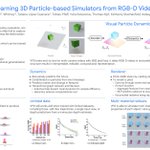
Come check out our Visual Particle Dynamics poster this morning at ICLR (board #60) to see find out how to train 3D dynamics models from 2D data!

@_akhaliq new work on nerf + physical dynamics may be interesting to you!

Visual Particle Dynamics (VPD) is a new model that combines graph networks and NeRF for end-to-end, physically accurate 3D simulation + rendering that you can train on RGB-D video. New ICLR paper!
arxiv.org/abs/2312.05359
willwhitney.com/learned-simu…
🧵
1
193
Visual Particle Dynamics (VPD) is a new model that combines graph networks and NeRF for end-to-end, physically accurate 3D simulation + rendering that you can train on RGB-D video. New ICLR paper!
arxiv.org/abs/2312.05359
willwhitney.com/learned-simu…
🧵

also available @wfwhitney@sigmoid.social so the cool researchers don't leave me behind
2
Very excited to see a new venue reviewing only the substance of the claims in a paper rather than having reviewers try to guess how influential a work will be!

TMLR:
- Uses OpenReview
- Focuses on conference-length publications
- Has no submission deadlines
- Aims for a fast turnaround
- Acceptance based on matched claims and evidence, not potential impact
3
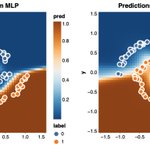
If you want to improve a policy based on a fixed batch of data, it's surprisingly hard to beat a single step of policy iteration.
Stop by our poster at 4:30PM GMT / 11:30AM EST to learn more about what makes offline policy evaluation so tough! neurips.cc/virtual/2021/post…

If you’re at #NeurIPS2021, come check out our poster for our spotlight paper “Offline RL Without Off-Policy Evaluation” at 11:30 EST at spot F3.
We examine why performing just one step of policy improvement provides a strong baseline for offline RL.
openreview.net/forum?id=LU68…

It finally happened: I finished my PhD, moved to London, and started a job at DeepMind! Friends in London, I would love to see you!
Very cool theory work studying representations for RL and the properties they induce for value and policy functions!

Excited to present our #AAAI2021 paper “Metrics and continuity in Reinforcement learning” with @marcgbellemare and @pcastr tomorrow ! We propose a new perspective on representation learning and generalization in RL 🌟
📜Paper: arxiv.org/abs/2102.01514
Intro Video👇 1/8
2
New blog post: training neural nets in parallel with JAX willwhitney.com/parallel-tra…
Small MLPs are 40000x smaller than a ResNet-50, but they only train 400x as fast. Training 100 in parallel gives you the missing 100x speedup. This post is a how-to.
