
Climate scientist at Uni of Oxford AOPP studying deep convection. Supporting inclusivity in academia. Who knew looking at pictures of clouds is a job? (he/him)
- Tweets58
- Following452
- Followers79
- Likes1K








ALT A profile strip over North America, captured on 4 August by the atmospheric lidar.


ALT Two heatmaps showing how the instantaneous cloud radiative effect of anvils changes according to their temperature and time of observation, and how the lifetime cloud radiative effect changes according to temperature and time of initiation. At nighttime, anvils have a warming effect which is stronger for colder anvils, however during the daytime they have a cooling effect due to the reflection of solar radiation. Anvils that initiate during the morning tend to have the strongest cooling effect. Colder anvils also tend to be longer lived, meaning that they show less variance in the lifetime cloud radiative effect due to their time of initiation. This means that the radiative effect of smaller, warmer, isolated deep convective clouds is more sensitive to the diurnal cycle than larger, organised convection


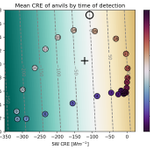
ALT A plot of the mean shortwave anvil cloud radiative effect vs longwave cloud radiate effect for deep convective clouds grouped by the hour of day that they initiate. The background colouring of the plot shows weather the anvil has a net cooling effect (blue-green) or warming (orange-brown). DCCs initiating from 6pm-midnight have little SW effect, and so are warming. Cloud initiating after midnight see large increases in SW and a small decrease in their LW effect until the cooling effect peaks at 8-9am with net CRE of ~-220Wm-2. In the afternoon, more intense convection over land results in higher, colder cloud tops with larger LW CRE which peaks at 2-3pm when the net CRE of anvils is near 0. The black cross shows the mean CRE of all anvils, which is slightly cooling (~-20Wm-2), and the black circle shows the area and lifetime weighted CRE which is approximately 0Wm-2 due to larger, longer live anvils tending to exist into the nighttime.


ALT A scientific poster titled “The diurnal cycle of the cloud radiative effect of deep convective clouds over Africa from a lagrangian perspective”. Cloud tracking techniques are used to study deep convective clouds in geostationary satellite data. It shows that while the average cloud radiative effect is near 0, the distribution is bimodal. Clouds which initiate during the day are strongly cooling, whereas those which initiate at nighttime have a warming effect. This effect is larger for isolated, short-lived convection than for longer-lives clouds.

