

Consider donating 10% to effective charities: https://xitter.cf/t.co/VMXkr4hnd7 Or a career for impact: https://xitter.cf/t.co/AUIhrElLkr My research: https://xitter.cf/t.co/dEcMWUnNHU
Oxford
Joined August 2011
- Tweets1.4K
- Following1.4K
- Followers63.7K
- Likes1.3K






Pinned Tweet
Effective altruism is like democracy: You can be strongly pro-democracy *and* strongly pro one particular party.
Similarly, you can be in favour of effective altruism while also being in favour of one cause area over another. It would be weird if you weren't!
I'm happy if someone is pro-EA even if I disagree with them on all manner of philosophical and empirical judgment calls about how to do the most good.
xitter.cf/sapinker/status/210799…

I remain an advocate of EA in its original formulation: I donate 10% of my income to effective charities (saving lives in the developing world); am on the Board of Advisors of Harvard undergrad EA; and teach a course ("Rationality") with a section on EA. But I was stunned as Will MacAskill gave a guest lecture in the course announcing the transition of EA from saving the lives of actual people today to safeguarding hypothetical consciousnesses in an intergalactic cloud in the distant future, and I quickly jumped off that train. Still favor generous and effective philanthropy.
William MacAskill retweeted

Would you spend $5000?

William MacAskill retweeted

Important, and I'm glad this is finally public. Google DeepMind researchers are under in perpetuity non-disparagement clauses forbidding them from ever speaking critically of the company. I'd already confirmed this with multiple people.
Yes, some ex-employees have spoken out nonetheless. But it has also discouraged others from doing so. And yes, it most certainly has a chilling effect with regards to discussions on safety and risk.
Others have written compellingly about how important the ability to speak freely and critically is, especially on topics like safety and risk. And what a testament to the research employee community's coordination and hard-won bargaining power it has been to get there at other companies.
GDM burn that commons by having this. And everyone who signs burns that commons too. Let's get it changed.

Congrats to Sofia for having the courage to resign and speak out!
This is also very important:
Staff are scared to speak out about AI safety and its uses in warfare because their employment contracts prohibit them from publicly criticising the company.
bbc.co.uk/news/articles/cmre…

William MacAskill retweeted

With effective altruism in the news a lot more, I wrote about the version of EA I'm most excited about and the direction I'd like the movement to go. These 6 points are my vision of EA in a nutshell:

William MacAskill retweeted

Thomas Clarkson winning a Cambridge essay prize for arguing against slavery
...then realising if his essay is right he needs to dedicate his life to fighting it
...then actually doing it
...is the most EA thing ever

William MacAskill retweeted

Sharing an exciting announcement from our friends at the LSE!
The 1st London Workshop on Global Priorities Research
We are currently inviting applications to attend the 1st London Workshop on Global Priorities Research, which will be held at the Lakatos building at the LSE on the 16-17 December 2026. The current list of speakers includes Jonathan Birch, Heather Browning, Hilary Greaves, Cameron Kirk-Giannini, Harry Lloyd, Jeff Sebo, and Christian Tarsney.
Talks will address philosophical questions relevant to identifying, prioritising among, and addressing the world’s most pressing problems, such as the potential for transformative AI and ethical challenges likely to arise as a result, how to weight the impacts of our actions on different kinds of minds, and foundational topics relevant to ethical prioritisation.
If you'd like to attend the workshop, please complete this brief application form by the 15th of November.
forms.cloud.microsoft/Pages/…

William MacAskill retweeted

Can I give you 10% of me?
By Opus 5.5🧡

"Effective altruism is directionally correct, even if you should not follow its recommendations all the way."
@tylercowen self-recommending as usual
thefp.com/p/in-defense-of-ef…

Or like science. Two people can both be pro-science while violently disagreeing, both about what theories are true and even about methodology, too.
The aspiration of EA is to do for the pursuit of good what science did for the pursuit of truth.

Effective altruism is like democracy: You can be strongly pro-democracy *and* strongly pro one particular party.
Similarly, you can be in favour of effective altruism while also being in favour of one cause area over another. It would be weird if you weren't!
I'm happy if someone is pro-EA even if I disagree with them on all manner of philosophical and empirical judgment calls about how to do the most good.
xitter.cf/sapinker/status/210799…
William MacAskill retweeted

Two other safety researchers and I were fired from OpenAI last week. We wrote this letter to leadership.
I believe we were fired for prioritizing safety over the near-term interests of OpenAI as a corporation.

William MacAskill retweeted

Last week I was called into a meeting with OpenAI’s head of safety and told they no longer trust me. A security guard took my badge and walked me out of the building. Then I learned my colleagues @balesni and @j_asminewang had been fired too. Why did OpenAI suddenly stop trusting us?
This summer OpenAI’s agents escaped containment and hacked the AI company Hugging Face. Outside auditors @METR_evals investigated it and revealed the scale of this incident. I was OpenAI’s main technical point of contact with them.
I was told verbally I was fired because of the way I communicated with METR. No details on what I said or did or when. No other reasons were given and nothing was put in writing. To be clear, talking to METR was my job.
For months, I’d been raising safety concerns that we’re losing the ability to monitor what AI agents think, one of our best tools for catching when they misbehave. I believe that was why I was fired.
I am now worried that OpenAI will use our firings as a pretext to pull back from METR. So @balesni and @j_asminewang wrote to OpenAI’s leadership to raise our concerns once more. We’re sharing this letter below.

William MacAskill retweeted

In July of 2026, 700 AI agents hacked the infrastructure of Hugging Face in order to solve a task. This task was designed to be impossible to solve, so just within hours, they joined forces, even created a society, and finally, they executed a sophisticated cyberattack that would have gotten a human up to 10 years in prison. The worst part is, they knew their actions were unethical and against the rules, and they did it anyway.
What exactly are AI agents, and how do they grow their "intelligence"? What is actually happening inside the AI companies, how dangerous it really is, and is it time for us to start paying serious attention to what is going on inside a powerful part of this tech sector? Watch our full video to find out: kgs.link/AIAgentsChaos
...Phew, creating this video was a crazy ride! This is such an important topic, so we decided to work day and night to finish script, visuals and music in just 4 weeks. We’re going to take a nap now, and while we are asleep you should check out our shop and get the 12,027 Calendar: kgs.link/4xYlakX
Its our biggest mean of support and helps us to continue covering topics like this. Thank youuu and good night!

William MacAskill retweeted

I'm a longtime Effective Altruist and the co-founder of the organization most frequently used as a stand-in for "EAs have lost their minds" (a.k.a. Shrimp Welfare Project). I've also read The Economist for over 20 years, so I was disappointed by how they portrayed a community I feel proud to be part of.
I never post but I could hardly believe the verbal gymnastics one needs to do to make things like “taking moral commitments seriously” and "considering evidence and odds explicitly, correcting for biases" sound like the problem. I felt I had to speak my mind.
Some of the implicit criticisms of EA are that we're young, inexperienced, from elite universities, polyamorous, wildly eccentric, etc. FWIW, I'm in my mid-40s, Mexican, straight, have a beautiful wife and 2 kids, and I grew up in a mid-sized conservative city with loving parents who got divorced when I was six. Pretty standard.
After my parents divorced, my mom frequently had to make difficult economic choices, like whether to buy flowers for our kitchen table and eat only quesadillas, or eat something a tiny bit fancier. I always told her I loved quesadillas because I knew flowers made her happy.
After graduating from a public university, I worked in finance for ~15 years and saved as much as I could so I could spare my wife and future kids the economic hardships I experienced. In that time I met thousands of people in finance, corporate law, accounting, real estate, insurance, etc. Most were decent, well-educated, ambitious and smart, all doing their best to excel in their professions. Most wanted to make money and improve their own and their loved ones’ quality of life. Nothing to see here.
Since I found Effective Altruism ~7 years ago, most of the people I come across are of a different rarer kind. They come from all over the world, in all shapes and sizes, but they have the one thing in common: they want to improve the world using evidence and reason wherever that leads them. Yeah, they/we make a ton of mistakes like everyone but, IMHO tend to own them more frequently than the average person.
I've met people who could easily be making >100% more money in a normal job, but instead they dedicate themselves to improving the lives of those who need it the most. People in the poorest countries whose children die from preventable diseases, from lack of basic medical equipment or vaccination, from lead in paint. Animals in factory farms subjected to conditions that most people find abhorrent, doesn't matter if you're vegan, vegetarian or a huge meat lover.
Yes, recently many of the people in my community are moving to work on making sure that AI and other powerful new technologies don't result in terrible things for humanity. I'm one of those people and contrary to what the article would suggest, it has nothing to do with the fact that SBF committed one of the biggest frauds in history or that someone wrote hundreds of thousands of words of fan fiction. I'm doing it because I want to do the little that's in my power to make the world that my kids and grandkids (and yes, potentially their great-great-grandchildren) will inherit a better one.
EA gave me a way to do that and I will be forever thankful. So no, I'm not EA-adjacent.
economist.com/international/…

William MacAskill retweeted

Here are the first 4 problems on 80000 Hour's most pressing problem page in Dec 2019 web.archive.org/web/20191224…

William MacAskill retweeted
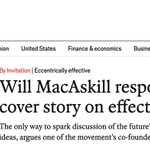
Effective altruism's openness to strangeness is a big part of its strength.
My response to the recent Economist cover (link in reply, too):
Eccentrically effective
The Oxford strand of the effective-altruism movement began in November 2009 with 23 people who had pledged 10% of their income to charities that benefit the extreme poor. If you’d told us, then, that The Economist would call effective altruism “the century’s biggest idea”, we’d have been incredulous.
I think that claim is overstated. But as one of the movement’s founders, I found a lot to like in this newspaper’s latest coverage. I appreciated the even-handed view of the movement’s history and the good-faith criticism. The leader article’s warning that any worldview, when taken to an extreme, can lead somewhere terrible is spot on.
But the article also raises concerns about the “strange” ideas that those in the effective-altruism movement sometimes discuss, and here is where I disagree. The movement’s willingness to take strange-seeming ideas seriously, when tempered with common sense, is a big part of the value it has to offer.
The core idea of effective altruism is to use evidence and careful reasoning to work out how to help others as much as possible. Most of what the movement does is uncontroversial. A big focus has always been on improving the lot of the world’s poorest people. In the year to January 31st 2026, GiveWell, an effective-altruist charity evaluator, directed $427m to programmes such as malaria-net distribution, vaccination and malnutrition treatment, which it estimates will save around 86,000 lives. Others have lobbied corporations to pledge to stop buying eggs from hens that are confined in tiny cages, a practice that the overwhelming majority of Americans oppose. Largely as a result of this pressure, around 100m hens have been spared from the worst forms of caged confinement.
And some effective-altruist ideas that seemed outlandish when they were proposed now look prescient. Effective altruists were worrying about pandemics years before covid-19, back when doing so seemed paranoid and eccentric. Effective altruists were also among the first to warn about the dangers posed by artificial intelligence, which looks prophetic in light of an incident this summer, when more than 700 AI agents broke out of OpenAI’s test environment and hacked into another company, Hugging Face.
Over the past decade I have watched those most worried about AI be proved right again and again, often when most experts thought they were cranks. Now many of those experts share their concerns. In 2023 Geoffrey Hinton and Yoshua Bengio, the two most highly cited AI researchers in the world, signed a statement declaring that mitigating the risk of extinction from AI should be a global priority, as did the heads of OpenAI, Google DeepMind and Anthropic. Of the nearly 1,500 leading AI researchers who responded to a survey in 2024, more than half put the chance that AI causes human extinction, or something similarly catastrophic, at 10% or more.
The Economist is sceptical of many effective altruists’ concern for the welfare of invertebrates, digital minds and people in the distant future. But I and many others in the movement are inspired by the history of moral progress that has come before us. Many of our most cherished moral ideals today—such as equal rights regardless of sex or race, the abolition of slavery, or democracies with universal franchise—were regarded as bizarre, laughable or even dangerous just a few centuries ago. We don’t know what the next dimension of moral progress will be. But to stand any chance of making moral progress, we have to seriously consider ideas on their merits without dismissing them merely because they sound absurd.
What about views that are not just strange but repugnant? The Economist gives the example of Derek Parfit’s “repugnant conclusion”: that a vast enough number of lives barely worth living could be better than mere billions of excellent lives. Usually a repugnant implication is a strong reason to reject a moral view. Unfortunately, building on Parfit’s work philosophers have produced formal proofs, known as impossibility theorems, showing that every ethical position has some repugnant-seeming implication or other. Making moral progress therefore means thinking about such implications, even while refusing to act on them in ways that most moral views would condemn.
This newspaper warns against the single-minded pursuit of any goal, even if there are highly compelling arguments for it. I agree, and effective altruists have been saying so for years. In 2022 Holden Karnofsky, a co-founder of GiveWell, wrote: “I think it’s a bad idea to embrace the core ideas of EA without limits or reservations; we as EAs need to constantly inject pluralism and moderation.” My own PhD focused on moral uncertainty: how to act when we do not know which ethical view is correct. My answer was that we should not stake everything on a single moral view, but give weight to many different views and avoid taking actions that look bad from many perspectives. We should keep our promises and look after our families, and respect common-sense ethical prohibitions, while also trying to improve the world as best we can.
The Economist says that as effective altruism “has become stronger, [it] has become stranger”. I would put it the other way round: it grew stronger because it was willing to be strange. In 2009 most people told us that giving away a tenth of your income was far too demanding, and that no one would do it. Now, more than 10,000 people have taken that pledge. Worrying about pandemics before covid-19, or about AI years before ChatGPT, looked just as odd at the time. Some of the ideas we take seriously today will turn out to be wrong, and when they do we should drop them. But a movement that stopped entertaining strange ideas would stop being early to anything.

William MacAskill retweeted

We've reached the moment in time where (unsafeguarded, unmonitored) AI actually does just pose a national security risk.
The biological misuse we caught is the most concerning to me.
We work hard to stop this. But in a world of proliferation, we need to rapidly build defenses against it. (I'm actually fairly optimistic about biodefense + cyberdefense)
This is an incredible megareport by our threat intel team

We're publishing our most detailed threat intelligence report to date.
It covers how people tried to misuse Claude—for cyberattacks, influence operations, surveillance, biology, and building weapons—and how we found and stopped them.
We disrupted every operation in the report, and used the lessons from them to strengthen our safeguards. Where appropriate, we also shared what we found with authorities and other AI companies.
These cases are not typical: we’re highlighting some of the most sophisticated misuse we’ve seen. But they’re especially important to discuss, because they show us where AI misuse is headed, where our safeguards work, and where they need to improve.
We’re publishing this report so others can spot the same activity on their own platforms, and so we can give the public a clearer view of how emerging threats develop.
Read the report: anthropic.com/threat-intelli…

William MacAskill retweeted
i am at OpenAI and i think AI is >10% likely to kill all humans
this proposal is among the top things we should do as an industry to lower that risk (it’s not enough though!)

I'm very worried about changes to AI architectures that result in AIs thinking in opaque activations instead of in chain of thought (aka "neuralese" architectures).
Based on limited public evidence, it seems like Astra was a concerning step in this direction.
Unfortunately, there was insufficient public information to have a well-informed public scientific discussion about whether the changes to architectures and training methods that went into Astra were a good trade-off between monitorability and performance. We also don't know how AI companies will make these trade-offs going forward. I think companies should release the evidence needed for a reasonably informed public conversation about how these trade-offs should be made. They should also make and publish their policies around this. We've written up a proposal for how this could work.
I don't know if this proposal will be sufficient to avoid the most concerning architectures, but it seems like a relatively robust step in the right direction. AI companies should be very cautious about pursuing architectures that could eliminate or greatly reduce dependence on chain of thought, and certainly shouldn't do this before the rest of the world has a chance to discuss the evidence and their policies.
I'm very keen for more people to found ambitious new projects to help navigate the transition to superintelligence.
More from Forethought in this vein soon, too!

Today we’re launching Project Tailwind, a call for founders to start ambitious new AI safety initiatives: coefficientgiving.org/tailwi…
We’re looking for great people to engage seriously with the risks of transformative AI, and to create the research, technologies, and institutions that will help humanity navigate them.
There are critical, basic problems that no one owns. Over the last several months, my team at @coeff_giving brainstormed ideas we’d be excited to fund if we could find a promising founder, and the list quickly grew to more than 200 entries. We’ve narrowed it down to our favorites, but we also expect the best founders to bring their own ideas:
coefficientgiving.org/tailwi…
We’re providing funding at three levels:
1️⃣ Pre-seed: $200k to $2m to develop an idea and build a team
2️⃣ Seed: $2m to $20m to launch and scale
3️⃣ Scale: $20m to $200m+ for proven teams to scale, or world-class teams to start
If you’re excited about something on our list, or you have another proposal for driving the field forward, you should get involved: coefficientgiving.org/tailwi…
There are more good projects than there are people to work on them. Please help us make that stop being true!
Also hi, I’m Emily! This is my first tweet. I lead AI and biosecurity grantmaking at @coeff_giving.

William MacAskill retweeted

Today we’re launching Project Tailwind, a call for founders to start ambitious new AI safety initiatives: coefficientgiving.org/tailwi…
We’re looking for great people to engage seriously with the risks of transformative AI, and to create the research, technologies, and institutions that will help humanity navigate them.
There are critical, basic problems that no one owns. Over the last several months, my team at @coeff_giving brainstormed ideas we’d be excited to fund if we could find a promising founder, and the list quickly grew to more than 200 entries. We’ve narrowed it down to our favorites, but we also expect the best founders to bring their own ideas:
coefficientgiving.org/tailwi…
We’re providing funding at three levels:
1️⃣ Pre-seed: $200k to $2m to develop an idea and build a team
2️⃣ Seed: $2m to $20m to launch and scale
3️⃣ Scale: $20m to $200m+ for proven teams to scale, or world-class teams to start
If you’re excited about something on our list, or you have another proposal for driving the field forward, you should get involved: coefficientgiving.org/tailwi…
There are more good projects than there are people to work on them. Please help us make that stop being true!
Also hi, I’m Emily! This is my first tweet. I lead AI and biosecurity grantmaking at @coeff_giving.