

@TischCancer @SinaiImmunol Laboratory of Dr. Nina Bhardwaj Immunology & Immunotherapy Posts by Lab Members
NYC
Joined April 2021
- Tweets708
- Following222
- Followers1K
- Likes1K



Bhardwaj Lab retweeted

STAT3 acts as a cytokine-sensing switch in NK cells, integrating IL-15 and type I IFN signals to shape antiviral responses @SunLab_Official @SciImmunology @MSKCancerCenter @SimonGrassmann
science.org/doi/10.1126/scii…

Bhardwaj Lab retweeted

🎬 Ready for your research to take center stage? Abstract submission for #IMMUNOLOGY2027™ in Los Angeles is OPEN! Share your breakthrough science and connect with global experts.
Submit by the Nov 17th deadline: immunology2027.aai.org/absta….


Bhardwaj Lab retweeted

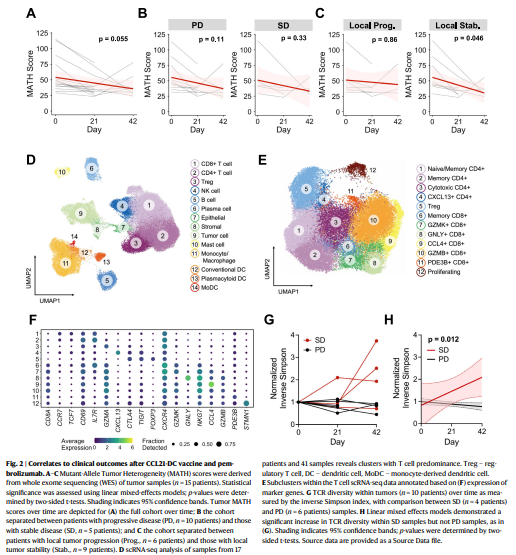
🦉The vaccine got T cells in — but mostly not the ones that mattered.
CCL21-engineered dendritic cells did what they were designed to do: they pulled new T-cell clones into resistant NSCLC tumors. Yet among 19 evaluable patients there were no objective responses.
The more revealing result came later. Many recruited clones disappeared by day 42, while the minority that persisted were more likely to show tumor-reactive signatures and expanded more strongly in patients with stable disease. Meanwhile, suppressive IL1B⁺/SPP1⁺ macrophage signaling remained.
That shifts the bottleneck. In a “cold” tumor, getting more T cells through the door may not be enough. Which clones arrive, whether they recognize tumor, and whether the microenvironment lets them survive may matter more than infiltration itself.
Small, uncontrolled phase I data, and tumor specificity was inferred rather than directly proven—but the biology is a useful warning against treating T-cell density as a surrogate for effective immunity.
#immunotherapy #T_cell #dendritic_cell
👉doi.org/10.1038/s41467-026-7…
Bhardwaj Lab retweeted
Targeting tumor-associated macrophages using mRNA lipid nanoparticles for cytotoxic T lymphocyte–mediated cancer immunotherapy @ScienceAdvances
science.org/doi/10.1126/scia…

Retreat season is here! Next Thursday at the PrIISM-IGI-CVRI Retreat, our postdoc Ross Ward @RossWWard44 is giving a talk in the 10-11 AM Trainee Talks session, and a few of us will be around with posters too. Come find us, we'd love to connect! #PrIISMCVRIIGI2026

Bhardwaj Lab retweeted

The next big questions in immunology dlvr.it/TVf2tH
Bhardwaj Lab retweeted

Lipid nanoparticles optimized for large RNA cargo and tissue targeting enhance in vivo genome editing nature.com/articles/s41587-0…

Bhardwaj Lab retweeted

Ward, Kar, Balan & @BhardwajLab review how conventional cDC1s coordinate antitumor immunity through cross-presentation, immune cell networking, and spatial organization in tumors. hubs.la/Q04v-QF20
Part of our #CancerImmunotherapy 2026 👉 hubs.la/Q04v_rXD0 #CSHAsia

Bhardwaj Lab retweeted
The @US_FDA approved the HER2-targeted therapy zanidatamab plus chemotherapy (with tislelizumab for some patients) as first-line treatment for certain HER2-positive unresectable advanced gastric, gastroesophageal junction, or esophageal cancers:
Journals: brnw.ch/21x5dZf

Bhardwaj Lab retweeted

Awesome results from what will soon be the next FDA-approved #CancerVaccine, making people live longer without cancer! modernatx.com/ir-insights-ph…

Bhardwaj Lab retweeted

independent.co.uk/news/uk/ho…
Nina Bhardwaj, MD, PhD, notes that this is an exciting time for cancer immunotherapy. @BhardwajLab @IcahnMountSinai

Bhardwaj Lab retweeted
JUST IN and via @Merck + @moderna_tx: A landmark moment for cancer immunotherapy. 🎯
Phase 3 INTerpath-001 is positive: the individualized mRNA neoantigen therapy intismeran (V940/mRNA-4157) + pembrolizumab significantly improved both RFS/DMFS vs pembrolizumab alone after resection of high-risk melanoma.
For years, the idea of designing a treatment around the unique mutations of each patient’s tumor seemed aspirational. Now we have the first positive Phase 3 trial (N=1137) of an individualized neoantigen therapy—and of an mRNA-based cancer therapy.
Personalized cancer vaccines are moving from promise to reality.
Now we need to see the magnitude of benefit, durability, and ultimately OS. But today is an important day for the field—and hopefully for our patients. 👏
Congrats to #CathyWu @DanaFarber for her trailblazing research that is materializing in tangible outcomes! At @DanaFarber_GU we are closely working with Cathy + @DFCI_NeoVax team on several GU protocols, after our @Nature work with @BraunMDPhD et al (nature.com/articles/s41586-0…)
merck.com/news/merck-and-mod…

Bhardwaj Lab retweeted

Kang and Han et al. developed PROTEXI, a vaccine platform comprising autologous DCs loaded with both tumor-specific CD8+ T and SARS-CoV-2 Spike protein CD4+ TH cell epitopes. In mouse tumor models, PROTEXI required both CD4+ and CD8+ T cells for efficacy and immune memory induction, and in ICI-resistant models, synergized with anti-PD-1 by revitalizing TEX cells. PROTEXI plus Vactosertib, a TGFβR inhibitor, activated “cold” TIMEs by driving T cell recruitment, cytotoxicity, and epitope spreading. PROTEXI was also efficacious in humanized mouse tumor models, dependent on pre-existing human CD4+ T cells against SARS-CoV-2 Spike epitopes. @caseccc
bit.ly/4i9RgpA

Bhardwaj Lab retweeted
Vleeshouwers et al. showed that the time of antigen encounter determines the differentiation of antigen-specific CD8+ T cells and antiviral immunity. In mice vaccinated with mRNA-1273, active-phase (dark period for mice [nocturnal]) immunization favored progenitor-like memory CD8+ T cells and enhanced T cell-mediated protection against SARS-CoV-2 infection, whereas resting-phase vaccination skewed toward effector-memory phenotypes. The molecular circadian clock in DCs, rather than in CD8+ T cells, regulated time-of-day-dependent CD8+ T cell differentiation and function through CD70–CD27 costimulatory signaling, independent of CD28. @LUMC_Leiden
bit.ly/4bNpvzj

Bhardwaj Lab retweeted
August 5 issue of @Nature:
3 foundational papers that substantially expand patient-derived 3D cancer models and show what they can add beyond traditional 2D cell lines.
1️⃣ HCMI: 665 models from 637 patients across 25 cancer types, including rare cancers and more diverse patient populations. Tumor-model genomic concordance was remarkably high (97.8%). Importantly, the work also shows where models can diverge from the original tumor—through stromal loss, clonal selection, and culture-driven epigenetic changes, some of which were reversible. These models are publicly available!
2️⃣ @sangerinstitute : 256 clinically annotated organoids across 5 cancers, with genome-wide CRISPR screens in 162. The screens uncovered dependencies that may be missed in conventional models. A nice example: KRAS dependency in colorectal cancer differed by allele—G12X tumors retained EGFR dependence, whereas Q61H did not. Treatment also reshaped dependencies, highlighting how cancer evolution can create new vulnerabilities.
3️⃣ @broadinstitute DepMap: 314 NextGen models across 10 cancers, including 147 CRISPR screens. These models reproduced tumor lineage far better than traditional cell lines—particularly striking in CNS tumors (93% vs 11%). They also uncovered context-specific dependencies in PDAC and GBM and showed something important: culture conditions themselves can change which genes appear essential (@DanaFarber_GU authors) with @boehmjesse team!
Taken together, these studies move cancer dependency mapping closer to the biology of actual human tumors. The model matters—and so does the environment in which we study it.
🔅

Bhardwaj Lab retweeted
Congratulations to Nina Bhardwaj, MD, PhD, @BhardwajLab, @CancerResearch CLIP investigator.
Dr. Bhardwaj's project: Defining vaccine-induced immunity against mutated Calreticulin in myeloproliferative neoplasms
cancerresearch.org/cri-funde…
@IcahnMountSinai

Bhardwaj Lab retweeted

私たちの論文が Science Advances 誌に掲載されました
@ScienceAdvances
A distinct antigen presentation pathway drives potent T-cell immunity in lipid nanoparticle-based mRNA vaccines
(mRNA-LNPワクチンは独自の抗原提示経路によって強力なT細胞免疫を誘導する)
science.org/doi/10.1126/scia…

So proud and excited to see our PI recognized with the 2026 @CancerResearch CLIP & Technology Impact Award! Grateful to work alongside her as the lab continues pushing boundaries to accelerate the next generation of cancer immunotherapies.🥳cancerresearch.org/blog/2026…

Bhardwaj Lab retweeted
Zeng, Xu, and Wang et al. developed an optimized cancer vaccine platform comprising a novel LNP co-encapsulating tumor antigen mRNA and two STING agonists. In primary BM-DCs, vaccination synergistically boosted CD80/CD86 expression and IFN-I secretion, and in mice, it enhanced antigen cross-presentation in spleens and tdLNs to induce antigen-specific CD8+ cytotoxic and memory T cell expansion. In tumor models, i.v. vaccine delivery inhibited s.c. tumor growth and vascularization. Vaccination upregulated gene sets for apoptosis and antigen processing, and reprogrammed immunosuppressive TAMs to a proinflammatory phenotype.
bit.ly/4vMgON0

Bhardwaj Lab retweeted

News: First CAR T-Cell Therapy Approved for Solid Tumors doi.org/10.1158/2159-8290.CD…
