
Promoting plant scientists, plant research, & plant admiration since 1893. Publisher of #AJB, #AppsPlantSci & #PlantSciBull. We no longer post on X as of 2025.
- Tweets11.1K
- Following3.5K
- Followers21K
- Likes3.2K


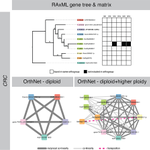




ALT Map of sampling sites in Taiwan, tree with epiphytic fern Ophioderma pendulum, and sampling design and purpose.


ALT Summary bipartite network diagram showing mistletoe-host interactions across all Australian showy mistletoe genera. The top half displays host orders, each colored by major seed plant clade: asterid orders in shades of red, rosid orders in blue, basal eudicots in yellow, magnoliids in green, and conifers in brown. Dilleniales is marked in orange and Santalales in lime green. Tick marks represent increments of 100 observations.


ALT A multi-part infographic featuring two maps showing species richness and range size patterns for ferns and lycophytes: Left Map (Ferns): The areas marked in orange represent regions with high species richness and low ranges (rich-low range areas). Areas in green represent regions with low species richness and high ranges (poor-high range), which are concentrated on the upper and lower limits of the biome. Right Map (Lycophytes): This map follows the same color pattern to depict species richness and range size patterns for lycophytes. Section 2 (bottom-left corner), a graphical illustration shows the drivers of high richness and low range sizes of ferns and lycophytes from the Atlantic Forest. An upward arrow illustrates factors contributing to high species richness. A downward arrow shows factors contributing to small range sizes.


ALT Drawings of details of Shepherd's purse plant from a flora. Lots of flower details.


ALT Map of sampling locations (pink circles) against genus range (purple).

ALT Map of sampling locations (pink circles) against genus range (purple).


ALT Shiran Ben-Zeev measuring stomatal conductance on corn plants interacting with neighbors of soy and sorghum. Shiran is wearing our section "Plant Fizz" shirt!!

ALT Green graphic from the Botanical Society of America (BSA) announces that several BSA awards are now open for applications, including Graduate Student Research Awards, J.S. Karling Graduate Student Research Award, AJ Harris Graduate Student Research Award, Graduate Student Dissertation Award in Phylogenetic Comparative Plant Biology, Donald R. Kaplan Dissertation Award in Comparative Morphology, and Corresponding Member Awards. Includes a QR code for more information, along with the BSA logo on a leaf background with water droplets.


ALT The page opener of the article, "Mutation rate is central to understanding evolution."


ALT Cross section of the main axis of Paracladoxylon kespekianum, and Early Devonian cladoxylopsid with complex xylem architecture from the Battery Point Formation of Quebec (Canada).


ALT Seed dispersal structures produced by members of the melicgrass tribe sampled in the present study. Images show the wide range of seed dispersal morphologies within the tribe, including several associated with wind dispersal (e.g., those producing plumose or winglike structures).


ALT The Wessinger lab at University of South Carolina is recruiting a postdoc and a phd student. We work on genetics of adaptation and speciation in penstemons. To learn more, contact [email protected]


