

🏒 VP Athlete Performance @NHLFlyers 🏀 10+ Years NBA Performance 🏃 CEO @AthleteFW 📚 Author: Redirect • Takeoff • Quadrant
Philadelphia, PA
Joined May 2009
- Tweets3.6K
- Following361
- Followers3K
- Likes7.4K






Daniel Bove retweeted

Cuts above 90 degrees are higher velocity, tendon driven, shallow ROM, higher COM.
Cuts below 90 degrees are higher force, muscularly driven, involve harder decels, bigger ROM, lower COM.
Influences: @EatSleepTrain_ @Nick__DiMarco @jordanbo5 @DanielBove


Daniel Bove retweeted

The NBA's Philadelphia 76ers and NHL's Philadelphia Flyers have released the first images of their new South Philly arena scheduled to open in 2030 on the grounds of old Spectrum.


Daniel Bove retweeted

Episode 163 with @DanielBove
NBA to NHL, Inception of ‘Redirect’, Understanding Multi-Directional Speed⤵️
podcasts.apple.com/us/podcas…

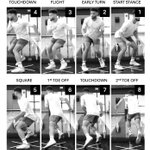
The hip turn is a sequence, and in this example it starts with the arms.
The arms move first. The trunk and pelvis follow into rotation. Then the arms quickly counteract — driving the opposite direction — and the trunk stabilizes while the pelvis and lower half keep rotating faster than the upper half.
As the foot plants, the pelvis opens toward the new direction of travel. The trunk and arms follow, creating a whipping motion that pulls the athlete out of the turn and into a sprint.
One note: here the athlete is responding to an auditory cue. When the stimulus is visual, the sequence often starts higher up — the head and cervical spine may rotate first to locate the target, then the arms and the rest of the chain follow.
The hip turn is the sequence an athlete uses to abruptly reorient into a sprint — initiated by the upper body, driven by the pelvis rotating faster than a stabilized trunk, and finished by a whip that squares the body into the new line of travel.
This has always been one of the more fascinatingly beautiful multi-directional speed patterns.
The Hip Turn: How an athlete aggressively rotates the hips and trunk to redirect motion
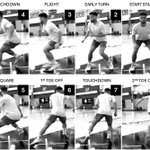
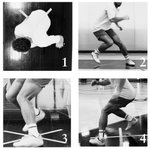
No single camera angle tells the whole story. So I broke it down into kinograms — frame-by-frame stills — from four different viewpoints, each revealing something unique.
Here’s what each angle shows 🧵

View #3: Anterior Start / Posterior Oblique (Sprint)
Shows hip rotation from start through early turn — and the whipping action of the arms from square to first toe-off.

View #4: Anterior Oblique Start / Posterior (Sprint)
Highlights hip rotation and the athlete’s ability to touch down and finish rotating into a straight line — no wasted energy from drifting off the line of travel.

At full speed, the moments that influence performance are invisible to the eye.
The kinogram fixes that — it stops time, stretches it out, and makes the invisible obvious. It’s the most underrated tool in not only multi-directional speed development, but athletic performance coaching as a whole.

Daniel Bove retweeted

Braking down horizontal DECELERATION ability…
✔️ Braking Force Control
✔️ Braking Force Attenuation
”An athlete will not speed up what they can’t slow down”❗️
─ Improving horizontal DECELERATION ability is key for our athlete’s performance, health & wellbein
Read more 👇

Thank you @DHMov for your contribution to not only this project, but also the field 🤝🫡

Delighted to recieve a copy of this new book… 📖
A Visual Guide to Multi-Directional Speed REDIRECT
And to contribute to a short expert summary on the topic of DECELERATION
Fantastic work again @DanielBove on pulling this all together! 👏


Daniel Bove retweeted

Current Pistons Director of Performance Cory Schlesinger & “The Box.”🔥
Made waves back in his time w/ the Suns
Hit strength, eccentrics & recovery work when players are warm & fired up, post game
Efficient/best way to stay strong & healthy through a long season.
In-season training = non-negotiable
Athletes & coaches — watch & learn:
Daniel Bove retweeted

OFFICIAL: We have hired Daniel Bove as Vice President, Athlete Performance & Wellness.
6 unforgettable years with the Pelicans.
Through every success, every challenge, and everything in between, I’ll always remember and cherish the people who made this place truly special.
Thank you, New Orleans Pelicans. I’m grateful for the memories and the growth.
Now, onto the next chapter.


Daniel Bove retweeted

Quadrant system understanding of volume/intensity like this example from @DanielBove can help guide S&C and other training related decisions.
One unique position that can be difficult to objectively quantify load parameters using wearable technology are catchers in baseball.
Subjective RPE of game stress, # of innings/length of game can be a starting point to conceptualize their load to make training decisions.
Subjective reporting can also be highly valuable information. This is a group you should be checking in with regularly!

Daniel Bove retweeted

Coaches @clh_strength & @MarkHoover71 dive into the Countermovement Jump (CMJ) and all things S&C on the @RockDaisyAMS Inside the Numbers podcast.
Great convo around testing & application. 💥📊
🎧 Full Episode👉 tinyurl.com/yje8nz2y
@clh_strength is reading Takeoff by @DanielBove — perfect timing for deeper insights! 🚀📖
Thanks @MarkHoover71 for taking the time to catch up.