

Isn't it all just a load of existential nihilism anyway? Having a little Snoop around. #WearAMask please & thanks. ❤️ = solidarity. 🏳️🌈 & Disability ally.
- Tweets9.7K
- Following785
- Followers1.3K
- Likes51K







ALT https://www.frontiersin.org/journals/psychiatry/articles/10.3389/fpsyt.2023.1065812/full Psychiatry, 16 February 2023 Therapies for obsessive-compulsive disorder: Current state of the art and perspectives for approaching treatment-resistant patients 2. 1st-line treatment Cognitive Behavioral Therapy (CBT) with exposure & response prevention (E/RP) is one of the first-line evidence-based treatments for OCD...several meta-analyses have found a significant reduction of OCD symptoms after a psychotherapy including E/RP, with 42-52% of patients achieving symptom remission ...results should be interpreted considering potential biases, such as the exclusion from the CBT trials of patients with comorbidities or the most severe cases of OCD 3. 2nd-line treatment Taking for granted the heterogeneity in the definition of response criteria in the literature, a recent review on pharmacotherapeutic strategies in OCD suggests that only up to 50% of patients respond to SSRIs

ALT https://www.sciencedirect.com/science/article/pii/S0010440X22000487#bb0595 Science Direct Comprehensive Psychiatry Volume 118, October 2022, 152342 The global assessment of OCD A recent meta-analysis confirmed the previous observation: at least one in ten patients with OCD attempts suicide during their lifetime, while nearly half of individuals with OCD have suicidal ideation.


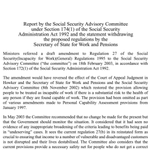
ALT https://assets.publishing.service.gov.uk/government/uploads/system/uploads/attachment_data/file/251107/6491.pdf The Draft Social Security (Incapacity for Work) (General) Amendment Regulations 2003 Ministers referred a draft amendment to Regulation 27 of the Social Security (Incapacity for Work)(General) Regulations 1995...[that] would have reversed the effect of the Court of Appeal Judgment in Howker & the Secretary of State for Work & Pensions & the Social Security Advisory Committee which restored the provision allowing people to be treated as incapable of work if there is a substantial risk to the health of any person if they are found capable of work In May 2003 the Committee recommended that no change be made for the present...it considered that it had seen no evidence of any inappropriate broadening of the criteria leading to benefits being paid in "undeserving" cases The Government has decided to withdraw the proposal at the present time

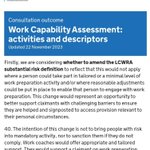
ALT https://www.gov.uk/government/consultations/work-capability-assessment-activities-and-descriptors/work-capability-assessment-activities-and-descriptors GOV.UK Work Capability Assessment: activities and descriptors 22 Nov 2023 Firstly, we are considering whether to amend the LCWRA substantial risk definition to reflect that this would not apply where a person could take part in tailored or a minimal level of work preparation activity &/or where reasonable adjustments could be put in place to enable that person to engage with work preparation. This change would represent an opportunity to better support claimants with challenging barriers to ensure they are helped and signposted to access provision relevant to their personal circumstances.

ALT https://committees.parliament.uk/committee/164/work-and-pensions-committee/publications/3/correspondence/ https://committees.parliament.uk/publications/55459/standard/pdf/ 13 October 2026 Dear Debbie, Thank you for your letter of 17 September and for the Committee's continued engagement with the Timms Review. We welcome the thoughtful and constructive challenge that the Committee has provided throughout this process. The steering group has heard feedback through Shaping Recommendations Workshops & Roundtables which will directly inform how the recommendations are refined before the final report is presented to the Secretary of State. No final decisions have been taken on future entitlement arrangements, including for people who currently receive support through the Substantial Risk provisions. Yours sincerely, Rt Hon. Sir Stephen Timms MP Minister for Social Security & Disability


ALT https://www.researchgate.net/publication/263217809_ New_Labour_the_market_state_and_the_end_of_welfare New Labour, the market state, and the end of welfare Jonathan Rutherford There is no evidence to suggest that impoverishing people who are ill will prompt them into longer-term employment, and this is particularly true for those with mental health problems. In 2006 the DWP published a report on the impact of the Pathways to Work pilots on people with mental health problems. It concluded that: 'the estimated impact of the policy on the outcomes of interest for those who report having a mental illness (as a single health condition) is never statistically different from zero at conventional levels'. The future looks bleak for those who have 'symptoms without diseases', or mental health conditions, and who cannot demonstrate that their illness has an 'objective medical pathology'.

ALT https://www.researchgate.net/publication/263217809_New_Labour_the_market_state_and_the_end_of_welfare New Labour, the market state, and the end of welfare July 2007 Jonathan Rutherford

ALT https://www.researchgate.net/publication/263217809_New_Labour_the_market_state_and_the_end_of_welfare New Labour, the market state, and the end of welfare July 2007 Jonathan Rutherford

ALT https://www.researchgate.net/publication/263217809_New_Labour_the_market_state_and_the_end_of_welfare New Labour, the market state, and the end of welfare July 2007 Jonathan Rutherford


ALT https://www.gov.uk/government/statistics/income-related-benefits-estimates-of-take-up-financial-year-ending-2025/income-related-benefits-estimates-of-take-up-financial-year-ending-2025 Income-related benefits: estimates of take-up: financial year ending 2025 22 Oct 2026 UC (or equivalent benefits) The estimates show that: caseload: up to 2.6 million families who were entitled to receive UC (or equivalent benefits) did not claim in FYE 2025 expenditure: up to £12.7 billion of available UC expenditure went unclaimed in FYE 2025 on average, this amounted to around £4,700 per year for each family entitled to receive UC who did not claim the benefit Eurofound 2015 identifies the following reasons for non-take-up: 'lack of awareness or misperceptions about entitlement or application procedures' 'complexity of the application procedure or lack of resources such as time & capabilities to navigate the system' 'stigma, perceived lack of need, pride & lack of trust in institutions'


ALT https://committees.parliament.uk/committee/164/work-and-pensions-committee/publications/3/correspondence/ https://committees.parliament.uk/publications/55459/standard/pdf/ THE RT HON. SIR STEPHEN TIMMS MP Minister for Social Security & Disability 13 Oct 2026 The Review has been guided by the principles of co-production throughout its work & the approach to this has been set & guided by the steering group. Almost all the steering group have lived experience of disability/long-term health conditions. They have set the Review's priorities, engagement activity & developed the emerging recommendations. It is not a single method, but a set of values, behaviours & commitments that guide how we work...each member of the steering group has equal power in the decision-making process for this Review.

ALT https://committees.parliament.uk/committee/164/work-and-pensions-committee/publications/3/correspondence/ https://committees.parliament.uk/publications/55459/standard/pdf/ The emerging recommendations were developed by the steering group, with all wording agreed by a vote of members. The steering group has gathered feedback from disabled people & people with long term health conditions, as well as organisations with expertise in disability, health & welfare policy, through shaping recommendations workshops & roundtables. The Review has frequently engaged with DPOs throughout its work, including through the Call for Evidence & its Evidence from Experts sessions. The Review has sought to engage people with, & organisations representing, a broad range of disabilities & long-term health conditions, as well as a diverse range of demographic characteristics.

ALT https://committees.parliament.uk/committee/164/work-and-pensions-committee/publications/3/correspondence/ https://committees.parliament.uk/publications/55459/standard/pdf/ The emerging recommendations published on 9 Sept are not the final recommendations...They are emerging initial ideas. No final decisions have been taken on future entitlement arrangements, including for people who currently receive support through the Substantial Risk provisions. However, the Review is clear that PIP should remain a flexible, non-means tested benefit that provides a cash contribution towards the extra costs faced by D/deaf & disabled people & people with long term health conditions.


ALT https://committees.parliament.uk/committee/164/work-and-pensions-committee/publications/3/correspondence/ https://committees.parliament.uk/publications/55459/standard/pdf/ THE RT HON. SIR STEPHEN TIMMS MP Minister for Social Security & Disability 13 Oct 2026 The Review has been guided by the principles of co-production throughout its work & the approach to this has been set & guided by the steering group. Almost all the steering group have lived experience of disability/long-term health conditions. They have set the Review's priorities, engagement activity & developed the emerging recommendations. It is not a single method, but a set of values, behaviours & commitments that guide how we work...each member of the steering group has equal power in the decision-making process for this Review.
ALT https://committees.parliament.uk/committee/164/work-and-pensions-committee/publications/3/correspondence/ https://committees.parliament.uk/publications/55459/standard/pdf/ The emerging recommendations were developed by the steering group, with all wording agreed by a vote of members. The steering group has gathered feedback from disabled people & people with long term health conditions, as well as organisations with expertise in disability, health & welfare policy, through shaping recommendations workshops & roundtables. The Review has frequently engaged with DPOs throughout its work, including through the Call for Evidence & its Evidence from Experts sessions. The Review has sought to engage people with, & organisations representing, a broad range of disabilities & long-term health conditions, as well as a diverse range of demographic characteristics.
ALT https://committees.parliament.uk/committee/164/work-and-pensions-committee/publications/3/correspondence/ https://committees.parliament.uk/publications/55459/standard/pdf/ The emerging recommendations published on 9 Sept are not the final recommendations...They are emerging initial ideas. No final decisions have been taken on future entitlement arrangements, including for people who currently receive support through the Substantial Risk provisions. However, the Review is clear that PIP should remain a flexible, non-means tested benefit that provides a cash contribution towards the extra costs faced by D/deaf & disabled people & people with long term health conditions.

ALT https://committees.parliament.uk/publications/55094/documents/305429/default/?utm_id=97760_v0_s00_e0_tv4 Work & Pensions Committee 17 Sept 2026 Dear Sir Stephen [Timms], The draft [PIP] recommendations made no reference to the Work Capability Assessment. It is understood that the WCA could be replaced by the new PIP assessment. The Committee would like to know if this is the Review's position, & to be included in final recommendations, or if this is being considered separately? If so, what is the timescale for this, is the same Review team undertaking this, & is co-production being used here too? Please confirm that Substantial Risk Regulations will continue with the changes to PIP & WCA. I know you appreciate that a large cohort of people on UC health fall under these criteria. Any changes to this protection put them at immediate risk of profound harm, including death. I would be grateful for your response by 16 October 2026. Debbie Abrahams (Chair, Work & Pensions Committee)

ALT https://committees.parliament.uk/committee/164/work-and-pensions-committee/publications/3/correspondence/ UK Parliament Committees Work and Pensions Correspondence Work and Pensions Committee Correspondence with the Minister for Social Security and Disability, relating to the Timms Review Published 18 September 2026