

Colours in for a living; hardly ever stays in the lines. Bristol born. International IB geography teacher. 🇬🇧🇮🇲🇧🇲🇹🇷🇵🇪
Lima, Peru
Joined February 2009
- Tweets59.5K
- Following2.5K
- Followers2.9K
- Likes27.1K


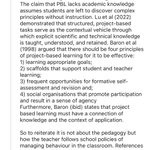


I’d say I am a balanced inbetweener - students need knowledge, understanding and application. I also firmly believe in guided inquiry. Hope that helps 😂
And that’s why I moved to booklets at IGCSE so we are not faffing around with glue and looking for the correct handout 😂
I saw a tweet from an eduinfluencer that said oracy is a progressive pedagogy & I wanted to throw myself off the bus. Giving students equal opportunities must include oracy. That’s not progressive, it’s what excellent teaching looks like. A balance between knowing and doing.
To achieve top marks in the language section students must ‘ response uses consistently precise and effective language that actively strengthens the argument.’ that language has to be taught by the teacher for the student to be able to do it, it doesn’t magically happen!
In the analysis & evaluation section students must give their opinions and break down the parts of their argument - under timed and controlled conditions with just 10 bullet point words! They receive marks for keeping controlled and sustained argument for 10 minutes of talking.
Look carefully - “Knowledge is not demonstrated by retelling the plot or listing contextual facts. It appears through precise references that support a defensible interpretation.” Knowledge must be taught for the students to be awarded the marks
People worry about how oracy can be assessed but they should look at the International Baccalaureate who have been doing this for years revisiondojo.com/blog/ib-eng…

An example of this is uni admissions where students who are called for interviews are given a map & are asked to explain what the map shows. A previous 1st gen uni student was given this task & she aced the interview because we had known the importance of oracy in the curriculum
We seem to be concerned as a profession about the use of AI - one of the quickest ways of solving that issue is through direct instruction, research & teaching students how to use their voice in both writing & oral activities.
It seems a real shame that there are some teachers in England that don’t realise that oracy benefits everything you do in your classroom. If students can’t talk about it do they really know it? How are they linguistically choosing the correct terminology in both BICS & CALP?
I have been waiting for this blog. Since working in 100% EAL schools for the last 7 years I chose to complete a masters in TESOL & Ed. as a Geog teacher - why, because oracy is just as important as being able to write it down for multilingual students.

NEW POST: Towards powerful oracy for all. Policy and practice; possibilities and pitfalls teacherhead.com/2026/10/25/t…

I have just seen a tweet that claims oracy is a progressive form of teaching. Allowing students to debate, give persuasive speech or even a teacher keeping a log of when a student uses the correct t linguistic term as part of the ‘we do’ section is seen as progressive
They also have it in their Spanish competencies so not sure what your point is. Other countries seem to value it
Some do not like the unknown Tom. What is interesting is if you look at other countries speaking is a core component of how students are assessed in English.
Briley Habib retweeted

Anyone want to play 'Circle The Inaccuracies In A Single Paragraph'?
Happy to advise on a rewrite, @HodderEducation
