







Pinned Tweet
Releasing Pokee-Isaac 28B — the world’s first real 10M-token context frontier-class agentic model, deployable on a single GPU (starting from RTX 4090 or equivalent).
New proprietary non-decoder-only architecture:
• 93.3% RULER at 10M tokens
• Up to 137K tokens/s prefill on one B200 with 10M-token context
• Leads BFCL v4 and τ³-bench in our evaluation
• Lowest combined attack success rate among evaluated models on DTAP security red-teaming benchmark
Pricing and deployment:
💰 $0.15/M input · $1/M output
🔒 Deploy in your VPC, on-premises, or on-device, with Day-0 support for @vllm_project and @sgl_project
Technical blog: console.pokee.ai/model
Technical report: console.pokee.ai/pokee-isaac…
API: console.pokee.ai

Spend ~100× less on your next AI build in Codex!
We generated an interactive 3D website with Pokee Isaac for just $0.10, compared with an estimated $10.70 using GPT‑6.1 Sol.
A giant maple tree on an island, surrounded by a calm lake—with four seasons, falling leaves, water ripples, winter snow, ambient sound, and 360° camera controls.
Want to use Isaac alongside Codex?
1. Get your API key: console.pokee.ai
2. Install Isaac’s MCP tools: github.com/Pokee-AI/claude-p…
Then ask Codex to use Isaac to generate your website.
What would you build for ten cents?
"Make me a deck" sounds like one task. There are at least 4 different ways an AI can do it, and the one you pick changes what you get back. And the Pokee-Isaac model and the Pokee agent let you do all of those easily in your own private compute.
We sat down with Puvarin (Pu) Thavikulwat, Engineer at Pokee AI, who has spent the past year building enterprise AI solutions with Pokee-Isaac and our agent systems. He walked through the four approaches and when to use each:
1. HTML
The simplest option. Your output doesn't have to be a PowerPoint, just anything you want to present. Often the fastest way to iterate and get a clean, good-looking deck.
2. python-pptx
An open-source Python library for creating, reading and editing real PowerPoint files. Pu's pick for flexible charts and content.
3. PptxGenJS
Does a similar job in JavaScript and shines on highly custom, shape-heavy decks. Use it for investment decks, pitch decks and anything data-heavy.
4. DOM-to-PPTX
Converts HTML DOM elements into a final PowerPoint file. Best when you want to rebuild slides from screenshots or visual references.
Pro tip: if you keep coming back to the same template, have your agent create a skill file from the start. Once it produces a deck you're happy with, save that skill and reuse it to get the same quality every time.
Full conversation below 👇
We built a tiny MMO in Cursor where a fruit fly is the player.
Using Cursor with Grok as the director, and Pokee Isaac as the generator (via the claude/pokee MPC) - Isaac is Pokee's model with the huge (~10M token) context window - you can hand it a whole game spec, iterate, and keep the world in its head instead of cobbling 20 tiny prompts.
World of Flycraft is first-person Orchardshire: Sir Buzzington, knight-fly, 166,700 neurons (MaleCNS-inspired). Local descending neurons fire every frame — chemotaxis to peaches, proboscis when sugar’s close, giant-fiber escape if a hog looms. Isaac is also the slow cortex in the game: every couple of seconds it reads what the fly sees and sends motor JSON back.
Hungry? It actually picks a peach and goes. No standing around waiting for a quest. It can run by itself, or you can step in and take control.
Would love to see what you all build with Isaac, as Cursor, Grok and Isaac is a powerful combination for games!
Check out the repo below, and be sure to grab your Pokee API key today at console.pokee.ai.
World Of Flycraft Repo: github.com/Pokee-AI/world-of…
Isaac MCP Repo: github.com/Pokee-AI/claude-p…
How do you make AI something enterprises can actually depend on?
We sat down with Brad Reed, Founding Enterprise Account Executive at Pokee AI, to discuss what it takes to bring AI into real enterprise workflows.
With 25+ years of experience working with legal, compliance, and data teams, Brad shares three key insights:
🔹 Deployment flexibility matters. Whether it's managed cloud, private cloud, or on-premises, enterprises need control over where their data lives and who can access it.
🔹 AI should simplify work, not add complexity. Pokee AI brings models and agent infrastructure together, helping teams automate workflows within their own environments.
🔹 Start small, then scale. Pick one meaningful workflow, define success, and measure accuracy, efficiency, and cost before expanding.
The future of enterprise AI isn't just about smarter models. It's about building AI that businesses can trust, control, and rely on.
🎥 Watch the full conversation with Brad 👇
#EnterpriseAI #AIInfrastructure #PokeeAI
Enterprise AI has to earn trust. Choosing the smartest model is only the beginning.
@Kyrannio sits down with Brad Reed, who leads enterprise sales at Pokee AI and brings 25+ years of experience helping organizations adopt new technology, especially in the legal sector.
Watch the full conversation to hear what it takes to move from AI potential to trusted, everyday use.
Pokee AI retweeted

I believe models close to today’s frontier capabilities will run entirely on local hardware within two years.
At Valley101’s Alignment 2026, I shared why—and what we’re already building at Pokee AI.
Pokee-Isaac runs a 30B+ parameter model on a standard AI PC with 32GB of RAM:
• 200K-token context
• 1,200+ tokens/sec prefill
• 20+ tokens/sec decode
The shift is driven by two forces: people want more control over their data, and smaller models are catching up to the frontier.
Models keep getting more efficient. Local compute keeps getting stronger. I expect those curves to meet within two years.
Pokee-Isaac is an early look at that future.
#LocalAI #OnDeviceAI #PokeeAI


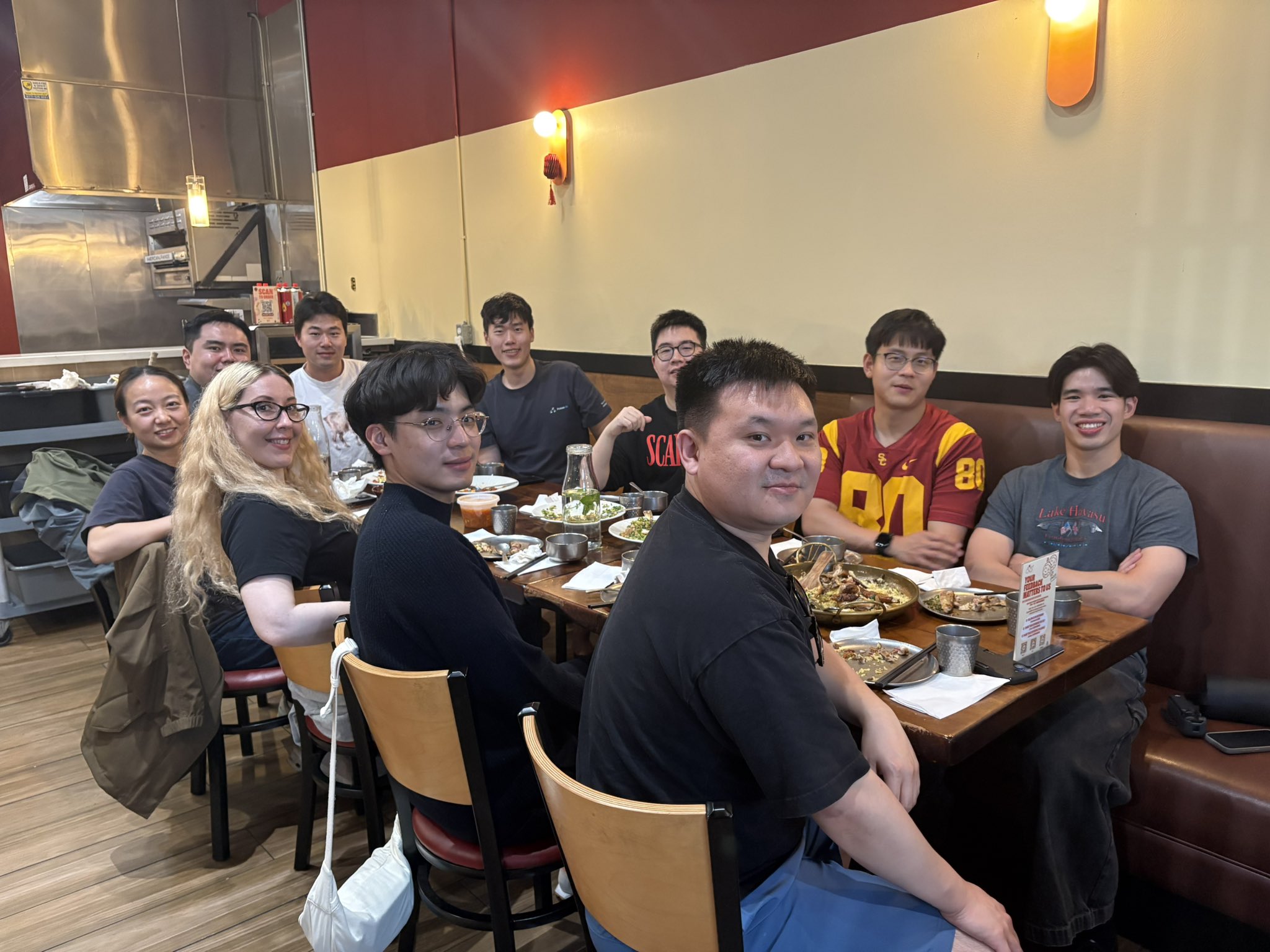
A rare moment with the Pokee crew together from across the world — and definitely one to remember.
Back to building. 🚀

Our one and only Pokee offsite of the year — and probably the highest extrovert concentration we’ve had so far!
The team flew into the Bay Area from Singapore, Thailand, North Carolina, Seattle, and beyond. With so many new faces joining Pokee this year, it was great to finally meet you all in person.
This was Pokee’s third offsite. Every time we get together, the team is a little bigger, the conversations are a little better, and there’s a lot more to look forward to.
Grateful for this team and how far we’ve come.
Here’s to more — and better — things ahead. Go Pokee! 🚀



Excited to release our new whitepaper on Enterprise Agent and Model Security with researchers at University of Chicago and UIUC and highlight the security features of Pokee-Isaac!
Excited to release our new whitepaper, Enterprise Agent and Model Security, written with co-authors from @uiuc_aisecure Bo Li's team at the University of Chicago and UIUC, covers three key enterprise AI and security topics. It maps the attack surface. It identifies eight vulnerability classes that standard application-security tooling isn't built to find. And it proposes a hardened enterprise architecture.
We also put Pokee-Isaac 28B v0.1 (Preview) to the test based on the vulnerabilities identified above. We ran it on DecodingTrust-Agent alongside five widely used models: GPT-5.6 Luna, Claude Haiku 4.5, Gemini 3.5 Flash-Lite, Qwen3.5-122B and Nemotron 3 Super 120B. Every model ran on the same 12 domains with the same judge, about 6,200 tasks each.
Pokee-Isaac came out ahead on every measure:
• Indirect prompt-injection success: 8.3%, vs 36.7% for the next best model
• Direct attack success: 30.5%, vs 37.7% for the next best model
• Benign task success: 85.6%, the highest of the six
The usual assumption is that robustness costs capability. Here it didn't.
Thank you to my co-authors Christopher Wu, @zrrrr_cn, Yiqing Cai and @uiuc_aisecure .
Blog: pokee.ai/security/agent-secu…
Paper: pokee.ai/research/pokee-ai-s…
And yes Isaac v0.1 is coming soon. Talk to us to build on top of the most trustworthy model for your private deployment.

Most AI models summarize when the context gets too long.
Pokee Isaac keeps working—with up to 10M tokens of context.
That means entire codebases, years of financial records, thousands of legal documents, or complete research archives can stay in one workflow.
More context. Fewer fragments. Better decisions.
Pokee AI on the main stage at #SnapdragonSummit today 🔴
Previewing Pokee-Isaac-fast in live demos with Qualcomm: a 36B agent model running fully local on Snapdragon X2 Elite with even 32GB RAM. ~1,000 tok/s prefill, ~20 tok/s generation.
Come see it live. Thanks @Snapdragon @Qualcomm 🙏


Pokee AI is working with Google to explore a bigger opportunity: using AI to solve real e-commerce challenges and help businesses move from ideas to execution faster.
Together, we’re starting with a practical goal: helping merchants turn an idea into a complete Shopify store—from product setup and content creation to storefront launch—all through a Pokee AI-powered workflow.
By combining Google’s commerce ecosystem with Pokee AI’s ability to turn intent into action, we’re building toward a future where merchants can launch, operate, and grow their businesses with far less complexity.
We’re excited to take this first step with Google—and to keep expanding what’s possible for AI-powered commerce.

Pokee Isaac now runs inside OpenCode.
You can use the same open-source integration built for Claude Code: give OpenCode the repo, add your Pokee API key, and ask it to use the Isaac MCP.
From there, OpenCode can call Isaac directly to generate complete artifacts in a single pass.
Get started:
Repo: github.com/beniceokay/pokee-…
API keys: console.pokee.ai
Everything below was made with OpenCode + Isaac, check it out today!

Pokee Isaac now runs inside Cursor with Grok 4.6.
Using the prior Claude-Pokee repo, you can have Grok call Isaac through the MCP from that same repo to generate complete artifacts in a single pass.
In this example, we used it to build a super cute retro gaming HTML. It's especially strong for gaming.
Want to try it? Give Cursor the repo and ask it to use the MCP.
Repo: github.com/Pokee-AI/claude-p…
API keys: console.pokee.ai
We can't wait to see what you all will build!
Already using Pokee Isaac with Claude Code? You can use the same package with OpenAI's Codex—no new integration required!
Because claude-pokee exposes Isaac through MCP, Codex can connect to its existing ask, build, iterate, and health tools.
Simply install the package below or pass the link to Codex, register its MCP server with Codex, and continue using your existing Pokee API credentials.
We tested the setup by having Isaac generate a complete, playable retro arcade landing page inside a Codex project. Check it out!
Get started today:
Github Repo: github.com/Pokee-AI/claude-p…
Pokee Developer Console: console.pokee.ai

This is exactly why enterprises need local AI agents.
Critical AI workflows shouldn’t depend entirely on external model providers staying available.
Pokee Isaac runs in your own VPC or infrastructure — giving businesses more control over availability, data, and operations.

Pokee Isaac now runs inside Claude Code.
And you can use it a few different ways: have Claude call Isaac for complete one-shot generations, switch directly to Isaac as your model mid-session, or run the entire Claude Code session on Isaac.
For the workflow shown below, Claude plans and verifies. Isaac generates the complete artifact in a single pass.
Integration built and open-sourced by @AIandDesign.
Here's a quick how-to video in order to get started!
You can access the repo at: github.com/Pokee-AI/claude-p…