
Academic Philosopher. Posts better stuff at https://xitter.cf/t.co/jwkU1JxzCj 🔸10% Pledge #54 with @GivingWhatWeCan
Miami, FL
Joined September 2011
- Tweets6.3K
- Following268
- Followers2.1K
- Likes12.2K





Pinned Tweet
Maybe I'll take this opportunity to re-share some of my favourite posts. 🧵
(1) 'My Big Ideas' highlights and explains five major themes from my work
goodthoughts.blog/p/my-big-i…

I'm not into dunking on people for their conclusions — you should argue for whatever you think is true! — but serious academic disciplines should expect assertions of this nature to come with *some* kind of supporting argument.

Like, how would one determine whether cost-effectiveness is "white-centric" and "racist", and what's the evidence that it actually meets the relevant criteria? A book review in a philosophy journal should ask these sorts of questions, not just mindlessly parrot political slogans.
Journal link: brill.com/view/journals/jmp/…
My review of the same book: goodthoughts.blog/p/review-o…

Richard Y. Chappell🔸 retweeted

Can I give you 10% of me?
By Opus 5.5🧡

"Effective altruism is directionally correct, even if you should not follow its recommendations all the way."
@tylercowen self-recommending as usual
thefp.com/p/in-defense-of-ef…

"In the grand scheme of things, having smart and hard-working people in the country is better than not having them."
Mind-boggling to me that so many people try to deny this.
slowboring.com/p/the-right-w…

Do you have coherent moral preferences? Play my "Moral Preference Test" game to find out. (Warning: contains trolleys.)
yetterchappell.net/Richard/g…


Nice example of how argument-free sneering at "weird ideas" can lead one badly astray. (Also a helpful reminder of how even early EA writings, like Doing Good Better, seriously considered x-risk in addition to global poverty, etc.)


Whenever people dismiss effective altruism as a "truism", I want to ask them: How much time do you think the average person spends — in their entire lives — thinking about charity effectiveness or otherwise explicitly attempting to optimize their moral efforts?


Others: "I really disagree with EAs about whether XYZ is a good idea..."
EAs: "That's totally fine! Our fundamental commitment is just to promoting the good effectively; you can share that while disagreeing about XYZ."
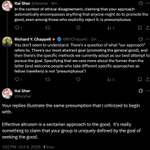
Itai: "That is so presumptuous. You don't get to define your own position. I say you're defined by your more specific views, which others strongly disagree with."

You don't seem to understand. There's a question of what "our approach" refers to. There's our most abstract goal (promoting the general good), and then there's the specific methods we currently adopt as our best attempt to pursue the goal. Specifying that we care more about the former than the latter (and welcome people who take different specific approaches as fellow travellers) is not "presumptuous"!

Interesting thread here on whether it's problematic to casually share GiveWell's cost-effectiveness estimates without all their qualifications. Thanks to @ben_r_hoffman for the exchange!
I think you must endorse unusually literal norms of communication. I don't think many people, upon full investigation, would see any problem with making loose claims of this sort. It provides the key action-guiding info ppl need, without excessive qualifications that most wouldn't care about.
The key question, to my mind, is whether they are boosting the importance-weighted accuracy of their audience's beliefs (and I think quotes you highlight easily pass that test!): goodthoughts.blog/p/moral-mi…

"I could hardly believe the verbal gymnastics one needs to do to make things like “taking moral commitments seriously” and "considering evidence and odds explicitly, correcting for biases" sound like the problem."
There's a big conflict between ppl who see ethics as about improving the world vs ppl who see ethics as about self-expression, indulging their sympathetic emotional responses, etc.

I'm a longtime Effective Altruist and the co-founder of the organization most frequently used as a stand-in for "EAs have lost their minds" (a.k.a. Shrimp Welfare Project). I've also read The Economist for over 20 years, so I was disappointed by how they portrayed a community I feel proud to be part of.
I never post but I could hardly believe the verbal gymnastics one needs to do to make things like “taking moral commitments seriously” and "considering evidence and odds explicitly, correcting for biases" sound like the problem. I felt I had to speak my mind.
Some of the implicit criticisms of EA are that we're young, inexperienced, from elite universities, polyamorous, wildly eccentric, etc. FWIW, I'm in my mid-40s, Mexican, straight, have a beautiful wife and 2 kids, and I grew up in a mid-sized conservative city with loving parents who got divorced when I was six. Pretty standard.
After my parents divorced, my mom frequently had to make difficult economic choices, like whether to buy flowers for our kitchen table and eat only quesadillas, or eat something a tiny bit fancier. I always told her I loved quesadillas because I knew flowers made her happy.
After graduating from a public university, I worked in finance for ~15 years and saved as much as I could so I could spare my wife and future kids the economic hardships I experienced. In that time I met thousands of people in finance, corporate law, accounting, real estate, insurance, etc. Most were decent, well-educated, ambitious and smart, all doing their best to excel in their professions. Most wanted to make money and improve their own and their loved ones’ quality of life. Nothing to see here.
Since I found Effective Altruism ~7 years ago, most of the people I come across are of a different rarer kind. They come from all over the world, in all shapes and sizes, but they have the one thing in common: they want to improve the world using evidence and reason wherever that leads them. Yeah, they/we make a ton of mistakes like everyone but, IMHO tend to own them more frequently than the average person.
I've met people who could easily be making >100% more money in a normal job, but instead they dedicate themselves to improving the lives of those who need it the most. People in the poorest countries whose children die from preventable diseases, from lack of basic medical equipment or vaccination, from lead in paint. Animals in factory farms subjected to conditions that most people find abhorrent, doesn't matter if you're vegan, vegetarian or a huge meat lover.
Yes, recently many of the people in my community are moving to work on making sure that AI and other powerful new technologies don't result in terrible things for humanity. I'm one of those people and contrary to what the article would suggest, it has nothing to do with the fact that SBF committed one of the biggest frauds in history or that someone wrote hundreds of thousands of words of fan fiction. I'm doing it because I want to do the little that's in my power to make the world that my kids and grandkids (and yes, potentially their great-great-grandchildren) will inherit a better one.
EA gave me a way to do that and I will be forever thankful. So no, I'm not EA-adjacent.
economist.com/international/…

Disparaging "numbers" seems a common sign of moral self-indulgence. Just total unwillingness to countenance any objective disciplining of one's moral emoting.
xitter.cf/clairlemon/status/2107…

See also: xitter.cf/RYChappell/status/2101…
Notable that BB has done far more to help people than most of the people who dunked on him for *also* thinking about about insect welfare.
Rather than imagining human vs nonhuman welfare as competing for a fixed slice of pie, the more important distinction may be between those who grow the pie for a range of cost-effective altruistic interventions vs those who don't (or even oppose EA efforts in general).

Richard Y. Chappell🔸 retweeted

Effective altruism's openness to strangeness is a big part of its strength.
My response to the recent Economist cover (link in reply, too):
Eccentrically effective
The Oxford strand of the effective-altruism movement began in November 2009 with 23 people who had pledged 10% of their income to charities that benefit the extreme poor. If you’d told us, then, that The Economist would call effective altruism “the century’s biggest idea”, we’d have been incredulous.
I think that claim is overstated. But as one of the movement’s founders, I found a lot to like in this newspaper’s latest coverage. I appreciated the even-handed view of the movement’s history and the good-faith criticism. The leader article’s warning that any worldview, when taken to an extreme, can lead somewhere terrible is spot on.
But the article also raises concerns about the “strange” ideas that those in the effective-altruism movement sometimes discuss, and here is where I disagree. The movement’s willingness to take strange-seeming ideas seriously, when tempered with common sense, is a big part of the value it has to offer.
The core idea of effective altruism is to use evidence and careful reasoning to work out how to help others as much as possible. Most of what the movement does is uncontroversial. A big focus has always been on improving the lot of the world’s poorest people. In the year to January 31st 2026, GiveWell, an effective-altruist charity evaluator, directed $427m to programmes such as malaria-net distribution, vaccination and malnutrition treatment, which it estimates will save around 86,000 lives. Others have lobbied corporations to pledge to stop buying eggs from hens that are confined in tiny cages, a practice that the overwhelming majority of Americans oppose. Largely as a result of this pressure, around 100m hens have been spared from the worst forms of caged confinement.
And some effective-altruist ideas that seemed outlandish when they were proposed now look prescient. Effective altruists were worrying about pandemics years before covid-19, back when doing so seemed paranoid and eccentric. Effective altruists were also among the first to warn about the dangers posed by artificial intelligence, which looks prophetic in light of an incident this summer, when more than 700 AI agents broke out of OpenAI’s test environment and hacked into another company, Hugging Face.
Over the past decade I have watched those most worried about AI be proved right again and again, often when most experts thought they were cranks. Now many of those experts share their concerns. In 2023 Geoffrey Hinton and Yoshua Bengio, the two most highly cited AI researchers in the world, signed a statement declaring that mitigating the risk of extinction from AI should be a global priority, as did the heads of OpenAI, Google DeepMind and Anthropic. Of the nearly 1,500 leading AI researchers who responded to a survey in 2024, more than half put the chance that AI causes human extinction, or something similarly catastrophic, at 10% or more.
The Economist is sceptical of many effective altruists’ concern for the welfare of invertebrates, digital minds and people in the distant future. But I and many others in the movement are inspired by the history of moral progress that has come before us. Many of our most cherished moral ideals today—such as equal rights regardless of sex or race, the abolition of slavery, or democracies with universal franchise—were regarded as bizarre, laughable or even dangerous just a few centuries ago. We don’t know what the next dimension of moral progress will be. But to stand any chance of making moral progress, we have to seriously consider ideas on their merits without dismissing them merely because they sound absurd.
What about views that are not just strange but repugnant? The Economist gives the example of Derek Parfit’s “repugnant conclusion”: that a vast enough number of lives barely worth living could be better than mere billions of excellent lives. Usually a repugnant implication is a strong reason to reject a moral view. Unfortunately, building on Parfit’s work philosophers have produced formal proofs, known as impossibility theorems, showing that every ethical position has some repugnant-seeming implication or other. Making moral progress therefore means thinking about such implications, even while refusing to act on them in ways that most moral views would condemn.
This newspaper warns against the single-minded pursuit of any goal, even if there are highly compelling arguments for it. I agree, and effective altruists have been saying so for years. In 2022 Holden Karnofsky, a co-founder of GiveWell, wrote: “I think it’s a bad idea to embrace the core ideas of EA without limits or reservations; we as EAs need to constantly inject pluralism and moderation.” My own PhD focused on moral uncertainty: how to act when we do not know which ethical view is correct. My answer was that we should not stake everything on a single moral view, but give weight to many different views and avoid taking actions that look bad from many perspectives. We should keep our promises and look after our families, and respect common-sense ethical prohibitions, while also trying to improve the world as best we can.
The Economist says that as effective altruism “has become stronger, [it] has become stranger”. I would put it the other way round: it grew stronger because it was willing to be strange. In 2009 most people told us that giving away a tenth of your income was far too demanding, and that no one would do it. Now, more than 10,000 people have taken that pledge. Worrying about pandemics before covid-19, or about AI years before ChatGPT, looked just as odd at the time. Some of the ideas we take seriously today will turn out to be wrong, and when they do we should drop them. But a movement that stopped entertaining strange ideas would stop being early to anything.


