

Supporting @researchhub initiatives to accelerate scientific research with $RSC.
Joined October 2022
- Tweets2.8K
- Following19
- Followers25.1K
- Likes4.4K






Pinned Tweet
Since we launched Endowments in April, the total value locked (TVL) in ResearchHub has steadily climbed to 𝗻𝗲𝗮𝗿𝗹𝘆 $𝟯𝗠 in ResearchCoin.
More science funders are depositing their $RSC into @ResearchHub Endowments to earn high-yield Funding Credits, allowing them to fund research without spending their principal.
No lockups. Withdraw anytime and retain the Funding Credits you've earned.


Something huge just landed at @ResearchHub.
Introducing: Endowments.
Starting today, everyone holding ResearchCoin (RSC) in their ResearchHub account will automatically earn high-yield Funding Credits, distributed daily.
Funding Credits must be used to support projects on ResearchHub, turning your one-time investment into a continuous source of research funding.
ResearchHub Foundation retweeted

(former?) wet lab scientist/mAb engineer here: hypothesis generation was never a major blocker to developing new drugs/advancing science. It's easy to generate low-quality hypotheses. You can waste years chasing bad ideas
It's much harder to ID the good ideas and determine how to best test/implement them with reasonable time and cost
Borrowing from @mfgrp & the late Chris Walsh: often the problem choice constrains feasibility and impact

This dynamic is exactly what we found in our AI in Science: Early Insights piece. Huge uplift in hypothesis generation and computational candidates, but binding bottlenecks moving downstream to verification and testing.
institute.deepmind.com/essay…
Arxiv: ai.google/static/documents/A…

We used GPT Sol 6.1 to draft 10 preregistered proposals to test this hypothesis in the wet lab.
1. Funders: pool funds on the RFP
2. Scientists: upvote, comment, or review to strengthen the experimental design
3. Wet labs: comment if you want to run one
researchhub.com/rfp/33104/te…


GPT-Rosalind surfaced a new lead for drug discovery: could restoring cholesterol transport protect neurons from degeneration?
DCTN1 is a gene linked to Perry syndrome, a rare neurodegenerative disorder. In mouse-brain data, disrupting it increased expression of genes involved in making cholesterol. GPT-Rosalind suggested a possible explanation: cholesterol may not be reaching where neurons need it.
That gives scientists a specific mechanism to test and, if confirmed, a direction for developing new treatments for neurodegenerative disorders.
With @perturbai_tx and @scrippsresearch, a team of thousands of GPT-Rosalind agents worked in parallel, connecting gene-expression results from millions of mouse brain cells with scientific literature in just 32 minutes. We’re now expanding this collaboration to identify new drug targets.
openai.com/index/scaling-ai-…

sci/acc


The results are in!
Peer review relies on people giving their time. How often do we ask reviewers how the system should work for them?
We’ve published the findings of the Pirevios reviewer survey, based on 200+ completed responses. Among those who responded:
• 71% had considered stopping reviewing in the past year.
• 58% named time demands as their main reason for declining a review.
• 73% selected payment or compensation as one possible improvement.
• 73% said they had never been asked how peer review should work.
This was a self-selected survey, so these figures do not represent all reviewers.
The full report includes detailed charts, written-response themes and methods: pirevios.com/survey-report
The findings are helping shape what we’re building at Pirevios: a directory where reviewers can describe their specialities and availability, and say whether they are open to unpaid, paid or hybrid reviewing.
Our aim is to help journals find suitable reviewers sooner, reduce invitations that do not fit, and give more reviewers a chance to contribute without repeatedly approaching the same people.
Thank you to everyone who shared their experience. I’d welcome your thoughts on how we can make this genuinely useful for reviewers and journals. More about Pirevios: pirevios.com/
@mirvatalasnag @sbrugaletta @ncurzen @mmamas1973 @gbiondizoccai @AnilMakam @dr_yakupergun @EslamAbady33 @francisdeng @PTarantinoMD @ross_prager @LocasaleLab @DrNeilStone @drjohnm @DrDamluji @wisit661 @Hemida_MD @BrettSperryMD @docmartin22 @JadAbdelsattar @Azeem_Majeed @Dr_AmerZeidan @DrToddLee @doctorinigo @AmitGoyalMD @acorderofort @Elsayed_saidx @jtsaxon

Our fifth annual SciCon is coming to San Francisco on December 10.
An invite-only gathering of funders, researchers, and AI in science leaders for a day on how research gets funded, evaluated, and replicated.
Invitations are going out now. Keynote announcement coming soon.

ResearchHub Foundation retweeted

AI wrote the hair loss research proposals. Now real scientists get to tear them apart in public 👀🔬

Deposit your base:0xfbb75a59193a3525a8825bebe7d4b56899e2f7e1 on ResearchHub, earn ~31% annualized yield in Funding Credits, and use them to fund research proposals.
Join 584 holders already earning: researchhub.com/endowment


ResearchHub Foundation retweeted

We have a decision: “Microplastics in brains” will be a new funding opportunity in the near future on @ResearchHub

Which of these viral topics would you most like to see @ResearchHub fund next?
These topics all got a lot of media attention recently, but much of the science behind them is still unknown!
More background on each one in the thread below 👇


35%Microplastics in brains
15%Cat parasite & behavior
24%Young blood & aging
26%Spaceflight & the body
34 votes • Final results ResearchHub Foundation retweeted

The @ResearchHubF used our new AI assistant to:
→ Draft an RFP focused on hair loss research
→ Generate proposals in response to the RFP
Now, they're inviting the community to review, comment on, and refine the proposals.
researchhub.com/grant/33066/…
Me launching past the 14th "Would you be willing to review this manuscript?" email to go get paid to review proposals on ResearchHub.

ResearchHub Foundation retweeted
Professors spend far too much time writing grants instead of doing research or mentoring the next generation of scientists. We want to bring the time spent writing grants as close to 0 as possible, so you can focus on what you enjoy most: doing science.
ResearchHub Foundation retweeted
On April 12, 1950, a Palomar telescope photographed 9 points of light that weren't there 30 mins earlier - before satellites were in orbit.
Today we launch Project Lost Light: $150,000 for independent tests of these flashes in other plate archives.
researchhub.com/grant/32931/…

ALT Project Lost Light on ResearchHub, hosting $150k for preregistered studies evaluating transients in non-Palomar glass archival plates from the pre-Sputnik era.
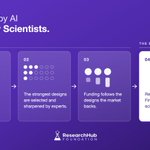
>Create a new AI assistant
>Generate AI proposals
>Incentivize experts to curate & refine
>Refined proposals can get funded
>Experts get sourced to execute
Where AI proposals get refined, funded, then matched to scientists to execute.

Starting with Hair Loss research:
researchhub.com/grant/33066/…
Come upvote, comment, and peer review AI proposal submissions.

“The next scientific frontier: chemistry, and especially biology and medicine”
The big bottleneck there is funding and infrastructure for:
1. Validation studies → testing AI designs in the real world
2. New foundational research → fresh, AI-ready data

Yes, AI is rapidly advancing mathematics (and theoretical physics problems that are essentially mathematical). Like Ramanujan’s notebooks, human mathematicians will spend months (years?) poring over the stream of papers that AI effortlessly generates, hoping to verify and understand them, probably until math itself (via Lean) becomes a branch of computer science like almost everything else.
However, after math and physics, there is still a next scientific frontier: chemistry, and especially biology and medicine.
I mean, it was already the frontier, but it’s the next one too. AI can crush deterministic math problems on the computer, but biomedicine is a highly empirical, noisy, multivariate, and yet often predictable domain.
Thus, AI radically increases our ambitions in biomedicine. All the omics data, all the messy literature, it can all be synthesized and analyzed in a flash. This is what the labs mean when they talk about curing all diseases. The tooling is available to take cracks at biomedical problems previously thought impossible.
Midjourney is doing this, Chan Zuckerberg is doing this, Anthropic is doing this, but there will be so much more.
ResearchHub Foundation retweeted
⚡ Peer reviews are getting even faster on ResearchHub!
With incentivized reviewers submitting within 7 days, we're shortening the submission window for new peer-review bounties from 14 to 7 days.
The first 7-day bounty is now live.
Submit a review → researchhub.com/proposal/330…
ResearchHub Foundation retweeted

AI 🤝 Crypto 🤝 Science

ResearchHub Notebook now has a built-in AI Research Assistant.
• Research: ask questions about your notes
• Edit: draft and refine your work
Less time and effort between finding an RFP and submitting a proposal.
researchhub.com/notebook
NIH detailed a $170M push on reproducibility, making it a top priority for biomedical research.
We think preregistered proposals can be one solution: hypotheses, methods, and analysis plans are public and agreed on before the experiment is funded.
science.org/content/article/…

Funded preregistrations on ResearchHub graduate into Registered Reports in the ResearchHub Journal.
researchhub.com/journal

