

Search Engineering & Topology. American.
Austin, TX
Joined June 2023
- Tweets16.4K
- Following2.6K
- Followers1.3K
- Likes51.3K


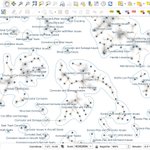


Does meaning possess an experimentally recoverable morphology .. and, if so, what does that morphology reveal about the processes that produce knowledge?
Does the organization of meaning obey discoverable principles that remain stable across subjects, languages, representations, and even the intentions of those who created the knowledge?

Can we distinguish document collections by their organizational function without reading their content?
A Semantic Terrain is the geometry of a corpus under one embedding model, metric and construction.
A Meta Terrain rebuilds that geometry from selected regions of existing terrains, and new structure appears,


Ennyd does this on your Mac: it transcribes your local videos (no upload, any size), you pick passages right from the transcript, and it exports them as clips. Fast export is lossless, with no re-encode.
48-second demo.

okay I have an interesting video editing problem - would really appreciate feedback/solutions.
i cut my video on descript simply because it gives me a transcript on which i can perform my cutting/editing actions.
i dont know any other tool that gives me that modality.
BUT i need to upload footage on it - it doesnt work on my local files. which means i am forced to work on lowered quality videos.
anyone has a fix for this? ie. give me the ability to cut my video based on the transcript - but on my local file that could be multiple GBs.
You can use Ennyd, it works on your local Mac folders, no problem. ennyd.com/

Clint J. retweeted

This preprint shows how deep learning and high-res aerial imagery can accurately map trees outside forests - those scattered across fields, hedgerows, and groves that are often overlooked in environmental monitoring, or sometimes even considered as data artufacts. Check out how this vision transformer-based model works:
More: arxiv.org/pdf/2510.25239
#365Papers #Day316
—--------------------------------------------------------
🌍 𝐒𝐞𝐞 𝐡𝐨𝐰 𝐈 𝐭𝐞𝐚𝐜𝐡 𝐠𝐞𝐨𝐬𝐩𝐚𝐭𝐢𝐚𝐥 𝐝𝐚𝐭𝐚 𝐬𝐜𝐢𝐞𝐧𝐜𝐞: linkedin.com/feed/update/urn…

Reliable Testing by Agents - Best Practices :
1. Start from intent, not the implementation
Write down what the user should be able to rely on before reading the code under test. A test derived from the code tends to check what the code does, bugs included.
2. Assert outcomes someone relies on
Check the result the user would notice, not that some code ran. "The job finished" can pass while the output is empty.
3. Test where bugs live
The happy path is rarely where things break. Choose the cases that matter for this behavior, and say why you skipped the rest.
4. Prove every test can fail
A test you have never seen fail proves nothing. It might click the wrong thing, assert something that is always true, or pass for an unrelated reason. Break the behavior on purpose and watch the test catch it.
5. Verify independently
The author of the code should not be its only verifier. An agent is especially prone to confirming its own work, because it already believes the result.
6. Triage failures instead of rerunning to green
Every failure has a cause. Rerunning until it passes hides the cause and teaches you to ignore the test.
7. Report evidence honestly
A summary is not evidence. Back every claim of "done," "passing" or "safe" with something a reader can check.

