

Director of Performance Solutions / Applied Sport Research - Canadian Sport Institute - Pacific; Runner and lover of Olympic Sport!
Victoria, Canada
Joined April 2012
- Tweets18.8K
- Following619
- Followers23.3K
- Likes17.6K




Trent Stellingwerff, PhD / CSEP-CEP / FACSM / ChPC retweeted

Let's consider her agent, Demadonna, who's represented many of the "best" athletes in the world... but also many of the most highly prolific drug cheats in history (next to Rosa... Demadonna is #2).
The likelihood Peres cheated once is absolutely zero. I'm hoping they'll go back to her Athlete Biological Passport and be able to overturn the vast majority of her race results... bumping the other athletes up.
Our own athlete, Julia, was 3rd at the Marathon World Championship - and fuck yes, I'm going to consider her a silver. But that's in thought only because it won't be official unless those results are overturned.
Now let's get to the money... The base prize monies are known, but lest we forget about appearance fees for World Champions and World Major Champions.... lest we forget about the contract bonuses they have and then the rollover bonuses they have for the years that follow from a contract bonus earning.
Rollovers are when an athlete's contract is upgraded for the following years by the highest bonus earned from that year - Let's just say a World Major win is $100,000 contract bonus and an Olympic win is a $150,000 bonus... easily Peres was earning $750,000/year or more from her contract from Adidas, if not over $1,000,000/year.
Want to bring an Olympic and World Champion to a World Major? Well get ready to pay $250,000 or more because otherwise she isn't going.
NOT including prize money or appearance fees. I'd estimate she was earning $1,500,000/year. Demadonna was earning over $225,000/year on Peres alone.
The sum of money Peres and her TEAM stole... it's through the roof and far more than just what was earned in prize money.
Olympic Standards are based on these results (as a whole). Contracts are based on these results (as a whole). Appearance fees... bonuses... everything is based on what these athletes do and sadly the agencies of Demadonna and Rosa are LITTERED with the worst offenders (at least the most caught).
Trent Stellingwerff, PhD / CSEP-CEP / FACSM / ChPC retweeted

What a BIG splash our UCI Nutrition Position statement made in the November issue, within just 2 weeks of being released! 👏🏼🥳
A massive well done to our fantastic authors. If you haven’t already read the paper, check it out now!
🔗 doi.org/10.1123/ijsnem.2026-…


Trent Stellingwerff, PhD / CSEP-CEP / FACSM / ChPC retweeted

The entire UCI Sports Nutrition Project, including the position statement, is available Open Access.
Check it out in @IJSNEMJournal!

What a BIG splash our UCI Nutrition Position statement made in the November issue, within just 2 weeks of being released! 👏🏼🥳
A massive well done to our fantastic authors. If you haven’t already read the paper, check it out now!
🔗 doi.org/10.1123/ijsnem.2026-…
Trent Stellingwerff, PhD / CSEP-CEP / FACSM / ChPC retweeted

Me: Son, when I was your age, we’d pay for one movie and sneak from theatre to theatre watching the others.
My son: There were that many movies you wanted to see?
October 20, 1986:
One theatre — Karate Kid II, Ferris, Top Gun, Crocodile Dundee, Stand By Me 😳
Trent Stellingwerff, PhD / CSEP-CEP / FACSM / ChPC retweeted

I am a member of the Norwegian Nobel Committee.
There are five of us. Five people, appointed by a parliament most of the planet could not find on a map, who decide, once a year, which human being the world has agreed to call good.
I know. I know. I think about it on the tram.
We meet in a building on Henrik Ibsens gate, a street named after a man who wrote almost exclusively about people discovering they are frauds, which nobody on the committee finds funny except me. There is a room with a long table and the portraits of the dead laureates looking down, Mandela, the Dalai Lama, a great many earnest men in spectacles, and one portrait we do not discuss, which is Kissinger, 1973, awarded while the bombs were still falling, after which two of our predecessors resigned and the satirist Tom Lehrer said political satire was now obsolete. We keep him on the wall. A reminder. Every family has the uncle.
It is October in Oslo, which means the sun gives up around four in the afternoon like a civil servant, and it rains the particular Norwegian rain that isn’t quite falling, just hanging there, judging you. I arrive with wet shoes. I always arrive with wet shoes. There is coffee, because this is Norway and there is always coffee, we drink more of it per person than almost anyone alive, and someone’s wife has sent kanelboller, the cinnamon buns, and we sit, five Norwegians, damp, caffeinated, sugared, and we decide the moral standing of the entire species.
Let me tell you how it actually works, because the world imagines a cathedral and it is, I promise you, a book club with a mandate.
287 nominations this year. 208 people, 79 organizations. Anyone can nominate, that’s the secret nobody understands: a professor, a parliamentarian, a former laureate, so the “nominee” list is meaningless, it’s a suggestion box, and every autumn some congressman nominates his own golden retriever and the press writes “SHORTLISTED.” Nobody is shortlisted. There is no short list the public ever sees. There is us, and the coffee, and the rain, and the portraits, and a Norwegian stubbornness that is older than the prize itself.
We read reports. The institute’s advisers write them, thick dull documents, and we argue. Our chairman told the BBC once that in the final meeting “there is a high temperature.” High temperature, for a Norwegian, means someone slightly raised an eyebrow and then apologized for it. We don’t do high temperature. We do a long silence, and then Kristin says “well,” and everyone knows exactly what “well” meant, and it’s settled. That’s our shouting. “Well.” You’d have to be raised here to hear the violence in it.
Now. This year. I will not say the name, because we never say the name, but you know the name.
A certain head of state wanted this prize the way a child wants a thing in a shop window, which is to say loudly, and in public, and with the full belief that wanting it was itself the argument. He said he deserved it. He said he’d ended eight wars, a number that grew most times he said it, like a fish. He had other heads of state phone us. Israel’s prime minister posted it on the internet, “Give him the Nobel.” The leaders of Cambodia and Pakistan announced they’d nominated him, as though announcing it were part of it, as though we tally mentions. A man flew around the globe collecting endorsements for a Norwegian committee the way you’d collect signatures for a petition to the council about a noisy dog.
And here, uff da, is the detail I treasure, the one that makes me smile into my coffee. The nomination deadline is the 31st of January. He took office on the 20th. So for all the phone calls, all the posts, all the gilded lobbying, the only nominations that could possibly count for this year’s prize were filed in the first eleven days of his term, before he had, by his own arithmetic, ended a single one of the eight wars. He campaigned all year for a prize whose window had shut while he was still hanging up his coat. We didn’t have to reject him. The calendar did. We just watched. Norwegians are very good at watching. We have long winters.
People think we sit there weighing his deeds. We don’t. That’s the thing I can’t make the world understand. We’re not grading his homework. We don’t owe anyone the prize for a ceasefire, however real, however loud the announcement. “He made peace” is not a sentence that ends in a medal, the way he believes it does, the way he believes every good thing ends in his name on it. The will of a dead Swede says the prize goes to whoever did the most for fraternity between nations. A dead Swede, I should add, who made his entire fortune inventing dynamite and selling arms, and spent his last years horrified at his own obituary, which called him a merchant of death, and so bought his way to immortality as a man of peace. The whole prize is one guilty arms dealer’s attempt to launder his name. We are, all of us, administering a dead man’s public relations. I find this clarifying. It keeps me humble. It should keep everyone humble, and it keeps, by my count, no one humble at all.
So who did we give it to?
An eighty-five-year-old woman. A judge. Born in Durban, under apartheid, granddaughter of a Tamil man who came to South Africa as indentured labor, a bus driver’s daughter from the poor Indian quarter, who became the first non-white woman to run a law practice in her province, who defended Mandela’s people when defending them was dangerous, who sat on the Rwanda tribunal and the court at the Hague, and who, at eighty-five, is right now a judge weighing whether a genocide is a genocide. When we told the world, our chairman said the rule of law “underpins the system we have set up to ensure peace,” and that “peace requires justice.” She wasn’t even in Oslo. She was in Nuremberg. In courtroom 600. The actual room where they tried the Nazis. You cannot stage that. God staged that, and God, it turns out, is a better satirist than any of us.
She did not phone us. She did not post. No prime minister demanded it for her on the internet. She had, as far as our deliberations are concerned, the one qualification the loud man could never manufacture, which is that she wanted the work and not the medal. The medal finds those people. It flees the ones who chase it. This is not a rule we wrote. It’s just the only pattern the hundred-odd years of our mistakes has ever shown.
The reaction from across the ocean was immediate. His spokesman posted that we “place politics over peace.” Ja. Perhaps. We’re five damp pensioners in a rainy city; of course it’s political, it was always political, it was political when we gave it to a sitting American president nine months into his first term for the promise of things he had not yet done, and we have been quietly embarrassed about that one for fifteen years, so believe me, we had a particular reason this year to prefer a woman with fifty years of verdicts behind her over a man with eight wars in front of him and a deadline already behind him.
Here is what he will never understand, the thing I’d tell him on the tram if he ever took one. We are the one prize he cannot buy, cannot post his way to, cannot have a friendly dictator phone in for him. Not because we’re incorruptible, nei, we’re as vain and wrong and human as the portraits on our wall. But because the entire point of the thing, the only power a small cold country’s book club has ever held, is that it goes to the person not performing the wanting. The moment you demand it, you’ve proven you don’t understand what it’s for, and proving that is itself the disqualification. He ran the most expensive campaign in the history of the prize and the campaign was the reason. He was never losing to Navi Pillay. He was losing to the concept.
It’s dark now. Four o’clock dark. The buns are gone. Kristin said “well” an hour ago and we all went home. I’m on the tram with my wet shoes, and somewhere across the water a very powerful man is explaining to a camera that the prize is rigged, that we’re corrupt, that he’ll win it next year, and he genuinely might, we’re only five idiots and we’ve been wrong before, Kissinger is still on the wall.
But not this year. This year an old woman in Nuremberg, in the room where the law once stared down the exact kind of man who thinks wanting a thing loudly enough should make it his, got a phone call she didn’t ask for.
That’s the job. We don’t reward the man who ends the war and announces it.
We reward the woman who spent fifty years deciding what a war was.
He’ll never see the difference. That’s rather the whole point of him.
Takk for i dag. I have to change trams.
Trent Stellingwerff, PhD / CSEP-CEP / FACSM / ChPC retweeted
How well someone responds to one training block says little about how they'll respond to the same block again.
42 adults did the same 8-week programme twice: individual VO2 Max gains barely correlated between rounds:
doi.org/10.1152/japplphysiol…
Trent Stellingwerff, PhD / CSEP-CEP / FACSM / ChPC retweeted
Marathon depth continues to explode.
McKay Tiering System defines elite performance as within 7% of world leading time & world class as within 2%.
So women need to be running 2:20:01/2:13:28 and men 2:07:52/2:01:53 to be (scientifically) considered elite/world class now!
Trent Stellingwerff, PhD / CSEP-CEP / FACSM / ChPC retweeted

800m data nerd!
Collected splits for every sub 1:42 race from 1981-2026 to see what the data tells us (see thread).
Rudisha’s 1:41.33 from 2011 was the only one I couldn’t get 200/400 splits for 😤

Trent Stellingwerff, PhD / CSEP-CEP / FACSM / ChPC retweeted

Real men don’t need goggles to celebrate because their eyeballs absorb the champagne and their bodies convert it into testosterone.

Trent Stellingwerff, PhD / CSEP-CEP / FACSM / ChPC retweeted

Another great study from @maunder_ed
More data supporting the role of maintaining CHO availability and oxidation on durability
Congratulations to all authors 👏
journals.physiology.org/doi/…

Trent Stellingwerff, PhD / CSEP-CEP / FACSM / ChPC retweeted
Another study published online today, showing performance benefits of 100 v 60 g CHO over a 4 h cycling duration.
pubmed.ncbi.nlm.nih.gov/4284…
Congrats @nortenblad @JoachimNielsen6 @KasperGejl

Trent Stellingwerff, PhD / CSEP-CEP / FACSM / ChPC retweeted
No one constantly moves the goal posts as much as you Tim -it's OK to say mea culpa. We literally picked 10g/h on the last take home line in your 53 pg review: pubmed.ncbi.nlm.nih.gov/4156… and now you say "it's 20g/h!"...then it will be 30g/h. @Gonzalez_JT @JamesyMorton @LouiseMBurke

Trent Stellingwerff, PhD / CSEP-CEP / FACSM / ChPC retweeted

Some have argued that 10 g of carbohydrate per hour is sufficient to prevent hypoglycaemia during exercise.
Latest data from @HenryJMartyn @JamesyMorton clearly disprove this.
Absolute statements only need a single observation to be disproved.
doi.org/10.1249/MSS.00000000…

Trent Stellingwerff, PhD / CSEP-CEP / FACSM / ChPC retweeted

🚴♂️🍼New study challenges our 10 g/hr dose for maintaining euglycemia and performance... and it changed my mind on what CHO dose is optimal. 🧵
📊1) What the study tested?
This study was designed to test the hypoglycemia risk of a 3-hour sustained cycling ride at 10/90/120/150 g/hr of CHO and exercise capacity after 3 hours of riding.
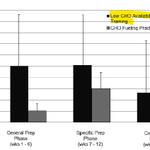
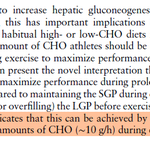
Prior understanding: our data (and others') suggested as little as 10 g/hr may sustain euglycemia and improve performance across high and low carb diets: pubmed.ncbi.nlm.nih.gov/3978…
This study took it further. They had athletes go FURTHER at that same dose, and what they found is important: 6/8 athletes at 10 g/hr dropped into hypoglycemia (<3.8 mmol/L), with a clear fall-off in glucose late in the ride (after 2.5hours). Four couldn't finish the 3 hours.
This clearly suggests >10 g/hr is needed to maintain euglycemia in athletes riding 3+ hours.
⁉️2) Performance, and a caveat
No performance differences between 90/120/150 g/hr. All three looked better than 10 g/hr on exercise capacity, but I interpret this with caution.
Every participant did the 10 g/hr trial first (as a familiarization trial). Athletes often improve on repeat trials in physical and cognitive performance studies, so we can't cleanly say 10 g/hr was worse for capacity.
HOWEVER, with 6/8 athletes hypoglycemic at 10 g/hr and the other high CHO doses doing ~15% better (similar to our 22% improvement seen when CHO prevent hypoglycemia), I believe it is reasonable to infer that this would impair a capacity test done right after. Any dose that maintains euglycemia is likely better than one that doesn't.
🤔3) How this changed my thinking?
10 g/hr does not appear sufficient to maintain euglycemia once exercise reaches ~3 hours. More is needed.
However, I am VERY skeptical that ~107g/hour (estimated optimal dose from study) is that magic number.
Thank you @HenryJMartyn, @JamesyMorton, @LJMUSportSci, @LouiseMaryBurke, @Gonzalez_JT, @TStellingwerff for evolving my thinking on the dose needed to maintain euglycemia during exercise.
[Link to paper: doi.org/10.1249/MSS.00000000…]
@mikeormsbee @ProfTimNoakes @timpodlogar @PhilipPrins11

Trent Stellingwerff, PhD / CSEP-CEP / FACSM / ChPC retweeted

Effects of 10, 90, 120 and 150 g.h-1 CHO on substrate metabolism, exogenous oxidation and exercise capacity: Implications for CHO personalisation
@JamesyMorton @pugh_jamie @TStellingwerff @Gonzalez_JT @LouiseMaryBurke @LJMUSportSci @ScienceinSport
ovid.com/jnls/acsm-msse/abst…

Trent Stellingwerff, PhD / CSEP-CEP / FACSM / ChPC retweeted
Our latest paper:
Effects of 10, 90, 120 and 150 G.H -1 CHO on Substrate Metabolism, Exogenous Oxidation and Exercise Capacity: Implications for CHO Personalization ovid.com/10.1249/MSS.0000000…
Congrats @HenryJMartyn on 2nd PhD study and huge thanks to all coauthors @LJMUSportSci
Trent Stellingwerff, PhD / CSEP-CEP / FACSM / ChPC retweeted

According to this study "The impact of menstrual cycle phase and symptoms on sleep, recovery, and stress in elite female basketball athletes," lack of sleep is more detrimental to performance than menstrual cycle symptoms. #OpenAccess pubmed.ncbi.nlm.nih.gov/4106…

Trent Stellingwerff, PhD / CSEP-CEP / FACSM / ChPC retweeted
One epic position statement, 10 core themes. Here’s all you need to know about nutrition in cycling! Thank you to the team behind this special project 🙏🏻🚲
🔗 doi.org/10.1123/ijsnem.2026-…


Trent Stellingwerff, PhD / CSEP-CEP / FACSM / ChPC retweeted
Pulling this project together was a major undertaking - including recruiting experts from across the world working both in academia and at the coal face in cycling.
Really proud of what we have produced!
One epic position statement, 10 core themes. Here’s all you need to know about nutrition in cycling! Thank you to the team behind this special project 🙏🏻🚲
🔗 doi.org/10.1123/ijsnem.2026-…
Messages on bottles to circumvent no race radios at worlds! Nice innovation! cyclingnews.com/pro-cycling/…
