





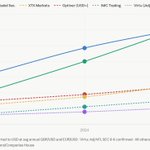
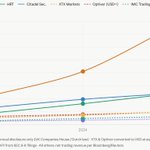


Ken generously let the hedge fund biz monetize the Situational Awareness liquidation…
CitSec’s weakest quarter since Q3’25, both in absolute trading revenue and normalized by US equity notional ADV.

*CITADEL SECURITIES PULLS IN RECORD $15 BLN IN FIRST NINE MONTHS
CitSec generated over $3.4B in revenue in Q3, up 29% from the same quarter last year. 2026 net trading revenue is already greater than all of 2025's revenue. Ken thanks you for your contributions
4
61
16,750

My X timeline is an endless barrage of stocks being either massively underpriced or wildly overpriced. Apparently nothing trades at fair value anymore.
Do I buy an iron fly and bet on a bimodal outcome, or just fade all of FinTwit and sell vol?
1
5
512
Great example of the mental gymnastics my fellow vol traders and market makers often perform to justify cheering on a crash that causes real harm to real people, when the actual appeal is being flush with cash while everyone else is forced to fire-sell their luxury goods.
1/2

I got into watches because the secondary market reminds me so much of trading. I know it sounds nerdy, but there’s something exciting to me about finding a dealer or seller who needs cash and has to move a piece off their balance sheet. If I can scoop it up at a steep enough discount, I’m already sitting on a sizable mark to market gain. And I love thinking about value like that.
I woke up this morning to a few price alerts I’d set for high end pieces on the secondary market. I don’t think it’s a coincidence that those alerts are going off just as equities and other risk assets are down.
IF (that’s a big IF) equities keep sliding over the next few weeks or months, I think that decline would do far more to bring inflation down than the ticky tack 25 basis point hikes the Fed has planned.
When risk assets really get hit, people who need cash start selling what they own, and even those who don’t need to sell may think twice about what they’re willing to spend. That would tighten financial conditions more than the efforts we’ve seen so far to constrain lending.
A good old-fashioned reset would likely be healthy for the economy in the long run.
Looking for liquidity on number of Jensen mistresses.
11/20 expiry 4 @ 7, last traded 5
12/18 expiry 5 @ 10
XZ spread 1 @ 3 size on both sides.
12
691


Vol Duck retweeted

Maven is shutting its New York office, saying it sees the greatest potential for business growth in Dubai, where the proprietary trading firm recently opened an office bloomberg.com/news/articles/…

Vol Duck retweeted

Optiver is looking to secure about $900 million in financing as the market maker seeks to expand its trading activities bloomberg.com/news/articles/…

Vol Duck retweeted

Dusting off this tweet from April because this gap in shared understanding of LLM capability is *widening*. It's now less "two groups of people speaking past each other" and more a sharp funnel.
- Napkin math somewhere around 6B people (~75% of the population) have barely come in contact with LLMs at all.
- Around 1-2B (~20%) are casual and infrequent users of free-tier ChatGPT-like products. This group sees derpy chatbots and treats them a bit like a better Google search, a writing aid, or etc. Maybe an agent tries to book you a flight. I have non-tech friends who (reasonably, imo) say they have not much use for it at all. Even many professionals outside of math&code are in this tier. For example, execs and many other functions spend a lot of their time talking to other people, so while they understand what is happening intellectually, it is still second-hand and a bit abstract.
- Now we get to professional use of frontier-grade LLMs in math&code. Somewhere around 20M people (0.2%) see first-hand that large, complex projects that used to take them weeks/months can now be completed by agents with a prompt. Building apps, copying apps, translating apps, decompiling apps from binaries... This has all happened very quickly and recently - less than 1 year ago, I was writing code manually by hand, typing memorized computer code commands into a code editor character by character, occasionally pressing Tab to autocomplete a little chunk of code.
- And finally we get to the ~5,000 people (~0.00006%) with access to frontier-grade systems internally. The external world has seen the preview. It looks like swarms of thousands of agents collaborating over weeks on software mega projects: minting zero days, running cyber attacks and defenses at machine speeds, discovering new science, advancing the frontier of mathematics. Things that would have taken top professionals in the industry years of work. Meanwhile, human review and comprehension are starting to fall behind. For example, people are still involved in the "archeology" of the OpenAI-HF incident from many months ago. Mathematicians may be poring over the 722 manuscripts on frontier mathematics for a while.
The funnel is driven by a combination of factors:
1. The impact scales with ambition, problem size, and horizon. A question with a paragraph answer barely stresses the system. You need a reservoir of big, difficult problems that you really care about. This aspect drives the consumer / professional dimension of the funnel.
2. The jaggedness of the system (which I have written about a lot separately). Capability peaks in domains that are digital, verifiable and economically valuable. This is because LLM capability emerges from reinforcement learning on verifiable rewards on a curated environment mixture driven by revenue potential. This aspect primarily drives the area (e.g. math&code) dimension of the funnel.
3. Access. Free-tier, paid-tier, internal.
So this is the weirdness of the moment. The general public has mostly not interacted with these systems. When they have, it looks like a derpy chatbot. The majority of professionals still see only a modest uplift. And a small sliver of professionals are experiencing the vertigo of the curve going vertical. And it is all happening at the same time.

Judging by my tl there is a growing gap in understanding of AI capability.
The first issue I think is around recency and tier of use. I think a lot of people tried the free tier of ChatGPT somewhere last year and allowed it to inform their views on AI a little too much. This is a group of reactions laughing at various quirks of the models, hallucinations, etc. Yes I also saw the viral videos of OpenAI's Advanced Voice mode fumbling simple queries like "should I drive or walk to the carwash". The thing is that these free and old/deprecated models don't reflect the capability in the latest round of state of the art agentic models of this year, especially OpenAI Codex and Claude Code.
But that brings me to the second issue. Even if people paid $200/month to use the state of the art models, a lot of the capabilities are relatively "peaky" in highly technical areas. Typical queries around search, writing, advice, etc. are *not* the domain that has made the most noticeable and dramatic strides in capability. Partly, this is due to the technical details of reinforcement learning and its use of verifiable rewards. But partly, it's also because these use cases are not sufficiently prioritized by the companies in their hillclimbing because they don't lead to as much $$$ value. The goldmines are elsewhere, and the focus comes along.
So that brings me to the second group of people, who *both* 1) pay for and use the state of the art frontier agentic models (OpenAI Codex / Claude Code) and 2) do so professionally in technical domains like programming, math and research. This group of people is subject to the highest amount of "AI Psychosis" because the recent improvements in these domains as of this year have been nothing short of staggering. When you hand a computer terminal to one of these models, you can now watch them melt programming problems that you'd normally expect to take days/weeks of work. It's this second group of people that assigns a much greater gravity to the capabilities, their slope, and various cyber-related repercussions.
TLDR the people in these two groups are speaking past each other. It really is simultaneously the case that OpenAI's free and I think slightly orphaned (?) "Advanced Voice Mode" will fumble the dumbest questions in your Instagram's reels and *at the same time*, OpenAI's highest-tier and paid Codex model will go off for 1 hour to coherently restructure an entire code base, or find and exploit vulnerabilities in computer systems. This part really works and has made dramatic strides because 2 properties: 1) these domains offer explicit reward functions that are verifiable meaning they are easily amenable to reinforcement learning training (e.g. unit tests passed yes or no, in contrast to writing, which is much harder to explicitly judge), but also 2) they are a lot more valuable in b2b settings, meaning that the biggest fraction of the team is focused on improving them. So here we are.


Vol Duck retweeted

I resigned from Anthropic today. I spent the last three years doing pretraining research at both OpenAI and Anthropic. Neither company is acting responsibly. They are racing straight to self-improving superintelligence and gambling with our lives. More thoughts below.


Vol Duck retweeted

GPT-6 Astra, trained on ~100K+ NVIDIA Grace Blackwell NVLink72. From ChatGPT to o1 to Astra in 4 years.
AGI has arrived. Congratulations @OpenAI team.
400K GPUs coming online next.
Yup. And ditto for angel investors and LPs.

Many startup employees do not recognize the sheer litany of ways that a founder can screw you over without you even knowing. Founder trust is one of the most important things to look at when you’re joining a startup.
From cutting you out of M&A, screwing your retention pool, overdiluting your equity, firing you before your cliff, not having attractive options exercise plans, poor 409a price management, not telling you about QSBS / early exercise, blocking you from participating in secondary, obscuring company performance and many more.
Many many decisions that are made in rooms you are not in as an employee where the only thing that matters is: “does the founder have your back?” Great startups with untrustworthy founders lead to poor outcomes and often good startups with trustworthy founders lead to great outcomes.
Pick wisely.
2
897