

Pumper In Chief of AppLovin $APP
United States
Joined August 2025
- Tweets482
- Following19
- Followers298
- Likes1.3K






$APP we are going higher my friend. there are only exceptional people working on this business.

Rafael Vivas (@rfvivas) dropped out of high school, got kicked out of his house, and was a billionaire by 32.
When he joined AppLovin, he had one condition: he had to live inside the office. Adam Foroughi built him a bed from IKEA. He said:
“The only way that we’re going to win is we’re going to have to out-hustle everybody else.”
When a partner called Cheetah squeezed AppLovin too hard, he started a game studio to compete with them and named it Lion Studios, “because lion is the only animal that can kill a cheetah.” It went from zero to over $250 million in revenue in two years.
Raf has a lot of ideas on dealmaking, persistence, attention to detail, why he’s against delegation, and why retiring at 28 made him miserable.
This is a fascinating conversation about purpose, performance culture, and staying in the game.
0:00 Kicked out of his house at 16
6:42 Starting his own ad platform at 17
9:58 “Don't be mad, but I'm going to compete with you”
11:06 His one condition: living in the office
15:40 Turned down by VCs while already profitable
21:00 Why he's against delegation
24:15 Two years of persistence to land one customer
30:42 Lion Studios: built to kill a Cheetah
38:41 Walking away from AppLovin at 28
44:13 The IPO that brought him back
45:44 The stock buyback that made $50 billion
1:01:01 The mentor who redlined the NDA
1:03:54 “Do you want to be Michael Jordan or Tiger Woods?”
1:05:46 The best advice he ever received: stay in the game
Includes paid partnerships.
$APP AppLovin at $500 after a slight Q3 beat would put it at 25x fwd on 25-30% eps growth in '27
I personally don't think that is expensive and that is 120% higher from here


$APP here is my honest opinion about what I think will happen next week with AppLovin:
1) I think they will modestly beat both revenue and earnings next week, like they have done for the past 15 quarters, excluding this most recent quarter. I don't think it's going to be a blowout. I think they're going to beat by a couple percent. They're going to raise Q4 guidance by a couple percent, and that'll be that.
2) I think they will give insight into e-comm, how it's scaling. They'll give us some numbers, and they'll start to give us an idea so that we can calculate CAC to LTV on these customers. And hopefully, they will give us an idea of total ad spend on the platform from e-comm brands.
3) I think they will give more insight into how e-comm and consumer make their moat more defensible against other bidders in the auction, and they will try to hammer that point home.
4) They will not give insight on the Unity lawsuit.
5) I think they will give insight into where this e-comm pixel installation growth is coming from. Pixel installation growth is customer growth, and I think we will see them ramping up marketing spend here. That's why I think they will start to give us CAC to LTV, so we can start to model out potential revenue from these e-comm businesses.
6) CTO started to tweet about Gist, and I think there's a very small chance they give some color, or at least entertain an analyst question about Gist, but nothing more.
7) I think Adam knows the severity of the situation, and he will not bend to the pressure. He knows what has to happen. He knows what's on the line for his employees. He knows if App doesn't start to reverse course, talent will leave, the business will suffer, and the lean operation he tries to run with SBC and all of that will not work anymore. So he has to revert Ship now.
8) Overall, I think they will calm nerves in the quarter. They will show everything is completely fine, that competition is not truly hurting margins or anything yet. etc
9) They will reauthorize a shitload of buybacks and they will show that they used as much of their buyback as they can this quarter. They will get back to buying at least $1B per quarter in stock, and I expect buybacks to be at least reauthorized to $2B. I also expect insider selling to stop.
My last color here is that I am an e-commerce advertiser myself, and it is booming on APP. We spend about $10M a year on ads. AppLovin has won in e-commerce. Us, as an e-commerce advertiser, we will never run on both AppLovin and Unity. So in that respect, AppLovin has won. The ads are working and it's so easy because it's a one-to-one port over from our Meta ads creative, and that's why I'm so bullish. It's not like it's TV where we have to get whole new creative and hire a whole new creative team to stand up ads for TV. It's mobile game ads that are basically the same as Instagram Reel ads, so it's so easy to set up, launch, and scale, and we don't need a whole new creative team. We just need to edit existing assets. It's about 10% wallet share for us, and it's not like it takes away from Meta. As the business grows, we spend more on AppLovin. It's incremental. Our next best dollar is spent on AppLovin rather than on Meta right now, and that's fine.
EOY PT: $400
2027 PT: $600

$APP
1. How Unity could compress AppLovin’s spread
AppLovin’s revenue is effectively the gap between what advertisers pay and what it pays publishers to win each impression. Unity doesn’t need to beat AppLovin overall to squeeze that gap. It only needs to bid competitively on more impressions. If Unity’s model values an impression at $10 and AppLovin’s values it at $12, AppLovin still wins, but it has to pay closer to $10 instead of $7. A competent #2 raises AppLovin’s costs even when it loses.
You’re right that this isn’t one-sided:
AppLovin has far more of the inputs that matter: most of the mediation share through MAX, the most data, and roughly $7B a year in EBITDA to spend on compute and research. Unity is a fraction of that.
It’s an arms race. AppLovin had a large model lift land in Q3, while the bear case assumes it stands still.
Edgewater’s view is an interpretation of channel checks, not a measured fact.
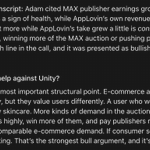
One thing from the transcript: Adam cited MAX publisher earnings growing double digits quarter over quarter as a sign of health, while AppLovin’s own revenue grew only 4%. Publishers earning a lot more while AppLovin’s take grew a little is consistent with other bidders, possibly Unity, winning more of the MAX auction or pushing prices up. It isn’t proof, but it’s the most bearish line in the call, and it was presented as bullish. Watch whether that gap closes in Q3.
2. Does e-commerce help against Unity?
Yes, and I think it’s the most important structural point. E-commerce advertisers bid on the same gaming inventory, but they value users differently. A user who won’t install another puzzle game might buy skincare. More kinds of demand in the auction means AppLovin can value more impressions highly, win more of them, and pay publishers more while keeping its margin. Unity has no comparable e-commerce demand. If consumer scales, AppLovin’s edge grows instead of shrinking. That’s the strongest bull argument, and it’s the one you’re making.
3. Do better frontier AI models mean better AppLovin models?
The link is positive but loose, nowhere near one-to-one. AppLovin’s ad engine is a recommendation and prediction model trained on its own conversion data, not an LLM. Frontier models help in three indirect ways:
Engineering speed. Adam said LLMs have raised their A/B testing rate. This is real but incremental.
Generated creative. This is the biggest one. Adam called the lack of 30–60 second video ads “the biggest hurdle” for e-commerce. Better video generation hits that bottleneck directly and could unlock smaller advertisers.
Research that transfers. Transformer architectures and scaling ideas carry over into ad models.
The catch is that Unity gets the same LLM tools. What decides the winner is proprietary data and compute, and that still favors AppLovin.
4. Can model improvements alone keep reaccelerating growth?
They alone probably can’t. I can’t verify the 1.2% conversion figure. The logic is sound, though: revenue is roughly impressions × price, and price is driven by predicted conversion. Going from 1.2% to 2% on the same impressions would raise revenue about 67%. That’s possible over years, but in a maturing gaming market each lift gets harder. Durable reacceleration more likely comes from new demand (e-commerce, consumer apps) and later new supply (non-gaming apps, the web, connected TV), with model gains as the engine underneath both. That matches your thesis.
5. Your e-commerce view
A 10% share of e-commerce ad spend would be enormous relative to AppLovin’s roughly $8B revenue run rate. Even a few percent would be a large second engine. “The pie grows” is partly true, since a channel with good return on ad spend does pull in new budget. In the near term, though, budgets shift slowly, and Adam admitted AppLovin is still a “testing bucket” for many advertisers. The risk to your thesis is the timeline, not the direction.
They have about $1.8B authorized and strong free cash flow, and buying at $228 is far more accretive than buying at $500.


Does this guy know what he is talking about? $APP

I am not sure people truly understand the potential significance of what is happening at $APP @HedgeyeCommOR
"We're an engineering-led company, and it shows."
Yea no shit! @AppLovin you're certainly not an investor relations led company!

@WeirdContrarian bro you really think APP gets smoked again and missed this quarter?
I really can't see it TBH they already lowered guidance in Q3
I would love to hear your HONEST and UNBIASED take
I think they will have a juicy guide for Q4 with ecom

$APP I highly suggested reading Zachary's take on AppLovin's current issue with Management and Investor relations if you are an investor in the business ...

Here's my take:
$APP hates hiring people. They particularly hate hiring people who aren't A+ engineers. Their philosophy is: make a better product and everything else will take care of itself. This has led to enormous success, so it will take an enormous incentive for that to...
$APP Zachary "Big Balls" Drake shares his take! I tend to agree.
Why would APP ever want to hire in IR? Truly, what incentive do they have to do it if they believe product solves all?
Not saying they are wrong or right, but market is voting them wrong that's for sure.
Here's my take:
$APP hates hiring people. They particularly hate hiring people who aren't A+ engineers. Their philosophy is: make a better product and everything else will take care of itself. This has led to enormous success, so it will take an enormous incentive for that to...

The most ironic thing in the world right now actually would be AppLovin smoking earnings and popping 20% and going on a ripper into the year end and ending the year at -5%