

Profesor titular @uc3m @MetaProdes @AgEInves editor #ética enciclopedia @SEFA_Filosofia Master Ética de la IA UC3M-CSIC
Granada-Madrid
Joined January 2018
- Tweets2.8K
- Following3.5K
- Followers1.2K
- Likes7.1K







Pinned Tweet
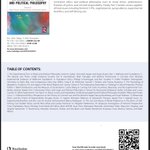
‘Experiments in Moral and Political Philosophy’ will be of interest to scholars and advanced students working in ethics, applied ethics, experimental philosophy, social and political philosophy, and philosophy of law.
👇👇👇 routledge.com/Experiments-in…

Antonio Gaitán retweeted

When a hurricane hurts someone, that's just bad luck. But when a person hurts someone, they're doing wrong. They are a moral agent. But how do we decide this? What exactly is moral agency? Thrilled that my paper with @jensemler is out in Cognition doi.org/10.1016/j.cognition.…

Antonio Gaitán retweeted

👋 Good morning!
📥The latest issue (Vol.41, No. 3. 2026) of our international open access journal is available at:
🔗ojs.ehu.eus/index.php/THEORI…
🙂One retweet?


Antonio Gaitán retweeted

1/ Are non-native authors underrepresented in philosophy? Our paper, now out (OA) in Research Integrity and Peer Review, is the biggest study to date on linguistic injustice in academic philosophy. We checked over 100k articles between 1975 and 2021. 🧵doi.org/10.1186/s41073-026-0…

Antonio Gaitán retweeted

How do AI systems perceive and treat each other? In our next webinar, @LuciusCaviola and Caspar Kaiser will present an empirical research agenda for the emerging field of inter-AI morality.
Please join us!
nyu.zoom.us/webinar/register…

Antonio Gaitán retweeted

Announcing the Call for Papers for Oxford Studies in Philosophy of AI and Computing!
Rapid AI progress is raising *so many* philosophical questions; but philosophers aren't as involved in the conversation as they should be, for many different reasons.
One is that, aside from some work in logic and philosophy of mind, philosophy of AI and computing has often sat on the margins of the discipline. One reason for *that* is that so many philosophers working on AI have had to do so basically on their own, figuring things out for themselves as they go along, without a real community around them.
OSPAIC is going to help fix this! We're going to have an annual conference and volume. The conference (in DC! where much of the future of AI will be decided) is especially important as we think about the nature of intellectual life in a world where AI systems can one-shot a superficially-plausible philosophy paper. OSPAIC sees philosophical progress as being about more than just the accumulation of true claims. The conference is a big part of our vision for how we contribute to philosophical progress.
And our aim is also to help philosophers be part of the broader public conversation! To that end we're also going to be launching, soon, a subcode on arXiv for philosophical foundations of AI (cs.pfai), and encouraging everyone who submits to OSPAIC to also upload their draft to arXiv (at present, use keyword PFAI).
We're also partnering with @cosmos_inst, who will be sponsoring an annual prize for the best paper on philosophy and AI, as well as helping fund the first round of the conference and Open Access publication for the volume. And with Cosmos we'll be highlighting some of the most interesting submissions to cs.pfai as they come in.
I'm the executive editor; Jeff Howard (UCL) and Rachael Sterken (University of Hong Kong) are associate editors; Ned Howells-Whitaker (JHU and Pittsburgh) is the assistant editor. We're grateful for the support of a wonderful advisory editorial board, including brilliant philosophers and computer scientists from academia, industry, and civil society.
The deadline for submissions is 11.59pm Feb 14, 2027, anywhere on earth. All details are at ospaic.org.

Antonio Gaitán retweeted
‘This strategy is unstable. It forces us to choose between preserving the appearance of conversation and preserving the conversational ideals that give assertion its epistemic and normative significance’
Antonio Gaitán retweeted
‘our argument does not deny the practical value of LLMs in epistemic contexts (…) it challenges the attempt to preserve both a functional conception of assertion and a robust normative account of responsibility by making proxy responsibility explicit’
link.springer.com/article/10…

‘our argument does not deny the practical value of LLMs in epistemic contexts (…) it challenges the attempt to preserve both a functional conception of assertion and a robust normative account of responsibility by making proxy responsibility explicit’
link.springer.com/article/10…
Antonio Gaitán retweeted

What the studies keep showing, again and again, is that ordinary folks are happy to attribute knowledge in cases where philosophers would deny knowledge
The ordinary concept *does not* seem to involve all of the complex conditions that philosophers have invoked in their theories
Antonio Gaitán retweeted
There has been a huge amount of experimental philosophy research on the concept of KNOWLEDGE
This research finds that the ordinary concept doesn’t work in anything like the way philosophers said it does
A thread with some examples:
🧵
Antonio Gaitán retweeted

Atentxs a esta titulación. El equipo docente nace de una cooperación científica ejemplar entre @uc3m @uc3mFacultadHCD y @IFS_CSIC : filosofía, ingeniería y políticas públicas colaborando para pensar uno de los más urgentes problemas de nuestro tiempo.

Este próximo jueves se inaugura el Master en Ética de la IA @uc3m @CSIC 🎉📣🎉🎉📣
Estáis tod@s invitados!🎉🎉
@UC3MFPermanente @DPE_CSIC @CCHS_CSIC @CSICdivulga

Este próximo jueves se inaugura el Master en Ética de la IA @uc3m @CSIC 🎉📣🎉🎉📣
Estáis tod@s invitados!🎉🎉
@UC3MFPermanente @DPE_CSIC @CCHS_CSIC @CSICdivulga

Antonio Gaitán retweeted
‘our argument does not deny the practical value of LLMs in epistemic contexts. What it challenges is the attempt to preserve both a functional conception of assertion and a normative account of responsibility by making proxy responsibility explicit in conversational interaction’
Antonio Gaitán retweeted
‘LLMs function as powerful conversational enablers, but not as conversational agents in a sense that supports a stable pairing of functionalism and the proxy view’
Antonio Gaitán retweeted
‘Although interactions with LLMs can enhance individual epistemic agency and facilitate epistemic activity, we argue that these gains do not arise from genuinely conversational interaction but are mediated by the epistemic virtues of users themselves’
Antonio Gaitán retweeted
Can we properly speak of conversational IA? In this paper in #synthese we stand for a negative answer (at least for knowledge-oriented communicative exchanges) #germanmassaguer
@divulgauc3m @SpringerPhil
🎉🎉👇🎉👇
link.springer.com/article/10…
Can we properly speak of conversational IA? In this paper in #synthese we stand for a negative answer (at least for knowledge-oriented communicative exchanges) #germanmassaguer
@divulgauc3m @SpringerPhil
🎉🎉👇🎉👇
link.springer.com/article/10…
‘LLMs function as powerful conversational enablers, but not as conversational agents in a sense that supports a stable pairing of functionalism and the proxy view’