
A cold-blooded researcher. Primary sources afiocionado.
India
Joined September 2010
- Tweets9.9K
- Following840
- Followers1.9K
- Likes20.1K






Apratim Tripathi retweeted

Ab Gandhi-Nehru sikhaenge anti-UC, anti-Brom kya hota hai.
In 1948 Chitpawan killings, culprits were Congress workers only. But even FIR was not filed on them due to pressure by Congress of muh Baman Hriday Samrat Nehru. This is mentioned by then CP & Berar home minister himself


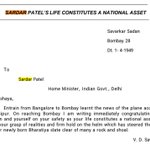
Many people are ready to reject Savarkar on the issue of Travancore but to me it was a political genius. The man understood statecraft, power consolidation and world history better than anyone. The only lament is: he did not have the first-mover advantage and hence couldn't contain the fractures of two decades of blunders by Hindu leaders. He came to the scene but all too late. His Calcutta address expresses his lament where he senses that he has stepped in for a losing battle but would want to perish like the bravest of soldiers in attempting the herculean.
The confusion is partly due to the troubled marriage between cultural nationalism and modern constitutionalism while in Savarkar's mind it was all clear. He was a cultural nationalist through-and-through. This is why ideological clarity is indispensable. Most people write him off on this issue and do not have half the intellect to judge him properly.
1
3
102
We are living in a Sardar Patel stitched India and have the luxury to judge Savarkar post-facto and hence doubt him. We were fortunate that the phenomenon of Sardar happened without which the Savarkarite way was the only option considering the dire straits of the final months leading to the partition.
2
71
This article deserves more flowers than it did at the time it was posted. Hence resharing. Short and sweet and passes the message of Hindutva profoundly. Well done as always @abbajabbadaba 💪

Here is my article on Babasaheb Bole, his association with Dr. Ambedkar and Non Brahmin parties and his later change of heart after he saw actions of Veer Savarkar during Mahad Satyagraha and the comments of one of his past collaborators when he joined HMS
cshc.substack.com/p/the-turn…
Apratim Tripathi retweeted
Since the Travancore issue is surfacing, one must remember this. Share if you want to.

Savarkar sends a letter to Secretary of State, Amery, opposing Mr. Gandhi's support to 'Muslims forming Independent states' [read as Pakistan] :
Who was playing divide-and-rule? Give a class 8th student this letter and he will tell you who. This letter should be seen by every Congressite to correct their cognitive dissonance on Savarkar vis-a-vis Gandhi.
Rajagopalachari-Gandhi formula granted Muslims the right to forming Independent States. Savarkar opposed it. PERIOD.

ALT The Transfer of Power, Vol. 4, p. 1123
These people don't have the right to say a word against Savarkar considering they fail to acknowledge the efforts he put to prevent the partition. All his HMS stint went towards this sole objective and guess the enemies that he found on the way? Obviously your idols and with very valid reasons all highlighted in Hindu Rashtra Darshan and the Transfer of Power volumes edited by Nicholas Mansergh. People who know nothing about power consolidation would fail to understand the Travancore move. On one hand you have princely states putting their bets on the Muslim League, so how does one counteract? By pleading a secular republic? The conundrum of who represented the Muslims became the focal point of the partition and all attempts at putting the blame on Hindus, except secularist leaders, is simple Hindu-hate/monkey balance. The truth is: The partition was a long unidirectional project with only occasional and individual divergences while the larger political consenses pointed towards partition from the get go. What else was Sir Syed responding to? What else was the Urdu-Hindi clash capturing? What else made Muslim leaders lament the revocation of the partition of Bengal? What else explains the Khilafat?
The problem is: you will do everything in your capacity to try and weaken a larger argument which anyways stays valid. Then you use your weakening argument as the crux of the phenomenon while your argument itself is flawed. Basically, you fear the facts and the fact that the Congress was literally taken for a ride by the Muslim leaders from the Lucknow Pact to 1947. Direct Action Day was just a burst of the volcano that lay dormant.

Namaste @josyjosephkj
1. While Savarkar viewed Hindus and Muslims as separate cultural and religious nations, he fiercely opposed the geographical division of the subcontinent and advocated for a single, centralized, unitary Indian state ("Akhand Bharat")
2. Presidential Address to the Akhil Bharatiya Hindu Mahasabha (Ahmedabad, 1937): Often misquoted to claim Savarkar wanted partition, this speech actually laid out his vision for a single, unified political state. In it, Savarkar argued against splitting the country, stating: "Let the Indian State be purely Indian. Let it not recognise any invidious distinctions whatsoever in matters of franchise, public services, offices, or taxation on the grounds of religion or race."
3. In the second volume of his biography on Savarkar, @vikramsampath directly addresses and refutes the claim that Savarkar supported the partition of India. Sampath documents Savarkar's "Akhand Hindustan" campaigns during the 1940s, his opposition to the Cripps Mission and Cabinet Mission plans (which opened the door to provincial secession), and his vehement rejection of Jinnah's demand for Pakistan.
With utmost modesty, i request you to either consider these facts and make either amendments to your purportedly misleading and sensational claims or refute me. Either ways, the malicious campaign by a cohort should end.
Apratim Tripathi retweeted

In fact, @josyjosephkj should have known, particularly after writing this book, that Hindu Mahasabha leaders faced the wrath of the Government of Dominion India for advocating the cause of Akhand Bharat in the years immediately following Independence.
It is also worth examining the Hindu Mahasabha’s proposed Free Hindustan Constitution. Its stated framework was strikingly different from the usual caricature: no special concessions to minorities, but equally, no privileges or advantages for the majority. Equal citizenship, rather than communal appeasement or majoritarian privilege, was the principle it professed.
And let us get the chronology right. Sir Syed Ahmad Khan, the founder of the Aligarh movement, articulated the idea of Hindus and Muslims as distinct political communities decades before Savarkar was even born. The intellectual genealogy of the Two-Nation Theory cannot simply be rewritten to begin with Savarkar.
It is therefore unfortunate that someone writing on this subject appears to have missed the most elementary distinctions between who proposed what, when, and in what political context.
@iyuvrajpokharna is absolutely right on one crucial point: Savarkar envisaged Hindus and Muslims as two distinct nations, but did not advocate their territorial separation. His conception was of two nations inhabiting the same country. One may disagree with that political vision, but one cannot honestly conflate it with the demand for Partition.
And, for that matter, even Jawaharlal Nehru acknowledged the profound differences between Hindu and Islamic religious traditions, particularly their contrasting approaches to proselytisation and accommodation of other faiths.
History deserves better than convenient chronology, selective quotations and ideological shorthand. If we are going to debate the origins of the Two-Nation Theory, let us at least begin with the historical record.
Namaste @josyjosephkj
1. While Savarkar viewed Hindus and Muslims as separate cultural and religious nations, he fiercely opposed the geographical division of the subcontinent and advocated for a single, centralized, unitary Indian state ("Akhand Bharat")
2. Presidential Address to the Akhil Bharatiya Hindu Mahasabha (Ahmedabad, 1937): Often misquoted to claim Savarkar wanted partition, this speech actually laid out his vision for a single, unified political state. In it, Savarkar argued against splitting the country, stating: "Let the Indian State be purely Indian. Let it not recognise any invidious distinctions whatsoever in matters of franchise, public services, offices, or taxation on the grounds of religion or race."
3. In the second volume of his biography on Savarkar, @vikramsampath directly addresses and refutes the claim that Savarkar supported the partition of India. Sampath documents Savarkar's "Akhand Hindustan" campaigns during the 1940s, his opposition to the Cripps Mission and Cabinet Mission plans (which opened the door to provincial secession), and his vehement rejection of Jinnah's demand for Pakistan.
With utmost modesty, i request you to either consider these facts and make either amendments to your purportedly misleading and sensational claims or refute me. Either ways, the malicious campaign by a cohort should end.
Apratim Tripathi retweeted

My complete interaction with Maharashtra Chief Minister @Dev_Fadnavis @Devendra_Office at Gadhiroli.
We spoke about the newly formed West Bengal government, academia, and Naxalism!
@drashokuike_mla
Thank you @rmponweb
#d3gadchiroli
#digitaldemocracydialogue


Apratim Tripathi retweeted

Earlier, while listening to history podcasts, I used to be very harsh on anyone who made factual mistakes. I would think that the person simply didn't know enough. But now, having appeared on several podcasts myself and made quite a few such mistakes, I can say that most of the time, they just happen. There is very little you can do about them.
Some of my most embarrassing mistakes include confusing Bindusara with Bimbisara, calling the Tolkāppiyam a Sanskrit grammar, and many more.
I try to be more cautious, but striking a balance between being accurate and being spontaneous in a podcast is a skill that is difficult to acquire. Judging by the mistakes I have made and probably will make, I still have a long way to go.
So, this is a rather long winded way of saying that if you catch me making mistakes, please give me the benefit of the doubt!
Apratim Tripathi retweeted

As Joel Mokyr once said: "The responsibility of economic historians is to remind the world what things were like before 1800."
Read this review to see how bad it was . . .
Spoiler: really bad!
Plague, gruel and bad teeth: why do people idealise the olden days? economist.com/culture/2026/1…

Apratim Tripathi retweeted

Giving him credit for the Hyderabad operation is the last thing one should do. Literally called Patel a “communalist” for advocating it
Plus wtf are u talking about China 😭 Forward policy was to take own territory+ he was actually outraged when Patel & Kathing took Tawang


Apratim Tripathi retweeted

.@4point2KILOyear took a 20-year-old pile of objection letters and turned it into the clearest account I’ve read of how a constituency map gets bent.
Boundaries First Essay On How Sharad Pawar Redrew The Map For His Daughter Supriya Sule.
boundaries.in/essays/pawar-b…


Our first essay.
In 2006 the Delimitation Commission rejected every Shiv Sena objection to its draft, then adopted a plan for Pune’s four Lok Sabha seats sent by three men on the ruling side (NCP-INC Alliance).
By @4point2KILOyear
Art By Preksha Jain
boundaries.in/essays/pawar-b…

Apratim Tripathi retweeted

This Deepavali, a lamp worth lighting: Smriti, @mid_org's record of India’s civilizational heritage, now holds over 11 lakh manuscript records and 1 lakh inscriptions, free to search, in one place.
That is roughly a tenth of the 1 crore+ manuscripts India’s national survey has mapped, and about a third of the 3 lakh inscriptions estimated to survive. To our knowledge, no other open platform brings Indian manuscripts and inscriptions together, at this scale.
When we, @Shreyas_mysuru, @SudarshanHS, @RahulDewanV2 & I, started on this journey a year ago, the intent was: a dataset that is public & free. What we have managed so far is owed to our donors, teammates, volunteers, custodians and partners.
This year, there are two priorities:
1. A platform for researchers and enthusiasts to add to and correct the knowledge base.
2. Fresh digitisation grants to partner institutions, for which we are raising a corpus of ₹15 crore.
A request to every donor: be our ambassador. Every hour spent fundraising is an hour not spent digitising. If you would like to help or volunteer, please write to [email protected] or DM @midf_org.
तमसो मा ज्योतिर्गमय।
smriti.midf.org.in


Apratim Tripathi retweeted

Like almost all autobiographies, Sonia Gandhi’s autobiography is NOT about what happened, but what she wants the world to BELIEVE happened.
Apratim Tripathi retweeted

A NEW CHAPTER IN THE INTELLECTUAL STUDY OF HINDUTVA.
This Diwali, we are pleased to announce the launch of our new website, a platform dedicated to the systematic, research-oriented study of Hindutva.
thehindutva.in/

Apratim Tripathi retweeted
New Delhi Review of Books invites proposals for review essays, particularly from researchers and faculty members working in fields relevant to the featured books.
Proposals for this call are due by 20 November 2026. Please refer to the post for the featured titles, submission guidelines, and honorarium details.
Please write to [email protected].
We also accept proposals throughout the year for books from our wider curated list, which is updated every month on our website. For more details, newdelhireviewofbooks.in/p/w….


Apratim Tripathi retweeted
have successfully escaped the danger of being reborn as a Chhuchhundar until the next Diwali


