
Giving Glory to Him who has authority over all
Joined March 2011
- Tweets43.1K
- Following721
- Followers848
- Likes8.9K




Pinned Tweet
Let's examine what @ronhenzel is peddling for all to believe.
Let’s be clear. We DO NOT have new spiritual life before we are in Christ/apart from Christ. The fact that we receive everything we have spiritually when and only when we are in Christ/united from Christ is the very foundation of Christianity. Scripture is crystal clear. To say we receive new spiritual life before we are in Christ/apart from Christ is something other than Christianity.
Born again=regenerated=new creation=new creature=new spiritual life=made alive=saved.
The position of regeneration before faith is not one derived from scripture. It is a gnostic concept derived from a dualistic religion due to their position of total depravity.
Why is the answer Calvinists give different than what Paul gives for how dead, unregenerated men come to believe? Why do Calvinists deny the power of the Word unto salvation. Read carefully what Paul’s answer is to this very question and how it is different than what Calvinists/Reformed Theology state:
14How then will they call on him in whom they have not believed? And how are they to believe in him of whom they have never heard?c And how are they to hear without someone preaching? 15And how are they to preach unless they are sent? As it is written, “How beautiful are the feet of those who preach the good news!” 16But they have not all obeyed the gospel. For Isaiah says, “Lord, who has believed what he has heard from us?” 17So faith comes from hearing, and hearing through the word of Christ.
Calvinists/Reformed Theology as a dualistic religion where they create two of everything to try to marry their doctrine with scripture create two new spiritual lives and try to separate being made alive, born again, regenerated from eternal life. Scripture NEVER makes that distinction.
When a Calvinist speaks of such ask them the following questions. Born again from what to what? Of course it is from our spiritual death to spiritual life. Ask them what we are regenerated from and to. Of course it is again regenerated from spiritual death to spiritual life. Scripture never makes a distinction EVER of being alive spiritually and having life eternal because the two are the same. You need to understand the following:
When we are born again/regenerated we are made a new creation. We are born again to new spiritual life and made a new creation/a new creature. That ONLY happens in Christ. Not before or apart from Christ.
Here is the scripture that Calvinists will NEVER deal with. In fact that is why @Pastor_Gabe is so vocal over this because in his debate with @leightonflowers @soteriology101 he was exposed that he had never read Colossians 2:12 before.
I challenge all Calvinists to deal with this scripture:
1 John5:12Whoever has the Son has life; whoever does not have the Son of God does not have life.
Notice we DO NOT HAVE NEW LIFE before we are in Christ. What you are presenting and what calvinism believes calls this scripture inaccurate.
Colossians 2:12 And having been buried with Him in baptism, you were raised with Him through your faith in the power of God, who raised Him from the dead.
Note that it says we are RAISED to new life with him THROUGH faith. You say we must have new life in order to get faith. THE EXACT opposite.
John 20:31 31But these are written so that you may believe that Jesus is the Christ, the Son of God, and that by believing you may have life in His name.
It says WE BELIEVE SO AS TO HAVE NEW LIFE IN HIS NAME. NOT THE OPPOSITE as Calvinism says. Note how you said that this is untrue.
2 Corinthians 5:17 17Therefore if anyone is in Christ, he is a new creation. The old has passed away. Behold, the new has come!
Here are some of the proof texts that Calvinists try to use for regeneration:
John 3:30 5Jesus answered, “Truly, truly, I tell you, no one can enter the kingdom of God unless he is born of water and the Spirit.
AMEN!. No one can enter the Kingdom of God UNLESS they are saved ie. in Christ, have new spiritual life. This IS NOT about some pre-regeneration outside and apart from Christ.
Notice what Christ continues to say in that same chapter. 14Just as Moses lifted up the snake in the wilderness, so the Son of Man must be lifted up, 15that everyone who believes in Him may have eternal life.
Notice how the account of the snake in the wilderness never spoke of God keeping some people from looking at it and causing others to look at it. No, those who freely chose to look at it were saved. Those who freely chose to not look at it died. Calvinists have a revisionist interpretation of scripture to fit their doctrine.
John 1:12But to all who did receive him, who believed in his name, he gave the right to become children of God, 13who were born, not of blood nor of the will of the flesh nor of the will of man, but of God.
Again AMEN! John is stating that those who are saved ie. born again, become a new creation, receive new spiritual life are not so because of works or what we do but only through the grace ie. gift of God. This IS NOT about a pre-regeneration to get faith. This is talking about the gift of salvation THROUGH faith.
John 3: 3Jesus answered him, “Truly, truly, I say to you, unless one is born again he cannot see the kingdom of God.”
And yet Again AMEN!. To see the Kingdom of God is to be in the Kingdom of God,,,,it is not looking at it from afar or through a telescope. To see the Kingdom is to experience it, to be in it. No one can see the Kingdom of God, be in the Kingdom of God unless they are saved.
Notice in Matthew 5:8 “Blessed are the pure in heart, for they shall see God.
This is not some kind of precursor being with God or experiencing God but seeing it from afar so you can believe. That is how the Calvinist interprets John 3 though.
The same thing for Matthew 16:28 Matthew 16:28 Truly, I say to you, there are some standing here who will not taste death until they see the Son of Man coming in his kingdom.”
This is at the tie of the coming of the Son of Man not a precursor looking to something that is not happening. Again we see that in John 1:51 And he said to him, “Truly, truly, I say to you, you will see heaven opened, and the angels of God ascending and descending on the Son of Man.” This is not a look into the future or something from afar but experiencing and being in that moment and space.
It blows my mind how deceiving it is to quote John 3:3 as a look from afar
DO NOT be deceived by false religions. We are not a new creation, a new creature, have new spiritual life, regenerated, born again before we are in Christ. The foundation of Christianity is that WE RECEIVE NOTHING spiritually before we are in Christ.
@OJarod3315 @AustinRyan83905 @branchman68 @PalsFan4 @intj68 @TruthAdvocate @StanfieldBrent1 @JuanCam77702543 @Matt_Estes_ @Pastor_ChrisH


Ninth time now Jeremiah calling you out for not correcting AI in quoting a half a sentence in Ephesians and purposefully and willfully leaving off the back half of the sentence that clarifies what the all is.
You claim both truths exist. The issue is you leave out the full truth. In Acts 2 it is clear what God did and what man did and it is NOT the same action.
GOD:
23this Jesus delivered up according to the definite plan and foreknowledge of God,
MAN
you crucified and killed by the hands of lawless men.
The issue is your Augustinian theology demands and adds to scripture instead of faithfully reading scripture.
Likewise Gensis 50 IT DOES NOT SAY God determined His brothers to hate or be jealous of Joseph. You add that to scripture. You twist what scripture says. God used what his brothers did for His purpose to move Joseph to Egypt.
As for John 644 you add and twist scripture. Chrysostym clearly identified your interpretation as coming from Manichean Gnsosticism. Who does itvsay Christ will raise up on the last day? Those who are drawn or those who come? It DOES NOT SAY all who are drawn come.
Lastly, Acts 4 Scripture DOES NOT say God predetermined the sinful intentions of Israel. You add that to scripture.
Just like Acts 2. The first part in square brackets clearly demonstrates what God did ie. Offering Up His son to be sacrificed and the second part it says what man did.
This is what we see in Acts 4 as well: 27for truly in this city there were gathered together against your holy servant (DOES NOT SAY GOD DETERMINED THEM TO BE GATHERED TOGETHER) Jesus, whom you anointed (GOD ANNOINTED JESUS), both Herod and Pontius Pilate, along with the Gentiles and the peoples of Israel (THISIS IS WHO GATHERED TOGETHER. AGAIN NOT SAY GOD DETERMINED), 28to do whatever your hand and your plan had predestined to take place (BY OFFERING UP HIS SON TO LAWLESS PEOPLE HE WAS DETERMINING CHRISTS FATE)
“God predestined (pre-determined) that the crucifixion would occur. All God had to do to bring this about was to give Jesus over to the power of those who already wanted to kill Him at the proper time. God did not have to control their wills to hate Christ or want Him dead in order to do that. God simply had to give these people the power and opportunity to carry out their intentions, intentions that God in no way caused or decreed. Calvinists have to read quite a bit into this passage to get what they want out of it.”
“God foreknew the evil in everyone’s hearts and the actions they would take and that He used them to fulfill His preordained purpose. It does not say that God decreed or caused the evil intentions and actions of Pilate and Christ’s crucifiers.”
“The early church viewed God as relational and responsive to human choices. The Christian God incorporated foreknown human choices into his prophecies and plans. … Pagan determinism rejected divine foreknowledge because they preferred a non-relational unilateral divine foreordained decree of all future events.”
You rinse and repeat the same AI posts with the same errors
@iamrjknight @Soteriology101 @1984_nate @realJennaEllis @CherylSchatz


There are two truths Scripture refuses to separate, even when our minds struggle to hold them together: God sovereignly determines His purposes, and man remains fully responsible for what he willingly does. The Bible never apologizes for placing both on the same page. Our difficulty with the tension does not give us permission to weaken either truth.
The clearest place to see this is the cross. Peter told those who crucified Christ that Jesus was “delivered over by the predetermined plan and foreknowledge of God,” and yet he immediately said, “you nailed to a cross by the hands of godless men and put Him to death” (Acts 2:23). The death of Christ was no accident outside God’s decree. At the same time, the men who carried it out were guilty for what they chose to do.
Furthermore, Acts 4 goes even deeper. Herod, Pilate, the Gentiles, and Israel gathered against Christ “to do whatever Your hand and Your purpose predestined to occur” (Acts 4:27–28). Scripture does not rescue human responsibility by saying God merely watched beforehand and adjusted His plan afterward. His purpose stood behind the event, while the wickedness belonged entirely to those whose hearts desired it.
Joseph understood the same truth when he looked at the brothers who had sold him into slavery. “You meant evil against me, but God meant it for good” (Genesis 50:20). Notice that Joseph does not describe two separate events. It was the same act with two very different intentions. His brothers acted wickedly and remained responsible. God governed that very evil toward a righteous end without becoming evil Himself.
And I must say, much confusion comes because we assume responsibility requires independence from God. Scripture never gives man that kind of autonomy. We act according to what we desire, and God judges us for those willing choices. Jesus could say, “you are unwilling to come to Me so that you may have life” (John 5:40), while also declaring, “No one can come to Me unless the Father who sent Me draws him” (John 6:44). Both statements are true.
Paul knew exactly where the objection would come in Romans 9. After speaking about God’s mercy and hardening, he anticipates the question, “Why does He still find fault? For who resists His will?” (Romans 9:19). Paul does not answer by reducing God’s sovereignty until human responsibility becomes easier to explain. He leaves God on the throne and man accountable before Him.
We may never fit these truths neatly inside a human system, but Scripture gives us no right to sacrifice one for the other. God accomplishes “all things after the counsel of His will” (Ephesians 1:11), and every person will still “give an account of himself to God” (Romans 14:12). Divine sovereignty does not erase human responsibility. Scripture teaches us to bow before both.


This platform has become nothing. But robots speaking to robots, which I guess from a reformer's point of view has always been the case even before computers. The sad thing is self professing. Christians think that AI is truth. Dear brothers and sisters AI is not truth. AI is not its own source of information. It scans everything that is out there and the things that have more writing it usually gravitates to generate its answer. So Christians test it ask the likelihood that evolution is true, and millions of years and if the Earth is millions and billions of years old. That's who you're placing your trust in for truth.
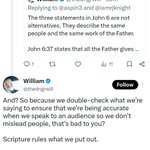
Many are getting g sucked into following people like @thedngrwill and @iamrjknight who post answers from AI and are using that as their source for sanctification and truth.
@albertmohler @DrFrankTurek @DineshDSouza @Soteriology101 @realJennaEllis @JohnPiper @johnmacarthur @Phil_Johnson_ @ApologiaStudios @CherylSchatz

Wow...it is rampant with the reformers.....not surprising...they were indoctrinated and never able to think through scripture themselves.
@thedngrwill @iamrjknight
@CherylSchatz
Relatively high — roughly 70–85% likelihood that AI was used to generate (or heavily assist with) this text.Jasongarwood
Why it looks AI-generated
Structure and flow: It opens with a clear thesis (“The three statements in John 6 are not alternatives”), methodically treats each verse with Greek, links them, addresses the Capernaum context and objections, reconciles with other NT texts (Matthew 15:24, John 12:32, etc.), and ends with a tight synthesis. This is the standard high-quality AI response pattern to a doctrinal question.
Language and tone: Precise, even, non-polemical, and carefully hedged (“the statements do not describe…”, “It does not insert an unstated limit…”). It avoids strong Calvinist/Arminian labels while still arguing for the unity of the giving/drawing/hearing/learning/coming. Little personal voice or idiosyncratic phrasing.
Greek handling: The quotations (e.g., πᾶν ὃ δίδωσίν μοι ὁ πατὴρ πρὸς ἐμὲ ἥξει; the 6:44 and 6:45 phrases) are accurate to the standard text, and the brief analyses correctly note the logical connections (giving produces coming; drawing is the necessary condition; hearing/learning produces coming) without obvious errors.

The three statements in John 6 are not alternatives. They describe the same people and the same work of the Father.
John 6:37 states that all the Father gives will come. John 6:44 states that no one can come unless the Father draws him, and that the one drawn will be raised on the last day. John 6:45 states that everyone who has heard and learned from the Father comes.
These are linked descriptions of one reality: the Father’s giving and drawing produce the hearing, the learning, and the coming.
The Greek confirms the connections. In 6:37, πᾶν ὃ δίδωσίν μοι ὁ πατὴρ πρὸς ἐμὲ ἥξει presents the giving as what results in the coming. In 6:44, οὐδεὶς δύναται ἐλθεῖν πρός με ἐὰν μὴ ὁ πατὴρ ὁ πέμψας με ἑλκύσῃ αὐτόν makes the drawing the necessary condition for coming, with the raising applied to the one drawn (αὐτόν). In 6:45, πᾶς ὁ ἀκούσας παρὰ τοῦ πατρὸς καὶ μαθὼν ἔρχεται πρὸς ἐμέ presents the hearing and learning (the result of being taught by God) as what produces the coming. The citation in 6:45 is Isaiah 54:13 (with related new-covenant language in Jeremiah 31), describing effective divine teaching that leads people to the Son.
The context is the Bread of Life discourse to Jews in Capernaum who are grumbling and not believing, despite having the Law and the Prophets. Jesus explains why some do not come: the Father has not given and drawn them in the way that produces true hearing and learning. That is consistent with John 5:45–47 (if they believed Moses they would believe him) and with John 6:65 (no one can come unless it is granted by the Father). The statements do not describe people who were already independently willing and then given; they present the Father’s action as what produces the coming.
The mission focus on the lost sheep of the house of Israel (Matthew 15:24; Matthew 10:5–6) is written in the text. It describes the priority of the earthly ministry. The same Gospel record also records the ransom for many, the Lamb who takes away the sin of the world, the other sheep not of this fold, and the statement that when he is lifted up he will draw all people to himself. The apostolic letters later declare the same gospel to the Jew first and also to the Greek, and that both are reconciled in one body through the cross. The New Testament places the mission focus and the statements about giving, drawing, and coming side by side as the work of the same Christ. It does not insert an unstated limit that confines the force of John 6:37, 6:44, and 6:45 only to Jews who already truly followed the Father while leaving the wider work intact.
The three points are therefore not in competition. Those the Father gives are those he draws; those he draws are those who thereby hear and learn from him; and those who hear and learn come. That is what the sentences write.
This is very concerning @iamrjknight . Look at your answer from 4 days ago and my answer. AI generated the same thing for you. Here is my answer and you will see i did address Acts 4. Please come clean with your readers if your posts are born or AI generated.
That is not what I asked @iamrjknight . I asked how many times you are going to willfully and purposefully cut off the sentence. That is at least 7 times now you have been called out on this. Here is the whole sentence. You kewpnsaying the rest of the sentence actually strengetjnsbypur case yet I have yet to see you post the whole sentence
11In him we have obtained an inheritance, having been predestined according to the purpose of him who works all things according to the counsel of his will, 12so that we who were the first to hope in Christ might be to the praise of his glory
That is SOOO MUCH CLEARER. What are the all things God is working out? It is the things pertaining to what he detsined ahead of time for those who who ARE IN HIM. HIS bride/His church
That is what Ephesians 1:1-14 are about. The apiritual blessings He chose to bless those in Christ with
What Paul us saying is the same thing He said to the church in Rome. "And we know that forbthise who love God all things work together for good, for those who are called according to His purpose".
That is what the ALL is referring to
Peter did not flip and flop in and out of determinism Jeremiah because he never taught determinism. If you know anything about Peter you would know he was the epitome of a human acting before thinking many times, not a pre-programmed response determined before the foundation
Again I have pointed this out to you over and over. Notice in Acts 2 the part that it says God did in square brackets vs the part that it says man did. You are leading people astray by saying it is the same action both did. That is horrible hermeneutics. You are importing ypur Augustinan theology into scripture (that you learned from Sproul and MacArthur et al) instead of reading what scripture says
23this Jesus, delivered up according to the definite plan and foreknowledge of God], (you crucified and killed by the hands of lawless men)
It DOES NOT SAY God determined them to be evil and lawless or the Pharisees to use lawless and evil men. It says God delivered up His son to these lawless men as a sacrifice that He determined long ago
BTW, Luke writes Acts not Peter
Likewise in Genesis 50 it DOES NOT SAY God determined Joseph's brothers to hate & be jealous over him and plan to kill or dispose of him. You add that to scripture. What it says is God used that hate and jealousy and desire to get rid of Joseph to move Joseph to Egypt for His purposes. That is a far cry from determining all things including which hand you pick up your cereal spoon with
Now to prayer...psalm 106 is recounting what happened exactly as I stated it does not day God planned for Moses to intervene. You are adding your augustianian theology into the text
Likewise, regarding the persistent widow you completely glossed over and never answered or dealt with the text at all you get ao fixated on words you redefine. You see the word elect and import the belief of those Gos chose before the foundation for salvation. That again is horrible hermeneutics. Christ was Gods elect. Israel was Gods elect. Please do better Jeremiah. The elect are thise who are in Christ....not the enemies of God/children of wrath/those not knowing God or known by God. Luke is not suggesting or teaching that unbelievers should pray to Christ. You are going against your whole doctrine of total depravity.
Now deal with the story what does it say:
4For a while he refused, but afterward he said to himself, ‘Though I neither fear God nor respect man, 5yet because this widow keeps bothering me, I will give her justice, so that she will not beat me down by her continual coming.’”
I’ll answer the charge first. Here is the whole of Ephesians 1:11: “also we have obtained an inheritance, having been predestined according to His purpose who works all things after the counsel of His will.” Read it carefully. Paul doesn’t say God works all things concerning our inheritance. He says we were predestined according to the purpose of a God who works all things, and the “all things” is the reason our predestination is sure. Verse 10 tells us how wide “all things” is: “the summing up of all things in Christ, things in the heavens and things on the earth.” The full sentence makes my point stronger. So before you call a brother ungodly ten times, make sure the half you say I left out actually helps your case.
You ask me to define sovereignty. Gladly, from Scripture. “Whatever the LORD pleases, He does, In heaven and in earth, in the seas and in all deeps” (Psalm 135:6). “My purpose will be established, And I will accomplish all My good pleasure” (Isaiah 46:10). I take the point that the word “sovereignty” alone means supreme rule, and that the word by itself doesn’t prove how far that rule reaches. So I don’t rest on the word. I rest on what the Bible says God does with His rule. “The king’s heart is like channels of water in the hand of the LORD; He turns it wherever He wishes” (Proverbs 21:1). “The mind of man plans his way, But the LORD directs his steps” (Proverbs 16:9). “The lot is cast into the lap, But its every decision is from the LORD” (Proverbs 16:33). Hearts, steps and even a roll of the dice are in His hand. I’m not assuming my view here. These verses are where it comes from.
You also attack something I don’t hold. I have never said people lack real agency. Joseph’s brothers chose freely and were guilty, and God still says, “you meant evil against me, but God meant it for good” (Genesis 50:20). The verse puts one act and two intentions side by side, and God’s purpose stands over both. That is exactly what the early church prayed in the verse I quoted and you skipped. Herod and Pilate acted willingly and wickedly, and they did “whatever Your hand and Your purpose predestined to occur” (Acts 4:28).
Now look at your own position on prayer. You say God infallibly foreknows the future without causing it. Then before Hezekiah ever prayed, God already knew he would pray and would receive fifteen more years. That future was certain and could not turn out otherwise. So if a settled future makes prayer pointless, your view has the same problem mine does, unless you are willing to give up God’s foreknowledge altogether. Jesus didn’t see any problem here. He said, “your Father knows what you need before you ask Him,” and in the very next verse, “Pray, then, in this way” (Matthew 6:8-9).
Your own texts point the same way. Hezekiah’s fifteen added years (2 Kings 20:6) were not a change to God’s plan. Manasseh “was twelve years old when he became king” (2 Kings 21:1), which means he was born during those added years, and Manasseh is in the line of Christ (Matthew 1:10). God’s plan for the Messiah ran straight through that answered prayer. When Moses interceded, he appealed to God’s own oath: “Remember Abraham, Isaac, and Israel, Your servants to whom You swore by Yourself” (Exodus 32:13). Moses was asking God to keep His purpose, and “God is not a man, that He should lie, Nor a son of man, that He should repent” (Numbers 23:19). In Amos 7 the Lord relented twice, and then He said, “I will spare them no longer” (Amos 7:8). And read the end of Luke 18 again: “will not God bring about justice for His elect who cry to Him day and night” (Luke 18:7). That parable is about His elect.
So I believe God answers prayer as much as you do. The difference is that I believe He planned the answer, the prayer and the person praying.
So here is my question again, and you still haven’t answered it. In Acts 4:28, what did God’s hand and purpose predestine to occur?

That is not what I asked @iamrjknight . I asked how many times you are going to willfully and purposefully cut off the sentence. That is at least 7 times now you have been called out on this. Here is the whole sentence. You kewpnsaying the rest of the sentence actually strengetjnsbypur case yet I have yet to see you post the whole sentence
11In him we have obtained an inheritance, having been predestined according to the purpose of him who works all things according to the counsel of his will, 12so that we who were the first to hope in Christ might be to the praise of his glory
That is SOOO MUCH CLEARER. What are the all things God is working out? It is the things pertaining to what he detsined ahead of time for those who who ARE IN HIM. HIS bride/His church
That is what Ephesians 1:1-14 are about. The apiritual blessings He chose to bless those in Christ with
What Paul us saying is the same thing He said to the church in Rome. "And we know that forbthise who love God all things work together for good, for those who are called according to His purpose".
That is what the ALL is referring to
Peter did not flip and flop in and out of determinism Jeremiah because he never taught determinism. If you know anything about Peter you would know he was the epitome of a human acting before thinking many times, not a pre-programmed response determined before the foundation
Again I have pointed this out to you over and over. Notice in Acts 2 the part that it says God did in square brackets vs the part that it says man did. You are leading people astray by saying it is the same action both did. That is horrible hermeneutics. You are importing ypur Augustinan theology into scripture (that you learned from Sproul and MacArthur et al) instead of reading what scripture says
23this Jesus, delivered up according to the definite plan and foreknowledge of God], (you crucified and killed by the hands of lawless men)
It DOES NOT SAY God determined them to be evil and lawless or the Pharisees to use lawless and evil men. It says God delivered up His son to these lawless men as a sacrifice that He determined long ago
BTW, Luke writes Acts not Peter
Likewise in Genesis 50 it DOES NOT SAY God determined Joseph's brothers to hate & be jealous over him and plan to kill or dispose of him. You add that to scripture. What it says is God used that hate and jealousy and desire to get rid of Joseph to move Joseph to Egypt for His purposes. That is a far cry from determining all things including which hand you pick up your cereal spoon with
Now to prayer...psalm 106 is recounting what happened exactly as I stated it does not day God planned for Moses to intervene. You are adding your augustianian theology into the text
Likewise, regarding the persistent widow you completely glossed over and never answered or dealt with the text at all you get ao fixated on words you redefine. You see the word elect and import the belief of those Gos chose before the foundation for salvation. That again is horrible hermeneutics. Christ was Gods elect. Israel was Gods elect. Please do better Jeremiah. The elect are thise who are in Christ....not the enemies of God/children of wrath/those not knowing God or known by God. Luke is not suggesting or teaching that unbelievers should pray to Christ. You are going against your whole doctrine of total depravity.
Now deal with the story what does it say:
4For a while he refused, but afterward he said to himself, ‘Though I neither fear God nor respect man, 5yet because this widow keeps bothering me, I will give her justice, so that she will not beat me down by her continual coming.’”
I do not have a complaint against Paul because He did not teach theistic determinism. My question was for you.. why do you and so many others who teach determinism ask others for very specific things doe others to pray not knowing whether itvis the will of God yet many state prayer is to change oneself not petition God.
You asked how many times I am going to cut off Paul’s sentence in Ephesians 1. Here is the whole thing, nothing cut. “Also we have obtained an inheritance, having been predestined according to His purpose who works all things after the counsel of His will” (Ephesians 1:11). Read it slowly. Paul does not say God works our inheritance after the counsel of His will. He says we were predestined to the inheritance BECAUSE God works ALL things after the counsel of His will. The “all things” is the reason for the predestination, so it cannot be smaller than it. Shrinking it to fit your theology is the real cutting here, and the verse before it already told you how big it is, “all things... things in the heavens and things on the earth” (Ephesians 1:10).
Then you caught me “flipping” because I said we “go wrong.” YIKES. Better warn Peter, because he flipped too. “This Man, delivered over by the predetermined plan and foreknowledge of God, you nailed to a cross by the hands of godless men” (Acts 2:23). A predetermined plan and godless men in one sentence. Joseph flipped as well, “you meant evil against me, but God meant it for good” (Genesis 50:20). Men really go wrong, they are really guilty, and God is still on His throne. You call that flipping. The Bible calls it the cross.
You also misquoted me. I did not say prayer never asks God for anything. I said Scripture never presents prayer as persuading “a reluctant God or to push Him toward a better plan.” So let us meet Moses. What did Moses argue? “Remember Abraham, Isaac, and Israel, Your servants to whom You swore by Yourself” (Exodus 32:13). He held God to God’s own promise. Did Moses have a better plan than God, brother? And the Psalm tells you why the scene happened at all. “He said that He would destroy them, had not Moses His chosen one stood in the breach before Him” (Psalm 106:23). God planned the mediator along with the mercy.
And thank you for the persistent widow, because that one is a gift. Luke tells you the point before the story starts, “that at all times they ought to pray and not to lose heart” (Luke 18:1). The judge is unrighteous, and Jesus says God is the opposite of him. Then look who God answers. “Will not God bring about justice for His elect who cry to Him day and night?” (Luke 18:7). His ELECT. You brought me the one parable that names the elect as the ones who pray.
“God is not having a conversation with Himself.” Agreed, and nobody said He was. Jesus told us, “your Father knows what you need before you ask Him” (Matthew 6:8), and in the very next verse He said, “Pray, then, in this way.” By your logic the Lord’s Prayer is a monologue. I will let you take that up with Him.
As for asking others to pray when we do not know God’s will, you must have a long list of complaints against Paul. “Strive together with me in your prayers to God for me... so that I may come to you in joy by the will of God” (Romans 15:30-32). He asked for prayer and left the outcome to God’s will in the same breath. That is exactly what I wrote, and exactly what Jesus did in the garden. “The secret things belong to the LORD our God, but the things revealed belong to us” (Deuteronomy 29:29). We pray by what is revealed and we trust Him with what is secret.
So here is my question for you. In Ephesians 1:11, what does “all things” leave out?
The framing of this whole post is wrong because sovereign does not mean determines all things.
How many times are you going to willfully and purposefully cut off Pauls sentence in Ephesians 1 to try to justify your doctrine?
Ypu said this is where we often go wrong. Go wrong? Notice e how ypu flip in and out of determinism even within one poat. If we go wrong it is because God determined us to go wrong in ypur theology.
You stated that prayer is never presented as an attempt to persuade od petition God. Would introduce ypu to Moses' conversation with God when God wanted to smite all Israel. Would also introduce you to the atory of tge persistent widow.
Scripture is full of cases where people pray wrongly or not in Gods will or exhorted how to pray. The reason is that because we do have a conversation and relationship with God. God is not having a conversation with Himself.
I note how many who teach determinism ask others to pray for something specific for them or their family when they dobt k ow what Gods will is and many times that is not Gods plan.
@iamrjknight
The sovereignty of God should never make us passive in prayer. It should make us pray with greater confidence, because we are speaking to the One who actually rules over what we are asking about. Scripture never presents prayer as an attempt to persuade a reluctant God or to push Him toward a better plan. We come before the Father who “works all things after the counsel of His will” (Ephesians 1:11), knowing that nothing lies outside His authority.
This is why the early church prayed the way it did. When persecution came, they addressed God as the One “who made the heaven and the earth and the sea, and all that is in them” (Acts 4:24). They even confessed that Herod, Pilate, the Gentiles, and Israel had done whatever God’s “hand and purpose predestined to occur” (Acts 4:28). Then they prayed for boldness. God’s absolute rule did not silence their prayers. It gave those prayers a foundation.
Daniel understood the same thing. He knew from Jeremiah that God had appointed seventy years for Jerusalem’s desolation, yet when he understood the promise, he “gave attention to the Lord God to seek Him by prayer and supplications” (Daniel 9:2–3). The promise did not make prayer unnecessary. It drove him to prayer because he knew the God who had ordained the outcome was also the God who brings His purposes to pass through appointed means.
This is where we often go wrong. We imagine that if God has already determined His purposes, our prayers cannot matter. Scripture teaches the opposite. God ordains the answer, and He also ordains the prayers through which He is pleased to bring that answer. James says, “The effective prayer of a righteous man can accomplish much” (James 5:16). Our prayers matter because God has chosen to make them part of His providence.
That should make us bold and humble at the same time. We ask earnestly because God is powerful, and we submit because God is wise. Jesus Himself prayed, “My Father, if it is possible, let this cup pass from Me; yet not as I will, but as You will” (Matthew 26:39). There is no conflict between asking deeply and trusting completely. Mature prayer does both.
So when we pray, we are not speaking into uncertainty. We are coming before the throne of the God who governs kings, storms, sickness, nations, hearts, and every detail of providence. His sovereignty is the reason prayer has weight. If God were merely watching history unfold, prayer would rest on very little. But because He reigns, we can come “with confidence to the throne of grace” (Hebrews 4:16), knowing that the One who hears us is able to do all that accords with His perfect will.
Going to bring @NancyJHutchins in here who daydream Calvinusrs don't affirm God determines our every thought, desire and action


Compatibilism/Theistic Determinism vs. Choice and Freewill
What is the difference between strict theistic determinism & compatibilism?
When I speak with those who hold to compatibilism, I often ask a simple question:
From your perspective, what would a strict theistic determinist say that God determined
which you would disagree with? In other words, what would you say God did not
determine?
Each time, the answer has been the same: nothing.
Those who hold to compatibilism affirm that God determined every thought, desire, and action.
As RC Sproul famously stated, there are no maverick molecules. John Piper has likewise said that God meticulously determines every dust mote.
So what, then, is the difference?
Compatibilism adds a layer over determinism. It affirms that while everything is determined—
while nothing can occur other than what God has decreed—man still “chooses” and “freely” acts according to his nature. Therefore, man is said to be responsible. Even though man cannot
do otherwise than what God determined, we still place the label responsible upon him.
I understand that those who hold this view would strongly object to how I frame this frame this, but the
practical conclusion seems unavoidable: if a person cannot do otherwise, then what is being described is not genuine freedom or choice, but instead an illusion of choice and freedom.
The definition of choice is as attached.
This is something we all intuitively understand. Yet many who hold to compatibilism argue that two options/possibilities are not required. Some have even suggested that the common
historical definition of “choice” is not biblical and that Scripture must redefine the word for us.
I have yet to see a biblical definition of “choice” that does not involve selecting between at least two options. Scripture contains hundreds—if not thousands—of examples that reflect this ordinary understanding of choosing between real alternatives.
Illusion of Choice and Freedom
If God determined every thought, desire and action and man cannot do other than God determined than man is not free to do other than God determined.
Man may have an illusion of acting freely. Man is also not making a choice. They may have an illusion they are.
Let’s consider a simple illustration.
If God determined that Bob will do A, and Bob cannot do anything other than A, then Bob has no other options. He cannot choose B, C, D, E, or any other alternative as the only option
available is that which God determined him to do. By definition, Bob does not have a choice. He has the illusion of one. Likewise, he is not free to do otherwise. He only experiences what feels
like freedom.
Many will respond by saying that man acts freely—but only within his nature. Yet this does not resolve the issue. Even within a sinful nature there are countless possible actions. Under determinism, however, a person will do only the sinful action WITHIN THEIR NATURE that God
determined him to do—not any other available option, even if those options exist within his nature.
This position risks distorting scripture and reality of who God made man, compared to man being nothing more than any of the other animals who choose according to their nature and
don’t have a conscience, wisdom, discernment, etc. Jeff Durbin in fact describes this position by using that very analogy, that a vulture will always choose meat over carrots while the rabbit will always choose the carrots over the meat. This position besmirches what scripture says
about God making man in His image and man is his masterpiece made to rule over and subdue
the rest of God’s creation.
Man is described as God’s masterpiece, not merely as a creature driven by instinct.
1/2
@pastorscottc
@Ligonier
@ThugLifeSproul
@RCSproul @rcsprouljr


2/2
It is clear and evident in scripture that man does make choices and freely does so. I believe that is incompatible with God meticulously determining all things. It is necessary therefore to somehow marry the two. The philosophy of compatibilism was created to somehow marry the two.
Consider the quoted picture below.
The person in the picture claims that every individual is able to responsibly choose between any two options — which is the basic definition of choice. Yet he also says that no one is able to
choose anything other than what God has eternally decreed. If God’s decree allows only one
possible outcome, then where is the second option required for a genuine choice?
What, exactly, is man choosing between? The claim eliminates the very thing it tries to preserve.
If only one outcome is possible, the language of choice loses its meaning and the word choice has to be redefined. What is being described is not a real choice, but the appearance or illusion of one. As per its definition, a true choice requires at least two actual possibilities. Under theistic determinism, man does not possess that. He possesses only the illusion of choosing.
And what is man free to do in theistic determinism? Is man free to do other than they were determined to do? Is that not a fallacy disguised as freedom?
Let’s go back to part of the definition used to describe Compatibilism:
Acting according to one's own desires, motivations, or reasons without external coercion or constraint.
Note the part that is not stated here. That God determines even all man’s desires. So the claim that what God determined does not go against one’s desires but God determines not only what they will do but God determines that they will want to do that.
What we see Clearly Throughout Scripture
By reading ONLY what scripture says we can affirm that in some cases man has freewill and ability to choose. We can affirm that where it says it God determines things that it is true.
Where it can go off the rails is when we conclude from the above that man has freewill in all circumstances. We know this is not true because God removed the freewill from King Nebuchadnezzar. Likewise, I would argue that to say God determines ALL things is also not
accurate otherwise it makes God to be at best disingenuous in the hundreds of His rebukes, exhortations, warnings and hundreds of if/then statements. It also makes God to be at best disingenuous when He says He hated, abhorred, detested, loathed, was angry, grieved, and was sorrowful at what some believe He determined for His glory and good pleasure.
It also makes God out to be at best disingenuous when He said He did not determine things and they are not of God and they are opposed to God.
The underlying issue with theistic
determinism is that in order to marry this doctrine to what scripture says, Christian theistic determinists create a foundation that rests on a dualism of God’s wills that has two wills (prescriptive will and decretive or secret will) that contradict each other and contradict what he tells us is truth and somehow this decretive/secret will is known by those who hold to theistic
determinism. In fact RC Sproul states that there are eight different wills of God.
@pastorscottc
@Ligonier
@RCSproul @rcsprouljr @ThugLifeSproul

The part that's missed here is that the people that don't agree or find unconditional election offensive are not unsaved people. They are saved Christians and the reason they find it offensive is not because they want to boast. such a notion tries to be little other Christians so that they can build up their false doctrine. what person do you know, or do any of us know that don't want to be chosen for something we all desire and have so much Pride in being chosen. chosen for a team, chosen to be invited to a party, chosen to be in a special group, chosen for whatever might be Nobody hates being chosen.
For you to say that is dishonest. The reason many people disagree with unconditional election is because they believe it is unbiblical, and because they have a heart that is the same as the Lord's who desires the salvation of the lost. They don't believe that the majority of people before they were born, before sin existed were chosen for eternal damnation based on nothing good or bad in them.
They don't believe that Christ is calling us to be more charitable and more merciful than the almighty merciful one. That's the part you get wrong, it's that those who have a heart the same as the Lords that have a true desire for the lost in not just doing it because we're commanded to share the gospel but have a true heart for the lost as Christ does find this offensive and unbiblical. They stand on scripture, and whether you agree with it or not to say that it's prideful and speaking that they would not be happy to be chosen is being dishonest.
there is a lot of confusion by those who believe exercising one's faith is a contribution to one's salvation.
God has the right to demand we bow are knee to him.
God has the right to set the parameters of salvation at whatever HE wants including faith, repentance and profession of Christ as Lord.
God has the right to save only those who believe.
Those who make exercising faith to be a work contradict scripture where Paul contrasts salvation by works vs. salvation by faith. Faith is not a work, it is the opposite of working. It is stopping working and trusting in the one who can save. It is stopping trying to climb the rope and letting go to submit to the one who can save.
By such a rationale and stating one can boast in the gift itself by obeying would have to state that Noah by obeying the command of God had reason to boast and saved humanity from the flood.
By this rationale the Israelites by obeying God's command to look upon the bronze serpent saved themselves.
By this rationale the Israelites by obeying God's command to paint he door frame with the blood of a lamb saved their first borns.
Accepting a gift does not make the gift any less gracious or effective. In fact rejecting the gift does not make it any less gracious either.
To say a homeless man who graciously is given a meal can boast in the meal he is eating and the nourishment he received from it because he accepted it; or a patient agreeing to life saving surgery can boast in the Dr.
saving his life is both irrational and disengenous with the rationale for such a conclusion nothing but trying to prop up a doctrine that cannot stand on its own.
Even a 4 year old understands this. When grandma and grandpa give a gift the child is so elated and smiles and hugs grandma and grandpa so repeatedly so thankful for the gift. They realize where the gift came from and tbey had no part in giving the gift. For anyone to use auch rationale is the lowest form of understanding of a basic concept not because it is logical or rationale but solely as a means to attack the word of God and what it says and demean others to try to prop up a false doctrine
All for His Glory retweeted

I’m sorry in advance for whatever complaint you may have about the length of my response sir. This is the best I can do if I am going to give your objection the careful, satisfying response it deserves. I believe it will be worth your time, and the time of everyone else who reads it.
John 17:12 is not an elephant I need to avoid and doesn't trouble my argument in whatsoever way. Judas indeed fulfilled Scripture. What I don't agree with is everything you have placed between those words and the conclusion you want them to prove: that God therefore had to irresistibly determine Judas to unbelief, secure his betrayal, prevent his repentance, and ensure his final destruction because otherwise Calvary could not happen. John 17:12 says none of that.
Jesus Himself gives us a remarkably precise statement about what was determined: “And truly the Son of man goeth, as it was determined: but woe unto that man by whom he is betrayed” (Luke 22:22).
Before laughing at my warning not to smuggle determinism into the word “determined,” maybe we should allow Jesus to finish His sentence. What does He explicitly say was determined? “The Son of man goeth.” Christ’s going to suffering and death is what the sentence places under God’s settled determination. Jesus does not say, “Judas goes to perdition, as it was determined.” He says that the Son of Man goes as determined, “but woe unto that man by whom he is betrayed.”
That distinction is not insignificant. Calvary belonged to God’s determinate redemptive purpose. Judas committed one of the wicked acts through which that purpose came to pass and bore responsibility for what he did. But Judas’s final destruction should not simply be folded into the determination of Calvary as though God needed not only a betrayal, but a permanently unbelieving and finally damned Judas, in order to save the world.
His hanging did not put Christ on the cross. His remaining in unbelief did not atone for sin. His perdition purchased nobody’s redemption. Christ’s death did. And this is precisely why John 17:12 has to be read in the light of what John has already told us about Judas.
Long before Gethsemane, John tells us that “Jesus knew from the beginning who they were that believed not, and who should betray him” (John 6:64). That is important because John does not first introduce Judas’s spiritual problem as predestination to perdition. He introduces him in a discussion of unbelief.
When many disciples leave, Jesus asks the Twelve whether they will also go away. Peter answers, “Lord, to whom shall we go? thou hast the words of eternal life. And we believe and are sure that thou art that Christ, the Son of the living God” (John 6:68–69). Jesus then immediately speaks about Judas.
That contrast becomes even more important when Peter and Judas later fail Christ. Satan wanted Peter too. Jesus tells him, “Satan hath desired to have you, that he may sift you as wheat: But I have prayed for thee, that thy faith fail not” (Luke 22:31–32). And please notice what Christ says He is preserving: Peter’s faith.
He did not preserve Peter from committing the predicted sin. Peter denied Him three times exactly as Christ said he would. The infallibility of Christ’s prediction did not make Christ the cause of Peter’s denial. Peter committed it, Peter bore the guilt of it, Peter wept bitterly over it, and yet his faith did not finally fail. Christ had prayed for precisely that, and Peter turned again and was restored.
Judas’s history is different. John has already told us about his unbelief. Then we learn that he was stealing from the common purse (John 12:6). The devil put the betrayal into his heart (John 13:2), and finally Satan entered him (John 13:27). Judas’s betrayal did not suddenly appear out of nowhere. It came at the end of a dreadful moral and spiritual progression.
James describes that progression in ordinary human sin: “God cannot be tempted with evil, neither tempteth he any man,” but a man is drawn away by his own lust and enticed; lust conceives and brings forth sin, and sin, “when it is finished, bringeth forth death” (James 1:13–15).
That is a remarkably fitting biblical framework for what we actually watch happening to Judas. Unbelief, greed, theft, satanic enticement, betrayal and finally death. Scripture never needs to insert “God irresistibly produced the wicked desire” into that sequence.
So when Jesus calls Judas “the son of perdition,” we should not reverse the biblical order. John 17 tells us where Judas ended. It does not tell us that God first decreed Judas to damnation and therefore caused the unbelief, greed and treachery necessary to get him there. Nor does “none of them is lost, but the son of perdition” mean Christ was preserving Judas in saving faith and then deliberately stopped preserving him so prophecy could work. John has already prevented that reading.
The people Jesus describes in John 17 have “received” His words and “have believed that thou didst send me” (John 17:8). Judas, by contrast, has already been identified in John 6 in connection with those who “believed not.” Judas’s tragedy is therefore not that Christ lost a believing man whom He was unsuccessfully trying to preserve. His tragedy is that a man could possess extraordinary privilege, walk beside Christ, hear His words, share apostolic ministry and yet remain in unbelief.
This also explains why Judas’s apostleship was not the irrelevant diversion you dismissed it as. Acts 1 itself places fulfilled Scripture and Judas’s genuine apostleship side by side. Peter says, “this scripture must needs have been fulfilled… concerning Judas” (Acts 1:16), and immediately adds, “For he was numbered with us, and had obtained part of this ministry” (vs 17). Later Matthias is chosen to take “this ministry and apostleship, from which Judas by transgression fell” (vs 25).
So yes, Scripture was fulfilled. But the same inspired account says Judas genuinely possessed a share in the ministry and fell from it “by transgression.” I did not bring up his apostleship to evade the betrayal. I brought it up because Acts itself refuses to reduce Judas to a disposable actor planted among the Twelve merely so God could have someone available to betray Jesus.
Even Acts 1:20 does not establish that. Peter cites, “Let his habitation be desolate” and “his bishoprick let another take,” drawing from Psalms 69 and 109. Go back and read those Psalms in context. They are judgment texts concerning wicked enemies. Psalm 109 describes a wicked adversary and calls for judgment upon him, including another taking his office. Peter sees Judas’s wickedness, death and vacated office as fulfilling that scriptural pattern.
That establishes judgment upon Judas. It does not establish that God caused the wickedness for which Judas was judged. There is a considerable difference between God foretelling the judgment of a wicked man and God irresistibly making the man wicked so that He can judge him for being wicked. The latter proposition needs to be demonstrated; it cannot simply be smuggled into the former.
And this brings us to what actually destroyed Judas. After the betrayal, Judas recognized the horror of what he had done. “I have sinned in that I have betrayed the innocent blood” (Matt. 27:4). Matthew describes remorse; he does not describe Judas returning to Christ in saving faith. Judas carried his guilt back to the priests, threw down the money and eventually took his own life. Nothing in that account says Judas came to Christ seeking mercy and Christ rejected him because prophecy required his damnation. He never came.
That is what makes the contrast with Peter so painful. Peter also committed a terrible sin against Christ after being warned beforehand. Peter also broke beneath the knowledge of what he had done. But Peter had faith in Christ, and Christ had specifically prayed that this faith would not finally fail. Peter lived to meet the risen Lord and was restored. I do not need to pretend denial and betrayal are identical offenses. The relevant question is whether betrayal of Christ is ever identified as an unpardonable sin. It is not.
And Calvary itself makes the suggestion extraordinarily difficult to sustain. While men are participating in His crucifixion, Jesus prays, “Father, forgive them; for they know not what they do” (Luke 23:34). Judas is obviously not the immediate referent of that prayer; he was already dead. The point is what the prayer reveals about Christ's loving nature toward wicked people involved in His death.
Acts makes the point even more forcefully. Peter later tells people in Jerusalem, “Ye denied the Holy One and the Just” and “killed the Prince of life” (Acts 3:14–15). These are people Peter implicates in the rejection and death of Christ. Yet he tells these very people, “Repent ye therefore, and be converted, that your sins may be blotted out” (vs 19). That matters a lot because Acts has already told us that Jesus was “delivered by the determinate counsel and foreknowledge of God” (Acts 2:23), while simultaneously calling what His killers did the work of “wicked hands.”
Here are human beings whose wicked actions participated in the very event God had determined, and yet after that event they can be told to repent so that those sins may be blotted out. That alone destroys the assumption that because someone’s wickedness became involved in accomplishing God’s predetermined Calvary, that person therefore had to remain unbelieving and perish for God’s plan to remain intact.
God determined the death of Christ. He did not therefore need the eternal destruction of every wicked person through whom that death came about. So why should Judas be treated differently unless Scripture tells us to treat him differently? His betrayal was terrible, but it was not greater than the blood Christ shed. Had Judas carried his confession, “I have sinned,” to Christ in faith rather than carrying his despair to a rope, where does Jesus say He would have refused him?
I know what Jesus says in the very chapter where Judas’s unbelief and coming betrayal are brought into view: “Him that cometh to me I will in no wise cast out” (John 6:37). There is no footnote saying, “except Judas.”
This also exposes the problem with turning the original counterfactual, “if Judas had repented, God could have used someone else,” into open theism or into some caricature where God is desperately searching the world for another scapegoat to rescue His failing crucifixion plan. God did not need to manufacture a wicked man to get His Son crucified.
The world into which Christ came was already fallen. Jesus was surrounded by unbelief, hostility, corrupt religious leadership, political cowardice and satanic opposition. The Gospels are hardly the story of God struggling to locate one sinner wicked enough to oppose His Son. Nor does God’s sovereign ability to accomplish His purpose through human wickedness mean He has to create that wickedness.
Joseph gives us one of Scripture’s clearest examples. His brothers acted wickedly against him. Years later Joseph says, “But as for you, ye thought evil against me; but God meant it unto good” (Gen. 50:20). Notice how carefully Scripture preserves both agencies. The brothers’ intention was evil. God’s intention through the same history was good. Joseph does not need to say God irresistibly caused their hatred in order to affirm that God sovereignly worked through what they did to save many lives.
And something else happened that is very relevant here: the brothers did not have to remain the same wicked men forever for God’s purpose through their earlier wickedness to stand. They eventually recognized their guilt. “We are verily guilty concerning our brother” (Gen. 42:21). Judah, who had once proposed selling Joseph, later offers himself in Benjamin’s place (Gen. 44:33). The evil had already occurred. God had already woven it into His saving purpose. Their later recognition of their sin did not undo what God had accomplished through it.
That is exactly why the assumption behind the Judas argument is unnecessary. Once Judas betrayed Christ, his subsequent repentance would not somehow travel backward through time and erase the betrayal. The wicked act had occurred. Scripture had been fulfilled in the betrayal. Christ had been handed over. Why then must Judas remain unbelieving and perish afterward for that fulfillment to remain fulfilled? He need not.
The idea that Judas’s repentance after the betrayal would somehow make the prophecy false confuses the foretold act with the final spiritual destiny of the actor. And even before the betrayal, saying that God is sovereign enough to accomplish His redemptive purpose without having to irresistibly manufacture one particular man’s wickedness does not make God's plan fragile. It says the opposite.
The God who could take Joseph’s brothers’ freely intended evil and mean it for good, who could use Pharaoh, Assyria, Babylon, Cyrus, pagan rulers and sinful Israel within His purposes, was hardly dependent upon creating unbelief in Judas because otherwise redemption might collapse. God’s sovereignty is not the desperate micromanagement of evil necessary to prevent history escaping His control. It is His perfect ability to accomplish what He purposes even through creatures whose intentions are contrary to His own goodness.
And that is precisely where I part ways with your conclusion. I am not willing to take the words “that the Scripture might be fulfilled” and make them say what John himself never says: that God had to cause Judas’s unbelief, make his repentance impossible, and ensure his final destruction in order to get His Son to Calvary. Scripture certainly says Judas fulfilled prophecy; what it does not say is that God had to make Judas an unbeliever and keep him one until death for that prophecy to be fulfilled. That is the very determinism being brought to the verse that I objected to in the first place.
Have a wonderful and blessed weekend sir.

I addressed most of your response (hadn't seen it, but there are only so many ways to try to avoid the Bible's teaching on God's sovereignty) on today's program, time indexed for you here. You seem to want to have your cake and eat it, too. You speak as a compatibilist above yet...do not follow it through in your conclusions. And I must say, it is pretty brave to tell someone not to "smuggle determinism into the word determined." Yeah, I'll let serious folks just cogitate on that one a moment.
Be that as it may, I was responding to the assertion that if Judas had repented, God would have found someone else. You spent a long time, as is your method, proving things that are not even in dispute. This isn't about Judas and the Apostleship. It is about Judas and the betrayal. So, leaving all that other stuff aside which is not the question, I just have to ask: why, in all your lengthy response, did you not deal with the one relevant text? The one relevant text that completely refutes your statement, "That does not mean Judas had to be irresistibly determined to become Judas the betrayer for God to accomplish Calvary"? Surely you know the text, right?
John 17:12 While I was with them, I was keeping them in Your name which You have given Me; and I guarded them and not one of them perished but the son of perdition, so that the Scripture would be fulfilled.
Judas' role as "son of perdition" is, according to Jesus, the fulfillment of SCRIPTURE. So, please tell us: even if you could find a way to make your "act is predestined, actor is not" work (which you can't), how can you write that whole post and not address the elephant in the room that is sitting on, and crushing, your rebuttal?
youtu.be/1yz6kkcnBfA?t=1974

Coming g from someone who cant define sovereign....
The part that's missed here is that the people that don't agree or find unconditional election offensive are not unsaved people. They are saved Christians and the reason they find it offensive is not because they want to boast. such a notion tries to be little other Christians so that they can build up their false doctrine. what person do you know, or do any of us know that don't want to be chosen for something we all desire and have so much Pride in being chosen. chosen for a team, chosen to be invited to a party, chosen to be in a special group, chosen for whatever might be Nobody hates being chosen.
For you to say that is dishonest. The reason many people disagree with unconditional election is because they believe it is unbiblical, and because they have a heart that is the same as the Lord's who desires the salvation of the lost. They don't believe that the majority of people before they were born, before sin existed were chosen for eternal damnation based on nothing good or bad in them.
They don't believe that Christ is calling us to be more charitable and more merciful than the almighty merciful one. That's the part you get wrong, it's that those who have a heart the same as the Lords that have a true desire for the lost in not just doing it because we're commanded to share the gospel but have a true heart for the lost as Christ does find this offensive and unbiblical. They stand on scripture, and whether you agree with it or not to say that it's prideful and speaking that they would not be happy to be chosen is being dishonest.

🌷 The scandal of TULIP is that it leaves man with nothing to boast about.
You were not spiritually neutral.
God did not choose you because He foresaw something better in you.
Christ did not merely make salvation possible.
Grace does not wait helplessly for permission.
And your final perseverance does not rest on your grip on God.
From election to glorification, salvation is God’s work.
That is precisely why fallen man hates sovereign grace.
#TULIP #Calvinism #SovereignGrace #Monergism
All for His Glory retweeted
I must say, sir, none of this really surprises me. I have followed you long enough, read your interactions with other believers, and watched some of your debates. I have seen how quickly things can become ungracious when someone persistently challenges your theological framework, and I have seen people blocked for doing so. I had actually wondered when my own turn would come. Apparently, here we are.
But I owe you no confession, denomination, church membership, academic biography, or theological résumé before the biblical arguments I have presented can be examined. You may establish whatever requirements you wish for engagement on your X page, but Scripture remains perfectly capable of judging my arguments without first knowing which denominational box to put me in. If my exegesis is wrong, demonstrate it from Scripture.
And since you asked again about your books, there is no mystery as to why I have not requested them. I appreciate the offer, but I simply do not need to read your books in order to discuss Scripture with you. Your books may contain valuable scholarship, but they are not inspired, and neither are mine or anyone else's. The Bible is the common authority before us. Jesus and the apostles reasoned from Scripture, and I am perfectly content for our arguments here to rise or fall by Scripture. I certainly do not need to adopt the framework of your books before I am permitted to challenge that framework from the Bible.
As for your other questions, I am not answering them in this exchange. Not because I cannot, but because the increasingly personal direction of these conversations has become more concerning to me than producing yet another multi-page response for you to dissect.
You are a Christian scholar whom many people respect and learn from, and that carries a greater responsibility to model patience and charity toward believers who disagree with you. Biblical knowledge and debating ability do not excuse an ungracious spirit. Christ said, “By this shall all men know that ye are my disciples, if ye have love one to another.” The character of Christ should remain visible even when our theology is being challenged.
You are free to answer me, ignore me, or block me. Thankfully, you are not Christ, and you are not the keeper of my salvation, my Bible, my understanding of Scripture, or my right to write on my own X page. I would simply hope that defending a theological framework never becomes so important that the grace of the Christ being defended disappears in the process.
And if all this is simply your way of working toward the block button, then I bid you goodbye and Godspeed, sir. It was genuinely nice interacting with you while it lasted. No hard feelings whatsoever, only love from my end. May Christ be glorified in us both.
I would like to ask a few questions before investing even more time into these lengthy responses.
1). What is your confession of faith? Church membership. Denomination. By what standards are you defined, to what confession can you be held accountable? It is easy to know where I stand, but very often next to impossible to know where everyone else stands, and hence impossible to hold the other side to a standard.
2). Number 1 is relevant because, for example, you use the unusual, odd phrase “God had to cause Judas’s unbelief.” Unbelief isn’t a “thing.” It is a lack of a thing. Unbelief is the default position of the fallen sons of Adam. So it seems you have some major assumptions in the area of anthropology that should be laid out by your answer to #1. God did not have to cause Judas’ unbelief. God would have to graciously grant the gift of saving faith to a rebel sinner for Judas to have such saving faith (Eph. 2:8-10, Phil 1:29). So you are importing some kind of extra-biblical anthropology that needs to be identified (and defended).
3). Despite all the words, I did not get an actual response to the real problem: Are you saying God can predestine an act (such as the betrayal of Christ) but not the actor that accomplishes that act? So, God could predestine “Jesus will be betrayed on such and such a date, leading to His crucifixion” but everything else…who does it, who condemns him, all of it, is just…whoever happens to be standing around? Because if the act and the actor are actually inescapably linked, your entire position collapses, and the “God did not irresistibly determine Judas to unbelief, secure his betrayal, prevent his repentance, and ensure his final destruction because otherwise Calvary could not happen” argument falls.
4). You used the phrase “prevent his repentance.” Again, your assumed, and as yet unidentified anthropology asserts itself. Since repentance, likewise, is the gracious gift of God (Rom. 2:4), the entire phrase is truly…weird. The only logical way to refer to the situation would be “God used Judas’ sinful disposition for His purposes, and did not by grace restrain him from accomplishing the betrayal.” Notice the vast difference in the phrasing, and the meaning. And by the way, God had clearly restrained Judas from acting earlier for, as John says repeatedly, Christ’s “hour had not yet come.” Judas was not free to betray any time earlier than the hour…and, I would say, anytime after, either. The betrayal is just as inevitable as the hour, at least, biblically speaking. Are you saying the hour could have been delayed because Judas repented? Are you saying he could have gone out after receiving the morsel from Christ and…chose NOT to betray Christ, even after Christ had said to the disciples in John 13 that His prediction of what was going to take place was part of His revelation to His disciples that He is the I am?
Finally, you know, and acknowledged, that I have offered, from the start, to send you, free of charge, my books on these topics. Thus far, you have not contacted us. Is there a reason you have not divulged, or, that you did, but I have not seen?
If you could answer these briefly, and not in multi-page treatises, that would be helpful.
Let me ask directly Jeremiah. Does Colossians 2:12 say we are raised to new life THROUGH FAITH?
DOES that mean FAITH COMES before life?
You keep saying you agree but you do a bait and switch and never even mentioned new life in your reaponse to colossians 2:12.
Your use of Lazarus to teach how salvation works goes to show how desperate calvinists are to hold to their doctrine. Lazarus was a believer and that was not spiritual life given by Christ, it was physical life. He already had spiritual life. That moment was to teach that God had power over physical death. The Jews believe that after 3 days, the soul left the body and hence why Christ waited till the 4th day.
I'm sure you have been told this many times the fact you have to keep going back to that example to try to prove your doctrine is pretty concerning.
As far as spiritual life, I never spoke about a gap. I am talking about the logical order which is clear.
BTW sproul taught there can be a significant gap.
You say dead man don't believe. Dead men don't sin either. What a ridiculous statement. I'm gonna provide something for you, Jeremiah in another poat that shows where your framework comes from around spiritual deadness.
It is not from scripture and it wasn't from the first 400 years of the church. As I've showed you many times scripture and Christ, use the example of our condition as sick and as you said in first Corinthians 2, not spiritually discerned.
They never used the example of a corpse as Calvinists do, that's not scriptural teaching.
How can anyone take someone seriously when they're actually using it as a corpselike state when a corpse cant sin either. Calvinists say we're not as sinful or as bad or as evil as it could be. How much worse does it get than a corpse. You say all men are like corpse like state, but then you make the statements that contradict that which goes back to the rich young ruler, which you will not address.
What does the status of one's wealth have anything to do with their condition? You're floundering and you won't address it. Iss a rich person more totally depraved? Are they a more of a corpse then a poor person? Is it harder for christ to save rich elect than it is to save poor elect. Otherwise the example Christ gave had no relevance.He specifically tied the status and wealth of a person to the difficulty of being saved. Do you see how exaggerated and how badly you're hermeneutics are when you're using such examples.
You say that you haven't, and you don't follow or didn't even know about calvinism and what they're teaching yet you use the exact scripture, you use the exact examples of a corpse etc, you're phrasing, everything is down to the T of the framework and systematic of proof text out of context handbook of calvinism. you don't speak from scripture.
In each of your examples when you say that you cannot do x or y unless you're born again, Amen, because born again means saved, it doesn't mean pre faith when we're born/have new spiritual life. You keep telling me that you don't believe we have new spiritual life outside of Christ. So then you have to agree with me that to be born again is to be saved and in Christ. Yet you keep giving these examples and these proof texts of trying to show the born again prior to being in Christ and awakening someone before Christ. You don't even realize how you're contradicting yourself or if you are , that's the scary part because you are choosing to turn your back on scripture , in what you clearly see in scripture to hold to your doctrine.
@CherylSchatz @1984_nate @DrFrankTurek
@iamrjknight
You keep drawing a chart for me and then telling me what I believe. Let me draw it myself, in simple words.
I do not teach a gap in time. Nobody is ever born again and not yet in Christ, not for one second. New birth and faith happen in the same moment. The question is which one causes the other. When Jesus stood at the tomb and said, "Lazarus, come forth" (John 11:43), the dead man came out. Did Lazarus first decide to obey and then get life? Or did the call give him the life to obey? Same moment. But the call caused the coming. That is all I am saying. So your "eternal life before faith" trap is built on a step chart I never drew.
Colossians 2:12. Yes, raised with Him through faith. I said yes because I believe it. Faith is how we are joined to Christ. Now tell me where the faith came from. "To you it has been granted for Christ's sake, not only to believe in Him, but also to suffer" (Philippians 1:29). Believing is granted. And the next verse still says "when you were dead... He made you alive" (Colossians 2:13). On your view a dead man believed first. Dead men do not believe. They get called out of the grave.
John 20:31. By believing we have life. Agreed, fully. It does not say where believing comes from. The same John tells you. "No one can come to Me unless it has been granted him from the Father" (John 6:65).
Now 1 John 5:1, and this is where your reading breaks. "Whoever believes... has been born of God." You say believing causes the birth. John uses the very same wording two more times. "Everyone who practices righteousness has been born of Him" (1 John 2:29). "Everyone who loves has been born of God" (1 John 4:7). So on your reading, practicing righteousness causes the new birth, and loving causes the new birth. That is salvation by works. YIKES. Or the plain reading is right in all three. The birth comes first, and righteousness, love and faith are what the born child does.
John 3:3 and 3:5. Fine, see means enter. I will take it your way. A man "cannot enter the kingdom" unless he is born again. How do we enter the kingdom? By faith. So he cannot believe unless he is born again. Thank you. And Jesus tells Nicodemus who decides it, "the wind blows where it wishes... so is everyone who is born of the Spirit" (John 3:8). Where it wishes. Not where we wish.
You say I teach the word is not enough. Paul said it before I did. "Our gospel did not come to you in word only, but also in power and in the Holy Spirit" (1 Thessalonians 1:5). Not in word only. The word is God's tool, and the Holy Spirit is the one who uses it. A tool with nobody holding it does nothing.
Now your view. On your view, God does the same thing for every man who hears. Same word, same light, same chance. One believes and one does not. So what made the difference? The man. One was wiser or softer or humbler than the other. That man has something to boast about, and Paul shuts that door, "What do you have that you did not receive?" (1 Corinthians 4:7). And Jesus puts the order the opposite way from you. "You do not believe because you are not of My sheep" (John 10:26). He did not say "you are not My sheep because you do not believe." Not sheep, so they do not believe. And "all that the Father gives Me will come to Me" (John 6:37). Given first, then they come.
Yes, I am ready for Ephesians 1. Post your reading of verses 3 and 4. But the question from 1 Corinthians 2:14 goes with us, because you still have not answered it. Not able, then able. Who did it?
Providing a good summary notcwritten by me:
#gnosticiam #manichean @DineshDSouza @CherylSchatz @Soteriology101 #calvinism
Augustine (354–430) joined the Manichaeans as a “hearer” (auditor) around age 19 and remained associated for roughly 9–10 years (c. 373–382/383).
Manichaeism (founded by Mani, 216–274/277 CE) was a syncretic dualistic religion with strong Gnostic elements (light vs. darkness cosmology, salvation through revelation/gnosis, ascetic liberation of divine sparks). Core relevant tenets:
Radical ontological dualism: Two co-eternal, opposing principles—Light (good, spiritual, divine particles) vs. Darkness (evil, material, chaotic). The material world/body is a trap/prison for light particles after a primordial cosmic battle. Evil has substantial reality (not mere privation).
Anthropology and depravity: Humans (especially the body/flesh) are mixtures of light and darkness. The “material” or enslaved person cannot freely choose the spiritual good without external divine intervention or awakening. Some language of divine election/selection of worthy souls.
Soteriology: Salvation involves gnosis (revealed knowledge from Mani/Paraclete/Jesus as revealer), ascetic practices (especially for the Elect), and liberating light back to the realm of Light. Strict views on sex/procreation as trapping more light.
Deterministic or unilateral elements in divine action on the “dead” or enslaved will.
Election language: A preserved 392 quote from a Manichaean presbyter (cited by Augustine): “God [...] has chosen souls worthy of Himself according to His own holy will. [...] that under His leadership those souls will return hence again to the kingdom of God according to the holy promise...”
Manichaeism was condemned as heretical by mainstream Christianity for its dualism (undermining creatio ex nihilo and the goodness of creation), docetic or diminished views of Christ’s incarnation, rejection of the Old Testament God in some expressions, and anti-material asceticism.
Critics argue that while Augustine rejected Manichaeism’s myths and explicit dualism, residual conceptual structures, categories, and interpretive frameworks persisted or re-emerged, especially after ~396 and during the Pelagian controversy (post-412). This shaped his mature soteriology, which Calvin later systematized.
Contemporary Accusations of Crypto-Manichaeism:
Julian of Eclanum (Pelagian opponent, early 5th century) repeatedly charged Augustine with never truly leaving Manichaeism. He pointed to Augustine’s linkage of original sin’s transmission to concupiscence (disordered sexual desire/lust in conception) and his strong emphasis on the flesh/body as the seat of sin/evil. Julian contrasted this with a more “natural” view of desire and accused Augustine of importing Mani’s demonic/evil view of sexual generation (Manichaean myths described Adam and Eve’s creation involving demonic sexual elements).
These charges were not isolated; Augustine faced “crypto-Manichaean” suspicions throughout his later career. Modern scholars (e.g., Fairbairn’s analysis of City of God and van Oort’s work on Manichaean background) note that political context (Manichaeism was outlawed under Theodosius, with severe penalties) gave Augustine incentive to distance himself rhetorically.
1/2
Doctrinal Parallels in Soteriology:
Total depravity / total inability / “dead will”: Post-~396 (especially Ad Simplicianum and later anti-Pelagian works), Augustine taught that fallen humanity has a liberum arbitrium captivatum (captive free will). Humans cannot initiate or choose spiritual good/faith without God’s prevenient or liberating grace that “infuses” or raises the dead will. This parallels Manichaean/Gnostic ideas of material or enslaved persons needing divine awakening/gnosis because they lack natural ability. Wilson’s research argues Augustine reverted to Manichaean-style deterministic interpretations of Scripture (e.g., Ephesians 2:8 as God regenerating/infusing faith into a dead will), which he had earlier refuted when attacking Manichaeans.
Unconditional election, predestination, and irresistible/effectual grace: Augustine’s mature view (especially after engaging Romans 9 more deeply c. 396–397 and during Pelagian debates) emphasizes God sovereignly choosing the elect unilaterally according to His will/mercy, not foreseen faith or merits. Grace is effectual for the elect (they are “awakened” or regenerated); the non-elect are justly passed over or left in their sin (massa perditionis).
A Manichaean presbyter’s language of God choosing “worthy souls according to His own holy will” is cited as a parallel. Later Augustine developed or implied double predestination elements. Wilson and others (e.g., analyses on Soteriology101) argue this deterministic framework—God unilaterally acting on a dead/inability-bound humanity—echoes Manichaean (and Stoic/Neoplatonic) determinism more than the libertarian free-will emphasis of most earlier Church Fathers (who opposed pagan/Gnostic determinism).
Two Cities dualism in City of God: Augustine structures history as a conflict between the City of God (love of God) and the City of Man (love of self, often linked to the material/fleshly). Critics see this as retaining a dualistic framework (good/spiritual vs. evil/material-tinged) even while rejecting ontological dualism.
Developmental Timeline and Shift in Augustine’s Thought:
Early Augustine (pre-~396) defended free will more robustly against Manichaean fatalism (De Libero Arbitrio). His shift toward stronger predestinarianism and inability language coincides with deeper Manichaean past resurfacing in new forms under pressure from Pelagianism (which over-emphasized human ability).
Scholars like Wilson (in The Foundation of Augustinian-Calvinism, based on his Oxford DPhil) document that no pre-412 orthodox Christian writer taught Augustine’s full package of divine determinism + total inability in this form. Earlier fathers opposed Stoic, Gnostic, and Manichaean determinism. Augustine’s later views, per this analysis, re-imported pagan deterministic categories (Manichaeism prominent among them) while Christianizing the cause (Adam’s guilt instead of matter itself).
Van Oort and others studying newly available Manichaean texts (e.g., Cologne Mani Codex) have strengthened the case for lingering conceptual influence in Augustine’s rhetoric, anthropology, and soteriology.
Transmission to Calvinism:
John Calvin explicitly and extensively cited Augustine as his primary patristic authority on original sin, total depravity, unconditional election, irresistible grace, and perseverance. Calvin saw himself as recovering Augustinian (and thus biblical) truth against medieval semi-Pelagian tendencies.
TULIP (Total depravity, Unconditional election, Limited atonement, Irresistible grace, Perseverance) systematizes key Augustinian emphases. Critics argue this makes Calvinism “Augustinian-Calvinism” with Manichaean tributaries via Augustine’s residual categories.
2/2