




B retweeted

$INTC Foundry has its first customer to officially announce EMIB, and it's $MSFT. @Microsoft will use @Intel_Foundry EMIB advanced packaging for Azure first-party silicon. To be clear, it's EMIB, not EMIB-T. There was some confusion. And the packaging piece is separate from the Xeon piece, even though both sit under one long-term agreement.
What was announced:
- EMIB packaging for Microsoft's own custom Azure silicon (Cobalt and or Maia)
- Multi-year Xeon supply capacity, including next-gen Diamond Rapids
- Xeon work in Azure on CXL memory, QuickAssist and TDX confidential computing
- No terms, volumes or timing
Some thoughts:
-Packaging is the door into foundry. It's a smaller commitment than wafers and it goes straight at a real bottleneck. I've been saying the transistor isn't what limits AI anymore. Power, memory and packaging are.
-Somebody had to go first. No one wants to be the first company to put its name on non TSMC, and now someone has. I'll be honest: I had Google and AWS as the likely first packaging announcements. Microsoft got there first.
-This is the follow-through I was looking for. @LipBuTan1 has said he won't spend capex without a customer commitment, and on the October call he said a couple of packaging customers would be ready to announce in the next two quarters. Less than three weeks later, here's the first one.
-The Xeon piece matters on its own. Agents need CPUs, and Intel says supply stays tight into 2028. Locking in multi-year capacity, Diamond Rapids included, is Microsoft buying supply insurance.
-What's missing: terms, volumes and which chips exactly. Packaging gets Intel in the door. Wafers, 14A above all, are where foundry makes its money, and I still think that's 2029 or 2030.
Congrats to the Intel Foundry folks.

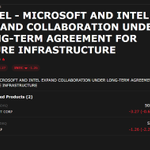
@Microsoft and Intel are expanding their decades-long collaboration, with plans to use Intel Foundry's EMIB advanced packaging technology to advance Azure infrastructure for cloud and AI.
Learn more: ms.spr.ly/6019x1yiv
#IntelFoundry #MSIgnite

B retweeted

Microsoft says it will use Intel Foundry's EMIB advanced packaging for its AI accelerator chips, becoming the first company to publicly announce it, it said. The long-term deal also locks in multiyear Xeon server CPU supply, including next-generation Diamond Rapids. $MSFT $INTC #semiconductors news.microsoft.com/source/20…
B retweeted

Down 92%…
Turns out he is worse than an average FinX degenerate.





B retweeted

The #HBM expansion race shows little sign of slowing! Despite #NVIDIA’s leadership uncertainty, #SKhynix and #Samsung continue to advance their capacity plans, with several major projects already in the pipeline.

#NVIDIA’s leadership turmoil isn’t slowing #SKhynix’s #HBM push. Its Yongin Fab 1 has reportedly completed structural construction, while the company is said to be lining up fresh HBM4 equipment orders for its P&T6 facility in Cheongju.💡More: pse.is/9vg69x 🔗

B retweeted

Morgan Stanley recommends “max overweight” on global stocks, citing an intact AI capital spending cycle that will extend resilient economic and earnings growth into next year bloomberg.com/news/articles/…

B retweeted
SK Hynix is building a US$450 billion (₩600 trillion won) four-fab complex just outside of Seoul, South Korea, Nikkei Asia reports, adding 25,000 people are working round the clock to ready the first, Y1, for operation by end-February 2027.
Y1 will be 50-stories tall when complete, ‘likely the world’s largest semiconductor building,’ the report says. SK Hynix plans to triple wafer capacity by 2034, and the Yongin site is vital to that plan. Samsung is also investing ₩360 trillion in the region for six fabs. $SKHY $NVDA $SSNLF $ASML $LRCX $KLAC $TOELY $AMAT #HBM #semiconductors asia.nikkei.com/business/tec…


B retweeted
🔥 No DRAM fabs, no problem? #TSMC may be staying out of memory manufacturing, but it’s far from a bystander in the AI-driven semiconductor boom.
#TSMC may be staying out of DRAM manufacturing after VIS’ past setback, but it’s hardly sitting out the memory boom. From embedded DRAM and HBM base dies to wafer-to-wafer stacking, the foundry giant is carving out its own role in the race.💡More: pse.is/9v62ee 🔗

B retweeted

Our message to Nvidia's board:
Do not fire Jensen Huang.
There is no clear replacement for Jensen Huang. We are confident that his departure would ultimately be a net negative for Nvidia, its shareholders, and the AI Revolution.
First, take a look at the data. History also suggests that removing a successful CEO will come with a significant cost.
A study of 187 forced CEO departures from S&P 1500 companies found that removing outperforming CEOs resulted in negative long-term stock returns. This case would be no different, in our view.
Jensen Huang is the definition of an outperforming CEO. Nvidia's board must not make a decision in the heat of the moment.
The board should take the time to conduct a thorough investigation and consult with shareholders, with a strong emphasis on the latter.
Quite literally, Nvidia's board should convene a special shareholder meeting and hold an advisory vote on this decision. This is the most consequential CEO controversy in world history. Shareholders deserve a say.
In addition, Nvidia's stock, $NVDA, is now down -35% in 26 trading days, nearly half of which is a result of the recent scandal.
We believe Jensen Huang's potential removal as CEO is now ~80% priced in.
Why take an action with massive downside potential when the market has already priced in much of that risk?
The downside of retaining Huang may be limited, while the potential upside is tremendous.
Lastly, history shows that retaining Jensen Huang could still lead to a favorable outcome. In 2019, Amazon retained Jeff Bezos as CEO after his extramarital affair became public, and the company's stock subsequently surged +108% by 2021.
Personal misconduct should not be ignored, but it must also be distinguished from corporate wrongdoing and weighed against the consequences of removing an executive who is instrumental to the company's success.
We believe Jensen Huang is an irreplaceable part of Nvidia and the AI Revolution more broadly.
Once the dust settles, firing Jensen Huang would prove to be a costly mistake.
It is time to pause and consult your shareholders.
B retweeted
Eli Lilly on Thursday became the first company to have a GLP-1 weight-loss pill approved in China, gaining a leg up on Danish rival Novo Nordisk in the world's second-largest pharmaceutical market.
reuters.com/business/healthc…

B retweeted
🚨 Texas and Georgia Now Face Severe Regulatory Risk for Data Centers.
TrendForce’s post-midterm risk map shows where new governors have pledged pauses or stricter rules. Over half of pre-construction hyperscaler capacity sits in high-risk states, with delay risk centered on projects planned for 2028 and beyond. Full analysis: pse.is/9uwzel 🔗

B retweeted

In deal staat niet alleen een verschuiving van belasting op arbeid naar vermogen van 1 mrd voor komend jaar, maar ook schrappen van 'vrijheidsbijdrage' voor 2028 (1,9 mrd) uit huidig belastingplan.

Bom in coalitie: D66 en CDA sluiten zonder VVD deal met Pro en Volt over vermogenstaks telegraaf.nl/politiek/bom-in…

B retweeted
Rapidus, Japan’s state-backed chip foundry, may push 2nm mass production back by a year to fiscal 2028 due to technical difficulties including trouble connecting transistors and slow progress on yields, media report, citing unnamed industry sources. $TSM $INTC $SSNLF #Semiconductors en.sedaily.com/world/2026/11…

B retweeted

Siemens Energy Targets Steeper Profit Gains Through 2030 on.wsj.com/4iCTOLy


B retweeted

Samsung is aiming to finish its next advanced packaging technology early next year.
The technology is called 3D Cube-H. It uses hybrid bonding to stack chips vertically instead of placing them side by side. That packs more transistors into the same space. Samsung already has an earlier version, 3D Cube-T, that uses thermal compression bonding. The new version moves to hybrid bonding, which connects copper directly between chips.
Industry sources say the first design kit is planned for early next year. After that, Samsung expects to start evaluations with potential customers. The main target is high-performance AI chips. Examples include stacking high-performance logic dies or placing logic on top of high-bandwidth memory.
Hybrid bonding allows much denser connections than the older method. The pitch is around 6 micrometers, compared with a minimum of about 25 micrometers for thermal compression. It also lowers energy use per bit and handles heat better. Lee Jae-yong recently visited Samsung’s advanced packaging lab in Yokohama to review progress on materials and processes for AI semiconductors.
Advanced packaging is becoming a key battleground for AI chips. If Samsung delivers the design kit on schedule, it gives its foundry business a clearer path to compete for big-tech customers that need dense, power-efficient stacking.
#Samsung
The open question is whether the early-next-year target holds once real customer evaluations start, or whether yield and thermal hurdles still push the timeline out.
B retweeted
TSMC’s October revenue rose 59.7% year-on-year to a fresh record high NT$586.89 billion (US$18.46B) amid robust global AI-related chip manufacturing demand.
The previous record was NT$514.81 billion in August.
TSMC did not provide a US$ figure. The above is based on its forex guidance for the 4th quarter. 1/3 $TSM $AAPL $NVDA $AMD $AVGO $QCOM #semiconductors #semiconductor
B retweeted

Citi is cutting U.S. equities and technology to Neutral while turning bullish on Europe, arguing the AI trade is showing signs of fatigue after a historic run. The shift doesn’t mean the AI story is over — but it does suggest Citi sees better risk-reward elsewhere as leadership broadens beyond U.S. mega-cap tech.
investing.com/news/stock-mar…