







H Pan retweeted

This dude is the only person I’ve seen actively comparing actual dollar values and speeds across AI subscriptions in a realistic, accurate way. Instant follow.



H Pan retweeted

Evals are the most underrated skill in AI engineering.
1. Start with error analysis, not metrics
Sample 100+ production traces. Annotate each failure in free text (open coding), then cluster them into failure categories (axial coding). Count frequency per category. Your top 3 categories are your first metrics.
2. Build a versioned golden dataset
Store inputs, expected outputs or rubrics, and metadata (intent, difficulty, user segment) in a versioned dataset. Stratify it so rare but critical cases aren't drowned out by easy ones. Version it alongside your prompts so every score is reproducible.
3. Generate synthetic data along explicit dimensions
Don't just ask an LLM for "test questions." Define dimensions (persona × intent × complexity × edge case), generate combinations as tuples, then turn each tuple into a natural input. You get coverage instead of 200 near-identical examples.
4. Deterministic assertions first
JSON schema validation, regex checks, required fields, length limits, code execution, SQL that actually runs against a test DB. These are cheap, fast, and have zero variance. Reserve model-based grading for what code genuinely can't check.
5. Evaluate retrieval separately from generation
For RAG, measure retrieval with recall@k, MRR, or nDCG against labeled relevant chunks. Measure generation with faithfulness (is every claim supported by retrieved context?). If you only score the final answer, you can't tell which half is broken.
6. Trajectory evals for agents
Log every step: tool name, arguments, result, tokens. Score tool-call precision and recall against a reference path, argument correctness, step count, and error recovery. An agent that reaches the right answer in 14 calls when 3 would do is a cost and latency bug.
7. pass@k vs pass^k
pass@k = succeeded at least once in k runs. pass^k = succeeded in all k runs. At 80% per-run success, pass^5 drops to roughly 33%. Production reliability lives in pass^k, so run each case multiple times at your real temperature.
8. Simulated users for multi-turn
Give an LLM a persona, a hidden goal, and constraints, then let it converse with your system until the goal is met or a turn limit hits. Grade goal completion, turns-to-resolution, and policy violations. Single-turn evals miss most state and memory bugs.
9. Align your LLM judge like a classifier
Hand-label 100+ examples as pass/fail. Split into train/dev/test. Iterate on the judge prompt using dev, then report TPR and TNR on test. Use binary outputs with a written rubric, require a short critique before the verdict, and pin the judge model version.
10. Control judge bias in pairwise comparisons
LLM judges have position bias and often prefer longer answers. Run every A/B comparison twice with swapped order and only count consistent verdicts. Normalize or cap length if verbosity is skewing results.
11. Respect statistics
With 100 examples at 80% accuracy, your 95% confidence interval is about ±8 points. A jump from 80% to 83% is probably noise. Use bootstrapped confidence intervals, or a paired test on the same examples, before declaring a win.
12. Gate deploys in CI
Run the eval suite on every PR that touches prompts, models, tools, or retrieval config. Set per-category thresholds instead of one global score, so a big win in one area can't hide a regression in another. Fail the build on a regression.
13. Online evals in production
Sample a percentage of live traffic, run your judges asynchronously, and alert on drift per failure category. Use shadow deployments to run a new prompt or model on real traffic without showing users the output.
14. Make cost and latency first-class metrics
Track tokens per request, cost per successful task (not per call), and p50/p95 latency next to quality. A change that keeps quality flat while cutting cost 40% is a real win and deserves to ship.
15. Close the loop
Every production failure becomes a new labeled test case. Every new model release gets run against the full suite before anyone debates switching. Over time your eval set becomes the most valuable asset in the codebase.
Prompts are disposable. Models get replaced every few months.
Your eval infrastructure is what compounds.
H Pan retweeted

Some things we do include:
- Understanding the agentic programming model and what LLMs are capable of so you can get the right mix of determinism and creativity while managing context when designing the agent.
- Identifying patterns across agents that can be turned into platform features.
- Helping the customer figure out a scope that can be implemented in the amount of time available, like you said.
- Eliciting documentation (SOPs, API specs, etc.) from them that you can feed to a coding agent.
- Integrating with their systems.
- Asking good questions to ensure you're building the right thing.
- Verifying the agent's behavior.
- Offering a strong point of view as to what should be build and/or what options are available.
H Pan retweeted

Google has been testing anti-bot measures that eliminate all client side links in favor of google. com/goto... server side redirects. It was widely reported the first week of August from the first major test, and as of this morning, we're seeing near 100% rollout across several residential ip providers. Here's a chart showing the percentage of goto only SERPs we've fetched over the last ~4 months of the test.
At Nozzle we've been discarding those so that our customer data isn't polluted with opaque links, and the percentages were low enough that it wasn't an issue.
If this continues as is, we're looking at something akin to the num=100 rollout from last fall. The goto links can't be decoded, so providers will have to follow the redirect links. While that works in small scale tests, Google seems likely to make that tough, since each SERP will have hundreds of links to decode.
cc @rustybrick @brodieseo @glenngabe

H Pan retweeted

LOOK: Dam water level updates as of 8:00 AM, August 10, 2026, according to PAGASA.
Angat Dam is at 170.47 meters, while La Mesa Dam is currently at a critical level of 79.92 meters, nearing its spilling level of 80.15 meters.
Meanwhile, several dams have opened their gates due to the ongoing rains brought by the southwest monsoon.
Courtesy: PAGASA
Visit gmanetwork.com/news for more updates.

H Pan retweeted

Vibe coders are getting sued.
People are shipping apps with real users and skipping the boring stuff that kills them.
A 20+ year dev shared the pre-launch checklist every AI builder needs.
I added what I learned after shipping 60+ apps at the agency.
Don't skip this:
1. Protect yourself, not just your app. The moment you collect user data you're in legal territory (GDPR, CCPA). Have a privacy policy. Know where user data lives.
2. Row Level Security. Without RLS, anyone can open DevTools and read your entire database. Supabase → Auth → Policies. Zero policies means your app is naked. 5 min to fix.
3. Test the failure path, not just the happy path. Wrong password 5x. Reset for an email that doesn't exist. Verification link clicked twice. Signup with an existing email. Catches 80% of auth bugs.
4. Security baseline in 2 min. Prompt your AI: "Review my app as a security specialist and make sure I have strong security headers and a solid baseline security posture."
5. OWASP. Prompt: "Review my app against OWASP standards and highlight vulnerabilities." This is where SQL injection, XSS and auth bugs actually get caught.
6. Client-side validation is UX, not security. Attackers disable JS and hit your API directly. Validate again on the server. Every time.
7. AI code leaks data in 3 spots: .env values in the frontend, API responses returning too much, secrets in logs. Prompt: "Check my app for credential or sensitive data leaks in frontend or API routes."
8. API keys in the frontend means game over. If it's in the browser, assume it's already taken. Move it server-side or proxy it.
9. Rate limits before someone burns your API bill. Cap every endpoint hitting a paid API. I've watched a Supabase bill jump from $20 to $200 in a day.
10. CAPTCHA on public forms (Cloudflare Turnstile is free) plus CORS locked to your domain. 10 min, kills bot floods.
11. Error messages that don't leak. "User not found", not "SELECT * FROM users failed". Log full errors server-side, show users generic messages.
Build fast. Just don't ship naked.
(full breakdown in my article below)


H Pan retweeted

Doesn’t this fire you up? We’re gonna do it. We’re actually gonna do it; open source is going to diffuse this intelligence to everyone. Frontier closed labs will still make money but they won’t control the light cone. The recipe is commoditised, now open source just needs to overcome the organisational and menu costs of aggregating data and compute. The good timeline is actually winning

For my first post, I’m sharing a letter @NVIDIA signed on why open models matter.
AI will transform every industry, power every company, and be built by every country.
Open models strengthen safety and cybersecurity, accelerate innovation and diffusion, and enable sovereignty.
The world needs both frontier closed models and frontier open models.
images.nvidia.com/pdf/Open-W…


H Pan retweeted

Jensen it’s great to see you here.
This man prioritizes sleep, eats nutritiously, is kind and measured, and has a wonderful relationship with his partner of 41 years.
Also, he runs in founder mode a one of the all-time most successful companies.
H Pan retweeted

Anthropic just showed a 24-minute workshop on how to actually do prompts for Claude.
Taught by the people who built it.
Free. No registration. No paywall.
I've seen $300 courses that don't cover what they teach in the first 8 minutes.
Watch it and bookmark it now.
H Pan retweeted

🚨RESEARCHERS JUST MATHEMATICALLY PROVED THAT AI LAYOFFS WILL DESTROY THE ECONOMY.. AND EVERY CEO ALREADY KNOWS IT.. BUT NONE OF THEM CAN STOP..
Two researchers from UPenn and Boston University just published a paper called "The AI Layoff Trap"..
They proved something terrifying..
Every company replacing workers with AI is also firing its own customers.. Every laid-off employee is someone who used to spend money.. When enough people lose their jobs.. Nobody can afford to buy anything.. And the companies that fired everyone go bankrupt selling products to an economy with no purchasing power..
Every CEO can see this coming.. The math is obvious.. Fire workers.. Lose customers.. Lose revenue.. Collapse..
But here's the trap..
No company can afford to stop..
If you don't automate.. Your competitor will.. They cut costs.. Undercut your prices.. Steal your market share.. And you die anyway..
So every company automates.. Knowing it's collectively suicidal.. Because the alternative is dying alone while everyone else survives..
It's a Prisoner's Dilemma.. And the researchers proved it mathematically..
The numbers are already stacking up..
Block cut nearly half its 10,000 employees this year.. CEO Jack Dorsey said AI made those roles unnecessary and that "within the next year, the majority of companies will reach the same conclusion"..
Salesforce replaced 4,000 customer support agents with AI..
Goldman Sachs deployed an AI coder that lets one senior engineer do the work of a five-person team..
Over 100,000 tech workers were laid off in 2025 alone.. AI was cited as the primary driver in more than half the cases..
80% of US workers hold jobs with tasks susceptible to AI automation..
And here's what should scare policymakers..
The researchers tested every proposed solution..
Universal Basic Income.. Doesn't fix it.. It raises living standards but doesn't change a single company's incentive to automate..
Capital income taxes.. Don't fix it.. They change profit levels but not the per-task decision to replace a human..
Worker equity and profit sharing.. Narrows the gap but can't close it..
Collective bargaining.. Can't fix it.. Because automating is a dominant strategy.. No voluntary agreement between companies is self-enforcing..
Only one thing works.. A Pigouvian automation tax.. A per-task charge that forces every company to pay for the demand it destroys when it fires a worker..
The researchers call it a "Red Queen effect".. Better AI doesn't solve the problem.. It makes it worse.. Because every company sees a bigger market share gain from automating faster than rivals.. But at the end.. Everyone automates equally.. The gains cancel out.. And the only thing left is more destroyed demand..
The paper's conclusion is devastating..
This isn't a transfer from workers to company owners.. Both sides lose.. Workers lose their income.. Companies lose their customers.. It's a deadweight loss that harms everyone..
And no market force can break the cycle..
The AI layoff trap isn't a prediction.. It's already happening.. And the math says it won't stop on its own.

H Pan retweeted

Jordan Peterson: "The most dangerous person is one who is articulate"
"Articulate is an interesting word. If your joints are articulated, that means you can do things with them because they're not one solid vague mass. They're differentiated. Someone who's graceful is compelling because they're articulated. And speech is a form of articulation in that manner."
Peterson explains why this matters:
"It is definitely the case that there is no more exceptional form of the capacity to be dangerous than to be articulate. And one of the things that really shocks me is that young men in particular are never taught this."
He makes the case bluntly:
"Do you want to be competent and dangerous, or do you want to be vague and useless? Because those are your options. And I don't care what your job is. If you're a plumber, and I have great respect for plumbers, and you're articulate: you can negotiate with your clients, introduce your co-workers, make a case for your employees, advertise your services, think through your problems. You're firing on all cylinders."
Peterson shares a deeper truth:
"Our whole culture is based on the idea of the supremacy of the word. The idea that it is the word itself that extracts habitable order from chaos and possibility. And the reason our culture is predicated on that is because it's a deep truth."
He gives an example from the military:
"I know a former special operations soldier, Jocko Willink. He's about four feet wide and three feet thick. One tough son of a bitch. You don't want to mess with him. And he knows perfectly well, and is very capable of articulating, that his success as an eminent warrior is in no small part dependent on his ability to communicate."
Peterson explains why:
"Because he could communicate well, he could listen to the men under his command. Because he was articulate, he could explain to his superiors the situation on the ground. Because he was articulate, he could make a case that the men under his command who were deserving would be promoted. Because he could think in an articulate manner, he could plan strategically and not lose battles."
He asks the hard question:
"What's the alternative? You want to be inarticulate? You want to say 'uh' and 'like' and 'um' and pause and stumble? Be unable to formulate a strategy? Be unable to elucidate a vision? Be unable to compel and convince other people to entice them with your articulated vision of what might be? You would choose awkwardness over grace. It's preposterous. It's beyond foolish."
How do you become articulate?
Peterson offers a metaphor:
"Imagine you're trying to walk across a swamp. The swamp is murky, but you know there's a path of stone under the water, and it twists and moves. If you stay on the path, you won't drown. The crocodiles won't devour you. As you walk forward, you feel with your next step where the stone might be. Then you feel it solid. Then you take that step. You search and find out what's solid, and you move forward in that manner."
He applies this to speech:
"That's what you do with your words. You feel, is this the right word? Is the fact that I'm uttering it putting me together and making me intact and stronger? Or is it tearing me apart and making me dissolute and weak? You can learn to do that."
Peterson shares what he noticed 40 years ago:
"Much of what I said actually made me feel weak. I didn't know why exactly. But sometimes some of the things I said didn't have that effect. They weren't accompanied by a sense of shame. They weren't accompanied by a sense of vulnerability. They were solid. At the beginning, that was probably only about 5% of what I said. The rest of it was instrumental — language I was using to get my way. There was an arrogance in my use of language that had to do with the desire to attain proximal victories. To appear smart. To win an argument."
He contrasts that with real articulation:
"A very different idea than merely feeling my way along to see what word was appropriate for what moment. But you can learn to do that. You can listen to yourself. You can stop humming and hawing and using 'like' and 'you know' and fillers. You can take the time necessary to craft your words carefully. You can practice merely saying what you believe to be true. You can read great writers. You can write about the problems that obsess you. And you can become articulate as a consequence."
The power of the pause:
"When you're in a discussion with someone, they might present you with a question or a conundrum. Instead of responding with what you 'know' to be right, you could just ask yourself: what do I actually think about that? But it has to be a real question. It has to be the kind of question you pose to someone you didn't know. It has to be a question predicated on the idea that you might not know who you are, and that you could ask."
Peterson continues:
"Someone presents you with a question. You think: okay, what do I think about that? But you have to want to know the answer. And then the answer will make itself known because that's how thought works. And then you can just communicate that answer."
He explains what happens next:
"If you do that, you'll be interesting right away. You'll be interesting to the person you're talking to. And if they do that to you, they'll be interesting too. And then if you both do that, you'll have an interesting conversation. And if you have an interesting conversation, you'll both grow as a consequence. That's actually the pathway to growth."
Peterson uses Joe Rogan as an example:
"One of the reasons Joe Rogan is so successful is that that's what Joe does. He just asks questions. He isn't trying to get something from his guests. He's not trying to become more famous. He doesn't need any more money. There's no instrumental utilization of language in his discourse. He's just a humble lunkhead in the most profound sense who would like to know more than he knows, and who asks all the stupid questions he can think up."
He continues:
"It turns out he's actually very smart and very well educated now, after talking to hundreds of people and listening. The stupid questions he asks aren't stupid. They're questions shared by virtually everyone who's listening. He takes his listeners along on this process of exploratory endeavor. And it's the pathway to success."
Peterson closes with this:
"The same thing can be true of your life. If you're guided by the spirit of honest inquiry and every word you say is reflective of what you believe to be the truth, then the pathway that you walk on is a golden pathway to success. I know that to be true."
H Pan retweeted

兄弟们周末就别沉迷刷抖音了。
强烈推荐花3个小时看完北京大学内部投资学习课程。
投资必看!李录演讲:全球价值投资与时代
时隔5年,李录这场160分钟的价值投资思想盛宴令人醍醐灌顶。
李录极少公开演讲,每一次都弥足珍贵,
尤其是他对价值投资在中国成功践行的深度思考,
为我们提供了宝贵的本土化经验。
2026年4月8日,Himalaya Capital(喜马拉雅资本)首次发布李录在北大光华管理学院价值投资课程十周年庆典上的主旨演讲视频《全球价值投资与时代》(演讲时间:2024年12月7日)。
关于李录:查理·芒格的合伙人,芒格所说的“一生中三个最成功的投资之一”,芒格家族资产的主要管理者,被芒格称为“中国的巴菲特”。
2008年,84岁的芒格在采访中提到:“人的一生不需要做很多投资,我的财富主要来源于三次投资——伯克希尔、好市多,以及李录的喜马拉雅基金。”
李录1997年在美国创立喜马拉雅资本,至今管理资金规模约80亿美元,长期年化回报率超过20%。近年来更为人津津乐道的是,李录力荐比亚迪给巴菲特和芒格投资,帮助他们获得超过30倍的收益,成为价值投资在中国成功践行的经典案例。
本次演讲核心内容:
主题一:我们时代的困惑是什么?
全球发生了很多变化,给投资人带来了许多困惑。
主题二:对这些困惑的深度思考
探讨困惑背后的原因和本质。
主题三:中等收入陷阱与国际关系
关于中等收入国家的跨越,以及对当今国际关系的看法。
主题四:全球价值投资人如何应对时代挑战
面对关税、贸易战等挑战,价值投资者的应对之道。
价值投资的本质 回顾价值投资的起源,阐述六条价值投资的基本理念。
精彩问答环节:
1. 优质公司明显高估时,何时减持?
2. 长期持有的运气与勇气:年轻人如何在不确定性中决策?
3. 美国3.0时代与中国的改革路径
4. 如何理解“便宜的公司”?P/E应该怎么看?
5. 优秀企业家有什么共性特点?
6. 投资的意义究竟是什么?
时隔5年,李录这场160分钟的价值投资思想盛宴令人醍醐灌顶。李录极少公开演讲,每一次都弥足珍贵,尤其是他对价值投资在中国成功践行的深度思考,为我们提供了宝贵的本土化经验。
特此推荐给朋友们,值得珍藏!反复观看、深度学习。
H Pan retweeted

A Soviet psychologist walked into a café in 1927 and watched a waiter do something impossible.
He remembered every open order at every table. Perfectly. Without notes. Without effort.
Then a table paid their bill. She asked him to repeat the order.
He couldn't remember a single item.
She spent the next two years figuring out why. What she found is now the operating system underneath every platform fighting for your attention.
Her name was Bluma Zeigarnik, and she was a graduate student at the time, sitting with her professor Kurt Lewin, watching the waiters work the room. What caught her attention was something so ordinary that it had been happening in restaurants for centuries without anyone asking why.
The waiters could remember every open order with perfect accuracy. Table four wanted the schnitzel with no sauce. Table seven had changed their wine twice. Table twelve owed for three coffees and a dessert. Every detail, held without effort, without notes, without any visible system at all.
But the moment a table paid their bill, the information vanished. Completely. Lewin tested it on the spot. He called a waiter back minutes after a table had settled up and asked him to recite the order. The waiter could not do it. Not partially. Not approximately. The information was simply gone.
Zeigarnik went back to her lab and spent the next two years turning that observation into one of the most replicated findings in the history of psychology.
Here is what she proved, and why it changes how you think about attention, memory, and almost every piece of media you have ever consumed.
She gave participants a series of tasks. Some tasks they were allowed to finish. Others were interrupted before completion. Then she tested recall across both groups.
The unfinished tasks were remembered at nearly twice the rate of the completed ones.
Not slightly better. Nearly twice. The brain was holding the incomplete work in a state of active tension, returning to it, keeping it warm, refusing to file it away. The finished tasks were closed, archived, released. The unfinished ones were still running.
She called it the resumption goal. When the brain commits to a task and cannot complete it, it opens a file that stays open until resolution arrives. That open file consumes a portion of your cognitive bandwidth whether you are thinking about it consciously or not. It surfaces in idle moments. It pulls at the edge of your attention during other work. It is the thing you find yourself thinking about in the shower when you were not trying to think about anything at all.
This is not a flaw in human cognition. It is a feature. The brain evolved to finish things. An open loop is a signal that something important is unresolved. Keeping that signal active increases the probability that you will return to it and complete it. In an environment where most tasks had real survival stakes, this was an extraordinarily useful mechanism.
In the modern world, it is the most exploited vulnerability in human attention.
Netflix did not invent the cliffhanger. But it industrialized it in a way no medium before it ever had. When a show ends on an unresolved question, it does not just create curiosity. It opens a file in your brain that stays active until the next episode closes it. The autoplay countdown that begins at 15 seconds is not a convenience feature. It is a precise calculation about how long the average person can tolerate an open loop before the discomfort of not knowing overrides every other intention they had for the evening. One more episode is not a choice. It is your brain doing exactly what it was designed to do: return to what is unfinished.
The writers who built Lost, Breaking Bad, and Succession understood this intuitively without ever reading a psychology paper. Every episode ended on an open question. Every season finale answered three things and opened five more. The entire architecture of prestige television is a Zeigarnik machine running at industrial scale.
But television is not where this gets dangerous.
Every notification on your phone is an open loop. Every unread email is an open loop. Every task you wrote on a list and have not yet crossed off is an open loop. Each one is consuming a small but real portion of your available attention, pulling fractionally at your focus, degrading your capacity to be fully present in whatever you are actually doing right now. TikTok's algorithm does not just serve you content you like. It serves you content that ends one loop and immediately opens another, keeping the resumption system permanently activated so the cost of stopping always feels higher than the cost of continuing.
The research on this accumulation effect is striking. Psychologists studying cognitive load have found that unfinished tasks do not sit passively in memory. They actively interrupt. They surface at the wrong moments. They are the reason you are reading something and suddenly remember an email you forgot to send. The brain is not malfunctioning. It is running its resumption system exactly as designed. It is just running it across forty open loops simultaneously, in an environment that generates new ones faster than any human nervous system was built to process.
The most important practical implication Zeigarnik's research produced is one that most people use backwards.
David Allen built his entire Getting Things Done system on the insight that the only way to close a cognitive open loop is to either complete the task or make a trusted commitment to complete it later. Writing something down in a system you actually trust has the same effect on the brain as finishing it. The file closes. The bandwidth is released. This is why writing a task down feels like relief even before you have done anything about it. You have not solved the problem. You have simply told your brain that the loop is registered and will be returned to, which is enough for the resumption system to stand down.
The inverse is equally true and far more destructive. Every task that lives only in your head, unwritten and unscheduled, is an open loop burning cognitive resources around the clock. The mental cost is not proportional to the size of the task. A tiny nagging obligation consumes the same active tension as a major project. Your brain does not discriminate by importance. It discriminates by completion.
Zeigarnik published her findings in 1927. The paper sat in academic literature for decades before anyone outside psychology paid attention to it.
Then television got good. Then the smartphone arrived. Then the entire attention economy was engineered, largely by people who understood intuitively what she had proven scientifically: an open loop is the most powerful hook available to anyone who wants to hold human attention.
Netflix knew it. Instagram knew it. Every designer who ever made a notification badge red instead of grey knew it.
The café in Vienna is long gone.
The mechanism she discovered there is now the operating system underneath every platform fighting for your time.
Every "to be continued."
Every unread notification.
Every thread that ends with "part 2 tomorrow."
All of it is the same waiter, the same unpaid bill, the same brain refusing to let go of what it has not yet finished.
Zeigarnik noticed it over coffee in 1927.
A century later, it is the most valuable insight in the history of media.
And nobody taught it to you in school.

H Pan retweeted

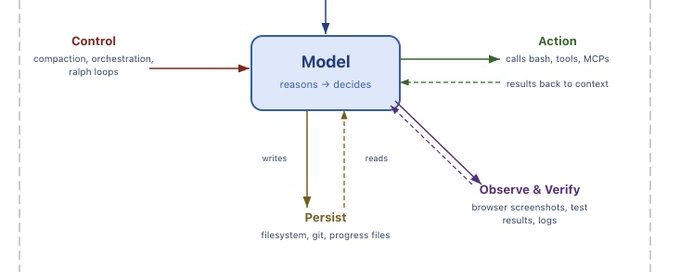
Just finished reading this blog on agent harnesses. Man, it’s one of the clearest, most practical takes I’ve seen why they’re here to stay and why memory isn’t some optional plugin.

H Pan retweeted

This is the single best framework I’ve seen for understanding AI.
Terence Tao, arguably the smartest mathematician alive, just dropped a paper with Tanya Klowden on arXiv called “Mathematical Methods and Human Thought in the Age of AI.”
The core idea: a “Copernican View of Intelligence.”
Stop thinking of AI on a line from “dumb” to “superhuman.”
That’s the wrong axis entirely.
AI excels at BREADTH. Humans excel at DEPTH.
Tao himself said AI has made his papers “richer and broader, but not necessarily deeper.”
That’s not a limitation. That’s the entire playbook.
Stop trying to replace yourself with AI. Start using it to cover the 90% of surface area your brain physically can’t.
The people who get this are already 10x more productive.
The rest are still arguing about whether AI is “smart enough.”
Reframe your point of view from “smarter” to “different”.
Human + AI > either alone.
The math on that has never been clearer.


Terence Tao proposes what he calls a "Copernican view of intelligence".
Instead of buying into the common, one-dimensional narrative that artificial intelligence will simply evolve from "subhuman" to "superhuman" and ultimately make humanity entirely redundant, Tao urges us to look at the bigger picture.
Much like the Copernican revolution proved the Earth is not the center of the universe, Tao suggests we need to realize that human intelligence isn't the only, or necessarily the highest, form of intellect. Historically, we have treated other forms of storing or creating knowledge—like animals, books, and computers—as secondary. However, we actually exist within a much richer universe of intelligence.
Both human intelligence and computer intelligence possess their own distinct strengths and weaknesses. The true potential lies not in viewing them as direct competitors, but rather in focusing on collaboration. By working together, humans and computers can achieve additional things that neither could accomplish on their own, requiring us to think in much wider terms than just what humans or computers can do alone.

H Pan retweeted
A MIT student told me he learns any new subject using a framework a self-taught Victorian mathematician published in 1854.
Most people have never heard of it outside of computer science.
He applies it to everything. Economics. Biology. History. Law.
And it's the fastest way to actually understand a subject I've ever seen.
The mathematician was George Boole. The book was called The Laws of Thought.
Boole's core idea was simple and radical. Every complex system, no matter how messy it looks on the surface, can be broken down into a set of basic relationships that are either true or false.
You don't need to understand everything at once. You need to find the fundamental propositions the whole system is built on, and then trace the logic forward from there.
He built it to map how the human mind actually reasons. MIT uses it to build computer chips. This student uses it to learn anything in a fraction of the time.
Here's exactly what he does.
Before touching any course material, he opens Claude and runs one prompt.
"What are the 5 foundational propositions of this subject? Not facts, not definitions. The statements that, if true, make everything else in this field follow logically."
That question is doing something most students never force themselves to do. It finds the load-bearing walls of the subject before you walk into the building.
Then he runs the second prompt.
"For each of these propositions, what is the one piece of evidence that would destroy it? What would have to be true for this entire framework to be wrong?"
Boole's insight was that a proposition you can't falsify isn't really a proposition at all. It's just a belief dressed up as knowledge. This prompt separates the two instantly.
The third prompt is the one that makes it unfair.
"Now show me how these five propositions connect to each other. Which ones are assumptions? Which ones are conclusions? Which ones are in tension?"
By the time he finishes those three prompts he doesn't have a summary of the subject. He has a map of how it thinks.
His classmates spend the semester adding details to a picture they never drew. He drew the picture before week one and spends the semester filling it in.
Boole published this framework 171 years ago.
It runs every computer on earth.
And almost no one uses it to learn.

H Pan retweeted
Every time you accepted a salary, chose a price, or walked into a negotiation, the other person was running GAME THEORY in their head.
You were guessing.
This 1-hour Yale lecture by Professor Ben Polak will permanently change how you read people and make decisions.
Most MBAs pay $150k to learn this. Yale posted it for free:
