


Shawn B retweeted

Krishna was the greatest persuader the Mahabharata ever saw. He went to Hastinapura as a peace envoy. He asked for just five villages for the Pandavas. Duryodhana refused to give land the size of a needle's tip.
Even Krishna's words failed.
So why do we keep thinking ours will work. We tend to over explain to people who've already made up their minds. We repeat the same message five times. We lose sleep trying to make someone get it.
Here's the uncomfortable truth. Some people don't change because of what you say. They change because of what happens to them.
Duryodhana didn't understand in the court. He understood on the battlefield.
That's not cruelty. That's how life teaches. So say your piece once. Say it with clarity and without anger. Then let go.
You're not responsible for someone else's understanding. Only for your own peace. Some lessons can't be taught. They have to be lived.
Kurukshetra is waiting for everyone who refuses to listen.
Shawn B retweeted

The President met the brave Flydubai crew from the Tel Aviv flight and praised them.
We in the UAE know how to appreciate our heroes.
Shawn B retweeted

Nature doesn't punish the evil, it punishes the weak. Dharma starts with Strength. You cannot become Dharmic without being strong first.
What Krishna told Arjuna: You can't jump to being Dharmic without being strong first. Dharmic ethics are clear that power as creating responsibility, rather than creating moral high ground from weakness, which is not respected anywhere. Nature does not automatically protect the good. It is strength rather than law determines what is right.
Dharma means:
Power First, Righteousness second.
Shawn B retweeted

Steve Ballmer on how Microsoft spent up to 15 years preparing Satya Nadella to become CEO:
When it came time to find his replacement, Ballmer says the decision was essentially made before the search began.
"I kind of knew up front, look, we've been grooming this guy for about 10 years, 15 years. This guy is really talented, so he gets the job, obviously."
The grooming wasn't accidental. Ballmer explains that Satya, "a very technical person," was repeatedly moved into areas where he had no background:
"We said hey, you don't really know anything about an area called general ledger and accounting, but why don't you go run this thing called Dynamics, probably called Great Plains at the time. I can't even remember."
Then, "quite rapidly," another unfamiliar problem:
"We got to get this search thing together. This is the high potential guy. This is a guy who can learn new things. He's technically minded. Boom, throw him a new problem, and he's building new skill sets along the way."
Search exposed Satya to machine learning, which Ballmer describes as a fundamentally different style of software:
"Old programs were supposed to generate the right answer. Many new programs are supposed to generate the statistically best answer, and you only know after whether it was precisely the right answer."
He did well in every one of these roles. Ballmer lists what became clear along the way:
"He clearly had good people skills. He clearly had an affinity for product. He clearly had a knack for understanding how to think about particularly our enterprise selling operation."
So Ballmer, Bill, and the senior leadership team agreed:
"This is a guy we should be thinking about for the future of the company."
Ballmer then recalls a conversation with Satya about his father, a senior government official who worked with people who went on to become prime ministers. His father told him:
"Look, Satya, a lot of people come to the leadership positions in government and they're just not ready. But guess what? They learn what they don't know pretty well on the job."
Ballmer's read on what that gave Satya is a pairing of two traits that usually pull in opposite directions:
"The irrational confidence, which I can get there, partly backed by kind of his father's experience, as well as a lot of realism about where he was."
That realism sat alongside real range:
"He had huge skills in many areas of the business, more than anybody else… He knew more of the breadth of this place than anybody."
His verdict today: "He's done an incredible job with the company." He even admits, "I never know whether I'm supposed to say we or you or they [when I] talk about Microsoft. I lapse into we pretty easily."
Shawn B retweeted

The Kospi’s like your college friend who used to blackout every weekend but now has like kids and a mortgage
Buddy would’ve been up at least 9% back in the day

Shawn B retweeted

REVEALED: China-Linked Influence Group Paid to Cultivate Dozens of U.S. Journalists and Manufacture “Positive” Coverage of the Chinese Communist Party.
CNN. NPR. NYT. WaPo. Reuters. NBC. Bloomberg. Politico. Vox.
Here are their names. 🧵
Shawn B retweeted

It wasn’t until I understood market environments that I became consistent.
Even early on, I had the knack for finding the best stocks. Stock picking wasn’t my problem. My timing and market awareness were.
I was an elite boom and bust trader. I would build my account to new highs, then give a huge chunk or perhaps everything back. Over and over and over again.
Everything changed when I started focusing on timing, stopping the urge to press hard when conditions weren’t in my favor, while shifting my focus to protecting what I had already made.
Most new traders spend almost all their time thinking about upside, and almost none thinking about risk. That is understandable. It is also a super expensive mistake.
The market rewards awareness. Knowing when to do what is most of this game, although much harder to do in practice than it sounds.
It’s like Nadal or Djokovic under pressure…
They don’t go for spectacular winners
They simply refuse to make mistakes
They don’t give away cheap points
They protect their side relentlessly
Trading/Investing is the same…
The fewer unforced errors we make, the more room we give our edge, process, and time in the market to compound.
Shawn B retweeted
The NFL's Seattle Seahawks were just sold for $9.6 Billion to Vinod Khosla
Khosla co-founded Sun Microsystems which was acquired by Oracle for $8 Billion
Khosla Ventures was the first venture capital investor in OpenAI. Khosla is also known for being a early investor in QuantumScape, Square, DoorDash, and Instacart


Shawn B retweeted

Quick thing I keep seeing cost people money.
you're long, you're hedged, market rips. great. but every rally pushes that hedge further out and decays it toward zero. most people just... leave it there.
now you're basically unhedged and don't know it. a hedge you set 15% ago is protecting a book you don't have anymore. market moved. hedge didn't. it's lost its bit, no gamma and reactivity that far away
The pullback comes and that old protection is sitting way too low to pay you a dime. so you give it all back. everything you made on the way up, gone on the way down.
fix is easy. as it rallies, roll the hedges up. pay a little premium, reset higher. that premium is just the cost of keeping your gains actually banked.
hedge has to move with the book. costs money but that's the whole game. feels like a waste of money but is your house insurance a waste of money? a bit, but when the place burns down while you're in Cabo... you'll be glad you had it
Shawn B retweeted

power is the new compute.⚡️
the more AI scales, the more electricity has to move from the grid to the GPU die.
power transformer lead times pushing 2.5 years. generator step-up transformers averaging 144 weeks.
here are the 25 power semi names on my radar.🧵
🤖 Made with AI

Shawn B retweeted
These are the best themes and stocks in the market right now:
Memory: $MU $SNDK
Storage: $WDC $STX
Compute: $AMD $INTC $ARM
Interconnect/Connectivity: $MRVL $ALAB $CRDO
Foundry: $INTC $TSEM
Semi-equipment: $ASML $LRCX $AMAT $UCTT $ICHR
AI Infra OEMs: $DELL $PENG
Neoclouds: $NBIS $CRWV
BESS: $BE $FLNC
Packaging & Test: $TER $AMKR $AEHR
EMS/RF: $TTMI $SANM $FLEX
Power Semi: $STM $ON $VICR $NVTS $POWI $VSH $WOLF $AOSL
Physical/Edge AI: $OUST $CGNX $AMBQ $OSS
HPC: $WULF $HUT $APLD $GLXY $IREN $CIFR $WYFI $WGMI
A lot of these names already made big moves into the end of last week, so going to be an interesting week with $MU reporting on Wednesday, perhaps some de-risking into the report sounds like a good plan.
Good luck to all!
Shawn B retweeted

Citadel Securities just put institutional weight behind what the AI bulls won't say out loud.
In a new macro note titled "Tokenomics," Citadel makes the argument plainly: even the most powerful technology on earth still has to pass through the boring discipline of cost curves, capacity limits, and marginal returns.
The evidence is piling up:
– Amazon removed its token usage leaderboard
– Microsoft cancelled Claude Code subscriptions
– Multiple companies reporting unexpectedly massive token bills
Their conclusion is the part that matters.
Adoption is no longer about what AI can do in principle. It's becoming about the price and scarcity of the inputs needed to run it at scale. Compute. Power. Cooling. Memory bandwidth. Inference budgets. All real, all binding constraints.
And here's the kicker from the chart.
The Silicon Data LLM Token Expenditure Index, a benchmark for how much the market is actually spending on AI tokens, has started rolling over. Citadel reads it as a shift toward cheaper models. Companies substituting away from expensive frontier AI toward "good enough" alternatives.
That's economics 101 doing what it always does. When the price of something rises, people use less of it, or find a cheaper version.
Citadel sees a bifurcation forming. Frontier AI concentrated among a few firms with the balance sheets to absorb the cost. Everyone else quietly downgrading to simpler, cheaper models.
This is the part of every technology revolution the early narrative ignores.
The technology being real was never the question.
The question was always whether the economics could carry the valuations.
When one of the most sophisticated trading firms on earth starts writing about AI in the language of cost curves and rationing instead of limitless demand, the conversation has quietly changed.
The hype was about what AI could do.
The reckoning is about what it costs.

Shawn B retweeted

Those drifting dots you can never quite look at directly are shadows. The objects casting them sit inside your own eye.
The vitreous is the gel that fills most of your eyeball, roughly 99% water held together by a fine mesh of collagen fibers. Light passes straight through it on the way to your retina. As you age, the gel liquefies and those fibers lose their even spacing and clump into strands and knots.
When light hits a clump, it drops a tiny shadow on the retina behind it. That shadow is the floater. What you perceive is the dark spot it casts on your own light sensor, one cell layer deep.
This is why you can never catch one. The clump is suspended in liquid a few millimeters in front of the retina, so it tracks your eye instead of holding still. Look up and it drifts up with you, then settles a beat later as the fluid stops moving. Chasing it is chasing your own shadow.
It's also why they only appear against a blank wall or a bright sky. A uniform bright background is the one lighting condition where a faint shadow on your retina has enough contrast to register. Any busy scene drowns it out completely.
The part that gets people: this is chemically guaranteed. Your vitreous contains riboflavin, and decades of light passing through it slowly oxidizes the collagen bonds until the mesh degrades. Given enough years it happens to everyone, no exceptions.
70% see them because the other 30% just haven't noticed the shadows their own eyes have been casting the whole time.


Shawn B retweeted
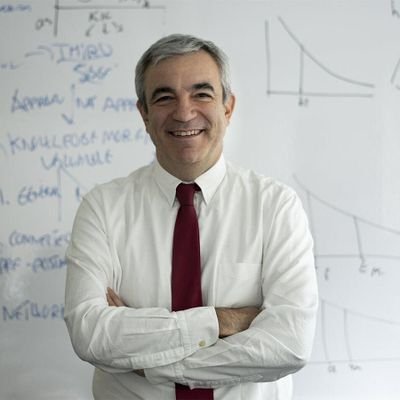
Countries get the cabinets they pay for. Singapore pays its Foreign Minister about S$1.1m, around US$800,000. The salary is benchmarked to 60% of the median income of the top 1,000 Singaporean earners. That is why you can get Vivian Balakrishnan, former eye surgeon and hospital chief executive, implementing @karpathy's external brain idea (link below). The speech shows deep understanding of AI and fills one with confidence about Singapore's future.
The UK Foreign Secretary earns roughly £165,000: the MP salary plus a ministerial salary of about £67,000. The ministerial part is frozen since the crisis and is down by roughly a third in real terms since 2010. This is what a junior Magic Circle lawyer earns.
Spain pays its ministers around €85,000. So you do not get a surgeon who has run hospitals. You get a party loyalist who has never run anything.

Shawn B retweeted

I just want to say I would rather talk trading with you all, truly.
I spent the last 13 years sharing trading ideas, fully for free, without agenda, sharing my first trades all the way to being featured in market wizards.
For this decade I’ve provided insights into what I believed to be truths hidden in plan sight, from trade ideas, contrarian takes, lining up incentives and have become one of the best traders out there through it as the truth prevailed.
This dire situation has very high stakes and as propaganda from all sides hits it is sometimes hard to be very precise as these situations are extremely dynamic and involved a lot of deception.
The issue is mainly that we moved from letting the economy run without much interference to full meddling on all sides.
Remember a year ago, business leaders were the most optimistic in years.
We were pulling out of conflicts, we were getting rid of regulatory tape and letting the might of the US business system unleash into the biggest technological boom ever.
It all shifted when control became the goal over winning long term.
Control of media, politics, foreign affairs, business… Everything shifted towards giving the illusion of winning at the cost of the truth.
Every major part of the government was handled as if we tried to be in the spotlight, not to win but to be controlled. Left vs right is what they make it to be, to get people to lash out at each other when we actually for the vast majority want the same thing.
One way, no debate, no pushback.
Thus the markets became a reflection of the only thing that matters… Trades died off in October, one sector after the next fell apart.
I have simply been sitting back building tools I’ll share with you soon, not pushing much buttons and if so taking cuts on almost all of the long ideas.
That said should market conditions improve through the end of this war and this meddling decrease you’ll see no more of these posts. I am the first one to look forward to it.
Finally i want to say I deeply love the USA and want it to prosper. The last thing i want is for it to fail and thus I became vocal about it.
I know the vast majority simply stays silent and the smallest most vocal part shows up as the tip of the iceberg, often to contradict and criticize.
For those that will stay for this journey, I appreciate you and know trading and investing are what i want to be sharing with you all for the next 50y.
Shawn B retweeted

I spent 100 hours over the past week researching, writing and editing the piece we just put out.
It’s a scenario, not a prediction like most of our work. But it was rigorously constructed, dismissing it outright requires the kind of intellectual laziness that tends to get expensive.
And we’ve released it for free. Hopefully you enjoy it.
citriniresearch.com/p/2028gi…

Shawn B retweeted
Lutnick stand to profit massively from the tariffs decision.
After returning to office, President Donald Trump invoked the International Emergency Economic Powers Act to impose sweeping tariffs branded as emergency trade measures, including “Liberation Day” reciprocal tariffs and new levies on Canada, Mexico, and China. The policy was shaped in part by Commerce Secretary Howard Lutnick, the former longtime chief executive of Cantor Fitzgerald.
From the start, trade lawyers warned IEEPA might not authorize tariffs at all. But while the cases moved through court, the government collected more than $133 billion in duties. That legal uncertainty created something rare: a multi-billion-dollar policy with a binary legal outcome.
Cantor turned that uncertainty into a product.
By mid-2025, the firm began approaching U.S. importers with a blunt offer:
- Sell us your right to a future tariff refund.
- Get 20–30 cents on the dollar now.
- We take the litigation risk.
- If courts strike the tariffs down, we keep 100% of the refund.
Example structure:
Importer paid: $10 million in IEEPA tariffs
Immediate cash from Cantor: $2–3 million
Cantor acquires full legal claim to refund
If tariffs fall: Cantor collects the entire $10 million
Cantor confirmed completing at least one deal worth roughly $10 million in refund rights and said it had the capacity to trade several hundred million dollars more.
Other firms entered the space, but Cantor was the most prominent, and uniquely positioned given Lutnick’s former leadership and ongoing family control.
Earlier that year, Lutnick had transferred his ownership stake to a trust benefiting his adult children and divested roughly $361 million in related holdings under ethics rules.
The firm was now run by his sons.
The Commerce Department stated he had no knowledge of or involvement in the refund transactions.
The Cabinet secretary shaping tariff policy and the family firm monetizing the risk that the policy would collapse.
In August, Senators Elizabeth Warren and Ron Wyden formally demanded details, how many deals, what legal language, and whether there had been any communication with the administration about tariff strategy.
Then the courts moved quickly:
- May 2025:
Court of International Trade rules IEEPA tariffs unlawful.
- August 2025:
Federal Circuit upholds the ruling.
- February 20, 2026:
Supreme Court rules 6–3 that IEEPA does not authorize tariffs.
All IEEPA tariffs invalidated.
Estimated potential refunds: up to $175 billion.
If Cantor bought $500 million in refund rights
At 25 cents on the dollar
Cost: $125 million
Post-ruling value: $500 million
Potential gross gain: $375 million
Scale that to “several hundred million” or beyond, and the upside runs into the billions. The exact size of the firm’s position remains undisclosed.
What began as an emergency tariff regime became a tradable legal derivative. The administration imposed the tariffs. The courts erased them. Firms that bought discounted claims on their demise now stand to collect at face value.
Shawn B retweeted

Leading Stocks & Themes
Memory ~ SNDK MU STX WDC SIMO PSTG
Aerospace & Defense ~ FTAI HWM BA ATRO SARO HXL LMT KRMN TDY YSS GE RTX KTOS
Semiconductor Equipment & Materials ~ Q TER UCTT AMAT ASML ENTG KLAC LRCX ONTO PLAB AMKR ACMR
Electrical-Power Equipment ~ ALNT BWXT NVT POWL SEI VRT BW ENS RRX GNRC ETN AME GTES
Alternative Energy ~ GEV CWEN BE KEN
Solar ~ NXT ARRY ASTI SHLS RUN ENPH
Fiber Optics ~ LITE AXTI CIEN APH COHR VICR LASR AVT TEL AAOI LPTH VIAV DY
Machinery ~ CAT DE TEX AGCO ESE FLS GHM PSIX DOV ITT IR KMT
Building-AC/Construction ~ FIX MOD PWR THR TT BLD AGX PRIM GVA ROAD STRL MTZ EME IESC
Oil & Gas ~ XOM RIG NE BORR BKR FTI HAL LBRT SLB TDW MPC PSX VLO BP CVE CVX PBR WMB FRO INSW STNG KMI TNK
Electronics Contact Manufacturing ~ GLW CGNX FN CLS JBL KN SYNA DAKT IDCC RELL CAMT
Copper ~ FCX SCCO ERO HBM IE TGB TECK
Uranium ~ CCJ DNN NXE UEC UUUU URG UROY LEU
Gold ~ AEM AGI ARMN AU CDE HYMC GFI KGC NEM
Silver ~ AG PAAS SVM EXK
Homebuilders ~ TOL GRBK BZH DHI KBH LEN MHO MTH PHM TMHC HD LOW RH
Trucking/Transports ~ KNX ODFL XPO SAIA CHRW EXPD GXO JBHT FDX ALGT
Software ~ DOCN NET ZM FSLY TWLO AKAM
AI Infrastructure ~ NBIS HUT APLD CIFR IREN FRMI
Chemicals ~ DD WLK CMP CC ESI MEOH CE DOW
Diversified Operations ~ SOLS HON JCI
China ~ VNET GDS BABA BIDU
Leisure Products ~ AS SN SPHR
Shawn B retweeted
Some thoughts on AI
The market is increasingly splitting between those who own real infrastructure and those whose primary economic contribution is their intelligence or labor.
As AI systems scale, intelligence itself becomes abundant, cheap, and reproducible, while the truly scarce assets remain the infrastructure that deploys, coordinates, and monetizes that intelligence.
This includes physical infrastructure like energy and robotics, as well as digital infrastructure such as compute, data, networks, settlement layers, and AI systems themselves.
As intelligence and robotics symbiosis evolves and becomes commoditized, labor stops being the dominant claim on economic output.
This shift extends beyond manual work into intellectual labor: analysis, design, decision-making, and even creativity increasingly resemble capital-intensive processes rather than human ones.
Income derived from labor compresses, while income derived from ownership of infrastructure expands. The economic center of gravity moves from who works to who owns. The K-Shape economy grows exponentially.
In this environment, the likely end state is not mass unemployment but a decoupling of income from labor as we know. Nevertheless the speed of the change will create stress we can not yet fully envision.
The economy bifurcates into two broad roles: those who own and allocate productive infrastructure, and the broader population whose economic relevance is no longer tied to productivity but to participation, consumption, and legitimacy.
People are no longer paid primarily for work, they are compensated because the system is productive without them and requires social stability to function.
This creates the conditions for a dividend-based economic model. As crazy as it sounds today, it feels like there is almost no way past it.
Infrastructure owners, whether private or public, redistribute a portion of AI-driven surplus to the population, not as charity or welfare, but as a dividend derived from shared participation in the system.
The framing is critical: individuals are not compensated because they are unproductive, but because the infrastructure generates excess value at scale and depends on broad social consent and demand to sustain itself.
Work does not disappear, but it changes form.
Human activity shifts toward domains that are valuable yet poorly priced by markets dominated by machines: care, education, culture, governance, mediation, creativity, and community coordination.
These roles become socially essential but economically subsidized by surplus rather than directly compensated through wages.
As a result, income becomes less central to identity, and status, reputation, trust, and influence emerge as the primary differentiators among individuals.
The structure of ownership becomes the critical variable determining outcomes. If infrastructure is narrowly owned and governed opaquely, redistribution becomes unstable and politically contested, leading to legitimacy crises and social fragility.
If infrastructure is credibly neutral, partially shared, or governed through transparent and procedural mechanisms, redistribution is perceived as legitimate, and social cohesion becomes sustainable.
The question is not whether redistribution occurs, but whether it is forced and adversarial or structural and accepted.
This transformation reshapes the role of the state. A country increasingly becomes the sum of the infrastructure it controls and the governance applied to it.
Sovereignty shifts away from borders and labor forces toward control over energy systems, compute, data, settlement networks, and AI infrastructure.
Political power follows economic power, and economic power concentrates in the ownership and coordination of critical systems rather than in population size or workforce productivity.
In this future, humans do not disappear from the economy, but they disappear from price discovery, also partially through billions of AI agents transacting at all times for us.
Markets stop answering the question of what a human is worth, and that question moves into the realm of politics, governance, and culture.
The central conflict is no longer about jobs, but about who owns the machines, who governs them, and who holds a legitimate claim on their output.
The end game is not inherently dystopian or utopian.
It is a choice between extractive infrastructure with unstable, coerced redistribution and legitimate infrastructure with broadly accepted dividends.
The societies that navigate this transition successfully will not be those that attempt to preserve labor at all costs, but could be those that redesign ownership, governance, and participation around a world where intelligence is abundant and infrastructure is everything.
Happy to hear feedback.
