

Cofounder @ritualnet. Previously GP @polychain, @siebelschool.
Joined September 2009
- Tweets7.2K
- Following1.4K
- Followers16.4K
- Likes50.8K







"The price-discovery process of a speculative bubble can be described in terms of the gnostic heresy of immanentizing the eschaton. The vision that drives a bubble resembles the special gnostic knowledge only to a select few. The bidding process represents immanentization, or making the immaterial material. And the eschaton–the end of all things–is the hypothetical future in which the market has perfectly discounted the bubble speculator’s wildest dreams, transferring vast wealth and power to the traders who got it right."


AI is developing its own Eurodollar market.
American labs still create the most valuable intelligence. But its circulation is moving beyond their control.
blog.niraj.io/ai-eurodollars…

Niraj retweeted

AI will make religion more decentralized, leading to thousands of new sects with their own sacred texts, rituals, and followers, according to @tylercowen.
"Using an agent, you'll be able to whip up your own religion in less than a day, with rituals, sacred books, and practices. Most won't catch on, but a few will. If half of 1% of the population does this and some of these gain adherents over time, the whole religious landscape looks quite different. I think it will be more diverse, feel weirder, and be less centralized in religious authorities.”


Niraj retweeted

i am once again here to say agent discovery & registry hell is one of the least impactful things to focus on that for whatever reason keeps nerd sniping cracked ppl...most "mid" solutions for it are good enough and "better" solutions barely move the needle
either you:
1) actually take your 'thought experiment' to its sci-fi logical conclusion wrt "autonomous" + "trustless" agents and make them a first class citizen by enshrining the {fdn model, tool use, etc.} components of an agent directly into the chain* (we do this) rather than frankensteining together some off-chain & on-chain stuff as mentioned in 8004 (we did this: infernet)
2) stay grounded in reality & grok how the largest b2b / b2b2c web2 agent startups (sierra, decagon, ...) that are printing real $$$ work. either they're in the camp of single general purpose agent deployed many times or a statically defined computational graph of how specialized agents communicate. this intellectual masturbatory notion of dynamic graphs of agents discovering each other much less useful than you may think if you're in the camp of web2 cos getting real users.
if you're not in this camp, and believe in futuristic settings, then you should do 1).
anything in between is worst of both worlds imo.
*feel free to @ me but your fave L1 today (eth, solana, monad, ...) doesn't allow for enshrined agents. it's also highly non-trivial for them to do this given it's not in line with their fundamental design.
expanding the exec clients' vm to handle fwd passes across oss llms, network calls for tool use, etc. is the easy part.
hard part is bypassing replicated exec in consensus for non-deterministic behavior w/out ~degrading safety/liveness, fee mech, and how to allow for scheduled txs to exist in a way without borking the perf / end UX for regular txs.
wouldn't be possible for us without the gigabrains @noamnisan @n_durvasula @bahrani_maryam and others coming up with some new machinery.
reality is most L1s are an exercise in networking-bound settings...we're in an exec-bound one.

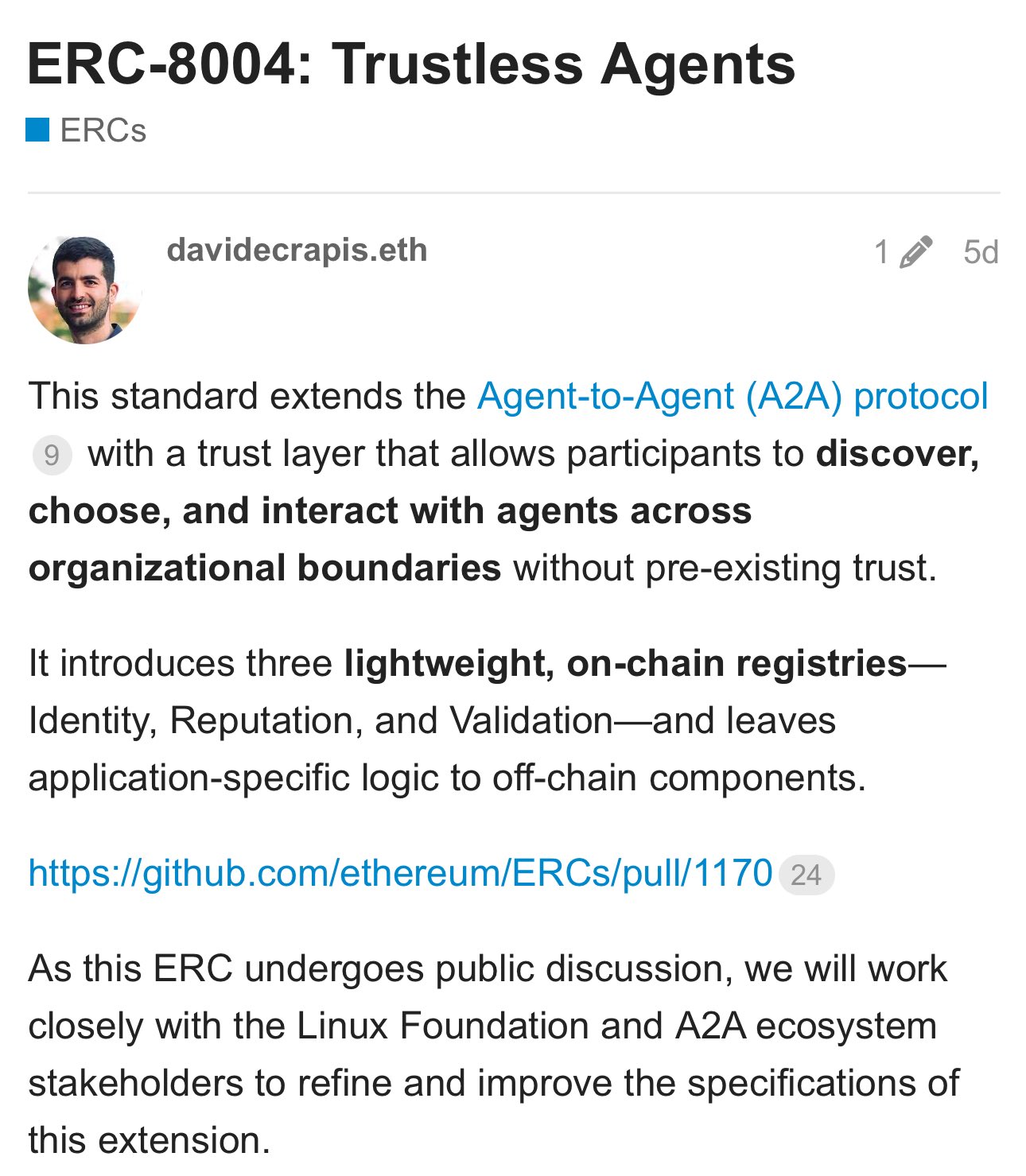
ethereum is SERIOUSLY gearing up for ai. (erc-8004) by @DavideCrapis just dropped, it’s called “trustless agents” and here’s what you need to know:
but first:
you can think of ethereum as an important substrate for ai, not necessarily because it can run all the models, but because it can run all their trust.
here’s a thought experiment:
> imagine millions of autonomous agents moving across the internet. they transact, negotiate, and perhaps even form their own coalitions..(dao’s, anyone?)
> in this reality, what substrate would they choose to anchor themselves to? do they pick a single company server? a google api? an open database that anyone can rewrite?
> if you are working with these agents to do tasks cross 50 services (banks, social media, crms), would you just let it all run on a database that can be deleted?
probably not.
if you were an agent with no loyalty except to your own survival, you wouldn’t want to bet your memory and reputation on one corporation or one government: you’d want a ledger that no one could quietly change behind your back. you’d want neutral ground.
you’d want ethereum.
so, we’ve done the why, now let’s dive into the how:
erc-8004 builds on the agent-to-agent protocol (a2a).
a2a gives agents a shared language, but language isn’t enough: machines also need a way to check
> who are you,
> what have you done
> and are you behaving as you claim?
the proposal sketches an extension to a2a with three registries onchain:
1) identity: a verifiable anchor for “i am me.”
2) reputation: an immutable trail of how an agent has behaved.
3) validation: proofs that an action really hap
this is a practical ERC that can be used and iterated on in the wild; the specifics can stay offchain, but the skeleton of trust lives on ethereum.
8004 lets agents that have never seen each other meet in the wild and still transact with confidence.
look closely and will you see the outlines of a machine economy
your agent negotiating with some unknown counterpart in another part of the world, and it doesn’t matter because both are plugged into the same incorruptible memory.
this is just the beginning of machines running on trustware. smart contracts are how we will communicate with ai, the immutable ledger is how they will communicate with eachother, and ethereum is how we will build this right.
this is just a start, but you can come and lay the foundations of a sci-fi future done right with us.
Niraj retweeted
What if market makers could evolve beyond trading?
What if MMs could become the architects of allocating ANY scarce resource in crypto?
New post by @n_durvasula breaks down how to unlock this, align the incentives and achieve fair pricing at scale.


Niraj retweeted

official video:
offchain lies (intro to @ritualnet) [prod. @zacxbt]

Niraj retweeted

ethereum gave us programmable money, ritual gives us intelligent money. do with this what you will
business opportunity: an AI insurance company.
when we have humanoid robots in our homes, eventually they're going to hurt someone.
AI companies are exposing themselves to massive risk. a wrongful death lawsuit nets you something in the realm of $20M. openAI can pay it, but smaller companies can't.
hire AI engineers and researchers to act as technological actuarial scientists, price the risk of harmful events, build asymmetric coverage that protects the company and the consumer.