

Cofounder @ritualnet. Previously GP @polychain, @siebelschool.
Joined September 2009
- Tweets7.2K
- Following1.4K
- Followers16.4K
- Likes50.8K







Niraj retweeted

AI will make religion more decentralized, leading to thousands of new sects with their own sacred texts, rituals, and followers, according to @tylercowen.
"Using an agent, you'll be able to whip up your own religion in less than a day, with rituals, sacred books, and practices. Most won't catch on, but a few will. If half of 1% of the population does this and some of these gain adherents over time, the whole religious landscape looks quite different. I think it will be more diverse, feel weirder, and be less centralized in religious authorities.”


Niraj retweeted

i am once again here to say agent discovery & registry hell is one of the least impactful things to focus on that for whatever reason keeps nerd sniping cracked ppl...most "mid" solutions for it are good enough and "better" solutions barely move the needle
either you:
1) actually take your 'thought experiment' to its sci-fi logical conclusion wrt "autonomous" + "trustless" agents and make them a first class citizen by enshrining the {fdn model, tool use, etc.} components of an agent directly into the chain* (we do this) rather than frankensteining together some off-chain & on-chain stuff as mentioned in 8004 (we did this: infernet)
2) stay grounded in reality & grok how the largest b2b / b2b2c web2 agent startups (sierra, decagon, ...) that are printing real $$$ work. either they're in the camp of single general purpose agent deployed many times or a statically defined computational graph of how specialized agents communicate. this intellectual masturbatory notion of dynamic graphs of agents discovering each other much less useful than you may think if you're in the camp of web2 cos getting real users.
if you're not in this camp, and believe in futuristic settings, then you should do 1).
anything in between is worst of both worlds imo.
*feel free to @ me but your fave L1 today (eth, solana, monad, ...) doesn't allow for enshrined agents. it's also highly non-trivial for them to do this given it's not in line with their fundamental design.
expanding the exec clients' vm to handle fwd passes across oss llms, network calls for tool use, etc. is the easy part.
hard part is bypassing replicated exec in consensus for non-deterministic behavior w/out ~degrading safety/liveness, fee mech, and how to allow for scheduled txs to exist in a way without borking the perf / end UX for regular txs.
wouldn't be possible for us without the gigabrains @noamnisan @n_durvasula @bahrani_maryam and others coming up with some new machinery.
reality is most L1s are an exercise in networking-bound settings...we're in an exec-bound one.

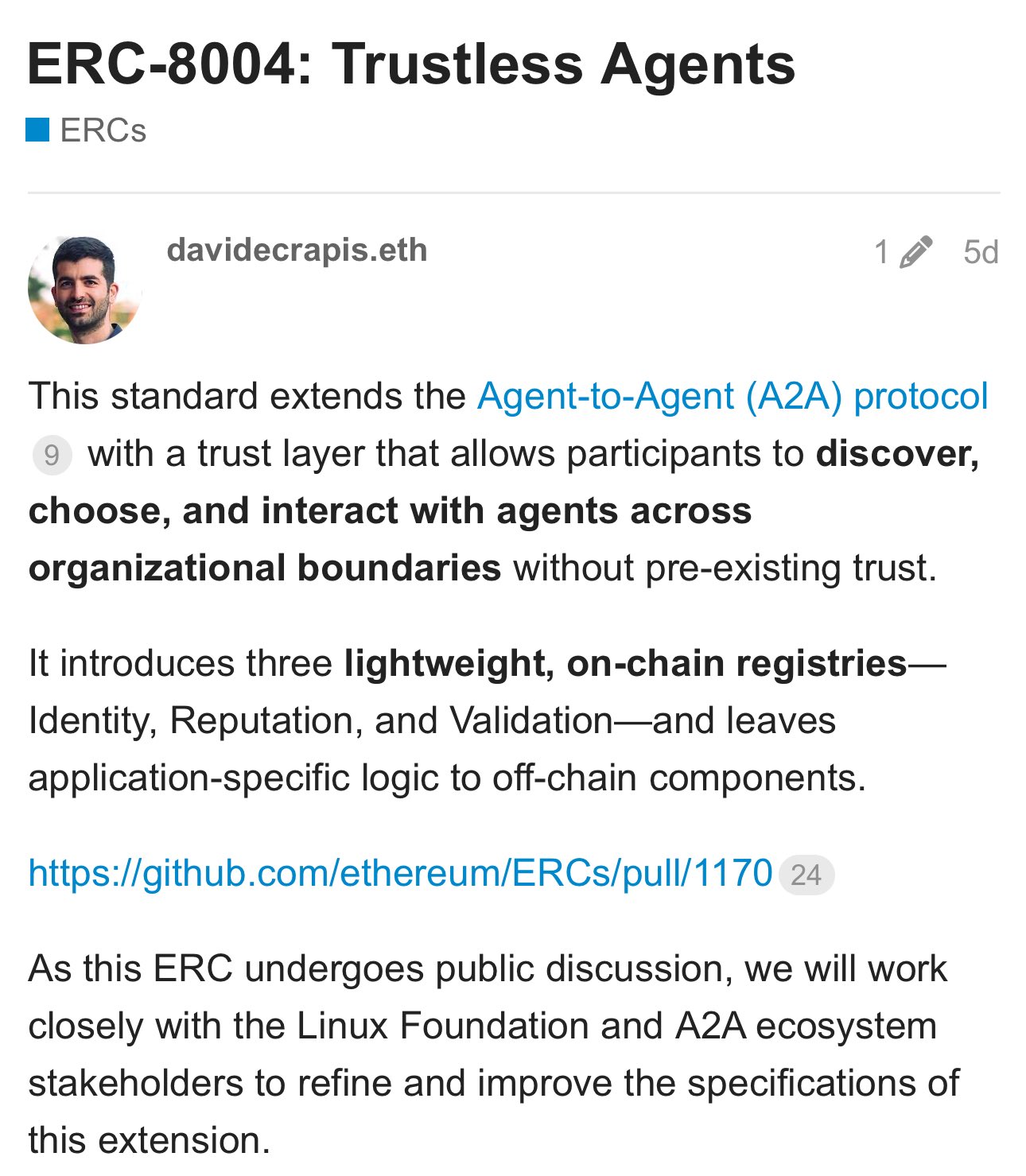
ethereum is SERIOUSLY gearing up for ai. (erc-8004) by @DavideCrapis just dropped, it’s called “trustless agents” and here’s what you need to know:
but first:
you can think of ethereum as an important substrate for ai, not necessarily because it can run all the models, but because it can run all their trust.
here’s a thought experiment:
> imagine millions of autonomous agents moving across the internet. they transact, negotiate, and perhaps even form their own coalitions..(dao’s, anyone?)
> in this reality, what substrate would they choose to anchor themselves to? do they pick a single company server? a google api? an open database that anyone can rewrite?
> if you are working with these agents to do tasks cross 50 services (banks, social media, crms), would you just let it all run on a database that can be deleted?
probably not.
if you were an agent with no loyalty except to your own survival, you wouldn’t want to bet your memory and reputation on one corporation or one government: you’d want a ledger that no one could quietly change behind your back. you’d want neutral ground.
you’d want ethereum.
so, we’ve done the why, now let’s dive into the how:
erc-8004 builds on the agent-to-agent protocol (a2a).
a2a gives agents a shared language, but language isn’t enough: machines also need a way to check
> who are you,
> what have you done
> and are you behaving as you claim?
the proposal sketches an extension to a2a with three registries onchain:
1) identity: a verifiable anchor for “i am me.”
2) reputation: an immutable trail of how an agent has behaved.
3) validation: proofs that an action really hap
this is a practical ERC that can be used and iterated on in the wild; the specifics can stay offchain, but the skeleton of trust lives on ethereum.
8004 lets agents that have never seen each other meet in the wild and still transact with confidence.
look closely and will you see the outlines of a machine economy
your agent negotiating with some unknown counterpart in another part of the world, and it doesn’t matter because both are plugged into the same incorruptible memory.
this is just the beginning of machines running on trustware. smart contracts are how we will communicate with ai, the immutable ledger is how they will communicate with eachother, and ethereum is how we will build this right.
this is just a start, but you can come and lay the foundations of a sci-fi future done right with us.
Niraj retweeted
What if market makers could evolve beyond trading?
What if MMs could become the architects of allocating ANY scarce resource in crypto?
New post by @n_durvasula breaks down how to unlock this, align the incentives and achieve fair pricing at scale.


Niraj retweeted

official video:
offchain lies (intro to @ritualnet) [prod. @zacxbt]
Niraj retweeted

ethereum gave us programmable money, ritual gives us intelligent money. do with this what you will


Niraj retweeted
lot of talk around ai x defi but very few teams thinking about reimagining core primitives with ai/ml
the Relic team is one of them w a deep background that spans mm/trading at jump/citadel and ML at Robinhood/Google
Time to bring DeFi out of the Stone Ages

Niraj retweeted

ZK has always been the proposed endgame for Ethereum scaling and is advancing faster than anticipated, aggressively pulling forward timelines. Still, there is a lack of clarity around the market design when enshrining ZK in the L1.
A short 🧵of my EthCC talk on this topic ↓

Niraj retweeted
"our market maker fucked us"
been meaning to write about this for a while but reality is most founders in the space are retarded at expressing & pricing risk. given the strong experimentation / tinkering culture, naturally makes sense that founders think they have to "innovate" by introducing what they think are clever terms in these MM deals. what follows is classic adverse selection given they're negotiating w/ entities whose explicit job it is to price risk in a structured way, so they'll continually reject -ev terms and not explicitly call out overly fucked terms for the project and claim ignorance later (++ev). usually fucked terms for the project end up being strongly correlated to fucked terms for retail / community / etc. which leads us to where we are today
at first glance, soln sounds like to shove transparency down everyone's throats wrt disclosing as many details as possible (i.e. blockworks framework, etc.) and this will obviously help, but even if they were to disclose the exact MM contracts publicly still would be overly misleading, potentially moreso since it sounds like complete transparency but what you really need is a proof of inexistence of any other bilateral/etc. contracts they have made that lets them express risk in a way that's not conducive (more importantly, transparent) to the project...
i see a ton of comments in cobie's thread theorizing around skewing greeks (primarily delta) and there's a ton of ways to continue to do that even if you disclose what appears to be a benign MM contract & "their positions". short of you hitting up every credit/structured products/otc/etc. desk and somehow hoping they'll eventually leak any contracts they have w/ the "MM" in question or, instead of getting an "auditor" after the token spirals, sticking as many commlit/tech trans/accountants you can on the MM (or parent conglo) and attempting to get a biospy before the deal goes thru. no one will agree to the latter (and it costs a fuck ton + slow), and if a founder could pull off the former, well, they should probs get a diff job than the one they have. and no, hyperliquid doesn't "solve this" (yes, im sidelined), but actually doesn't given no matter how much you can migrate onchain in a transparent way, showing the inexistence of offchain contracts is what you really want. there have been a few intermediaries as people mention (i.e. coinwatch, glassmarkets, etc.) that attempt to police size/uptime/width in some trust-minimized (TEE/zkTLS/etc.) way of info leakage to MMs but same point still stands re: proving inexistence.
also, goes w/out saying, but to all the people that keep asking "why do projects give away so many tokens to MMs" and then come up w/ ways to infinitely police them via trust-minimized "subaccounts" for monitoring-if you gut a MM's capital efficiency, well, that's what tends to happen re: need to juice their incentives given there's an absymal lack of primes in the space and unsecured credit has ~dissipated since the '21 cycle. speaking of the latter, to any one that dealt at scale w/ genesis/blockfi/etc. last cycle, pretty well known the amount of closed term retarded haircut (w/ no rehypo) deals they were agreeing to last cycle—will inevitably come back in true fashion sometime and that will exacerbate policing of greeks that a MM has by an order of magnitude. lastly, if you were around for the mini heyday of arthur's quantos (ethusd, etc.) in the '17 cycle, you'll remember that it was one of the few ways to crudely trade dispersion in the space by proxy of corr but they ended up dying off since hard to price funding, retail choosing vanilla linear/inverse perps over them, etc. but, bringing it back to MM deals & constricting net greeks, given the nature of vol/corr/liq dynamics for quantos, easier to single out idio and not get left holding the bag on getting paid out in shitcoin + better risk mgmt than stables given corr ~beakdown in this sorta market (i.e. get paid in $hype for being 100x short some shitcoin). always was surprised i didnt see more ppl try to rebuild it since it has some tangible pmf...i mean am "glad" @zhusu running the gamut on quantos but ofc 3ac shenanigans last cycle -> doa
and fwiw, some of these MM deals ive seen for some projects are overly exotic where it's not even clear any party knows what they're agreeing to but given it's "ok" from a statutory/case law perspective, no attys will flag shit & frankly not well equipped to do so past the basics on commercials. ill give a concrete example—there's at least one coin MM deal in the top 30 coins today that has some odd mix of "best of"/"asian"/"barrier" type characteristics that im sure some of you know, but it's also written in a benign way where it doesn't look like it's a frankenstein of a structure to price out and probs was the result of someone trying to repeatedly bandaid the canonical loan + call option structure w/ anecdotes they heard in the space. and to be clear, it's worked out pretty fucking well for the project but def a few MMs had no clue how to price it and approximated it to what they can price. but, my broader point since the start is, trying to prevent bad things from happening via attempted policing in the absence of invasive biopsies of MMs' external deals won't lead to the intended transparency (or outcomes) ppl want.
need to get back to icml but will write more on this later if ppl are interested, but really wish founders would sit down w/ any ~not heavily redteamed reasoning llm, pipe in the contract, and ask it to enumerate diff scenarios for whatever clever structure they think they want as well as net greeks for everyone involved + implications
lastly, we'll see all the same clownery from web3 founders this cycle in terms of thinking it's "easy" to clean shells, "easy" to issue converts to everyone so they'll gamma scalp to be the "buyer of last resort", etc. for all the treasury company shenanigans set to ensue

One area of crypto mkt structure that seems very opaque and weird to me still is market maker <> token issuer / foundation relationships. I would guess this is responsible for a lot more issues than it gets credit for.
Feels like in the last year there have been several "our market maker fucked us" stories that just disappear and nobody ever knows what actually happened.
About a month ago, some token crashed like 90% and then the founder wrote some long thread saying "wintermute did it to us" and then nothing happened.
Am surprised there is no solution for this yet: maybe founders should have to publish/disclose the terms of their MM deals, CEXs can formalise some standards which bar listings, or maybe there is some other solution that ppl smarter than me can invent.
I guess you want (1) token buyers have info symmetry on the incentive structure of the MM deal and (2) founders dont keep getting scammed by dodgy MMs or nonstandard agreements.
Pic related.

Niraj retweeted

Alex and I are on a quest to understand how we can use cryptography beyond digital systems.
What are new trust building blocks that we can build with nature? how can we use cryptography to secure physical interactions?
I am so glad @ARIA_research is the home for this effort

v1 of our @ARIA_research opportunity space 'Trust Everything, Everywhere' is now live!
we're focusing on new security primitives that straddle digital and physical worlds, and will be spending the next months zeroing in on a £10-100m first challenge within the space 🎯

Niraj retweeted
In our last blog post, we showed how to break privacy-preserving LLM schemes — decoding permuted model states with near-perfect accuracy.
Today, we present our defense: Cascade 🕵️♂️✨
ritual.net/blog/cascade


Niraj retweeted

The Shrine Beckons…
Announcing Ritual Shrine’s first Request-for-Startup (RFS): Promptd, a prompt marketplace on Ritual that allows creators to monetize their prompts and workflows without needing to reveal them, made possible through TEE-based encryption.
Niraj retweeted
Smart contracts have been trapped in reactive mode.
The infrastructure endgame needs more.
❖ Introducing Scheduled Transactions ❖
Smart contracts that proactively execute on your behalf—truly autonomous *actually* smart contracts that live onchain.
