

Ex-Google Sr Director of Product Management (Maps + Shopping), Angel Investor, startup CEO. Partner @ https://teapawt.org/t.co/KFHq0MP58m. Study ₿itcoin! E/Acc!
Switzerland
Joined June 2014
- Tweets1.7K
- Following1.9K
- Followers982
- Likes24.4K


Pinned Tweet
As pinned recommendation, I think some of the best current knowledge is in the essays by Paul Graham paulgraham.com/articles.html and then the Almanack of Naval Ravikant navalmanack.com. If you study those, it will change your life.
2
23
1,228


Agree with almost everything

My current views on investing:
- Government will never stop printing money, so bitcoin / gold / land will all do well for 2 decades
- AI is drastically underestimated and the best AI companies are significantly undervalued
- Shorting individual stocks is very difficult, so I wouldn’t try it but the biggest indicator of whether a company survives or not is the internal speed of iteration now
- Bonds shouldn’t be in the conversation for anyone under age 50. Picking up pennies in front of steamroller
- Venture investing & public markets will blend in next 5 years, so private valuations will rise due to lots more capital chasing a few great companies
- Young people should look at assets & markets that Wall Street hasn’t adopted yet. This used to be bitcoin/crypto, but now private markets, prediction markets, compute markets, and data brokering
- every investor should be sovereign. You can use a financial advisor, but you have to know your numbers, your strategy, and your risk exposure. AI makes this too easy (Silvia .com)
- Everyone arguing over interest rates, oil, and other historical macro factors are not wrong, but these just have less impact today (thx @jvisserlabs)
- agents are coming for finance and things are going to rapidly change. Don’t fight it, embrace it and use to your advantage.
- Tesla / SpaceX merger will happen and create largest company in human history. My simple rule is to never bet against Elon.
There are many more, but what are yours?
3
113



So true. Not only is it incredibly hard to separate from US technology, it will also have huge (opportunity) costs. And nobody is helped if we end up with a bad version of Gmail and Office 365 in the end.

The below, from the FT, is an interesting framing.
But I would add another element to it. Given that most of these services are free at the point of use, it's not just that we are dependent on US services. Rebuilding them from scratch — while maintaining the same efficiency and user cost — would be prohibitively expensive.
Europe simply doesn't have deep enough capital markets for it.
Most of these services run on loss-leader models or data-captured two-sided platforms that only start paying off after years of accumulation.
That means — in a roundabout way — the US maintains influence around the world by giving away such services for "free" (and/or making the upfront investments on everyone’s behalf).
Just like the Ancient Romans, it builds digital roads and rails as a public good, in exchange for allegiance.
From the US point of view, the effort pays off, not just because it eventually draws digital data-based tribute, but through the cohesive effects and alignment with American standards, protocols and T&Cs — which it believes (because they are centred on liberty) generate the greatest overall growth for everyone.
Of course, this creates resentment in regions that disagree with those principles.
It’s notable that the EU’s push to break free from this protocol “bondage” is now focused on building its own financial digital infrastructure via the “Appia and Pontes” initiative.
That might be a noble aim in terms of strategic autonomy. But the problem will come the moment we Europeans grasp the true scale of the subsidies we’ve been benefiting from all this time — and therefore the real cost of Brexiting from the Pax Americana system.
It's time to start thinking carefully about "What have the Americans ever done for us?"
teapawt.org/FT/status/205376962823…
1
64
Unpleasant for Europe, but true

Waking the Hegemon
The US and Europe need to redefine the relationship.
In the latest ramble we talk through how we got here and where we are going.
campbellramble.ai/p/waking-t…

1
2
50


Well written summary of where Europe stands

#Europe missed the boat on strategic autonomy a long time ago. It will take a long time to get back on it. @asiatimesonline
asiatimes.com/2026/02/eu-nee…
Excerpt,
"When Brussels convinced itself that regulation could substitute for power and values for capacity, leverage migrated elsewhere. Europe rendered its own vulnerabilities exploitable; Washington and Beijing simply did not hesitate to use them.
Sermons multiplied as factories vanished; dependence was a policy choice, defended in public, moralized at home, and institutionalized through repetition until it hardened into reflex.
European leaders luxuriated in talk of principles, moral superiority, a manicured garden threatened by the jungle, normative power, ethical trade, the Brussels Effect and enlightened multilateralism, while neglecting the unglamorous work of building industrial capacity, hard infrastructure, technological depth and military endurance."

56
Energy is life and wealth

Four charts that show how China is beating the US in the energy race
🇨🇳⚡🇺🇸
1) Since 2021, China has added more power capacity than the US has in its history
Via @lili_pike

1
76
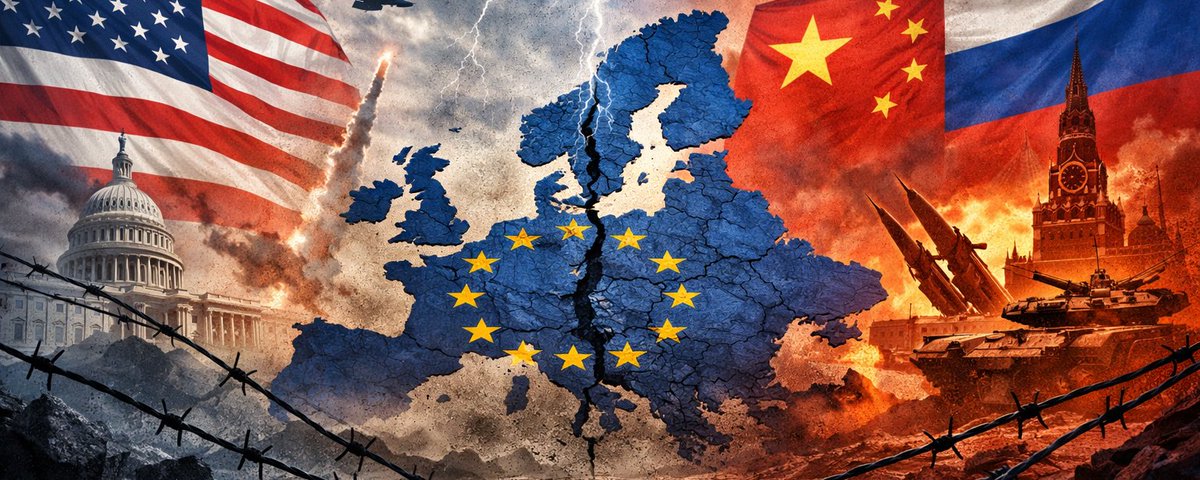
fully agree "A critical error now taking shape, particularly among the Western Middle Powers such as UK, France, Germany, and their Canadian counterparts, is the belief that they have durable optionality in Cold War 2.0: that they can keep deepening economic and trade ties with China while remaining anchored in US-led tech, security and defense architectures. In practice, this is not “strategic autonomy.” It is strategic liability."

42


Very articulate and fitting

Also great summary, like it or not

Upon second reading, I realized the wording about Europe is not lack of respect but a signal — the more Europe pushes for supranational authorities (climate, taxes, tech, norms) which in the U.S. reading represent illegitimate interferences with its domestic affairs, the more the U.S. will support “patriotic” parties, an illegitimate interference with Europe’s domestic affairs. For the rest, an earlier summary:
- America first: international organizations should support not undermine national sovereignty
- Western Hemispheric defense central with a new Trump Corollary to the Monroe Doctrone
- Europeans must defend themselves
- Europe good, EU bad: rules and regulations prevent Europe to grow while its “globalist” approach undermines sovereignty and democracy.
- Indo-Pacific Allies must do more to counter China, not only militarily but also on trade and technology
- China’s manufacturing overcapacity a threat to domestic stability (loss of blue collar jobs) and international security (monopolistic rents after killing competition through dumping)
- Taiwan is safe, Ukraine less so.
- Middle East: no more past mistakes
- Africa: the last paragraph, 200-300 words.
A realist document, most realist will reject as they cannot appear pro-Trump, with some common sense, ideology and undiplomatic claims (support to Eu patriotic parties). Agree or disagree, it’s a clear document, Europeans will never be able to write because they cannot agree on most issues, from language to goals and means.

1
66
good summary

🙏Super read of the NSS ! Appears indeed to be a big change.
“Trump Corollary” to Monroe Doctrine is now the core pillar.
China downgraded from existential threat to economic competitor.
Taiwan deterrence = “ideal” but conditional on allies paying up.
Indo-Pacific secondary, Western Hemisphere + homeland first.
No more democracy crusades, no value imposition abroad.
Tariffs quietly admitted as failure, focus shifts to multilateral pressure.
Biggest shift since 1945: from global cop to fortified hemisphere power.
Allies will be asked to foot the bill while US rebuilds at home.
Fortress America is back.
1
2
66
Just wow!

This is big. The final U.S. National Security Strategy was just published and the refocus on the Western Hemisphere (i.e. the Americas) is confirmed.
The document clearly establishes this as the U.S.'s number 1 priority, saying that the U.S. will now "assert and enforce a 'Trump Corollary' to the Monroe Doctrine."
In terms of military presence, they write that this means "a readjustment of our global military presence to address urgent threats in our Hemisphere, and away from theaters whose relative import to American national security has declined in recent decades or years."
On China, a couple of points.
The most striking aspect to me is that China is NOT anymore defined as "the" primary threat, "most consequential challenge," "pacing threat," or similar formulations used in previous such documents.
It's clearly downgraded as a priority. Based on the document's structure and emphasis, the top U.S. priorities could be characterized as:
1) Homeland security and borders (migration, cartels, etc.)
2) Western Hemisphere (Monroe Doctrine restoration)
3) Economic security (reindustrialization, supply chains)
4) China and Indo-Pacific
To be clear they don't define China as an ally or a partner in any shape or form but primarily as 1) an economic competitor, 2) a source of supply chain vulnerabilities (but also a trading partner) and 3) a player who regional dominance should be "ideally" denied because it "has major implications for the U.S. economy."
Interestingly, I believe for the first time ever, they mention the possibility of being overmatched militarily by China:
- They write that "deterring a conflict over Taiwan, ideally by preserving military overmatch, is a priority": "ideally" clearly means that it's ideal, but not necessarily a given. The fact that they call deterring conflict over Taiwan merely "a priority" also suggests, by definition, that it's no more a top strategic priority, or a vital interest.
- On Taiwan they also clearly imply that if the U.S.'s "First Island Chain allies" don't "step up and spend - and more importantly do - much more for collective defense", then there might be "a balance of forces so unfavorable to us as to make defending that island impossible."
They still maintain that "the United States does not support any unilateral change to the status quo in the Taiwan Strait" but, clearly, there's a widening gap between what the US says it opposes and what it's actually willing to do about it.
Interestingly as well, contrary to previous such document, there is zero ideological dimension in the document when it comes to China. No "democracy vs. autocracy" framing, no "rules-based international order" to defend, no values-based crusade. China is treated as a practical issue to be managed, not an ideological adversary to be defeated.
In fact the document explicitly mentions, I think for the first time ever as well, that US policy is now:
- "not grounded in traditional, political ideology"
- that they "seek good relations and peaceful commercial relations with the nations of the world without imposing on them democratic or other social change that differs widely from their traditions and histories"
- and that they seek "good relations with nations whose governing systems differ from ours."
Which is quite a stunning departure from the rhetoric of the past few decades. We all knew this but it's now amply clear that the era of missionary liberal internationalism in US foreign policy is dead and buried.
The competition with China is primarily described in economic terms, explicitly so: they write the competition is about "winning the economic future" and that economics are "the ultimate stakes."
Notably, they admit that the tariffs approach "that began in 2017" when it comes to China essentially failed because "China adapted" and has "strengthened its hold on supply chains."
The new strategy, as described in the document, is to build an economic coalition against China that can exert more leverage than the US economy alone - a tacit admission that America just isn't powerful enough on its own anymore.
The contradiction is however obvious: unclear how you build an economic coalition against China while simultaneously waging trade wars against your coalition partners, demanding they shoulder more of their own defense, and treating every allied relationship as a deal to be renegotiated in America's favor.
At some point these "allies" will be asking a very obvious question: why sacrifice our economic interests to prop up an America that can no longer compete on its own - and that offers us less and less in return?
The document can be found here: whitehouse.gov/wp-content/up…


52


