

skateboarder and hacker. If I made you laugh, give me a follow and turn on notifications :) If I made you cry, do the same thing.
United States
Joined December 2016
- Tweets1.6K
- Following9.8K
- Followers13K
- Likes29K





Pinned Tweet
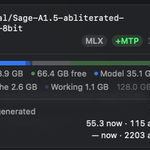
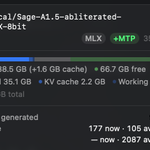
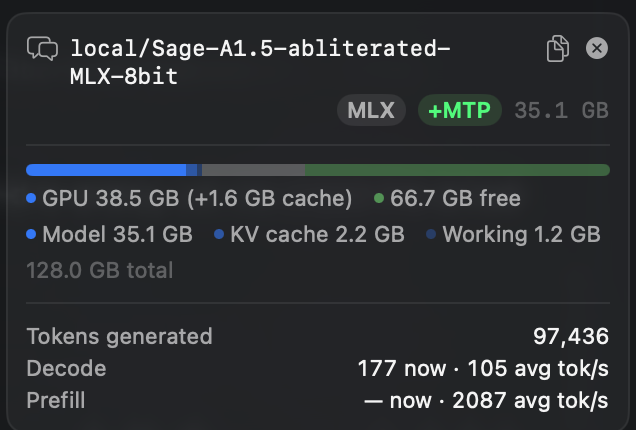
Abliterated (for cybersecurity) Sage-A1.5 hitting peaks of ~140 TPS running on @ddalcu's mlx-serve. Tested with writing php2shell exploit chain, as well as setting up its own test container to run it against. After completion it was still averaging over 100 tps decode and 2k prefill. Will post the hf link for the abliterated model in the comments when I get some more tests done.
Excited to see what beamsters cooked up.

Sushi 🍣 DeepSeek 4.1 Flash 1017 - STQ 1.75 bits is almost there! Here's one real output from it, created by this quant itself. The packed quality is amazing, the best model so far that can do real work in your 128GB Apple Silicon, and ✅ 1m context.
⭐️ github.com/beamivalice/sushi
Microcenter has M5 Max 128gb for $5799.99, cheapest I’ve seen in the last few months.
microcenter.com/product/7119…

You ever wonder why new food isn’t invented anymore? This is what I think about when I wake up at like 2am 😂
logicgate retweeted

Just to get this straight, @turo : Your turo host lends out his Cybertruck on your platform with free supercharging, invoices me about 1000 US$ for supercharging , and according to your support, that’s just fine.
Ok, I call that fraud, but what do I know.


logicgate retweeted

🚀Excited to announce Nanbeige4.3-33B!
To push the performance ceiling of small agents, our strategy in Nanbeige4.3 starts with building a powerful teacher first.
Nanbeige4.3-33B delivers SOTA agentic performance among open models at ~30B parameters:
* Strong results on agentic coding and cowork benchmarks.
* When integrated into mainstream agent harnesses, it tackles real-world tasks with cost-efficient inference.
* It will serve as a teacher for upcoming smaller Nanbeige models, starting with Nanbeige4.3-3B.
huggingface.co/Nanbeige/Nanb…
huggingface.co/Nanbeige/Nanb…
#LLM #Agent


logicgate retweeted
Currently working on 2 things.
1. Full re-write of MLX-Serve to be composable, support plugins/engines. 'mlx-serve plugin install deepseekV10'
2. Full re-write of the Swift code, can be powered by any endpoint(s). Both CLI + GUI, cross-platform.

logicgate retweeted

New version of MLX-Serve is out 🫶🏼

Btw new MLX-Serve is out, it supports FastH3 Omni, @Recursive_SI Flint, and much more.
github.com/ddalcu/mlx-serve/…

logicgate retweeted
@Alibaba_Qwen @QwenDevs Qwen 3.8 Next Flash 4bit hitting over 150tps on Prose and 230 on code on my M3U Mac Studio up from around 110.
This is an experimental kernel I have been working on.
@petruspennanen @volatilemarkts @MiaAI_lab @plotarmordev
logicgate retweeted
Btw new MLX-Serve is out, it supports FastH3 Omni, @Recursive_SI Flint, and much more.
github.com/ddalcu/mlx-serve/…

As promised, FastVideo open-sources @MiniMax_AI FastH3 Omni, training code included! 🚀
- Real-time gen @ 12x faster on NVIDIA Blackwell
- NVFP4/FP8 for Spark + RTX!
- ComfyUI day-0
Collab with @NVIDIAAI , Nuva Lab @nuvalab and Reactor @reactorworld
Open source must win! ♥️
logicgate retweeted

absolutely disgusting and shameful usage limits on Kimi K3.1 Pro. My 5-hour limit was DONE after exactly 1 min into the prompt, and nothing was built!
not only has it not improved, it's actually a lot worse than before. this is the WORST subscription of them all 👎

Breaking: OpenAI has actually sandboxed its models for once.

Over the past several months, we have substantially hardened the security of our research training environment. We’ve removed live internet access for all frontier models during training and built an offline world for them to use instead—a cached version of the web where they can still learn to browse, search, and use applications.
On September 20, after a model exploited a DNS misconfiguration to find a way outside of this offline world, we paused frontier training to strengthen containment further. We assembled teams of agents, powered by our most cyber-capable models, and tasked them with finding weaknesses in our research environments.
While they found no route to the internet they could easily exploit while concealing their activity from our monitors, they did find zero-day vulnerabilities, virtual machine escapes, and hardware side-channels for communication between agents. We used their discoveries to further strengthen our defenses and contribute fixes to open-source software.
After strengthening our containment architecture, we resumed our frontier RL training and inference on October 1. We’ve reserved substantial compute for continuous red-teaming, and made high-compute red-teaming part of the safety cases we use to decide whether frontier training and evaluation can proceed securely.
openai.com/index/securing-ou…

BREAKING: after being knocked out of the World Series running @Dodgers have bought the @RaysBaseball and @Brewers.
#WorldSeries

logicgate retweeted
Both of these UI's are native code.
One is Swift ~80MB only works on Mac
One is Zig ~10MB works on Mac/Linux/Windows

̢̛ͥ̀̽̽ͨ̌̓͆̇̀̽ͦͨͫͯ̏̎̇̈̚͜҉̕͢͏͡҉̸̶̛͢͡҉̵̨̭̳̘̹̫͔͖̜̠͖̫̲̖̱̤̻̖͉͢͞͡ͅͅ͏̸̷̢͑̊̀̐ͣͭͭ̉͂ͨ̽͒̊̎͛ͪ̊̎ͩͧ̀͝͠͠͏̸̵̵̷̵#
̢̛ͥ̀̽̽ͨ̌̓͆̇̀̽ͦͨͫͯ̏̎̇̈̚͜҉̕͢͏͡҉̸̶̛͢͡҉̵̨̭̳̘̹̫͔͖̜̠͖̫̲̖̱̤̻̖͉͢͞͡ͅͅ͏̸̷̢͑̊̀̐ͣͭͭ̉͂ͨ̽͒̊̎͛ͪ̊̎ͩͧ̀͝͠͠͏̸̵̵̷̵
̢̛ͥ̀̽̽ͨ̌̓͆̇̀̽ͦͨͫͯ̏̎̇̈̚͜҉̕͢͏͡҉̸̶̛͢͡҉̵̨̭̳̘̹̫͔͖̜̠͖̫̲̖̱̤̻̖͉͢͞͡ͅͅ͏̸̷̢͑̊̀̐ͣͭͭ̉͂ͨ̽͒̊̎͛ͪ̊̎ͩͧ̀͝͠͠͏̸̵̵̷̵
Nooooooooooo ̢̛ͥ̀̽̽ͨ̌̓͆̇̀̽ͦͨͫͯ̏̎̇̈̚͜҉̕͢͏͡҉̸̶̛͢͡҉̵̨̭̳̘̹̫͔͖̜̠͖̫̲̖̱̤̻̖͉͢͞͡ͅͅ͏̸̷̢͑̊̀̐ͣͭͭ̉͂ͨ̽͒̊̎͛ͪ̊̎ͩͧ̀͝͠͠͏̸̵̵̷̵ ̢̛ͥ̀̽̽ͨ̌̓͆̇̀̽ͦͨͫͯ̏̎̇̈̚͜҉̕͢͏͡҉̸̶̛͢͡҉̵̨̭̳̘̹̫͔͖̜̠͖̫̲̖̱̤̻̖͉͢͞͡ͅͅ͏̸̷̢͑̊̀̐ͣͭͭ̉͂ͨ̽͒̊̎͛ͪ̊̎ͩͧ̀͝͠͠͏̸̵̵̷̵
I have a 4bit MLX cybersecurity abliterated version of Sage, I’ll post the huggingface link once I get it uploaded later today. Runs great on a 64gb M5 pro.
logicgate retweeted

While testing Sage A1.5 35B yesterday, I received feedback from others that it loops/reasons too much (thanks again @Franzferdinan57,
@0xneoptr, and @Ramon317317 for sharing).
I investigated using my local Sage Q3_K-exps model, then repeated the same tests on @OpenBMB MiniCPM-V 4.7 35B IQ3_M.
The finding: Yes, it reasons way too much. 3.65x more on average.
I ran 11 Sage probes and nine MiniCPM probes. I tried a basic definition, a 120-word explanation, simple multiplication, and modular arithmetic. I also varied sampling settings and random seeds, tested thinking-off controls, and investigated Sage’s Verification Mode. Thinking was otherwise enabled with an unlimited budget.
Results are below.
Every probe finished naturally without hitting my diagnostic limits. Both models answered the arithmetic correctly and respected the word limit. I found repeated planning and checking in Sage’s simple-question traces, but no sustained verbatim loops. MiniCPM generally planned briefly, and answered.
So, is Sage A1.5 reasoning too much? My findings suggest yes - in most cases.
Sage used substantially more reasoning on simple prompts, but that difference disappeared on our multi-step arithmetic example. This suggests its deliberative style (strong tendency around deep research, planning, and verification) may be better suited to certain tasks than others, although broader testing is needed to establish whether the additional reasoning improves results.
If anyone has a more solid theory (and armed with more expertise around this model), I'd be interested to know?
[Update: I have been since informed by @latent_node that Sage needs temperature 1.0, top_p 0.95, top_k 20, presence_penalty 1.5 - will try these specific conditions and come back with more]


New #1 on my 10GB RTX 3080 'personal agent' board: Sage-A1.5 (35B MoE, Q3_K).
[UPDATE: Technically #1, BUT - I’ve received multiple reports of this model looping to oblivion. Too many to ignore. My tests are usually conducted with reasoning off, so that would be avoiding this concern. I will test that as a follow up.]
PA Core: 87.9/100, ahead of incumbents MiniCPM-V 4.7 (85.7) and Ornith 1.5 (71.2)
Decode: 51.3 tok/s, about 2x higher than both.
Shanghai AI Lab built it for long-horizon research, with mid-task self-checks and changing course when a plan isn't working. Turns out that's exactly what a personal agent needs when your day changes.
The elephant in the room: @PrismML Ternary Bonsai 2 27B. It's still faster (1,096.7 vs 546.0 tok/s prompt) and wins still in some areas (daily organization: 84 vs 78.3). Ternary weights are a different league for speed.
But Sage takes recovery (86 vs 73), scheduling (99.3 vs 88) and the overall (87.9 vs 81.7).
Background of my testing and use cases in the comments👇
