






Eugene retweeted

Many of us who grew up with a reverence for the ANC have mourned its demise. We were labeled " DA coconuts, clever blacks, counter revolutionaries " because those who wear ANC regalia believe they have legitimacy.
They ignored the umbilical chord that tied us to this party and the painful separation that HAD to happen because of its own conduct. The party chose itself and not "the people." They didn't ask WHY. So with that in mind, I respond to you.
My dear sister, what, exactly, is a “black party”? A party founded by black people? Led by black people? Supported by black voters? And what happens when its leaders steal from the people whose racial identity they share?
Does a black official who loots a public institution advance black power? Does a black politician who protects corruption become progressive by virtue of pigmentation? What liberation reaches a black household when money intended for its water, electricity, healthcare or education disappears?
A party that helped teach the world the meaning of non-racial liberation cannot respond to electoral rejection by dividing South Africans into racial camps and suggesting that black voters who choose differently are restoring colonial rule. If the ANC has abandoned its commitment to non-racialism, its leadership must tell us. PUBLICLY. And explain which conference authorised that departure.
Because history and documents say otherwise.
In 1955, the Congress of the People adopted the Freedom Charter, declaring that “South Africa belongs to all who live in it, black and white”.
Albert Luthuli addressed precisely this in his 1961 Nobel lecture. He explained that the liberation movement had consciously rejected the easy mobilisation of racial resentment, despite the brutality inflicted on black South Africans. He described its vision as “a nonracial, democratic South Africa”. The refusal to answer racial oppression with racial exclusion was a considered political choice.
Mandela expressed that commitment at Rivonia in 1964: “I have fought against white domination, and I have fought against black domination.” Those words placed a moral limit on the exercise of power, including power exercised by black leaders.
The ANC translated principle into organisational decisions. At Morogoro in 1969, it opened membership to South Africans of all races, although the NEC remained restricted to Africans. At Kabwe in 1985, it removed that leadership restriction. Tambo subsequently described the opening of membership as “a giant leap forward towards the true nonracialism within the ANC”.
These were deliberate changes to who could belong and who could lead. So wena what are you saying here? And is this the party's position or are you all saying what you want, when you want?
The constitution adopted at the ANC’s 2022 conference retains non-racialism as part of the organisation’s defining character. Rule 3.4 commits it to combating racial, tribal and ethnic exclusivism or chauvinism. None of this requires silence about racism, white economic power or the enduring distribution of deprivation along racial lines.
The people harmed by corruption do not experience it less brutally because the person responsible looks like them. You invoke historical and dialectical materialism. This makes your argument especially vacuous. A serious materialist analysis would examine ownership, class interests, institutions, labour and the distribution of resources. Counting parties by the presumed race of their leaders tells us remarkably little about whose interests those parties actually serve.
Black citizens are entitled to withdraw support from a party that disappoints them. Their freedom includes the right to reject the ANC without being accused of betraying their people. You celebrate the political wisdom of black voters when they support you, then diagnose their ignorance when they leave?
You, @MYANC abandoned us. YOU have made us a laughing stock. Don't you dare preach to us about what we do next.

The “we will be the generation that removes the ANC from power”, turned out to be “we are the generation that brings back colonists back to power”🙈
Go se tsebe ke kotsi🙏🏾, biblically this is located in the book of Hosea, Chapter 4: verse 6, “ my people perish for lack of knowledge”
It does not just end there, we had abandoned our revolutionary duty of conscientising and imparting dialectical and historical materialism amongst the people, the motive force as their tools of analysis when confronted with many complex issues affecting our country . We abandoned this revolutionary duty by also allowing the enemy camp to be the ones who drive the narrative in the country.
I do not have to repeat what we have already conceded to and accepted as our weaknesses as the ANC, and how we have contributed to loosing public trust amongst the people. We accepted and we will change that for the better. But South Africans must equally understand that we can’t auction the country away just for vibes and because there is an anti-ANC bandwagon we jump onto without being scientific and by being ahistorical. I don’t know how many times we have repeated these words, that the disintegration of black power will never be to the benefit of the progressives in this country but to the minority.
I asked a simple question to day why do we have 544 different black parties in the country contesting each other, but only have two major white political parties that have remained as they were since 1994 and the only answered I got were insults etc. we have never heard of a DA splinter, or FF + splinter party. Their numbers remain solid whilst we continue to disintegrate and the black power neutralised and we think we are spitting one another and proving superiority over one another. Whilst the enemy camp marches ahead and advancing towards complete victory.
Let those who can hear, hear!

Eugene retweeted

So you mean to tell me that someone down your ancestry line survived being chaıned to other human bodięs for several months in the bottom of a disease-infested ship during the Middle Passage, lost their language, customs and traditions, picked up the English language as best they could while working free of charge from sun up to sun down as they watched babies sold from out of their arms and women rapęd by ruthless sIave owners.
Took names with no last names, no birth certificates, no heritage of any kind, braved the Underground Railroad, survived the Civil Wąr to enter into sharecropping... Learned to read and write out of sheer will and determination, faced the burning crosses of the KƘK, everted their eyes at the black bodies swinging from ropes hųng on trees...
Fought in World Wąrs as soldiers only to return to America as boys, marched in Birmingham, hosed in Selma, jailed in Wilmington, assassinated in Memphis, segregated in the South, ghettoed in the North, ignored in history books, stereotyped in Hollywood...
and in spite of it all, someone in your family line endured every era to make sure you would get here, but you receive one rejection, face one obstacle, lose one friend, get overlooked, and you want to quit?
How dare you entertain the very thought of quitting. People, you will never know survived from generation to generation so you could succeed. Don’t you dare let them down!
It is NOT in our DNA to quit!

Eugene retweeted

This must be shared until the right wing groups and their foreign funders are fully exposed.
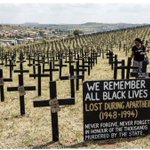
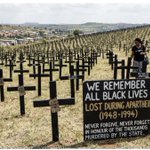
They planted white crosses in Washington for a fake White Genocide. In response, we are reclaiming the narrative with the real heroes and victims of racist violence in South Africa.
Chris Hani. Steve Biko. Solomon Mahlangu. Ruth First. Albertina Sisulu. Matlhomola Moshoeu. Maria Makgato.
These are the names they want erased. These are the names the world must see. AfriForum wants to sell a lie for money. We will not let them.
Share this everywhere.

Eugene retweeted

They’re using black women to promote and sell alcohol.
The latest advert is disgustingly evident that it’s purpose it’s to show black powerful women fighting for a course celebrating with alcohol.
They first destroyed the black family structure by taking away our Fathers to the mines, selling alcohol to them at train stations.
Now they’ve successfully targeted black women in the name of “soft life” everything we do has to have alcohol in it.
Black women have fallen for this trap, it’s sad to witness our sisters turning into functional alcoholics.
Beautiful celebration of diversity during halftime show. If only the war mongers would have same spirit instead of needless wars 🙄🙄 #WorldCupFinal
277
Eugene retweeted

All those in Ukraine fighting a war against Russia. All those in Russia fighting a war against Ukraine. How many would rather be at home with their loved ones and kids that they may never see again? Imagine if they both said 'fuck off' to their 'leaders' who never see a bullet fired in anger - there could be no war.
When are we going to grasp that the pawns fight wars for those sipping coffee away from the conflict that they orchestrate, and they have no power except for the power we give to them in the form of acquiescence.
Put Putin, Zelensky, Trump, Xi, the lot of them, in a room and lock the door. Let them fight each other while the rest of us get on with our lives.
What if they declared a war and no one turned up? War would be over.


Eugene retweeted

RESIGN RESIGN RESIGN RESIGN RESIGN RESIGN RESIGN RESIGN RESIGN RESIGN RESIGN RESIGN RESIGN RESIGN RESIGN RESIGN RESIGN RESIGN RESIGN RESIGN RESIGN ASSHOLE 🤬🤬🤬🤬🤬🤬🤬


Eugene retweeted

South Africa got two red cards during the opening match. A player had to miss three matches. US player who got a red card and was supposed to serve suspension is given another chance. This is bad @FIFAcom . No shame. Former @FIFAcom @SeppBlatter is vindicated. @FIFAWorldCup @BafanaBafana @CAF_Online
Eugene retweeted

[COMMENT]
Lieutenant-General Nhlanhla Mkhwanazi is National Commissioner material. His years of experience in policing, his operational leadership, and his deep understanding of crime intelligence and investigations set him apart.
He is not a desk-bound officer — he has consistently demonstrated a hands-on approach to policing, taking decisive action in high-pressure situations.
At a time when public trust in law enforcement is under strain, leaders who combine discipline, integrity, and real-world experience are exactly what the country needs.
Mkhwanazi’s track record in tackling serious and organised crime, as well as his willingness to confront difficult issues within the system, speaks volumes about his leadership capacity.
He understands the complexities of policing in South Africa and has shown that he is not afraid to act.
South Africa needs strong, credible, and experienced leadership at the highest level of the police service.
On merit, Lieutenant-General Mkhwanazi fits that profile.
RT if you agree…

Eugene retweeted

The most useless mayor 🙈🙈🙈 we are not voting for this rubbish who destroyed Tshwane 😒 sifuna @nasiphim Brink must retire because we are enjoying good services finally under @Action4SA
Re sharp mo Tshwane❤️☺️
Eugene retweeted

To remind South Africans that politicians are trash and that in 2025, most of our problems stem from this partisanship and the ideological shackles that form the foundations of your BS ideological manifestos.
That politician party's very existence fosters division, not only amongst races, but also party colours and creeds.
South Africa's party politics MUST die.
Happy Mandela Day. 🫶
Why is everyone surprised? It's like every year; everyone commenting how cold it is in winter. Why would Ramaphosa change all of sudden. Same script, same cast
51
Eugene retweeted

Dr John Hlophe: Once Parliament has pronounced, it is wrong for the courts to upset that
SA is no longer run by elected Members of Parliament, but by unelected courts
If you give too much power to the judiciary, it will make decisions that conflict with the will of the people

Many South Africans believe that “The Law” is made by Parliament—that the people they vote into office are the ultimate lawmakers in a democratic Republic. This is not true.
Yes, Parliament passes laws, the executive signs them, and various institutions give them effect. But “The Law”—the jurisprudential system that governs us—is not under democratic control.
South Africa is a judicial supremacy, a constitutional order where unelected judges have the final say on the laws of the land. This is not rule of law; it is rule by judges. And we should name it for what it is: a judicial dictatorship.
South Africa follows a hybrid common law system, deeply influenced by British traditions. In such systems, case law—not statute—forms the foundation of legal interpretation. Because the courts set legal precedent and interpret the law, they don’t merely “apply” it; they shape, define, and create it.
In South Africa’s context, this role of the judiciary is compounded by the fact that the Constitution is the supreme law, and the Constitutional Court is its priesthood. Parliament may pass legislation, but the judiciary decides whether that legislation lives or dies.
Let’s imagine a majority of voters support a political party that promises to amend the Constitution, say, the property clause in Section 25, in order to redress apartheid-era dispossession. They win two-thirds of the seats in Parliament and push through the amendment through legal and constitutional channels. Everything has followed the will of the people.
But then, a well-resourced interest group that stands to lose property or power challenges the amendment in court. And here’s the kicker: the Constitutional Court may strike down a constitutional amendment—yes, an amendment to the very Constitution it claims to be upholding by declaring it “unconstitutional.”
This is not a hypothetical danger; it is a real one. That’s how a handful of unelected judges can override the will of millions of voters. This is called a “constitutional democracy.” But what does that term really mean?
In an interview, Advocate Muzi Sikhakhane offers a powerful critique of this very phrase. He argues that it’s no accident “constitutional” comes before “democracy.” The adjective modifies the noun, meaning it’s not a democracy in the full sense, but a specific type, a constrained one.
“There’s a reason,” he notes, “why the system is not called ‘democratic constitutionalism.’” According to Adv Sikhakhane, this is because so-called “constitutional democracies” are structured around a deep mistrust of majorities. They are designed to restrict the power of democratically elected governments, limiting what the majority can do, even when acting through legal means.
In his words, “constitutional democracy distrusts majorities.”
But if the terms were reversed to “democratic constitutionalism”, then the priority would be different: democracy would come first, and the Constitution would follow as its expression.
In democratic constitutionalism, “You first accept that the majority is an important component for protection,” Adv Sikhakhane contends. Crucially, he links this formulation to the racial history of postcolonial societies like ours.
“Liberal democracies use ‘constitutional democracy’ because they are not trusting of Black majorities that emerge from the colonial political setup,” he argues. In other words, constitutional supremacy serves as a tool to manage and neutralise the democratic aspirations of the formerly colonised.
This is not unique to South Africa. In Kenya, Zambia and Ghana, attempts to undertake radical land reform or nationalise key industries were routinely shot down by courts citing “constitutional violations”—often under pressure from donor countries or foreign investors.
Courts in these contexts did not stand as shields for the poor, but as guards for elite property rights.
To this end, South Africans are taught to worship this domination by the judiciary as sacred. The media, legal elite and academic class warn us never to “attack the judiciary” or cause a “constitutional crisis.” Criticism of judicial overreach is treated as heresy, especially coming from African political voices.
The public has been indoctrinated to believe that politicians, particularly Black ones, are inherently corrupt, while judges are incorruptible sages beyond political influence.
This is obviously a myth. Judges are not angels. They are people, and they operate within political and class contexts. To imagine they are immune to bias, ideology, or pressure is wilful naiveté.
Let’s take a concrete example. In 2017, under Public Protector Thuli Madonsela, the North Gauteng High Court affirmed that her office had the power to direct other organs of state:
“There is nothing in neither the Public Protector Act nor the Ethics Act that prohibits the Public Protector from instructing another organ of state to conduct a further investigation...” —Judge President Dunstan Mlambo.
In 2020, under Public Protector Busisiwe Mkhwebane, the same court—led again by Judge Mlambo, ruled that: “The Public Protector Act and the NPA Act are clear that she has no power to direct the NDPP to investigate any criminal offence...”
What changed? The law? No. What changed was the Public Protector—from one admired by elites to one relentlessly discredited. So, too, did the court’s tone and conclusions shift. Consistency, it seems, is optional—and legal “reasoning” bends toward political convenience.
Legal apologists will throw sand in our eyes with some Latin, toss around “stare decisis” and hide contradictions behind academic jargon. But the plain truth is clear: judges are not neutral, and the law is not a fixed object—it is a battleground.
So what is the alternative? Parliamentary supremacy.
In a real democracy, elected representatives, not courts, must have the final say. The people must be sovereign, not judges cloaked in legalism.
This does not mean abandoning protections for the vulnerable. But we must distinguish between oppressed minorities (racial, gendered, sexual) who need protections, and elite minorities (Apartheid beneficiaries, corporations, landed interests) who need limits.
Failing to make that distinction allows the privileged to mask their advantages as rights, and courts to act as guardians of inequality.
Elite minorities, cite a concept they call the “tyranny of the majority” to justify why those who could not win elections are somehow a vulnerable minority needing protection.
Except, this American language of minority protection was originally designed to shield elites from redistribution by suppressing majority rule. (See James Madison, in Federalist No. 10).
The US Constitution itself along with its South African counterpart were crafted as counter-majoritarian documents, intended to protect wealth and privilege rather than foster democracy.
As political theorist Sheldon Wolin argued, modern democracies risk becoming “inverted totalitarianisms”—systems where elite minorities dominate marginalised majorities under the disguise of democratic procedure.
This is what is happening in South Africa. The courts are (ab)used to uphold property rights, shielding private interests and disciplining populist challenges to privilege.
The concept of “minority rights” is frequently hijacked to defend the interests of the privileged few, while majority demands are dismissed as populism or mob rule.
Furthermore, South Africa has elevated the judiciary into a priestly caste, above criticism, above democracy, above accountability. This is not a safeguard. This is authoritarianism in legal robes.
As Adv Muzi Sikhakhane’s critique reveals, “constitutional democracy” is not a neutral or innocent term—it is a legal-political mechanism built to protect certain interests against democratic transformation. It is designed to secure stability for the few, not justice for the many.
Unfortunately, the current system has made Parliament a mascot. Ministers continue to pose, MPs pretend to debate, but the real power lies with unelected judges who cannot be voted out and who face no meaningful public scrutiny.
Until the people confront this imbalance and reclaim democratic sovereignty, South Africa will remain a democracy in name only—a Republic ruled not by its people but by its robes.
To claim true democratic sovereignty, South Africans must reject judicial supremacy not in favour of chaos, but in favour of accountable people-driven government, one where no institution, not even the judiciary, stands above the people.
Eugene retweeted

As a proud Jorburg resident, I can say with pride and joy, @HermanMashaba will turn JHB around. even Gogo Zille knows it, as Mashaba was about to turn JHB to World class city again back then, gogo Zille couldn't swallow that, she changed the status quo to get Mayor Mashaba removed.
She basically cut her noise to despite her face, Adam you were in London at the time I think.
So please...........
