






Keith Crighton retweeted

🚨 BREAKING NEWS: Albo’s $1m Wagyu Dinner That Definitely Didn’t Happen
ADELAIDE — In a stunning display of Transparency™, Comrade Albanese spent an entire soft-focus ABC interview refusing to confirm he attended a private Point Piper dinner hosted by the son of a Chinese high-roller currently entangled with the Tax Office.
When asked about the $1 million pledge, the father’s alleged money-funnelling, or why former Premier Dan Andrews was spotted the next morning at the Lee family’s Terrey Hills golf club, Albo simply repeated the sacred mantra: “I attend lots of functions.”
Meanwhile the same regime that shrieked about Gina Rinehart buying access for One Nation somehow sees nothing wrong with Wagyu eye fillet and finger-lime ceviche in a $40 million harbourside mansion.
Critics fail to appreciate the sophisticated fundraising model that delivered premium Wagyu eye fillet to the people’s champion.
The ABC, as always, asked the tough questions with the appropriate level of respect.
The revolution is safe.
@abcnews @AlboMP @David_Speers @DanielAndrewsMP
Keith Crighton retweeted

Sébastien Jean and Jean-Pierre Landau: "In terms of welfare, European consumers should welcome cheap electric vehicles, batteries, and solar panels that are subsidized directly or indirectly by Chinese workers and taxpayers. But Europeans instead see them as a threat, which is rational from a dynamic perspective. Cheap imports may raise purchasing power today, but they can destroy the industrial base on which tomorrow’s income depends. The transfer is generous in the present, but costly in the future."
Jean and Landau are right, and they represent a real shift in the way the world understands trade, away from the complacent (some would even say condescending) neglect still favored by mainstream economists, to a deeper grasp of how trade imbalances allow countries that exert greater control over their external accounts to export their industrial policies (in reverse) to those of their trade partners with more open external accounts.
In a world in which some economies exert substantial control over their external accounts, in other words, while other countries don't, if the former decide to implement aggressive industrial policies, not only are they restructuring their own domestic economies, but they are also restructuring the domestic economies of the latter in a such a way as to accommodate their own economic needs.
Jean and Landau add: "A useful complement to this strategy is capital controls. Controls on outflows keep domestic savings at home, while restricting inflows prevents the economy from rebalancing from tradable to non-tradable sectors—the opposite of what the strategy aims to achieve. Capital inflows strengthen the currency, weaken exports, and support consumption. They accelerate domestic absorption before scale and learning are secured, thus impeding the pursuit of comparative advantage."
I agree, and this suggests that rather than encourage capital inflows, economies that want to strengthen their manufacturing and productive sectors and to benefit workers by raising productivity and wages should consider capital controls as a far more effective tool than tariffs. Unfettered financial inflows largely benefit the large banks and owners of movable capital at the expense of manufacturers and workers. They also force the economy to shift out of producing tradable goods (including manufacturing) and into non-tradable goods (real estate and services).
ifri.org/en/media-external-a…

Keith Crighton retweeted

Australia's student visa crackdown is reshaping who gets in — and exposing a system driven as much by politics as policy. bit.ly/3P125yi

Keith Crighton retweeted

New from RaboResearch today, Pia Piggott and I wade into the waters of housing affordability in Australia.
Is it *really* expensive? Is it a bubble? Is it supply? Are tax settings to blame?
You can read it here 👇
rabobank.com/knowledge/linkt…


Keith Crighton retweeted

There are TWO fuel crises. Price and actual run-out risk. They have different causes and different solutions. Let's be honest about both.
Price pain is real but largely driven by global commodity markets. Norway produces enormous oil and still pays world prices. 'Drill baby drill' doesn't automatically mean 'cheaper at the pump.' No energy minister in Canberra controls that.
The shortage/rationing risk is the bigger threat. 90% crude import dependent. Strategic reserves chronically below IEA minimums. Refining capacity largely gutted. That's 30 years of bipartisan neglect: Howard, Rudd, Abbott, Gillard, Morrison, Albanese. All of them.
Wind and solar are electricity solutions. They don't replace diesel, avgas or petrochemicals. Agriculture, heavy transport, mining, aviation will need liquid fuels for decades. Current transition policy largely ignores this. That's a legitimate criticism worth making seriously.
Transition costs are real. Agriculture is genuinely exposed. Jobs in affected industries matter. These deserve serious policy responses not dismissal.
Australia needs two serious conversations - fuel security and energy transition - not one culture war. They are not the same problem and conflating them helps nobody.
Keith Crighton retweeted

Folks want to extrapolate outcomes continuously. Everyone wants to be Nostradamus.
Pundits behave as if a large enough pile of facts can abolish uncertainty. The ideological pundits interpret everything through the same lens. No matter the facts, they arrive at the same outcome: the fall of Russia or Ukraine, the guaranteed pacifism of Trump. Then there is the moral layer as well. Everyone is more moral, more ethical, and if you do not agree with them, you are the immoral one.
That has always been a recurring cultural error through history . What changes across eras is the vocabulary. The old world had augurs, oracles, court historians, theologians, and imperial strategists.
We have pundits, influencers, historians, analysts, podcasts, models, data dashboards, intelligence communities, and panels.
The conceit is the same: that command over information gives command over consequence and outcome , that one’s ego can extrapolate away obvious uncertainty.
How many now declare Trump a failure and Iran the winner? How many declare China the winner, or the US the winner?
Rumsfeld was useful on this because he understood that reality does not present itself as a closed system. Some things are known. Some things are known to be uncertain. Then there are the unknown unknowns: the forces, reactions, second-order effects, and concealed conditions that only reveal themselves in motion.
If we want to ground ourselves in reality then uncertainty is part of that ground
Rumsfeld made one of the more intelligent observations about political reality to come out of that era.
The world is not a static brief. It is an unfolding field of interaction, a pinball machine more than a chessboard.
History is full of elites mistaking situational awareness for predictive mastery. Croesus thought the oracle’s warning could be read cleanly and learned too late that interpretation is where ruin enters. Europe in 1914 believed mobilisation schedules, alliance maps, and industrial capacity gave them a rational grasp of war’s likely path. Instead they got slaughter, collapse, and a new century of disorder. Iraq showed the same pattern in modern form: rapid battlefield success, followed by consequences that the planners had neither contained nor really conceived.
That is the delusion of our culture, though it belongs to many cultures before it. People imagine that if they gather enough facts, model enough variables, or speak with enough authority, they can turn history into a managed sequence.
Yet history tells us the opposite.
Facts and analysis matter. Serious people should know as much as they possibly can. But mastery of facts never produces mastery of outcomes.
It gives you a better map of the terrain, but it won’t remove the fog, the friction, or the existence of forces you can’t even know are there.
Nobody knows the outcome of Iran and the US. Pretending otherwise is part of the disease.
Keith Crighton retweeted

"Canada’s decision to radically cut migration levels and slash the number of foreign workers and students in the country has delivered on its goal of reducing housing costs, experts say" theguardian.com/world/2026/a…

Keith Crighton retweeted

Australians are facing a legitimacy crisis about democracy and this is reflected in the surge in numbers who say they will vote for One Nation. Forget the One Nation party, forget Pauline Hanson, put away the pitchforks for a while and let’s dig into our empathy reserves to work out what these fellow Australians are trying to tell us. Conflict is often inevitable and not necessarily harmful but a humane, democratic society will practise reasonable disagreement and rational and civil community discourse to deal with issues. You can get a lot of likes on your post by bagging ON but I would prefer to see some rigorous and humane analysis.
Keith Crighton retweeted

The Albanese government's rhetoric on housing affordability is good.
But, on balance, their policies have made things worse.
They've added more to demand than to supply.
afr.com/property/residential…

Keith Crighton retweeted
The One Nation figure for Gen Z is not far below the Greens. Young people voting outside the major parties are divided between those who go along with woke and those who are repulsed by it (mostly young men I suspect.) While the Greens are unable to talk to people outside the bubble that ON vote is not likely to drop any time soon.

Keith Crighton retweeted
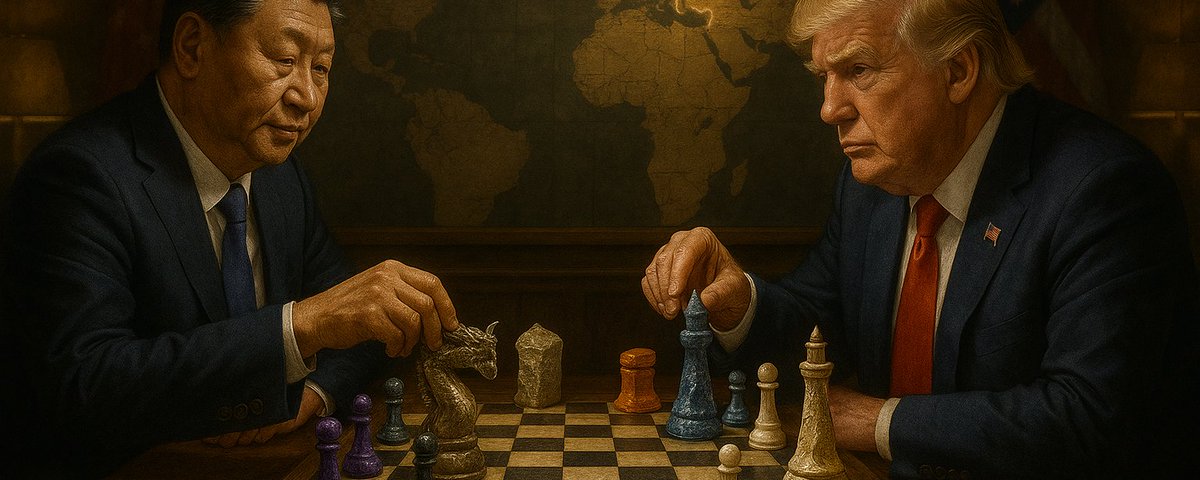
Pre-war Japan is a historical rhyme worth keeping in mind.
Pearl Harbour came at the end of a tightening sanctions regime imposed by the West. Oil. Scrap iron. Strategic inputs. Each restriction narrowed Japan’s room to manoeuvre.
Once a state concludes that the foundations of its economy and war machine are being closed off, the urgency of decisions change.
Stability stops being the governing aim. The question becomes whether action now offers better odds than passivity under encirclement.
If you want to understand the motivation, start there: fear of encirclement.
That sits near the center of the moral question people are wrestling with now.
Chinese control over critical minerals and industrial supply chains carries the same structure.
If Beijing can place at risk the inputs required for American military production, grid expansion, AI systems, and industrial continuity, then the issue sits well beyond ordinary trade friction.
It becomes leverage over the material basis of power itself.
In that setting, dependency acquires a strategic meaning. A supply chain is no longer a market arrangement. It is a potential instrument of compulsion.
It begins to register as a survival question.
American conduct follows from that insight.
Washington appears to believe that a future vulnerability must be arrested before it hardens into a permanent strategic fact. The issue is not mood or rhetoric. It is anticipation of future disablement.
States act with force when they judge that delay will deepen exposure and narrow their remaining options.
Israel’s view of Iran belongs to the same family of reasoning.
A threat interpreted as maturing, entrenching, and approaching irreversibility produces a distinct political psychology.
Restraint loses prestige. Preemption gains coherence. It starts to appear rational.
History offers rhymes. Japan in 1941. Israel in 1967. Germany in 1914. Sparta facing Athens.
A state perceives an adverse shift in the conditions of survival.
Time ceases to appear neutral. Decisive action starts to present itself as necessary.
The future is imagined as a worse bargaining position, a worse military position, a worse chance of endurance.
Under those conditions, radical action begins to present itself as reasonable .
Which is the deeper point.
States become dangerous when threat attaches itself to material dependence, shrinking time horizons, and the real expectation of future weakness.
At that moment, power makes a clean break in linear diplomatic terms. It thinks in windows, chokepoints, bottlenecks, and irreversible loss.
Its perceived menu of options is radicalised by the structure of the threat itself.
Those who read the United States as soft, irresolute, or indefinitely patient may be misreading the situation completely.
A state that believes its future industrial base, military capacity, and strategic freedom are at risk won’t behave like a complacent hegemon. It behaves like a power trying to prevent encirclement before it becomes permanent. That is why the present moment has to be read through matter.
This is where The Return of Matter comes back into view. The real contest is no longer about slogans, values, or even finance in the narrow sense. It is about control over the physical substrates of power: energy, metals, refining, grids, shipping, compute, and the industrial systems that make military and economic life possible. Once matter returns to the center, states stop speaking the language of frictionless markets and start acting in the older ancient language of survival.
What we are watching now is that transition made visible: the progression of action under perceived material threat, the re-entry of physical constraint into strategy, and the collapse of the fantasy that interdependence had abolished coercion.
With that realisation comes a grief for the passing of the old world.
.
Keith Crighton retweeted
Abul, a useful piece, but I think the argument rests on some assumptions the data don't yet support.
On migration: the net arrivals proxy and implied ERP migration are both still running around 300,000 plus. Migration has fallen from the 2023 peak, but it has plateaued materially above the 260,000 and 225,000 assumptions your later conclusion depends on. The tightening measures announced from late 2025 may not be sufficient to get there, and the track record of announced tightening delivering the intended numbers is mixed at best.
On housing supply: the 1.2 million homes target requires around 60,000 completions per quarter. Current approvals are still below that level, commencements are below that, and completions are well below that, and that is before accounting for pipeline leakage. Not every approval commences, and not every commencement completes. In a period of construction insolvencies, cost blowouts and financing stress, that conversion rate cannot be assumed. Completions per capita are around a 40-year low. That is evidence of chronic structural weakness, not of an imminent catch-up.
The demand arithmetic also understates the problem. Household size is not stable. Crowding has already risen above the pre-COVID trajectory. Adults per dwelling and population per dwelling are both tracking above where the pre-COVID trend would put them. That means the existing dwelling stock is already absorbing more people than it was designed to, and any honest accounting of housing need has to include unwinding that backlog, not just matching new population growth from here.
The deeper issue is that your conclusion, that we might see completions substantially exceed population growth from 2027, requires migration to hit target, completions to rise sharply, pipeline leakage to remain limited, and industry capacity to improve despite persistent cost and labour pressures. That is a demanding combination of favourable assumptions.
And it addresses the wrong threshold. Even if completions did overtake population growth, that would only mean the shortage stops growing. Given the crowding already embedded in the data, housing conditions would not meaningfully normalise until completions substantially exceeded population growth for an extended period. That is a much higher bar than the one the piece sets.
More charts follow.


Keith Crighton retweeted

NOW they know EXACTLY what gender means...

German men must ask the army for permission to leave country for more than three months under new rules trib.al/ZcJh4Ka


Keith Crighton retweeted
It is about time those of us in progressive politics owned up to our failures.
· We argued for social justice for all and ended up arguing it should only be for a favoured few identity groups.
· We argued for women’s rights and ended up arguing men could be women and could occupy women’s spaces.
· We argued for same-sex marriage and ended up with saying there are no sex-based rights.
· We argued for renewable energy and ended up allowing giant, multinational energy companies to bulldoze thousands of hectares of our precious, high biodiversity forests for wind farms.
· We argued for free speech and ended up by practising cancel culture.
· We argued for multiculturalism and ended up believing that criticism of the practices of a minority culture is, necessarily, racism.
· We argued that imperialism should be combated and ended up believing only US imperialism causes authoritarianism and repression.
Keith Crighton retweeted

Most convincing argument I've read recently that the Pentagon knows what it's doing, from ... Al Jazeera aljazeera.com/opinions/2026/…

Keith Crighton retweeted

Hey @ChrisMinnsMP
@JohnRuddick2 just called me and said you couldn’t remember saying that “free speech is incompatible with a multicultural society…” and demanded the evidence to be pulled up.
Let me pull that shit up.

Keith Crighton retweeted

As promised, our tool is live. It is time to write, whilst you still can!
freespeechunion.au/albocenso…

THREAD: The horror show which is the so-called 'Combatting Antisemitism, Hate and Extremism Bill 2026' has been published.
It is very clear that the goal of the Australian government is to emulate the UK and start to arrest people for comments on social media.
Here's one of the UK offences in the Public Order Act 1986:
