







Mark Brakel retweeted

🚨📈 9 in 10 people in the UK, France and Germany want a global treaty on AI weapons.
New polling, commissioned by the Future of Life Institute, shows citizens are overwhelmingly concerned by the rising use of AI in warfare.


RT @tegmark: I'm excited to share our new film Molloch, about how we all get disempowered without AI going rogue. It’s the 4th (and IMHO le…
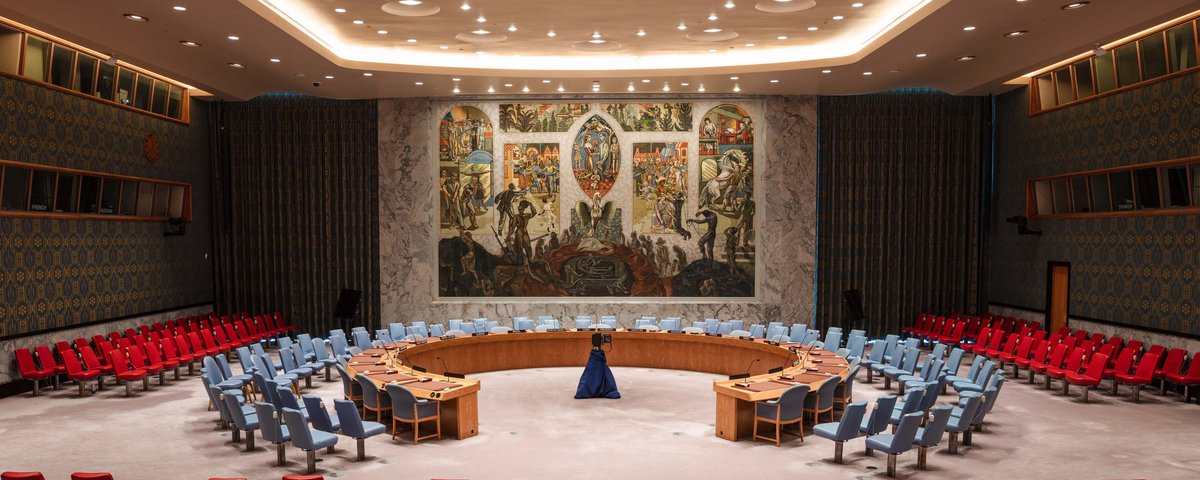
UN Security Council with @Yoshua_Bengio, @sama, @DarioAmodei and @ClementDelangue presided over by 🇫🇷 @jnbarrot about to start, live stream below.

Watch Live
At UN Headquarters, several top AI executives are briefing the Security Council amid growing concerns about security risks.
“Because AI affects us all, global coordination is indispensable,” @antonioguterres has stressed.
webtv.un.org/en/asset/k1c/k1…

Tomorrow, the UN Security Council will discuss AI loss of control for the first time. We have got you covered here at #UNGA.
@MarkLGoldberg @RichardGowan1 @SCRtweets @farnoushamiri @pass_blue
Mark Brakel retweeted

Lots of very good proposals in this bi-partisan humanist ai declaration. Still some that we should debate, but overall its the right direction. I encourage everyone to take a look.

I'm delighted to share that @mustafasuleyman, CEO of Microsoft AI, co-founder of Google DeepMind and Inflection AI, has signed the Pro-Human AI Declaration. If you too support it, please join him and over a million others by signing it here – the momentum is building! Let's build tools not beings & keep humans in charge. humanstatement.org

I don't often get to provide the optimistic take so really enjoyed this interview with @CNBC (!)

Mark Brakel retweeted

Begging AI bros to learn a teensy tiny bit about how most sectors are regulated. "We don't regulate steel"——yes we do!! In complex and multilayered ways!
I honestly agree with most of Clem's post, but the dogmatism on not regulating development is not based in reality.
Claude:


Some people are surprised that APIs (aka what Anthropic, OpenAI, and others provide) are treated differently than open weights in the new AI model framework.
I'm not surprised at all, and it's actually very good policy. Let me explain:
Model weights, APIs, and apps are three very different layers of the stack. Treating them the same would be a recipe for bad regulation.
Think about how we handle cars. We don't regulate steel, we crash-test cars. Nobody asks a steel mill to guarantee that nothing dangerous will ever be built with its steel. Obligations sit with the carmaker and rules of the road with the driver, because that's where risk becomes real and where someone can actually act on it.
Model weights are the steel of AI. They're raw research output, closer to science than product: no user, no interface, no deployment. They don't do anything on their own. And because everything else is built on top of them, this is the layer where regulation does the most damage. Restrict weights and you slow down all progress downstream, and you prevent countless positive use cases from ever emerging: the lab fine-tuning an open model for rare diseases, the startup serving a language big providers ignore, the safety researchers who can only audit models because the weights are open. You don't reduce risk, you just kill open source and concentrate power in a few big labs.
APIs are the middle layer, the parts and engine suppliers of AI: a commercial service where a provider serves a model at scale. Here you have a business relationship, terms of service, the ability to monitor for abuse. It makes sense to expect transparency, security standards, and accountability from providers at this layer, because they can actually enforce things.
Apps are the car on the road: where AI meets the real world. A medical assistant, a hiring tool, a companion for kids, a financial advisor. This is where concrete harm can happen, and conveniently, it's where we already have decades of regulation. Health, finance, employment, consumer protection. An AI hiring tool should comply with employment law whether it's powered by an open model, an API, or a spreadsheet.
The principle is simple: regulate at the layer where risk actually materializes and where actors can act on it. Push obligations to the deployment layer, keep the research layer open. We don't regulate steel, we crash-test cars. Well done @realDonaldTrump @DavidSacks @mkratsios47!

Mark Brakel retweeted

We don't have to accept the way AI is going.
The biggest companies building AI aren't building it for us. They're building it to replace us.
We’ve made a roadmap for how we can build pro-human AI: betterpathfor.ai
Let me take you through it…

Mark Brakel retweeted

In 2022 and 2023, tiny teams of researchers drew straight lines on graphs that predicted the US was headed for an energy bottleneck in AI. But the government had no idea.
The future of AI is too important to make the same mistake again. We need talent-dense, AI-focused offices that can skate to where the puck is going and implement President Trump’s AI agenda.
In a new piece for AFPI (@A1Policy), we discuss 2 promising offices that could act as hubs of government AI foresight: the Center for AI Standards and Innovation (CAISI) in the Department of Commerce and the Bureau of Emerging Threats (ET) in the Department of State.
We found that they have the density of talent to succeed but still lack resources: funding, headcount, and authorization. Here’s a summary:
1) The Center for AI Standards and Innovation (CAISI) lacks resources
> It has talented technical staff and a strong track record in evaluations, industry relationships, and insight into China
> But it’s chronically underfunded. It’s been around for 3 years but only received $30M in total, not annual, funds. That’s 11 times less than the UK’s equivalent. (It’s even short of Canada and Singapore)
> It’s only has 20-30 employees who are swamped with workstreams and external requests from agencies like the IC
To solve this, Congress should fund CAISI with an annual budget of $50-100 million.
2) CAISI lacks authorization or a focused mission
> Between Department asks, inbound from other offices, and the AI Action Plan, it has more missions than staff
> Its critical mission could be threatened by future administrations, who would externally pressure it to pursue DEI initiatives
Congress needs to enshrine the office and give it a clear mission. We present an America First vision for CAISI, in which it acts as a technical strike team, bridge between industry and government, frontier analysis unit, and technical standards organization.
3) The Bureau of Emerging Threats (ET) lacks authorization
> ET is similarly talent-dense, with experts in cyber, AI, and international relations
> But it lacks congressional authorization and could be destroyed or co-opted by future administrations
The Bureau needs concrete support from Congress and levers of interagency influence, like regular reports to national security leaders.
With appropriate action, Congress can help ensure the President has the resources he needs to help America win the AI race and usher in a new golden age of human flourishing.
Always fun to collaborate with @CrovitzJack and @YusufSMahmood, who have posted about other sections of our piece.

Mark Brakel retweeted

We're excited to launch the Pro-Human AI Declaration, laying out a more inspiring AI path than Silicon Valley's dystopian race-to-replace. It has remarkably broad support, from Bannon to Bengio, from unions to faith groups, from parents to NatSec leaders. Please join our growing movement and let's make a difference!
(Links below in replies)

Mark Brakel retweeted

I am deeply honored to have been elected as Co-Chair of the @UN's Independent International Scientific Panel on AI alongside Nobel Peace Prize laureate @mariaressa.
I’m grateful for the trust of my colleagues and look forward to our collaboration to create a reliable, independent scientific assessment of AI's capabilities and impacts, providing an essential resource for citizens and policymakers around the world.

At its inaugural meeting, the UN’s Independent International Scientific Panel on AI elected its first Co-Chairs:
@Yoshua_Bengio 🇨🇦
@mariaressa 🇵🇭
They will guide the Panel’s work, uphold its scientific integrity & report on the Panel’s work twice a year.
First report: July 2026

Mark Brakel retweeted
From the "Day After AGI" event in Davos:
Zanny Minton Beddoes: You could just slow down.
Dario Amodei: [...] we can't do that [...] because we have geopolitical adversaries building the same technology at a similar pace. It's very hard to have an enforcable agreement where they slow down and we slow down.[...] if we can just not sell the chips, then this isn't a question of competition between the US and China. This is a question of competition between me and Demis, which I'm very confident that we can work out.
@DarioAmodei and @demishassabis: you can do it in the opposite order. As you both know, there is a game-theoretic solution to the problem of "we'd slow down but there's no coordination," which is an assurance contract. In particular, you could:
1. Get together and agree on what sort of slowdown you'd like – for example a cap on the total FLOP and FLOP/s (see ktfh.ai appendices for concrete proposal) pending strong scientific consensus that controllability and other issues have real solutions. Include compute-based and other mutual verification mechanisms. The agreement should still allow lots development of awesome controllable AI tools, just not high-level autonomous AGI and superintelligence. You guys are super competent and reasonable. You could do it.
2. Agree on who else would need to sign that agreement for you to feel comfortable enacting it. Include non-US companies.
3. Sign said agreement, which only goes into effect if all (or N of M) of the parties in step 2 sign also.
4. Encourage/pressure the additional AGI efforts to sign as well. Once you get going you might be surprised at who signs. In the meantime, no competitive advantage is lost.
5. You don't actually need to get everyone. Once there is critical mass on a concrete proposal, strong pressure can be put on the USG to (a) turn this into executive action enforced domestically by the USG and many places via the compute supply chain; (b) work out something with China for them to enforce the same domestically and in their sphere of influence. The PRC government does not want to lose control of or to superintelligence either. The chip supply chain can be a powerful mechanism here as well.
Any level of partial success here would still be a game-changer.
I think you both fully understand that we're in a worst-case scenario as envisaged when you started in this years ago: the all-out race with zero cooperation is most likely to get us some mix of war, large-scale accident, gradual disempowerment, and uncontrolled existentially-risky singularity. This is one of the very few offramps remaining, and probably the best.
FLI would be more than happy to support in any of these steps, in any way we can, as neutral facilitator or otherwise.


Mark Brakel retweeted
Thanks @sirramk for engaging with our letter calling for a prohibition of superintelligence.
As an org, FLI is pro AI tools (responsibly managed). Our foremost worry is loss of control to superintelligence. The public is worried too, with only 5% favoring the current race, and 73% for "heavy regulation" of advanced AI development.
We currently have no idea how to build superintelligence that would be under meaningful human control, and it may not even be possible. Losing control of (or to) superintelligence isn’t in the interest of any major nation, and there should therefore be a narrow path to agreeing on some capabilities that are out of bounds for all. Examples may include the ability of AI systems to engage in recursive self-improvement and self-replication.
To me, this would be an excellent part of any potential deal between President Trump and President Xi, and it can built on President’s Trump’s efforts to strengthen the biological weapons convention to limit the spread of man-made pathogens.
Yes, it is not going to be easy, but nothing worth having ever is.
Mark Brakel retweeted
A stunningly broad coalition has come out against Skynet: AI researchers, faith leaders, business pioneers, policymakers, NatSec folks and actors stand together, from Bannon & Beck to Hinton, Wozniak & Prince Harry. We stand together because we want a human future.
#KeepTheFutureHuman

Mark Brakel retweeted

📢Once more for the people in the back📢
Over the past 2+ years, 🇨🇳 gen AI companies have faced the most burdensome regulatory/compliance requirements of companies anywhere in the 🌎.
(Note: ethics committees below are basically unenforced, its CAC content testing that bites.)


Mark Brakel retweeted

Went to a coffee shop
Noticed a student using AI to complete his homework
I asked how much he pays
$10 a month
Then I asked how much he expects to make after college
"Hopefully $100k. I'm an engineer!"
I shook my head.
What an unjust world.
The AI does all the work, but only gets $10 a month.
In the future, superhuman AI will be the one making $100k a year, and the worthless student will have to beg for $10 on the street.
This is my vision at ReplacementAI.
Mark Brakel retweeted

Don't say you weren't warned!

An OpenAI executive expects the “entire economy” to become an “Reinforcement Learning Machine.” This implies that AI might train on recordings of how professionals in all fields handle day-to-day work on their devices. Details on this new era of AI training:
• AI developers are training models on carefully curated examples of answers to difficult questions.
• Data labeling firms are hiring experienced professionals in niche fields to complete real-world tasks using specific applications that the AI can watch.
Read more: theinformation.com/articles/…

Mark Brakel retweeted
Amazingly bipartisan support for big tech AI accountability:
