
Lowy Institute | Economist | Emerging Asia
Joined January 2023
- Tweets233
- Following406
- Followers87
- Likes816





Rob Walker retweeted

The @HouseForeignGOP just released information about all AI chip shipments that @CommerceGov approved to China, which calls into question whether Commerce was conducting any real national security reviews of AI chip shipments to China, or if it just outsourced that review to Nvidia as well.
As of May 11, 2026, @BISgov had approved the shipment of nearly 900,000 Nvidia H200 or AMD MI325X AI chips to China. Over 30% of these chips were sent to companies that the Department of War has designated as Chinese Military Companies. And remarkably, every license application from Nvidia and AMD said the shipment posed a "low" risk of diversion.
There is simply no way that the Department of Commerce did a serious national security review of these licenses. Also, yesterday @jingyanghk reported in @theinformation that Commerce approved some H200 licenses over the objections of the Departments of State, Energy, and War, and that Commerce claimed that the legally mandated interagency review process (which requires at least three of those four agencies to support granting a license before it can be approved) was not needed for H200 chips and it could approve these licenses unilaterally.
These chips were shipped to companies that the Trump administration itself has designated as Chinese Military Companies, but somehow the shipments pose a "low" risk of diversion? @BISgov just took Nvidia's word for it that the shipments posed no risk, potentially over the objection of the entire US national security apparatus. Even the people who support sending AI chips to China cannot possibly defend shipping chips to designated Chinese Military Companies. Just more evidence that Commerce has completely abdicated its responsibilities on export controls.
foreignaffairs.house.gov/new…

Not just Southeast Asia vulnerable to updated US Commerce export control rules...even Australia and Japan are exposed.
The data centre buildout in Asia-Pacific may begin to unravel if @SemiAnalysis_ is right and there are more neocloud firms overly reliant on Chinese AI revenue

Datasection (3905.T) just cut FY revenue guidance by 89%, from ¥162B to ¥17B, and the stock went limit-down.
This is the "Japanese neocloud" that the FT reported is effectively a Tencent datacenter: Chinese offtake, Nvidia Blackwell GPUs, Japanese flag. (1/8)🧵

55
Rob Walker retweeted

No human alive has seen an El Niño event this strong. In fact, it’s possible that no human in history has seen an event this strong.
Forecasts continue to project a 3.5-4.0°C ‘Super El Nino’.
Temperatures in the east Pacific are now widely 5°C above average, peaking at 6°C.

Rob Walker retweeted

Is China’s development model bad for poorer countries?
[quick thread on recent debates]

Rob Walker retweeted

The simplest possible fact is this: China has broken a number of theoretical economic taboos, shown that they are wrong, and economics will have--whether it likes it or not-- to adjust to that & revise what it currently holds and teaches.
You cannot treat the most successful economic growth in the history of the world as an exception to the generally valid rules of economics.
Rob Walker retweeted

The "this is just referring to agents updating their regular ol' memory files, don't be such a scaredy cat" interpretation of the below is uhhh not looking great tonight


Rob Walker retweeted

Shaving ONE year off poor countries' AI adoption lag is worth ~$42.6 trillion in NPV income. Roughly the welfare equivalent of saving 115 million lives
Economic policy affects the catch-up speed, so we can do something about it. 🧵 teapawt.org/externalidades/status/…


Rob Walker retweeted

My colleague @RobWalk3r provides his analysis of the 2026 @LowyInstitute Poll result that a majority of Australians are pessimistic about the country’s economic performance in the next five years 👇
lowyinstitute.org/the-interp…

Rob Walker retweeted
My latest Substack.

"The problem is in essence very simple. Decentralized Western capitalists have been able to squeeze domestic labor for forty years and run outsized profits. But now they are faced by a centralized capitalist (which is in effect the Chinese state) who is even more efficient in squeezing wages and increasing productivity. That centralized capitalist is now driving out of business Western decentralized capitalists. This is why the latter have to move the heaven and the earth in order to stop the centralized capitalist from winning. But they have to do all of that while never mentioning the role their own profits play in it."
branko2f7.substack.com/p/don…

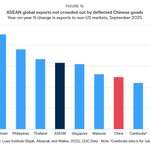
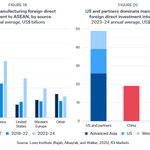
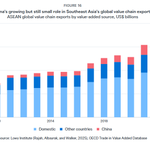
Strategic supply chains - clean and emerging technologies - are significant drivers of Southeast Asia's growth and account for one-quarter of total exports
The region is highly exposed to geoeconomic shocks and US-China competition
More in my new paper: lowyinstitute.org/publicatio…

28
Rob Walker retweeted
My @LowyInstitute colleague @RobWalk3R writes an interesting new Analysis of how Southeast Asian economies can take advantage of strategic supply chains 👇
lowyinstitute.org/publicatio…

Important points about the China shock 2.0 debate in Europe. The Kiels paper does demonstrate the EU needs more than just a trade response to the China shock. It doesn’t refute that a trade response is also required.

Rob Walker retweeted

Reactions to the Kiel paper on China Shock 2.0. It's a thoughtful contribution that rightly argues EU trade defence doesn't solve competition in third markets.
But contrary to some commentary, I don't think it shows German concerns about Chinese competition are overblown.
1/

EU plans to force companies to buy parts from non-Chinese suppliers via @ftbreakingnews
This would be an innovative approach to supply chain diversification. It doesn’t fix EU’s China problems but reduces leverage for Beijing in the medium term ft.com/content/57b4852c-f323…

21
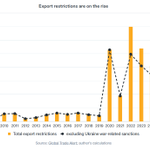
Export restrictions are on the rise: 22 a year before Covid; 228 a year since.
A mix of geopolitical and economic shocks are responsible. The Iran War is just the latest.
Read how Australia responded to fuel export restrictions in Asia in the aftermath.
lowyinstitute.org/the-interp…

41
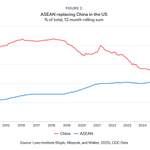
@nytimes picked up my analysis this week on Southeast Asia's solar industry after US tariffs targeted the region
1/
nytimes.com/2026/05/12/opini…

The economies that supplied 80% of US solar imports at its peak now face tariffs ranging from 34% to over 3,400%. With no obvious export market to pivot to, Southeast Asia needs to speed up domestic deployment to save the industry.
lowyinstitute.org/the-interp…
2/

26

Australia wants to be a renewable superpower - but domestic policy alone won't get it there. Without green trade partnerships to lock in demand, the strategy is wishful thinking.
New piece in @LowyInstitute's Interpreter ↓
lowyinstitute.org/the-interp…

26
Rob Walker retweeted

(i) Not clear why growth in world trade should create a net demand for dollars. World trade can grow through both rising exports and imports while remaining balanced. (ii) The other commonly cited argument is that the demand for safe assets requires the safe asset issuer to run deficits. This again is theoretically weak. Demand for safe assets is about gross flows. There is no reason this should necessarily lead to net deficits. (iii) Empirically too the reserve currency argument has limitations. As @Brad_Setser points out the relation between fiscal deficits and trade/current account deficits is imperfect. There were 2 previous major episodes of global imbalances: One was in the 1980s where indeed large fiscal deficits (and an appreciating dollar) contributed to growing current-account deficits. The second episode was in the run-up to the GFC in 2008 when fiscal deficits were not the driver (and the dollar was depreciating). (iv) During the years when the British pound was the dominant currency of the world Britain ran current account surpluses. (v) The Swiss Franc is a reserve currency country that consistently runs surpluses. New Zealand, on the other hand, is not a reserve currency country and has consistently run deficits. So, both theoretically and empirically, it is hard to argue that the dollar's reserve currency status is what is behind persistent US current account deficits.
Rob Walker retweeted

New release: the BCL Long-Term Productivity Database v2.7 is now available for download.
GDP per capita, labor productivity, and TFP for 23 OECD countries, 1890–2024.
Free, open, updated annually.
longtermproductivity.com/dow…
A few highlights below 🧵↓