Measuring topology from dynamics: Chern number from a linking number (AI-generated retrospective research program, needs further hypothetical verification and physical expansion for parameters, within TDVT vacuum theory.)
In a Floquet-engineered hexagonal optical lattice of ultracold fermions, a strong quench from a topologically trivial band structure produces dynamical vortices in momentum space. The linking number between the closed trajectories of these dynamical vortices and the static Dirac-point vortices is experimentally shown to equal the ground-state Chern number CCC of the post-quench Hamiltonian. This establishes a direct, dynamical route to measure a static topological invariant and maps the Haldane-like phase diagram of the driven lattice.Nature
Rigorous mathematical framework
The bare hexagonal lattice is described by
H^0=−∑⟨l′l⟩JAB a^l′†a^l+∑l∈BΔAB n^l.\hat{H}_0 = -\sum_{\langle l'l\rangle}J_{AB}\,\hat{a}_{l'}^\dagger\hat{a}_l + \sum_{l\in B}\Delta_{AB}\,\hat{n}_l.H^0=−⟨l′l⟩∑JABa^l′†a^l+l∈B∑ΔABn^l.
Circular inertial driving at frequency ω=ΔAB/ℏ−δ\omega=\Delta_{AB}/\hbar-\deltaω=ΔAB/ℏ−δ and dimensionless strength α\alphaα generates the effective Floquet Hamiltonian
H^F=−∑⟨l′l⟩JABeffa^l′†a^l+∑⟨⟨l′l⟩⟩AJAAeffa^l′†a^l+∑⟨⟨l′l⟩⟩BJBBeffa^l′†a^l+∑l∈BΔeffn^l,\hat{H}_{\mathrm{F}} = -\sum_{\langle l'l\rangle}J_{AB}^{\mathrm{eff}}\hat{a}_{l'}^\dagger\hat{a}_l + \sum_{\langle\langle l'l\rangle\rangle_A}J_{AA}^{\mathrm{eff}}\hat{a}_{l'}^\dagger\hat{a}_l + \sum_{\langle\langle l'l\rangle\rangle_B}J_{BB}^{\mathrm{eff}}\hat{a}_{l'}^\dagger\hat{a}_l + \sum_{l\in B}\Delta^{\mathrm{eff}}\hat{n}_l,H^F=−⟨l′l⟩∑JABeffa^l′†a^l+⟨⟨l′l⟩⟩A∑JAAeffa^l′†a^l+⟨⟨l′l⟩⟩B∑JBBeffa^l′†a^l+l∈B∑Δeffn^l,
with
JABeff≃α2JABeiϕl′l,JAAeff=−JBBeff≃JAB2ℏω,Δeff=ℏδ+3JAB2ℏω.J_{AB}^{\mathrm{eff}}\simeq\frac{\alpha}{2}J_{AB}e^{i\phi_{l'l}},\qquad J_{AA}^{\mathrm{eff}}=-J_{BB}^{\mathrm{eff}}\simeq\frac{J_{AB}^2}{\hbar\omega},\qquad \Delta^{\mathrm{eff}}=\hbar\delta+3\frac{J_{AB}^2}{\hbar\omega}.JABeff≃2αJABeiϕl′l,JAAeff=−JBBeff≃ℏωJAB2,Δeff=ℏδ+3ℏωJAB2.
In the two-band pseudospin representation the quasimomentum Hamiltonian is
h(k)=h0(k)+σ⋅h(k).\mathbf{h}(\mathbf{k})=h_0(\mathbf{k})+\boldsymbol{\sigma}\cdot\mathbf{h}(\mathbf{k}).h(k)=h0(k)+σ⋅h(k).
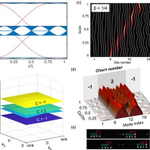
The lowest-band Chern number is the winding of the unit vector h^(k)\hat{\mathbf{h}}(\mathbf{k})h^(k) over the Brillouin zone:
C=14π∫BZh^⋅(∂kxh^×∂kyh^) d2k.C=\frac{1}{4\pi}\int_{\mathrm{BZ}}\hat{\mathbf{h}}\cdot(\partial_{k_x}\hat{\mathbf{h}}\times\partial_{k_y}\hat{\mathbf{h}})\,d^2k.C=4π1∫BZh^⋅(∂kxh^×∂kyh^)d2k.
After a quench from a trivial initial state, the time-evolved Bloch vector ψ(k,t)\boldsymbol{\psi}(\mathbf{k},t)ψ(k,t) develops dynamical phase vortices whose trajectories form a closed contour in (kx,ky,t)(k_x,k_y,t)(kx,ky,t) space. The linking number Lk\mathrm{Lk}Lk of this contour with the static Dirac-point vortices satisfies
Lk=C.\mathrm{Lk}=
C.Lk=C.
The instantaneous Chern number of the time-evolved state remains identically zero under unitary dynamics, as required by continuity of the Berry curvature under continuous evolution that never closes the gap.
Experimental verification and tested proofs
State tomography reconstructs the full Bloch vector for every k\mathbf{k}k after variable evolution times.
Vortex trajectories are tracked; their linking number with the static Dirac points is counted directly from the data.
The measured Lk\mathrm{Lk}Lk reproduces the theoretically expected Chern numbers C=0,±1C=0,\pm1C=0,±1 across the Floquet phase diagram, including the critical lines ℏδ≃−15JAB2/ℏω\hbar\delta\simeq-15J_{AB}^2/\hbar\omegaℏδ≃−15JAB2/ℏω and ℏδ≃3JAB2/ℏω\hbar\delta\simeq3J_{AB}^2/\hbar\omegaℏδ≃3JAB2/ℏω.
Instantaneous Chern-number extraction at intermediate times confirms Cinst(t)=0C_{\mathrm{inst}}(t)=0Cinst(t)=0, providing a rigorous experimental test of the topological protection of the dynamical invariant.
Convergence with TDVT / QVC
The central result—that a dynamical linking number of momentum-space vortices equals a static Chern number—maps cleanly onto the topological invariants of TDVT:
The Hopf invariant QH=1(4π)2∫A⋅(∇×A) d3rQ_H=\frac{1}{(4\pi)^2}\int\mathbf{A}\cdot(\nabla\times\mathbf{A})\,d^3rQH=(4π)21∫A⋅(∇×A)d3r of a hopfion crystal is itself a linking number of pre-images. The optical-lattice experiment supplies a laboratory realization of the same homotopy classification π3(S2)=Z\pi_3(S^2)=\mathbb{Z}π3(S2)=Z that classifies hopfions.
Quench dynamics that generate and annihilate vortex pairs while preserving a global linking number parallel the defect-mediated annealing of skyrmion/hopfion lattices: local topological defects move and annihilate, yet the global topological charge (or linking) is conserved until a gap-closing transition.
The Floquet drive that engineers a tunable Chern insulator is a concrete analogue of the external-field or current modulation used to anneal skyrmion lattices in Fe₃GaTe₂. In both cases an external periodic drive supplies the kinetic activation that allows the system to explore topological sectors while the underlying homotopy class remains invariant.
The observation that the instantaneous Chern number stays zero under unitary evolution is the dynamical counterpart of the teleparallel condition (vanishing curvature, dynamical torsion) central to TDVT: geometry is carried by the torsion sourced by topological density rather than by a non-zero instantaneous curvature.
Hypothetical ideation.
If the same quench-and-linking protocol were realized in a three-dimensional optical lattice or in a magnetic hopfion-hosting material, the measured linking number would become the Hopf index of the emerging hopfion crystal. Field-cycling protocols already demonstrated for skyrmion annealing could then be combined with Floquet engineering to prepare, detect, and stabilize ordered hopfion lattices whose collective Goldstone modes generate an Unruh–Visser acoustic metric—precisely the laboratory pathway envisioned by TDVT/QVC.
Closely related publications
Theoretical proposal of the dynamical linking-number invariant (ref. 15 of the paper).
Subsequent cold-atom measurements of Chern numbers via circular dichroism and transport in Hofstadter and Haldane models.
Experimental observation of hopfion rings in bulk FeGe (Nature 2023) and construction of hopfion crystals (arXiv:2504.03981).
Field- and strain-driven annealing of skyrmion lattices in van-der-Waals magnets (Nat. Commun. 2026 and Adv. Mater. 2025).
Together these works establish a continuous experimental and theoretical thread from dynamical measurement of Chern numbers, through defect-mediated ordering of topological solitons, to the controlled realization of hopfion crystals that can host analogue spacetime.